
Understanding the Visa Landscape for Med-Peds IMGs
For an international medical graduate (IMG) pursuing Medicine-Pediatrics (Med-Peds) training in the United States, understanding residency visa options is just as important as perfecting your ERAS application. Your ability to start, complete, and potentially stay in the U.S. after residency hinges on early, strategic visa planning.
This IMG residency guide focuses on:
- How Med-Peds programs view IMGs and visas
- Key differences between the J-1 vs H-1B pathways
- How your visa choice can affect subspecialty training, moonlighting, and long-term career plans
- Practical steps and timelines for a successful medicine pediatrics match as an IMG
While the rules are similar across specialties, Med-Peds has its own patterns and nuances regarding IMGs and sponsorship. This article will walk you through them in detail.
The Med-Peds Residency Landscape for IMGs
What is Medicine-Pediatrics?
Medicine-Pediatrics (Med-Peds) is a four-year combined residency that provides full, board-eligible training in both Internal Medicine and Pediatrics. Graduates can:
- Practice as dual-trained generalists (adult and pediatric care)
- Enter adult subspecialties (e.g., cardiology, GI)
- Enter pediatric subspecialties (e.g., pediatric endocrinology)
- Work in hospitalist medicine for adults, children, or both
- Serve in global health or underserved communities
Because the track is relatively small compared with categorical internal medicine or pediatrics, the Medicine-Pediatrics match is more competitive and more personality-driven. Programs often recruit candidates with strong adaptability, broad interests, and clear long-term goals.
How IMG-Friendly is Med-Peds?
Compared to categorical Internal Medicine, Med-Peds has:
- Fewer total positions nationwide
- A smaller proportion of IMGs overall
- A higher emphasis on “fit,” continuity, and long-term commitment
However, many Med-Peds programs do accept international medical graduates and a growing number support visa sponsorship. The key differences compared with categorical medicine or pediatrics:
- Some Med-Peds programs are located in smaller communities with fewer resources for visa sponsorship
- A subset of programs rely heavily on institutional policy—if their parent Internal Medicine and Pediatrics programs support visas, Med-Peds often follows
- Program directors often look carefully at long-term commitment, because Med-Peds residents typically pursue varied career paths and subspecialties
Why Visa Strategy Is Especially Important for Med-Peds
Because Med-Peds opens doors to both adult and pediatric subspecialties, your residency visa type may significantly influence:
- Ability to pursue subspecialty fellowships (especially if they also require visa sponsorship)
- Post-training work options, especially if you want to work in both adult and pediatric settings
- Where you can practice after residency, as some visas require service in underserved or specific locations
For Medicine-Pediatrics IMGs, aligning your career goals with your visa pathway as early as possible is essential.
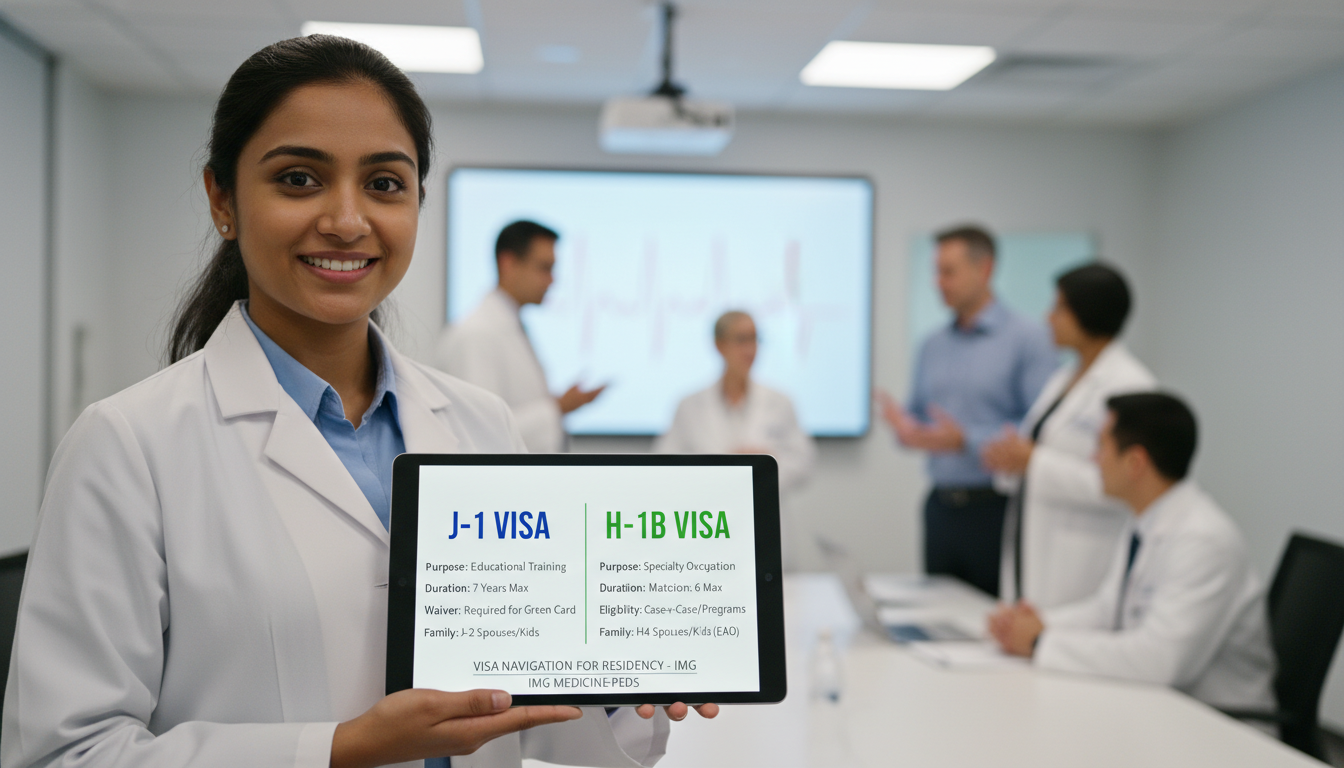
Core Residency Visa Options for IMGs: J-1 vs H-1B
Most IMGs who match into Med-Peds will enter the U.S. on one of two main visa types:
- J-1 Exchange Visitor (ECFMG-sponsored)
- H-1B Temporary Worker (employer-sponsored)
Understanding the J-1 vs H-1B differences is central to any IMG residency guide, because your choice affects not only residency, but:
- Fellowship options
- Flexibility with moonlighting
- Scholarship and teaching roles
- Post-training immigration pathways
The J-1 Visa: The Most Common Route for IMGs
For medical residency and fellowship, the J-1 is almost always the ECFMG-sponsored J-1 Exchange Visitor visa. This is currently the most common residency visa for IMGs in all specialties, including Med-Peds.
Key Features
- Sponsored by ECFMG, not by the individual hospital
- Valid for duration of training, with yearly renewals
- Requires maintaining full-time participation in an accredited program
- Subject to the two-year home country physical presence requirement (Section 212(e)) in most cases
Advantages
- Widely accepted: Many Med-Peds programs can support J-1 candidates through standard institutional processes
- Predictable structure: ECFMG has clear guidelines and a standardized application process
- Easier for programs: Program doesn’t need to handle as much immigration paperwork; this increases the number of programs open to J-1 applicants
Limitations
- Usually includes a two-year home country requirement after training (residency and fellowship combined)
- During training, restrictions on moonlighting, especially external moonlighting, depending on sponsor rules
- No “dual intent” (unlike H-1B), which can complicate some long-term immigration planning
- Post-training pathways often require:
- A J-1 waiver job (e.g., Conrad 30, VA, Appalachian Regional Commission, HHS waiver), OR
- Returning to the home country for two years OR
- Obtaining a waiver through marriage to a U.S. citizen or certain hardship/waiver categories
For a Med-Peds IMG who expects to do both residency and multiple fellowships, the total J-1 time can reach 7–8 years; careful planning for waiver options becomes critical.
The H-1B Visa: Less Common but More Flexible
The H-1B is an employment-based visa category for specialty occupations, including physicians in residency and fellowship.
Key Features
- Sponsored by the employer (residency program/hospital)
- Requires successful completion of USMLE Step 3 before visa filing in nearly all cases
- Generally valid for up to six years total, including all H-1B time (residency + fellowship + employment)
- Considered a dual intent visa (can pursue permanent residency while on H-1B)
Advantages
- More straightforward pathway to post-residency employment-based green cards
- Typically no two-year home country requirement
- Programs may allow moonlighting under H-1B, subject to institutional policy and visa compliance
- Facilitates a smoother transition to hospitalist or subspecialty positions immediately after training
Limitations
- Not all Med-Peds programs sponsor H-1B due to cost, legal complexity, or institutional cap restrictions
- Requires Step 3 passed early—ideally before ranking and definitely before program’s visa deadlines
- Time-limited: The six-year cap can be challenging if you plan:
- Four years of Med-Peds residency
- Plus 3+ years of fellowship
- Plus needing time to secure green card status
- Programs may give preference to J-1 applicants simply because the sponsorship burden is lower
For an IMG focused on long-term practice in the U.S., including possible subspecialty training and academic roles, the H-1B may offer a more direct immigration path—but is often harder to secure.
Choosing Between J-1 vs H-1B for Med-Peds: Strategic Considerations
1. Clarify Your Long-Term Career Goals
Before deciding your preferred residency visa, think 5–10 years ahead. Ask yourself:
- Do I want to remain in the U.S. long term?
- Am I interested in primary care, hospitalist medicine, or subspecialty fellowship (adult, pediatric, or both)?
- Would I consider working in an underserved or rural area (common for J-1 waiver jobs)?
- How important are moonlighting and salary during residency/fellowship?
- Am I open to eventually working in my home country?
If your priority is a stable long-term U.S. career, particularly in competitive subspecialties or academic medicine, H-1B may be more attractive if you can secure it.
If you are flexible about possibly returning home or working in underserved U.S. regions for a period, J-1 can still be an excellent path, particularly because more Med-Peds programs are comfortable with it.
2. Understanding the Impact on Fellowship Plans
Med-Peds opens a large variety of fellowship options, including:
- Adult fellowships: Cardiology, Pulmonary/Critical Care, Infectious Diseases, Endocrinology, Hematology-Oncology, etc.
- Pediatric fellowships: Pediatric Hospital Medicine, Pediatric Infectious Diseases, Pediatric Critical Care, etc.
- Combined or niche pathways: Global health, transition medicine, complex care, adolescent/young adult care
Visa implications:
- On a J-1, your fellowship will also usually be on a J-1, extending the two-year home requirement until you finish all training. However, many fellowship programs are used to sponsoring J-1 via ECFMG.
- On an H-1B, your fellowship must also find H-1B sponsorship and you must track your total H-1B years carefully. Some fellowships only accept J-1; some accept both; some only accept U.S. citizens/green card holders.
Actionable advice:
- While still in medical school or early in residency planning, browse fellowship program websites (especially in your prospective interests) and see their policies on visa sponsorship.
- If you are strongly drawn to a subspecialty that is less IMG-friendly and mainly accepts J-1 or green-card holders, that might affect your current visa preference.
3. Moonlighting, Income, and Work Flexibility
Many Med-Peds residents moonlight later in residency or during fellowship, especially in hospitalist roles. This can be a key financial and professional development opportunity.
- J-1: Typically, your work must be limited to the sponsoring institution and program. Some tightly controlled internal moonlighting may be allowed, but external paid work is often restricted.
- H-1B: Moonlighting may be possible but usually requires:
- A separate H-1B filing or amendment, OR
- Being included within your main employer’s coverage; and
- Strict adherence to immigration rules and worksite designations
Because policy varies widely by institution, always:
- Confirm with your GME office and immigration counsel before accepting any moonlighting shifts
- Consider that relying heavily on moonlighting may be easier under some H-1B structures than on J-1
4. Long-Term Immigration: Green Card Pathways
Your residency visa choice directly shapes your long-term U.S. immigration journey:
J-1 Pathway:
- Complete residency/fellowship on J-1
- Obtain a J-1 waiver job (often in a medically underserved area or at certain governmental institutions)
- Work for 3+ years under the waiver terms
- Transition to H-1B or another status and then pursue a green card (e.g., PERM labor certification or NIW)
H-1B Pathway:
- Complete residency/fellowship on H-1B, staying within the six-year limit or extending via green card steps
- Employer sponsors you directly for PERM/EB-2 or other employment-based categories
- More straightforward to pursue dual intent and start the green card process while still in training
For an international medical graduate targeting a long-term combined adult and pediatric career, understanding this sequence early is crucial.
Practical Steps and Timelines for Visa Navigation in the Med-Peds Match
Step 1: Pre-Application Planning (12–18 Months Before Match)
1. Understand your own visa history
- Have you ever held J-1 or F-1 status before?
- Are you already subject to a two-year home country requirement from any prior U.S. government-sponsored programs?
- Do you have any family-based or other immigration processes already started?
2. Prepare for USMLE Step 3 (if aiming for H-1B)
- If your goal is an H-1B residency visa, you should aim to pass Step 3 early, ideally:
- Before applying for the match, or
- At least before rank list deadlines and definitely before programs file H-1B petitions.
Programs are often reluctant to promise H-1B sponsorship without Step 3 in hand.
3. Research program visa policies
For each Med-Peds program of interest:
- Check the program website and GME pages for:
- Whether they accept J-1 and/or H-1B
- Whether they require Step 3 for H-1B sponsorship
- Any historical notes about IMGs or visa support
- Contact program coordinators (politely and briefly) if information is unclear.
Tip: Create a spreadsheet with:
- Program name and location
- Visa types sponsored (J-1, H-1B, both, or none)
- Historical IMG presence
- USMLE score expectations
- Personal notes on fit and interests
This will guide your application strategy and inform how you prioritize programs.

Step 2: ERAS Application and Interviews
1. Addressing Visa Status in ERAS
- Be accurate and honest in the “Citizenship and Visa” sections.
- If you are open to both J-1 and H-1B, consider indicating this flexibility where appropriate.
- Highlight any assets that strengthen your candidacy for H-1B:
- Step 3 passed
- Prior U.S. clinical experience
- Research or academic achievements
2. Discussing Visa Issues During Interviews
Programs want to know:
- What visa you will need
- Whether you are realistic about the sponsorship limitations
- How committed you are to completing Med-Peds training and potential fellowships
During interviews:
- Be prepared to clearly state:
- “I require visa sponsorship, and I am eligible for J-1 through ECFMG; I have also passed Step 3 and would be interested in H-1B if your institution sponsors it.”
- If a program mentions they only sponsor J-1, avoid pushing aggressively for H-1B unless they show openness.
- Show you understand the basics of J-1 waiver and long-term career planning—this signals maturity and realism.
Step 3: Ranking Programs With Visa in Mind
When building your rank list for the Medicine-Pediatrics match:
- Consider ranking higher the programs that:
- Sponsor your preferred visa category
- Have a track record of successfully graduating and placing IMGs into fellowships and waiver/immigration pathways
- Balance program quality and visa feasibility. A world-class program with no visa sponsorship is not a real option for you.
For example:
If you must have H-1B:
- Rank only those programs that explicitly support H-1B and have recent experience doing so.
If you are open to J-1:
- Broaden your list to many more programs; but think ahead about regions with good J-1 waiver opportunities (e.g., Midwest, South, rural areas).
Step 4: Post-Match: Visa Processing and Deadlines
After you match into a Med-Peds residency:
You will coordinate with your GME office and, for J-1, with ECFMG.
For J-1:
- You’ll complete the ECFMG online application for sponsorship
- Provide required documents (passport, DS-2019 request, financial proof, etc.)
- Attend a J-1 visa interview at a U.S. embassy/consulate
For H-1B:
- Your employer’s legal team files the petition (Form I-129) with supporting documents
- You may need to attend an embassy/consular interview if outside the U.S.
- Timelines can be tight; delays in Step 3 or documentation can delay start dates
Always respond quickly to document requests and keep your passport and personal records up-to-date.
Special Considerations for Med-Peds IMGs
Balancing Adult and Pediatric Career Goals Under Visa Constraints
Because Med-Peds trains you in both adult and pediatric medicine:
- Your J-1 waiver job (if on J-1) might be:
- Adult-only (e.g., internal medicine hospitalist in rural area)
- Pediatric-only
- Occasionally a combined role in underserved regions
Plan ahead:
- If you strongly want a combined practice, look for waiver options (Conrad 30 or others) that allow or encourage Med-Peds dual practice.
- If you see yourself primarily in adult subspecialties, focus on areas with strong internal medicine job markets for waivers or H-1B positions.
Med-Peds and Global Health or International Careers
Many Med-Peds trainees are attracted to global health and international work. For IMGs:
- J-1 and its two-year home requirement can be integrated into a global health career if you plan to build ties and projects in your home country.
- H-1B may be preferable if your long-term base is the U.S., with periodic international work.
Consider:
- University global health centers that support both training and eventual academic posts
- NGOs and government institutions that may count as waiver-eligible employers (e.g., some federally qualified health centers, VA systems, or HHS waiver positions)
Common Pitfalls to Avoid
- Waiting too long to take Step 3 if you want H-1B
- Applying heavily to programs that don’t sponsor visas
- Assuming J-1 is “bad” and H-1B is “perfect”—each has trade-offs
- Ignoring fellowship visa policies until after you start residency
- Misunderstanding moonlighting rules and unintentionally violating status
Early awareness and strategic planning can prevent costly delays or forced career changes.
FAQ: Visa Navigation for Med-Peds IMGs
1. Is Med-Peds less IMG-friendly than categorical Internal Medicine or Pediatrics?
In general, yes, Med-Peds tends to have fewer IMG positions than large categorical Internal Medicine programs. However:
- Many Med-Peds programs do welcome international medical graduates.
- Visa sponsorship is often tied to the parent departments—if their Internal Medicine and Pediatrics programs sponsor J-1 or H-1B, Med-Peds often follows suit.
- Strong USMLE scores, U.S. clinical experience, and a well-articulated reason for choosing Med-Peds can significantly strengthen your chances.
2. Should I avoid J-1 if I want to stay in the U.S. long term?
Not necessarily. While J-1 includes the two-year home country requirement, many IMGs:
- Complete residency and fellowship on J-1
- Obtain a J-1 waiver position in an underserved region or at an eligible institution
- Transition to H-1B, then to permanent residency
If you are flexible about location after training and open to working in shortage areas, J-1 can still be a very viable path to a long-term U.S. career.
3. Is H-1B always better than J-1 for Med-Peds residents?
“Better” depends on your situation:
- H-1B advantages: Dual intent, more straightforward green card process, potential for moonlighting, no two-year home requirement.
- H-1B challenges: Fewer programs sponsor it, Step 3 must be passed early, six-year total time limit can be tight for long training + green card processes.
- J-1 advantages: Widely supported, easier for programs to sponsor, predictable training pathway.
- J-1 challenges: Two-year home requirement, waiver job needed to stay in the U.S., more limitations on external work.
You should weigh these against your personal goals, training length, and flexibility about location.
4. How can I quickly identify Med-Peds programs that support my preferred visa?
Use a structured approach:
- Check each program’s website and institutional GME page for “International Medical Graduate” or “Visa” information.
- Use filters in databases (e.g., FREIDA) to find visa-friendly programs where possible.
- Email program coordinators with a brief, professional question such as:
- “I am an international medical graduate requiring visa sponsorship. Does your Med-Peds residency sponsor J-1 and/or H-1B visas?”
- Track responses in a spreadsheet and prioritize applications accordingly.
Navigating residency visa options as an international medical graduate in Medicine-Pediatrics is complex, but manageable with early planning. Define your career goals, understand J-1 vs H-1B trade-offs, research IMG-friendly programs, and align your choices with long-term plans for fellowship and practice. With a strategic approach, your visa can support—not limit—your future as a Med-Peds physician.