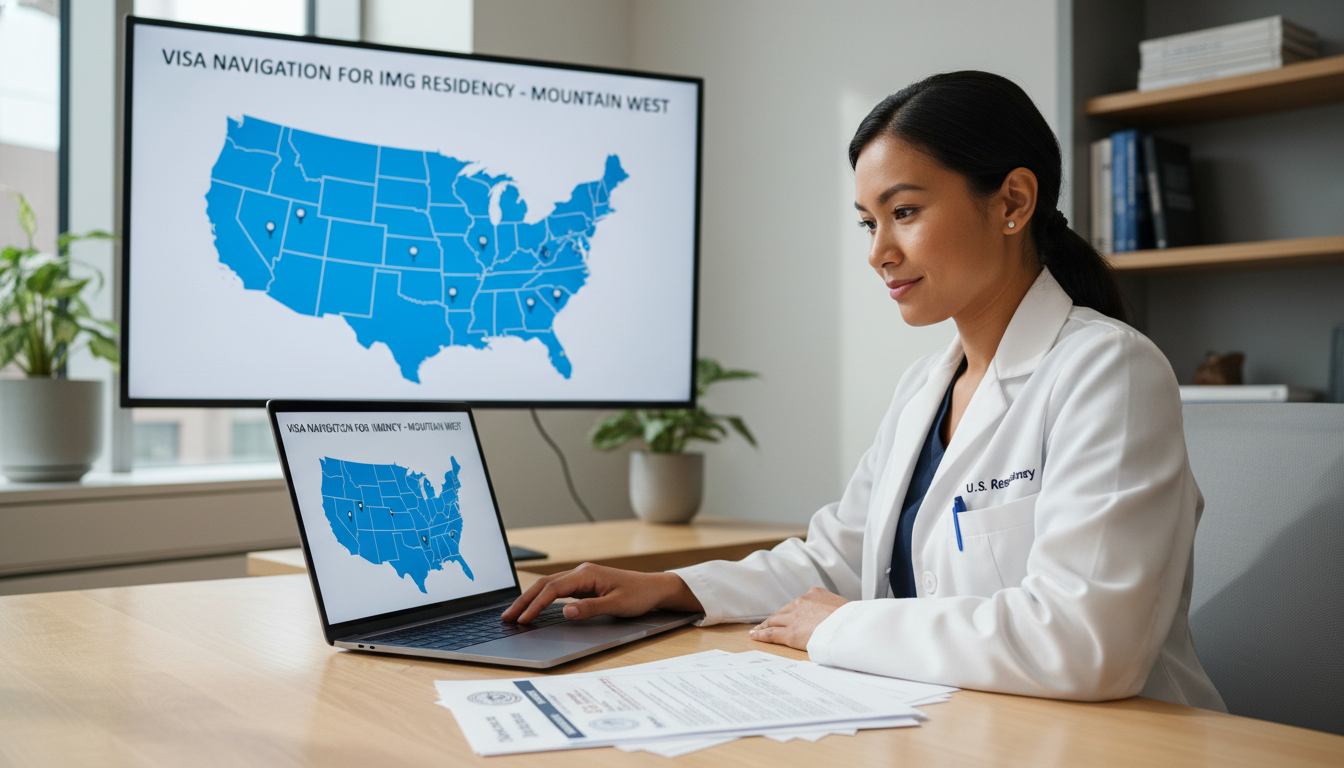
Understanding the Visa Landscape for IMGs in the Mountain West
For an international medical graduate (IMG), securing the right visa is just as critical as securing a residency position. In the Mountain West—states like Colorado, Utah, Wyoming, Montana, Idaho, Nevada, and New Mexico—programs are often IMG‑friendly but may differ significantly in their visa sponsorship policies.
This IMG residency guide focuses on visa navigation for residency specifically in the Mountain West region and is tailored to help you make smart, strategic decisions about where and how to apply.
Key goals for you as an IMG:
- Understand which visas are realistically available for residency (and which are not)
- Learn the difference between J‑1 vs H‑1B and how it plays out in Mountain West programs
- Anticipate residency visa timelines so you don’t miss key deadlines
- Identify Colorado residency and broader Mountain West programs that commonly sponsor IMGs
- Plan ahead for post‑residency options (waivers, fellowships, green card strategy)
Core Visa Types for IMGs Entering US Residency
For clinical residency training, only a few visa categories are truly relevant. Other student or work visas (F‑1 OPT, O‑1, etc.) may play supporting roles but are rarely primary pathways into GME.
1. J‑1 Exchange Visitor (ECFMG‑Sponsored)
The J‑1 physician visa is the most common visa type for IMGs entering U.S. residency.
Key points:
- Sponsor: ECFMG (Educational Commission for Foreign Medical Graduates)
- Category: Exchange Visitor, “Alien Physician”
- Duration: Typically the length of residency and fellowship, up to 7 years (extensions possible in some circumstances)
- Home-residency rule: Comes with the two-year home-country physical presence requirement after completion of training, unless you obtain a waiver
Advantages:
- Widely accepted: Most IMG‑friendly programs in the Mountain West sponsor J‑1 visas
- Predictable process: ECFMG has a well-defined, standardized pipeline
- Not capped: No annual quota like the H‑1B lottery
- Flexible for training: Easier to move between residencies/fellowships within J‑1 framework
Disadvantages:
- Two‑year home residency requirement:
- You must return to your home country for an aggregate of two years OR
- Secure a J‑1 waiver (e.g., Conrad 30, federal agency waiver) to stay and work in the U.S.
- Work restriction:
- Clinical work must be within the ECFMG‑approved training program
- Moonlighting is heavily restricted or prohibited
For many Mountain West IMGs, J‑1 is the default and most realistic entry route into residency.
2. H‑1B Temporary Worker (Specialty Occupation)
The H‑1B is the main alternative to the J‑1 for clinical training. However, its use in residency is much more limited and highly program‑dependent.
Key points:
- Sponsor: The residency program or institution
- Category: Specialty occupation worker
- Duration: Up to 6 years total, including time spent during residency and fellowship
- No home-residency rule: No two‑year return requirement
Advantages:
- Dual intent: H‑1B allows you to pursue permanent residency (green card) while in status
- No J‑1 waiver requirement after residency
- More flexible for some post‑residency employment planning
Disadvantages:
- Fewer sponsoring programs: Many Mountain West residencies do not sponsor H‑1B for residents
- Licensing/exam hurdles:
- Most H‑1B programs require all USMLE Steps (including Step 3) passed before the H‑1B petition
- This timeline can be tight for IMGs applying directly from abroad
- Cost and complexity:
- Legal and filing costs are higher
- More administrative burden for programs, so some avoid it
- Cap issues:
- Non‑profit hospitals/academic centers are usually cap‑exempt
- But if you later change to a private employer, you may face the H‑1B lottery
Practical reality for the Mountain West:
- Some large academic centers (e.g., in Denver, Salt Lake City, Albuquerque) may sponsor H‑1B for selected programs/trainees.
- Smaller community programs, rural programs, or new ACGME‑accredited programs often J‑1 only.
3. Other Visa Types (Less Common in Entry to Residency)
Although the focus of most IMG residency guides is on J‑1 vs H‑1B, a few other visa/immigration situations occasionally apply:
- F‑1 with OPT (Optional Practical Training):
- Rarely used for residency itself (GME typically requires J‑1 or H‑1B)
- Sometimes relevant if you completed an MPH or research degree in the U.S. and are transitioning
- O‑1 (Extraordinary Ability):
- Very rare for incoming residents; more common for senior faculty/attending physicians
- Green card / U.S. permanent resident:
- If you already have a green card, no residency visa is needed—this puts you on equal footing with U.S. graduates from a visa perspective.
- TN (for Canadians/Mexicans):
- Not commonly used for residents; classification issues for clinical training
For the residency application phase in the Mountain West, your real IMG visa options are usually:
- J‑1 (ECFMG‑sponsored)
- H‑1B (institution‑sponsored), if offered
Everything else is an exception.
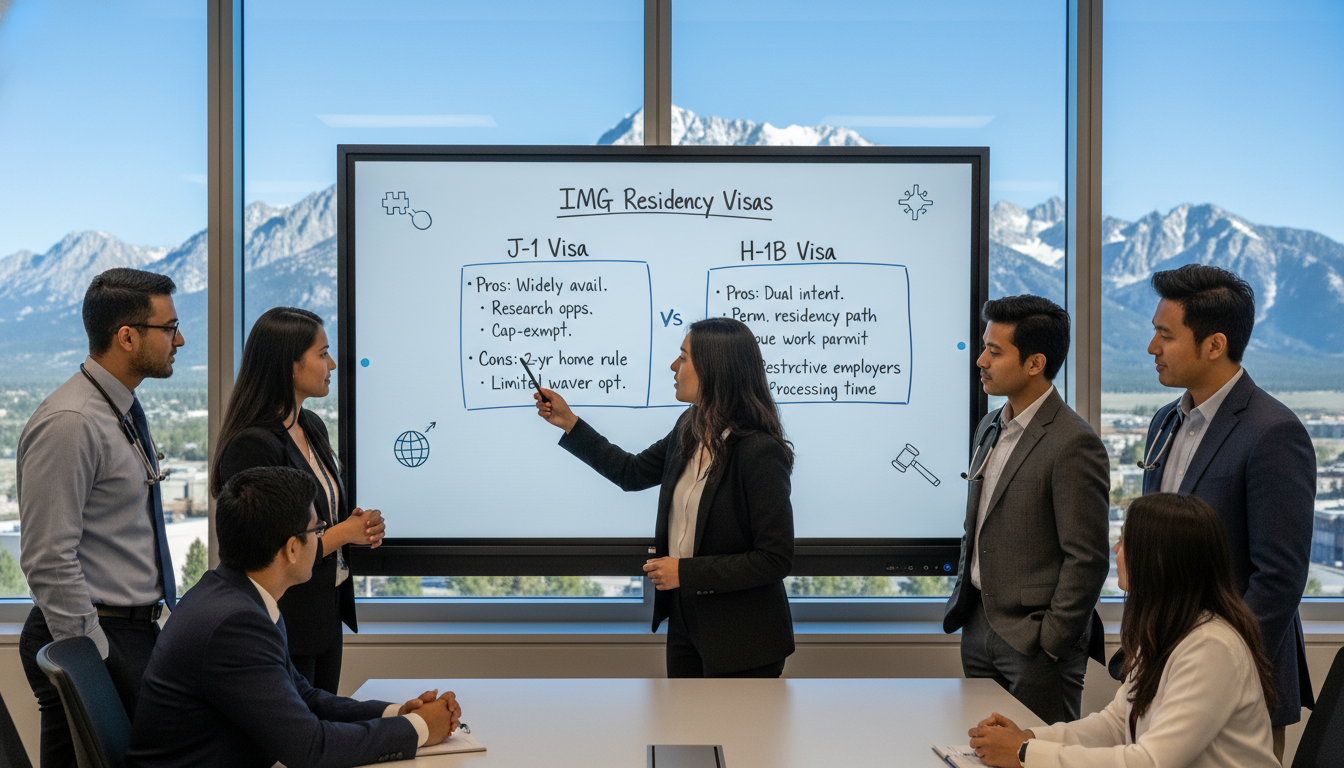
J‑1 vs H‑1B: How to Decide as an IMG Targeting the Mountain West
Choosing between J‑1 and H‑1B is one of the most critical decisions for an international medical graduate. However, in practice, the decision is often made by programs, not by candidates.
1. Program‑Driven Reality
In your ERAS research, you will find programs labeled:
- “J‑1 only”
- “J‑1 and H‑1B considered”
- “No visa sponsorship” (commonly not IMG‑friendly)
- Occasionally: “Currently not sponsoring visas due to institutional policy”
Your first step in visa navigation is mapping programs by their sponsorship patterns, especially for the Mountain West.
Actionable steps:
Check program websites
- Look under “For Applicants” or “Eligibility & Requirements” sections.
- Many programs clearly state:
- “We sponsor J‑1 visas only.”
- “We may sponsor H‑1B visas for exceptional candidates who have passed USMLE Step 3.”
Cross‑check with FREIDA / AAMC / NRMP program descriptions
- Visa info is often included but can lag behind website updates.
Email the program coordinator (especially for Mountain West programs where policies can change year to year):
- Ask concise, specific questions:
- “Do you sponsor J‑1 visas for residents?”
- “Do you ever sponsor H‑1B visas, and if so, what are the requirements (Step 3, timing, etc.)?”
- Ask concise, specific questions:
2. Strategic Considerations for J‑1
Opting for a J‑1 pathway makes sense if:
- Your priority is maximizing the number of programs you can apply to, including smaller Colorado residency programs or rural Mountain West programs.
- You are open to:
- Completing a J‑1 waiver job in a medically underserved area after training (common in the Mountain West)
- Or returning to your home country for 2 years
- You are applying directly from abroad and do not yet have Step 3.
Mountain West–specific advantages of J‑1:
- Most states in the region actively use Conrad 30 and other waivers because:
- They have large rural/underserved areas
- They struggle to recruit physicians, especially primary care and psychiatry
- This means that if you train on J‑1, you often have realistic waiver job options in the same region.
3. Strategic Considerations for H‑1B
Pursuing H‑1B makes sense if:
- You have USMLE Step 3 completed early (before rank list deadlines or before institutional H‑1B filing deadlines).
- You are targeting large academic centers in Denver, Salt Lake City, Las Vegas, Albuquerque, or other major cities that have a history of H‑1B sponsorship.
- You want to avoid the J‑1 home-country requirement and value a more direct path to a green card.
However, be realistic:
- Many Mountain West programs will not sponsor H‑1B at all.
- Even those that “consider” H‑1B may:
- Prioritize J‑1 due to lower administrative workload.
- Reserve H‑1B only for sub‑specialty fellows, not residents.
4. Hybrid Strategy: Open to Both
For many IMGs, the best Mountain West strategy is to:
- Prepare for J‑1 as the baseline (since it’s the most common and widely offered)
- Still take USMLE Step 3 early if possible, so that:
- You qualify if an H‑1B option becomes available
- You are a stronger applicant overall (some J‑1 programs also appreciate Step 3 done)
This “open to both” mindset helps you maximize match chances while preserving flexibility.
Mountain West Focus: Program Patterns, State Nuances, and Timeline
The Mountain West is unique in that it combines:
- A few large academic centers
- Numerous community programs
- Significant rural and frontier areas
This mix has important implications for IMG residency visa options and long-term planning.
1. Typical Visa Sponsorship Patterns by Setting
While each program is unique, the following patterns are common:
Large academic medical centers (e.g., Colorado, Utah, New Mexico, Nevada):
- Commonly sponsor J‑1 for residents
- May sponsor H‑1B for selected residents/fellows
- Institutional lawyers/HR usually experienced in immigration
- More structured timelines and clear policies online
Mid‑size and community programs:
- Often J‑1 only
- H‑1B may be rare due to cost and complexity
- Very IMG‑friendly in specialties like internal medicine, family medicine, psychiatry, pediatrics
Rural and frontier programs:
- Frequently rely on J‑1 IMGs to staff training programs
- Strong alignment with Conrad 30 waiver pathways after residency
- Sometimes limited administrative capacity for H‑1B
2. Colorado Residency and the Wider Mountain West: Practical Examples
Note: Program policies change. These examples are illustrative, not definitive. Always confirm current information.
Colorado residency (e.g., Denver-based academic internal medicine, pediatrics):
- Typically sponsor J‑1
- H‑1B may be limited and often requires Step 3 plus strong academic credentials
Utah and New Mexico:
- Major universities often J‑1 friendly and may consider H‑1B
- Community FM/IM programs: heavily reliant on J‑1 IMGs
Wyoming, Montana, Idaho:
- Fewer programs, but many are IMG‑friendly, particularly in family medicine
- J‑1 is commonly the main visa route
- This region can later offer excellent J‑1 waiver jobs in underserved areas
Nevada (Las Vegas, Reno):
- Growing GME landscape
- Mix of academic and community programs; J‑1 widely used
3. Visa and Application Timeline: What You Must Get Right
Your residency visa timeline is tightly linked to ERAS and NRMP schedules.
Before ERAS opens (June–September):
- Decide on your visa strategy:
- J‑1 only
- Try for H‑1B
- Open to both
- If considering H‑1B:
- Plan Step 3 timing
- Gather evidence of any prior U.S. visa status
During interview season (October–January):
- Ask targeted questions during interviews:
- “What visa types do you currently sponsor?”
- “For H‑1B, are there additional requirements (Step 3, timing, funding)?”
- “Have you sponsored H‑1B residents in recent years?”
Rank list and post‑match (February–March):
- Once matched, your program and ECFMG will start the J‑1 sponsorship process (if J‑1) or your institution’s H‑1B petition (if H‑1B).
- For J‑1:
- Ensure you meet ECFMG requirements (such as primary source verification, Statement of Need from your home country).
- For H‑1B:
- Confirm all USMLE and licensing criteria are fulfilled.
- Expect to provide detailed documentation (degree, evaluations, prior status).
US consular processing (March–June/July):
- Book your visa interview as early as possible.
- Prepare for possible delays or administrative processing—especially important if you will be training in a smaller Mountain West city with limited start-date flexibility.

Planning Beyond Residency: J‑1 Waivers, H‑1B Transitions, and Green Card Pathways
An IMG residency guide is incomplete without discussing what happens after residency, especially if you want to stay in the Mountain West as an attending or fellow.
1. If You Train on a J‑1 Visa
Your main challenge after residency is the two‑year home-country requirement. You must either:
- Return home for a cumulative 2 years, or
- Obtain a waiver through specific programs or agencies.
Common J‑1 waiver routes:
Conrad 30 State Waiver Programs:
- Each state can sponsor up to 30 J‑1 waiver physicians annually.
- Prioritize underserved areas and shortage specialties (family medicine, internal medicine, pediatrics, psychiatry, OB/GYN, etc.).
- Many Mountain West states are very active users of Conrad 30 because they struggle to recruit doctors to rural and frontier regions.
- If you want to stay in Colorado, Wyoming, Montana, Utah, Idaho, Nevada, or New Mexico, Conrad 30 is often the main route.
Federal Programs:
- VA (Department of Veterans Affairs)
- Department of Health and Human Services (HHS)
- Appalachian or Delta Regional Authorities (less relevant for much of the Mountain West, but check borders/eligibility)
- These can be additional options if state slots are full.
Once you secure a waiver job:
- Your employer typically files an H‑1B for you.
- After working in the approved waiver position (usually 3 years full‑time), the home-residency requirement is considered fulfilled.
Mountain West advantage:
- Many rural hospitals and clinics in these states are eager to sponsor J‑1 waiver physicians.
- Your experience as a resident in the Mountain West makes you a natural candidate for local waiver positions.
2. If You Train on an H‑1B Visa
If you start residency on an H‑1B:
- You do not have a J‑1 home-residency requirement.
- After residency, you may:
- Continue on H‑1B with a new employer (subject to cap rules if moving out of cap-exempt setting).
- Begin or continue the green card process (e.g., EB‑2/EB‑3, often with National Interest Waiver for primary care or underserved service).
However, be aware:
- Time spent in residency/fellowship counts toward the 6‑year H‑1B maximum.
- If you spend 3 years in residency and 3 in fellowship, you might reach the 6‑year limit unless:
- You have an approved I‑140, allowing H‑1B extensions beyond 6 years, or
- You switch to another status.
3. Long‑Term Settlement in the Mountain West
Many IMGs who train in the region choose to stay in the Mountain West for their careers, especially if they:
- Value outdoor lifestyle, lower cost of living outside big cities, and close professional communities.
- Secure stable positions in underserved areas, which often support green card sponsorship and can align with National Interest Waiver (NIW) criteria.
Actionable advice:
- During residency, especially in J‑1 status, start:
- Building relationships with community hospitals and clinics.
- Exploring possible waiver employers early (PGY‑2 or early PGY‑3 for 3-year programs).
- Attend state medical society meetings and regional conferences.
- Talk to senior IMGs who have successfully completed Conrad 30 or similar paths in Colorado and neighboring states.
Practical Tips for Navigating Visa Questions During Residency Applications
Visa topics can feel sensitive, but handling them professionally is essential.
1. How to Present Your Visa Needs in Your Application
- In your personal statement or ERAS application, you do not need to go into visa technicalities.
- It is enough to be truthful when asked:
- “Are you a U.S. citizen or permanent resident?”
- If not, select the appropriate non‑citizen option.
- If a program asks about visa preference:
- You can answer: “I am open to J‑1 or H‑1B sponsorship, depending on institutional policy.”
2. Discussing Visa Issues in Interviews
When interviewing with Mountain West programs:
- Time questions for the end of the interview or ask the program coordinator outside the formal interview slots.
- Phrase questions neutrally and professionally:
- “Could you tell me what visa types your program typically sponsors for IMGs?”
- “If H‑1B is an option, are there specific requirements or deadlines I should be aware of?”
- Avoid sounding like the visa is your only priority; emphasize your interest in:
- The region
- Training quality
- Patient population
3. Common Mistakes to Avoid
- Waiting too late to ask if the program sponsors visas:
- Don’t rank programs that clearly state “no visa sponsorship” if you need a residency visa.
- Ignoring program policies:
- If they clearly say “J‑1 only,” pushing for H‑1B is usually fruitless and can hurt your standing.
- Overcomplicating your story:
- Be clear and simple about your current status and needs.
FAQs: Visa Navigation for IMGs in the Mountain West
1. As an IMG, is it easier to match into a Mountain West residency on J‑1 or H‑1B?
In the Mountain West, it is usually easier to match on a J‑1 visa because:
- Most IMG‑friendly programs sponsor J‑1.
- H‑1B sponsorship is more limited and sometimes reserved for select candidates or specific specialties.
- Programs in rural or smaller cities often rely heavily on J‑1 IMGs.
2. Can I switch from J‑1 to H‑1B during residency?
Switching from J‑1 physician status to H‑1B without fulfilling the two-year home residency requirement or obtaining a waiver is extremely difficult and generally not allowed. The J‑1 home-country requirement applies even if you later qualify for another visa type like H‑1B. Most J‑1 IMGs complete residency and then obtain a J‑1 waiver job which transitions them to H‑1B.
3. Do all Colorado residency programs accept IMGs and sponsor visas?
No. Colorado residency programs (and other Mountain West programs) vary widely:
- Some large academic programs accept many IMGs and sponsor J‑1 regularly.
- Some smaller or more competitive specialties may sponsor no visas.
- Before applying, carefully check each program’s visa policy on their website or by contacting the coordinator.
4. Should I take USMLE Step 3 before applying if I’m aiming for the Mountain West?
If you can take Step 3 without compromising your Step 1/Step 2 scores or application timing, it can be beneficial because:
- It strengthens your application overall.
- It keeps H‑1B as a realistic option at programs that require Step 3 for H‑1B sponsorship.
- However, Step 3 is not required for most J‑1 positions, so if time is limited, prioritize strong Step 1/2 scores and clinical experience first.
Navigating residency visa options as an international medical graduate is complex, but with early planning, clear information, and realistic expectations about J‑1 vs H‑1B in the Mountain West, you can craft a strategy that maximizes both your match chances and your long-term career options in the region.