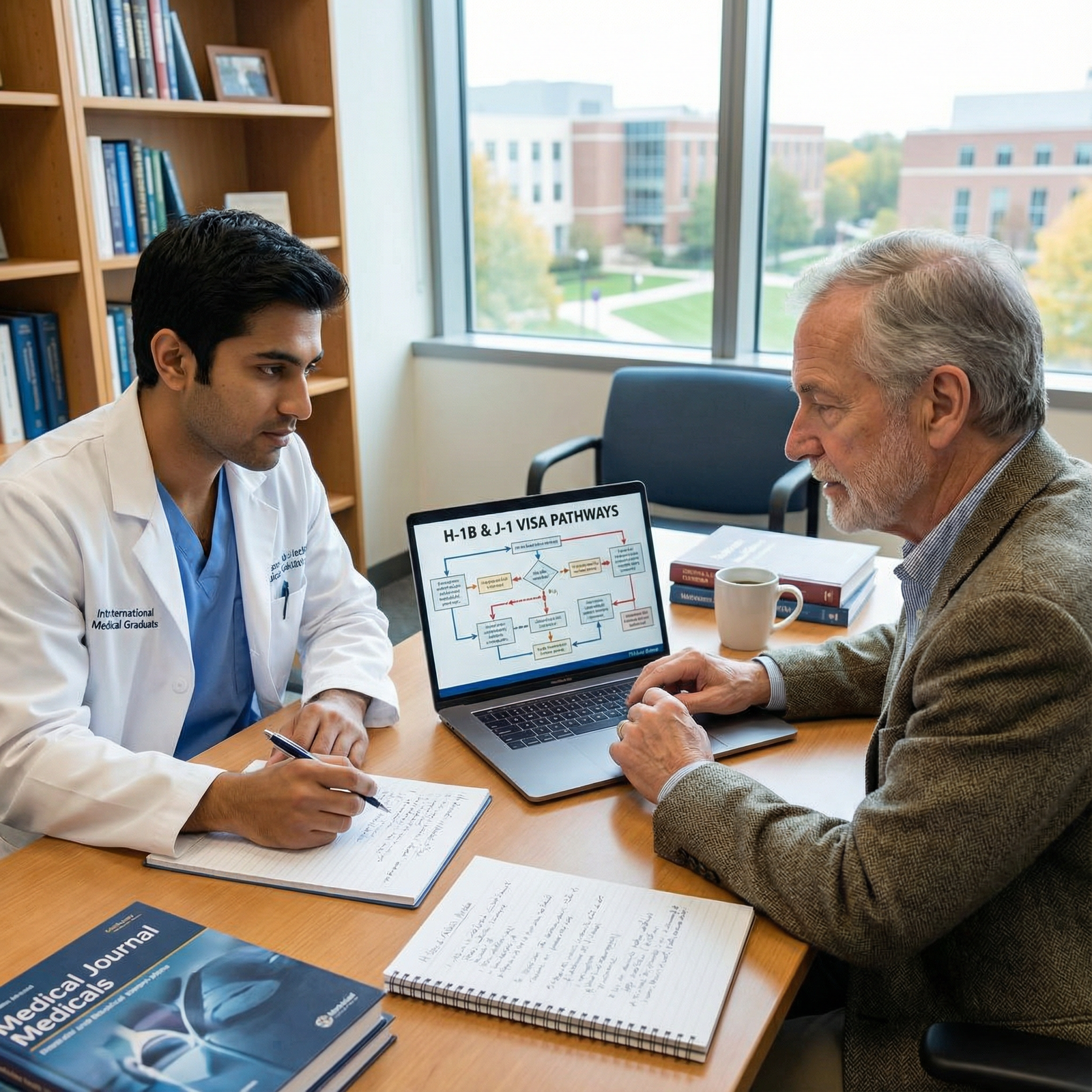
Navigating the U.S. visa system as an International Medical Graduate (IMG) can feel as challenging as mastering a new specialty—especially when your goal is to match into residency in a specific region like the Research Triangle in North Carolina. This IMG residency guide focuses on how to successfully plan your residency visa strategy for programs in and around Raleigh–Durham–Chapel Hill, including institutions such as Duke, UNC, and other North Carolina residency programs.
Understanding the Visa Landscape for IMGs in the Research Triangle
Before you can plan effectively, you need a clear overview of the IMG visa options most relevant to residency training in the United States.
The Two Main Residency Visa Pathways
For graduate medical education (GME) in the U.S., IMGs generally train on one of two visas:
- J-1 Exchange Visitor (Alien Physician) Visa
- H-1B Temporary Worker (Specialty Occupation) Visa
Both can be used for residency in the Research Triangle, but not all institutions sponsor both. In this region:
- Duke University Hospital / Duke residency programs
Historically J-1–friendly; limited, selective H-1B sponsorship in some specialties and fellowships (subject to change yearly). - UNC Hospitals (Chapel Hill) and affiliate programs
Primarily J-1 sponsorship through ECFMG; certain programs may sponsor H-1B under strict conditions. - Other North Carolina residency programs (e.g., in Raleigh, Durham, smaller community programs)
Often J-1 only; H-1B is less common and more variable.
Always verify on:
- The program website
- FREIDA (AMA residency database)
- Directly with the program coordinator or GME office
Core Differences: J-1 vs H-1B for IMGs
Here is a decision-oriented comparison for the typical IMG in the Research Triangle context:
J-1 Visa (ECFMG-sponsored)
- Most widely available visa for IMGs in NC and across the U.S.
- Sponsored by ECFMG, not the hospital directly (though the hospital must host you).
- Requires:
- Valid ECFMG certification
- USMLE Step exams completed (II and I; some programs now emphasize Step 3 before training ends, but not required for visa issuance)
- Statement of need from your home country
- Comes with a two-year home-country physical presence requirement after training unless a waiver is obtained.
- Easier to obtain for initial residency.
H-1B Visa (Employer-sponsored)
- Sponsored directly by the residency program / institution.
- Requires:
- USMLE Step 3 passed before filing the petition
- Valid state medical license eligibility (some states accept training license with Step 3; North Carolina typically requires Step 3 for full licensure but not always for a training license—check NC Medical Board requirements)
- No automatic two-year home return obligation.
- Harder to obtain because:
- Many programs do not sponsor H-1B for residency, or do so only in select circumstances.
- More institutional legal/administrative cost and effort.
Understanding this high-level distinction is essential for any international medical graduate targeting the Research Triangle.
Deep Dive: J-1 Visa for Residency in the Research Triangle
For most IMGs entering residency in North Carolina, the J-1 visa is the most realistic route. It is the default for many Duke residency and UNC programs.
How J-1 Sponsorship Works
The J-1 for physicians is administered through ECFMG (Educational Commission for Foreign Medical Graduates). The residency program accepts you, and then:
- The program confirms sponsorship eligibility to ECFMG.
- You submit your J-1 application through OASIS (ECFMG’s online system).
- ECFMG reviews your documents and issues Form DS-2019.
- You book your visa interview at a U.S. embassy/consulate in your home or current country of residence.
Key Requirements for J-1 Physicians
Most IMGs need to show:
- ECFMG Certification
- Passing USMLE Step 1 and Step 2 CK.
- Primary source verification of your medical degree.
- Valid Residency Contract or Offer Letter
- From a GME-accredited program (e.g., Duke, UNC, other NC hospitals).
- Statement of Need
- Official letter from the Ministry of Health or equivalent authority in your home country stating:
- There is a “need” for physicians in your specialty.
- They expect you to return after training.
- Official letter from the Ministry of Health or equivalent authority in your home country stating:
- Financial Support
- Your residency salary meets or exceeds ECFMG minimums (in practice, almost always met by standard PGY salaries).
- Non-immigrant Intent
- You must demonstrate that you intend to return home after training (this is formalized by the two-year requirement).
The Two-Year Home-Country Requirement
The biggest long-term implication of the J-1 route is the two-year home-country physical presence requirement.
- After finishing residency (and any fellowships), you must either:
- Return to your home country for a cumulative two years, or
- Obtain a J-1 waiver that allows you to remain in the U.S. or transition to H-1B/green card.
For those who want to build a long-term career in the U.S., the waiver path becomes crucial.
J-1 Waiver Options Relevant to North Carolina
After residency/fellowship, common waiver routes include:
Conrad 30 Waiver Program (State-based)
- Each state (including North Carolina) can sponsor up to 30 J-1 waiver positions per year for physicians.
- Usually requires:
- Full-time practice (typically 40 hrs/week)
- Employment in a Health Professional Shortage Area (HPSA) or Medically Underserved Area (MUA)
- A 3-year service commitment.
- NC Department of Health and Human Services manages this; many roles are in smaller towns or underserved regions, sometimes commutable from larger cities but often outside Raleigh-Durham-Chapel Hill.
Federal Programs
- Veterans Affairs (VA)
- Appalachian Regional Commission (ARC) (sometimes applicable in parts of NC)
- Delta Regional Authority (not central to the Triangle region, but good to know broadly)
- Generally require a service commitment in specific underserved or populations.
Interested Government Agency (IGA) Waivers
- Agencies like HHS may sponsor waivers for physicians in specific high-need areas or research roles.
You don’t need to decide on the waiver path during residency, but knowing these options helps you plan ahead if you choose J-1.
Deep Dive: H-1B Visa for Residency in the Research Triangle
For some IMGs, especially those clearly planning a long-term U.S. career, the H-1B route is attractive because it avoids the J-1 two-year home requirement. But it’s more limited and competitive.
Core Requirements for H-1B in Residency
For an H-1B residency position in North Carolina (including Duke/UNC or affiliated community programs), you typically must:
Pass USMLE Step 3 before the H-1B petition is filed
- This can be the single biggest barrier for IMGs applying directly to PGY-1 from abroad.
- Often more realistic for:
- IMGs already in the U.S. on another status (research, F-1, etc.) who can sit for Step 3.
- IMGs entering at PGY-2 or later after a preliminary year.
Qualify for a Medical License or Training License in NC
- North Carolina Medical Board requirements must be checked carefully:
- Some institutions use a training license, which might have different exam/credential requirements than full licensure.
- Many H-1B petitions still rely on eligibility for some form of state license.
- North Carolina Medical Board requirements must be checked carefully:
Program Must Be Willing to Sponsor
- H-1B sponsorship demands:
- Legal costs
- Labor Condition Application (LCA) with the Department of Labor
- Institutional policies aligning with H-1B rules (e.g., prevailing wage)
- Many programs explicitly state “J-1 only” or “J-1 preferred” to avoid this burden.
- H-1B sponsorship demands:
Cap-Exempt Advantage in Academic Settings
University-affiliated hospitals, including Duke University Hospital and UNC Hospitals, are generally H-1B cap-exempt employers. This means:
- They can file H-1B petitions any time of year.
- You are not subject to the H-1B lottery, which affects private employers.
However, cap-exempt status does not mean they must or will sponsor H-1B for all residents. It simply makes the process easier if they choose to.
Strategic Considerations for H-1B in the Triangle
For an international medical graduate targeting the Research Triangle:
If you are still in medical school abroad:
- Achieving Step 3 before Match is challenging, but if you can, it opens a conversation about H-1B.
- Many programs still may not sponsor H-1B at PGY-1, regardless of your Step 3 status.
If you are already in the U.S. doing research, observerships, or another degree (e.g., MPH):
- Prioritize taking and passing Step 3 early.
- During interviews, ask specifically:
- “Does your program sponsor H-1B for residents?”
- “Under what circumstances?”
- “Have you sponsored H-1B for IMGs in the last few application cycles?”
If you are aiming for Duke residency programs:
- H-1B sponsorship tends to be selective and specialty-dependent (more common in some fellowships than core residencies).
- Some highly competitive specialties may favor J-1 only; always verify.
Choosing Between J-1 vs H-1B: Practical Decision Framework
Many IMGs struggle with the J-1 vs H-1B decision. For the Research Triangle context, use this framework:
Step 1: Reality Check – Program Policies
Ask yourself:
- Do the specific NC programs I’m applying to sponsor H-1B at all?
- Is there a history of these programs supporting H-1B for incoming PGY-1 or PGY-2 IMGs?
- Do I realistically have Step 3 passed before they would need to file the petition?
If the answer is “no” to (1) or (2), or “not sure” to (3), then you may not have a real H-1B option.
Step 2: Career Goals and Timeline
If you strongly intend to settle in the U.S. long-term:
- H-1B aligns well with directly pursuing a green card later.
- But turning down good J-1 offers in the hope of H-1B can be risky.
If you are open to returning home or working abroad:
- J-1 is usually simpler and more realistic.
- You can still pursue a waiver and U.S. career later if plans change.
Step 3: Visa Risk Tolerance
Lower Risk, Higher Flexibility (Short Term)
- J-1 is more predictable and widely accepted.
- You focus on matching well, then figure out waivers/opportunities near the end.
Higher Risk, Long-Term Strategy
- H-1B may require:
- Limiting your application list to a smaller set of H-1B-friendly programs.
- Potentially losing out on excellent J-1-only programs in the Triangle.
- But benefits include no two-year home rule and easier transition to employment-based green card.
- H-1B may require:
A Common Hybrid Strategy
Many IMGs choose this path:
- Apply broadly, prioritizing overall program quality and fit (including in the Research Triangle).
- Assume they will likely be on J-1 for residency.
- Use residency years to:
- Build a strong CV.
- Network strategically (especially if interested in staying in NC).
- Explore J-1 waiver practices and employers in underserved North Carolina areas.
- Closer to completion, pursue a J-1 waiver job in NC or another state, often on H-1B.
This creates a stepwise path: Residency on J-1 → Waiver job on H-1B → Green card.

Applying to Research Triangle Programs as an IMG: Visa-Focused Tactics
Knowing the theory is not enough. Here is how to operationalize your visa strategy when applying to Research Triangle residency programs.
1. Research Program Visa Policies Early
Use multiple sources:
- FREIDA: Filter programs by state (North Carolina) and review “Visa Sponsorship” details.
- Program websites: Look for:
- “We sponsor J-1 visas through ECFMG.”
- “We sponsor H-1B for residents and fellows” or “J-1 only.”
- Direct email to program coordinator: Brief and specific:
- Example wording:
I am an international medical graduate planning to apply to your program this cycle. Could you please confirm which visa types your program can sponsor for incoming residents (J-1 and/or H-1B)? If H-1B is possible, do you require USMLE Step 3 at the time of application or only prior to visa filing?
- Example wording:
Document responses in a spreadsheet so you can tailor your application and interview questions.
2. Tailor Your Strategy by Institution Type
Duke residency programs (Durham, NC):
- Expect strong emphasis on academic excellence, research, and strong USMLE scores.
- J-1 is standard; H-1B may be possible in selected scenarios but not guaranteed.
- Highlight research experience, clinical excellence, and commitment to academic medicine.
UNC and its affiliated programs (Chapel Hill):
- Similarly academic, with significant emphasis on community service and public health.
- J-1 sponsorship is standard; H-1B may exist for select positions.
- Showcase interest in health equity and community engagement.
Smaller community programs in the Research Triangle and nearby NC cities:
- Often J-1 only; some may not sponsor any visas.
- Visa policy can change year to year depending on institutional resources.
3. Use Interviews to Clarify Visa Flexibility
During interviews (especially if you reach second looks or have a chance to speak with the program director or GME office), ask:
- “Do you foresee any changes in your visa sponsorship policies in the near future?”
- “If I match here on a J-1, are there typical pathways that prior graduates used to obtain J-1 waivers after training?”
- “Have any former residents obtained positions in North Carolina after finishing here, and if so, what visa routes did they use?”
These questions do more than give you information; they also signal that you are planning ahead and committed to a sustainable career path.
4. Plan Your Timeline Backwards from Match Day
Visa processes are time-sensitive. For a typical IMG matching into a July 1 start date in the Research Triangle:
By September–December (Application/Interview Season):
- Confirm your passport validity (ideally valid for the entire duration of residency).
- Keep all your documents (medical diploma, ECFMG cert, USMLE transcripts) accessible.
By March (NRMP Match):
- Match results are announced mid-March.
- Within a few weeks, you should receive your official contract/offer letter from the NC program.
April–May:
- Start J-1 application through ECFMG (if J-1).
- Request your Statement of Need from home-country authorities.
- Gather financial documents if required by ECFMG.
May–June:
- Once DS-2019 is issued, book your J-1 visa interview.
- For H-1B (if applicable), the institution’s legal office will file the petition; you may also need a consular appointment if you are abroad.
Late June:
- Travel to the U.S. (J-1 entry allowed up to 30 days before start date).
- Attend orientation at Duke/UNC/other NC program.
Good planning reduces stress immensely and prevents delays that could affect your ability to start on time.
Long-Term Planning: Building a U.S. Career from the Research Triangle
Residency is only the beginning. If you envision a long-term career in the U.S.—perhaps even remaining in the Research Triangle—start planning early.
For J-1 Residents
During residency (2–5 years depending on specialty):
- Network with faculty who may have connections to employers in underserved areas of NC.
- Attend sessions or workshops on J-1 waiver opportunities at your institution.
- In PGY-2 or PGY-3, start exploring:
- North Carolina’s Conrad 30 program requirements.
- Employers in rural or underserved NC communities willing to sponsor waiver positions.
- Discuss your long-term interests with mentors; many academic attendings in the Triangle trained on J-1 and navigated waivers themselves.
For H-1B Residents
If you are on H-1B from the start:
- You can usually extend H-1B status for full residency duration and possibly fellowship.
- Begin conversations about:
- Employer-sponsored green card (EB-2 or EB-1).
- Whether you prefer academic jobs (e.g., Duke, UNC) or private practice in NC.
- Because you’re not tied to a J-1 waiver, your geographic and specialty choices may be broader after residency.
Staying in the Research Triangle Long-Term
The Triangle offers:
- Multiple academic centers (Duke, UNC, NC State collaborations).
- Growing private practices and hospital systems.
- Research and biotech companies in and around Research Triangle Park (RTP).
As an IMG who completes residency here, you will be well-placed to:
- Secure a fellowship at Duke/UNC.
- Transition into academic appointments.
- Move into clinical roles in nearby underserved areas that may still be within commuting distance.
Your residency visa choice (J-1 vs H-1B) will influence the sequence of steps, but not necessarily whether you can ultimately build a successful career in this region.
FAQs: Visa Navigation for IMGs in the Research Triangle (NC)
1. Do Duke residency programs sponsor H-1B visas for IMGs?
Duke residency programs predominantly sponsor J-1 visas through ECFMG for IMGs. Some departments or fellowships may sponsor H-1B under specific circumstances, usually requiring USMLE Step 3 and meeting institutional criteria. Policies can vary by program and year, so always check:
- The specific program website for current information.
- Directly with the program coordinator or GME office before ranking.
2. Is it realistic to get H-1B for residency as an IMG applying from abroad?
It is possible but less common. For most IMGs applying directly from outside the U.S.:
- Obtaining Step 3 before application is challenging.
- Many programs in North Carolina and nationwide are J-1 focused.
- You may significantly limit your match chances if you apply only to H-1B-sponsoring programs.
Most IMGs prioritize matching into a solid program, often on J-1, and then address long-term visa strategy later (via J-1 waiver and H-1B transitions).
3. Can I switch from J-1 to H-1B during or after residency?
You generally cannot change from J-1 to H-1B without first addressing the two-year home-country requirement. To move from J-1 to H-1B:
- You must either:
- Complete two years of home-country physical presence, or
- Obtain a J-1 waiver (e.g., Conrad 30, VA, ARC, IGA).
- After the waiver is granted, a U.S. employer (often in an underserved area) can file an H-1B petition for you.
Switching mid-residency is rare and complicated; most transitions occur after training.
4. Should I avoid J-1 if I want to stay in the U.S. permanently?
Not necessarily. While J-1 has the two-year home requirement, many IMGs have successfully:
- Completed residency/fellowship on J-1.
- Obtained a J-1 waiver job (often on H-1B) in an underserved area.
- Transitioned to permanent residency (green card) later.
If your only goal is to stay in the U.S. with maximum flexibility, H-1B is ideal—but it is not always feasible. A strong J-1–residency → waiver job → green card pathway is perfectly viable for building a permanent U.S. career, including in North Carolina.
For an international medical graduate targeting the Research Triangle (NC), successful visa navigation starts with early information gathering, realistic expectations about J-1 vs H-1B, and alignment with program policies at Duke, UNC, and other North Carolina residency programs. With careful planning and proactive communication, you can turn a complex visa system into a clear, stepwise path to training and building a rewarding medical career in this vibrant academic and clinical region.