
Understanding the Visa Landscape for IMGs in the Northeast Corridor
For an international medical graduate, the “where” of residency is often shaped by the “how” of visa navigation. The Northeast Corridor—stretching from Boston through New York City and Philadelphia down to Washington, DC—is one of the most IMG-friendly and academically dense regions in the United States. At the same time, visa rules here are strictly followed and highly structured.
To succeed, you must understand:
- The main residency visa pathways (J-1 vs H-1B and a few less common options)
- How northeast residency programs view and sponsor these visas
- How visa timing interfaces with ERAS, interviews, and Match
- Special regional considerations (e.g., New York and New Jersey waiver environments, large academic centers)
This IMG residency guide will walk you through the core visa concepts, with a specific focus on navigating east coast residency programs in the Northeast Corridor.
Core Visa Types for Residency: J‑1 vs H‑1B and Beyond
When U.S. residency programs consider international medical graduates, they are usually thinking in terms of two primary visa categories:
- J‑1 Exchange Visitor (ECFMG-sponsored)
- H‑1B Temporary Worker (employer-sponsored)
Other options (e.g., F‑1 with OPT, O‑1) exist, but are much less common as primary entry routes into residency training.
J‑1 Visa for Graduate Medical Education
The J‑1 Exchange Visitor Visa for physicians is sponsored exclusively by ECFMG for residency and fellowship training in the United States.
Key features:
- Purpose: Clinical training (residency/fellowship), not long-term employment.
- Sponsor: ECFMG (not the hospital directly).
- Duration: Usually the length of your ACGME-approved training, renewed annually.
- Home Residency Requirement: Nearly all physicians on a J‑1 are subject to the two-year home-country physical presence requirement (INA §212(e)).
Pros of the J‑1 Visa
- Widely accepted in the Northeast:
Most northeast residency programs—especially large academic centers in Boston, New York City, Philadelphia, Baltimore, and DC—are very familiar with ECFMG-sponsored J‑1s and have streamlined processes. - Predictable processing structure:
Clear timelines and standardized document requirements through ECFMG. - No USMLE Step 3 required to start residency:
Unlike H‑1B, J‑1 sponsorship does not require Step 3. - Less institutional burden:
The residency program does not have to navigate complex USCIS filings for you; ECFMG does most of the heavy lifting.
Cons of the J‑1 Visa
- Two-year home-country requirement:
After training, you are generally required to return to your home country for a total of two years before being eligible for most U.S. immigrant or H-type visas, unless you obtain a J‑1 waiver. - Limited moonlighting flexibility:
Moonlighting is often heavily restricted or prohibited, depending on ECFMG rules and program policies. - Dependent limitations:
J‑2 spouses can apply for work authorization but are dependent on your J‑1 status.
J‑1 in the Northeast Context
- Many east coast residency programs explicitly state, “We sponsor only J‑1 visas through ECFMG.”
- New York, New Jersey, Pennsylvania, and Massachusetts have active J‑1 waiver programs (especially through the Conrad 30 program and federal agencies like HHS, VA), which becomes important when you finish training and seek to remain in the U.S.
- Because of the high density of training hospitals and a long history of welcoming IMGs, the J‑1 route is often the most straightforward entry into residency in the Northeast Corridor.
H‑1B Visa for Residency
The H‑1B Temporary Worker Visa is often perceived as more “permanent-track friendly” because it can be a stepping stone to long-term employment and eventual green card sponsorship.
Key requirements and features:
- Employer-sponsored: The residency program must petition USCIS on your behalf.
- Specialty occupation: Physicians easily qualify as a specialty occupation.
- USMLE Step 3 required:
For a residency program to sponsor an H‑1B, you typically must have:- Passed USMLE Step 1, Step 2 CK, and
- USMLE Step 3 prior to H‑1B filing (timing varies by program; earlier is better).
- State medical licensure prerequisites:
You must meet the minimum licensing requirements of the state where your program is located (varies by state; some allow training licenses with limited prerequisites).
Pros of the H‑1B Visa
- No two-year home-country requirement:
Unlike J‑1, there is no automatic obligation to return to your home country. - More direct path to long-term U.S. practice:
Often considered advantageous if you intend to remain in the U.S. for employment and potential permanent residency. - More flexibility for certain work arrangements:
Depending on institutional policies, H‑1B may allow broader moonlighting options within legal and contract limits.
Cons of the H‑1B Visa
- Fewer programs sponsor it:
Many northeast residency programs either:- Do not sponsor H‑1B at all, or
- Will consider H‑1B only for exceptional candidates or only after initial J‑1.
- Higher administrative burden:
Legal fees, filing costs, and HR complexity for the hospital/health system. - Step 3 timing pressure:
You must complete and pass Step 3 early (often by November–January of application cycle) so the program can initiate timely filings. - Cap considerations:
Most teaching hospitals affiliated with universities are cap-exempt, which is good. However, cap-exempt status may limit your ability to later transfer to a cap-subject employer without navigating the H‑1B lottery.
H‑1B in the Northeast Context
- Major academic centers in urban hubs (Boston, NYC, Philadelphia, Baltimore, DC) sometimes sponsor H‑1B, but policies vary widely, even within the same hospital system.
- Some community and university-affiliated northeast residency programs will state:
- “J‑1 only,” or
- “We may sponsor H‑1B for exceptional candidates who have passed Step 3 and meet all requirements.”
- Because of the density of cap-exempt institutions in the Northeast Corridor, H‑1B cap concerns are less critical during residency, but become more relevant when you transition to non-academic practice later.
Other Less Common Routes (F‑1, O‑1, EAD)
While the J‑1 vs H‑1B discussion dominates IMG visa options, a few additional pathways may intersect with your residency journey:
F‑1 Student Visa with OPT:
- Some IMGs complete U.S. degrees (e.g., MPH, MS, PhD) on F‑1.
- In rare cases, they may use Optional Practical Training (OPT) to begin residency if structured appropriately and if the program/hospital accepts it.
- This is complex and not standard; most northeast programs prefer J‑1 or H‑1B for clinical residency roles.
O‑1 Extraordinary Ability Visa:
- For applicants with significant research portfolios, major publications, and international recognition.
- Some elite northeast academic hospitals will consider O‑1s, typically for research-heavy positions or post-residency faculty roles, but it is uncommon as a visa for categorical residency entry.
Other Work Authorization (EAD):
- Applicants with pending asylum, DACA, or other statuses may hold an Employment Authorization Document (EAD).
- In such cases, the discussion is less about residency visa sponsorship and more about whether the program accepts your specific status.
For most IMGs targeting northeast residency programs, your realistic primary residency visa options are J‑1 and H‑1B.
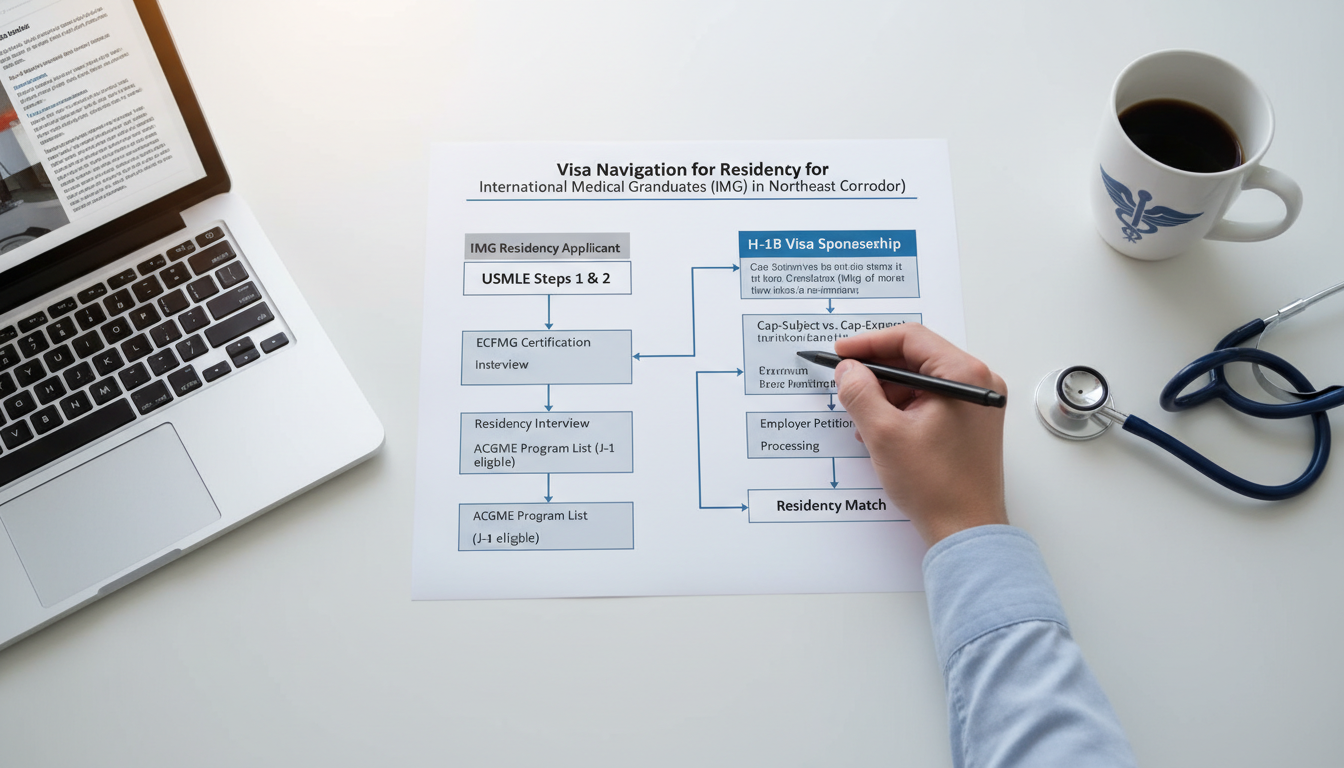
How Visa Choices Affect Your Residency Strategy in the Northeast
Your visa status is not just a formality; it actively shapes your application strategy, program list, and post-residency plans.
1. Defining Your Long-Term Goals First
Before choosing or prioritizing visa types, clarify your long-term goals:
- Do you wish to return home after training?
- Do you strongly want to practice long-term in the U.S., especially in the Northeast?
- Are you open to practicing in underserved or rural areas (often outside the Northeast) for a few years after training?
If you are comfortable with:
- Potentially accepting a job in a less urban, underserved area (often in the Midwest, South, or rural Northeast)
- Committing to such practice for 3+ years
…then a J‑1 followed by a J‑1 waiver job can be a realistic path to long-term U.S. practice.
If you are determined to:
- Maintain maximum geographic flexibility after training
- Minimize obligations like service commitments in specific locations
…then an H‑1B route during residency, if available, might better align with your goals.
2. Building a Visa-Smart Program List
When applying to northeast residency programs, study each program’s official stance on IMG visa options:
- Look at program websites under:
- “Eligibility”
- “International Medical Graduates”
- “Visas”
- You will typically see one of the following statements:
- “We sponsor J‑1 visas (ECFMG) only.”
- “We sponsor J‑1 and H‑1B visas for eligible candidates.”
- “We do not sponsor visas; applicants must have U.S. work authorization.”
- “H‑1B sponsorship is considered on a case-by-case basis.”
Create a spreadsheet including:
- Program name and city (e.g., Boston, New York, Newark, Philadelphia, Baltimore, DC, New Haven, Providence, etc.)
- Visa policy
- Whether they require USMLE Step 3 for H‑1B
- Recent feedback from current residents or alumni (if available)
Use this to build a rational application strategy:
- If you do not have Step 3 yet:
- Focus on programs that clearly accept J‑1.
- Include a few “H‑1B possible” programs but know that you may be considered only for J‑1 there.
- If you have Step 3 passed early:
- Actively target programs in the Northeast known to sponsor H‑1B (e.g., some university hospitals, large community systems).
- Still apply widely to J‑1-friendly programs; don’t limit your options.
3. Realistic Expectations for H‑1B in the Northeast
Even in IMG-friendly east coast residency programs, H‑1B sponsorship is the exception, not the rule. You should understand:
- Some programs reserve H‑1B for:
- Highly competitive specialties (e.g., radiology, dermatology, some surgical subspecialties)
- Exceptional profiles (strong research, U.S. clinical experience, multiple publications)
- Many internal medicine and family medicine programs in the Northeast Corridor sponsor J‑1 routinely but will mention H‑1B only rarely.
- For preliminary-only or transitional year positions, H‑1B sponsorship is even less common, as H‑1B processing efforts are not worthwhile for 1-year roles.
Your application narrative must remain focused on clinical excellence and fit, with visa as a secondary but clearly understood factor.
Practical Timeline: Aligning Visa Steps with Match and Licensing
To navigate visa issues smoothly, align your actions with the residency application calendar.
Before ERAS Opens (January–June, Year Before Match)
- Clarify your IMG visa options:
Read ECFMG guidance on J‑1, and research H‑1B requirements for your target states (NY, MA, PA, NJ, CT, MD, DC, RI). - Decide on Step 3 timing:
- If you are considering H‑1B, aim to complete Step 3 by:
- Late summer or early fall at the latest (some programs want results by interview season).
- If you are comfortable with J‑1, Step 3 is not mandatory before residency.
- If you are considering H‑1B, aim to complete Step 3 by:
- Collect documentation:
- Medical school diploma and transcripts
- ECFMG certificate (if available or expected soon)
- Translations and notarizations as needed
ERAS Application and Interview Season (September–February)
- State your visa needs clearly in ERAS:
Indicate that you will require J‑1 or H‑1B sponsorship, and ensure your CV and personal statement are consistent. - Use interviews to clarify policy:
- Ask program coordinators/directors (tactfully):
- “Does your program routinely sponsor J‑1? Do you ever consider H‑1B for residents?”
- “If H‑1B is an option, is there a deadline by which Step 3 must be completed?”
- Ask program coordinators/directors (tactfully):
- Update programs with Step 3 results, if relevant:
Once you pass Step 3, send updated score reports to programs that consider H‑1B.
Match to Residency Start (March–July)
- After you match, your residency visa process begins in earnest.
For J‑1 (ECFMG-sponsored):
- Your program’s GME office and ECFMG will:
- Provide you with instructions for J‑1 sponsorship application through OASIS/EVNet.
- Request documents:
- DS‑2019 application form
- Contracts or offer letters
- Proof of funding (usually your residency stipend)
- Once approved, ECFMG issues your DS‑2019, which you use at the embassy for your J‑1 visa stamp (if outside the U.S.).
For H‑1B:
- Your program initiates the H‑1B petition:
- Files a Labor Condition Application (LCA) with the Department of Labor.
- Submits Form I‑129 with supporting documents to USCIS.
- You must:
- Provide USMLE Step 3 evidence.
- Meet the state’s licensing requirements for trainees (often the training license or physician-in-training permit).
- Supply copies of medical degree, ECFMG certification, and passport.
In the Northeast Corridor, GME offices are generally experienced with this process and will set internal deadlines to ensure you can start on July 1.

Post-Residency Considerations: J‑1 Waivers and Beyond
Your residency visa choice directly influences your post-residency options, especially if you hope to stay in or return to the Northeast.
J‑1 Waiver Pathways
If you complete residency in the Northeast on a J‑1, you are typically subject to the two-year home-country requirement. To avoid leaving the U.S., many physicians pursue a J‑1 waiver job.
Common J‑1 waiver options:
Conrad 30 State Programs:
- Each state can recommend up to 30 waivers per year.
- Positions must generally:
- Be in a Health Professional Shortage Area (HPSA) or Medically Underserved Area (MUA), or
- Serve high-need populations.
- Some northeast states (e.g., New York, Pennsylvania, New Jersey, Massachusetts, Maryland) participate actively but often prioritize:
- Primary care
- Psychiatry
- Certain high-need specialties
Federal J‑1 Waivers:
- Veterans Affairs (VA), Health and Human Services (HHS), and other federal agencies can sponsor waivers.
- These positions may be in or outside the Northeast, often in underserved areas.
Hardship or Persecution Waivers:
- Based on:
- Exceptional hardship to a U.S. citizen or permanent resident spouse/child, or
- Fear of persecution in home country
- Complex and require strong legal representation.
- Based on:
In practice, many Northeast-trained IMGs accept waiver jobs in non-urban or semi-rural areas, sometimes outside the Northeast Corridor. Some do find waiver jobs in upstate New York, rural Pennsylvania, New Jersey, or non-metropolitan parts of New England and Maryland.
Transitioning from J‑1 Waiver Job to Green Card
After securing a J‑1 waiver job (usually on H‑1B status):
- You typically work for 3 years (or more) for the sponsoring employer.
- During or after this period, many physicians pursue:
- Employment-based green card (EB‑2/EB‑3) with employer sponsorship.
- In some cases, National Interest Waiver (NIW) petitions, especially in underserved or public health roles.
This can eventually allow you to relocate back to the Northeast Corridor if your waiver job is elsewhere.
H‑1B After Residency and Long-Term Practice
If you complete residency on H‑1B:
- You may continue on H‑1B with an employer willing to sponsor you, typically within:
- Academic centers
- Large healthcare systems
- Private groups
- You must remain aware of:
- H‑1B cap-exempt vs cap-subject transitions.
- The six-year maximum on H‑1B (unless extended via green card processing).
- Many physicians leverage their H‑1B status to:
- Secure employment in the Northeast (academic or private practice).
- Pursue permanent residency earlier, without J‑1 waiver constraints.
Putting It All Together: Practical Strategies for IMGs Targeting the Northeast Corridor
To navigate residency visas effectively as an international medical graduate focusing on east coast residency opportunities, use these actionable strategies:
Start with a realistic self-assessment:
- Visa-independent competitiveness (scores, research, clinical experience).
- Willingness to accept J‑1 and potential post-training service obligations.
Be explicit but flexible about visa type:
- On applications and during interviews, you can state:
- “I am eligible for J‑1 sponsorship and have also completed Step 3, so I would welcome consideration for H‑1B where possible.”
- Avoid sounding inflexible (“H‑1B only”) unless you truly cannot accept J‑1.
- On applications and during interviews, you can state:
Prioritize timing:
- If aiming for H‑1B, treat USMLE Step 3 as a high priority, ideally completed by early fall of your application year.
- Keep copies of all critical documents easily accessible for fast response to program requests.
Know state-by-state nuances in the Northeast:
- New York / New Jersey / Pennsylvania / Massachusetts / Maryland / Connecticut / Rhode Island / DC:
- All have active graduate medical education ecosystems.
- All are familiar with ECFMG J‑1.
- Some are more open to H‑1B than others; check each program specifically.
- For long-term planning, look at each state’s Conrad 30 program if you foresee needing a J‑1 waiver job.
- New York / New Jersey / Pennsylvania / Massachusetts / Maryland / Connecticut / Rhode Island / DC:
Consult experts when needed:
- Many large northeast GME offices have in-house or contracted immigration attorneys.
- Consider a personal immigration consultation if:
- You have complex history (prior U.S. visas, status violations, pending asylum, etc.).
- You are choosing between multiple offers with different visa sponsorship options.
FAQs: Visa Navigation for IMGs in Northeast Residency Programs
1. Is J‑1 or H‑1B better for an IMG aiming for northeast residency programs?
Neither is universally “better”—it depends on your priorities.
- J‑1 is easier to obtain and widely accepted in the Northeast Corridor but carries a two-year home-country requirement after training (often addressed with a J‑1 waiver job).
- H‑1B avoids that requirement and may align better with long-term U.S. plans, but far fewer northeast residency programs sponsor it, and it requires USMLE Step 3 and more complex processing.
2. Can I switch from J‑1 to H‑1B during residency in the Northeast?
Usually no, not for the same training program. ECFMG-sponsored J‑1 status is specifically for GME training, and switching to H‑1B mid-residency is highly restricted and generally not approved unless very specific legal criteria are met (and often involves hardship/persecution waiver contexts). Most IMGs stay on J‑1 for the entire residency and then switch to H‑1B for their J‑1 waiver job afterward.
3. Do northeast programs prefer applicants with a specific visa type?
Most programs primarily care about your qualifications, not the visa itself. However:
- Programs that only sponsor J‑1 may favor applicants open to J‑1.
- Programs willing to sponsor H‑1B will strongly prefer candidates who:
- Already passed USMLE Step 3.
- Have straightforward credentialing and documentation.
Being flexible and well-prepared (especially with Step 3 completed) can increase your attractiveness to both J‑1 and H‑1B-sponsoring programs.
4. If I do residency on J‑1 in New York or Massachusetts, can I stay in the Northeast for my J‑1 waiver job?
It is possible but not guaranteed. J‑1 waiver positions must usually be in underserved areas:
- Some waiver jobs exist in upstate New York, rural Pennsylvania, parts of New Jersey, and non-urban New England, which may still be considered broader Northeast but not in major cities like Manhattan or central Boston.
- Urban academic centers in the core Northeast Corridor are less commonly designated for Conrad 30 waivers. Many J‑1 waiver jobs for northeast-trained IMGs end up in non-metropolitan or smaller community settings, sometimes outside the region altogether.
Planning early, networking with alumni, and staying informed about each state’s Conrad 30 policies will improve your chances of finding a waiver job aligned with your geographic preferences.
By understanding J‑1 vs H‑1B, aligning your exam and documentation timeline with residency applications, and realistically assessing post-residency options, you can navigate IMG visa options strategically and increase your chances of a successful residency and long-term career anchored in the Northeast Corridor.