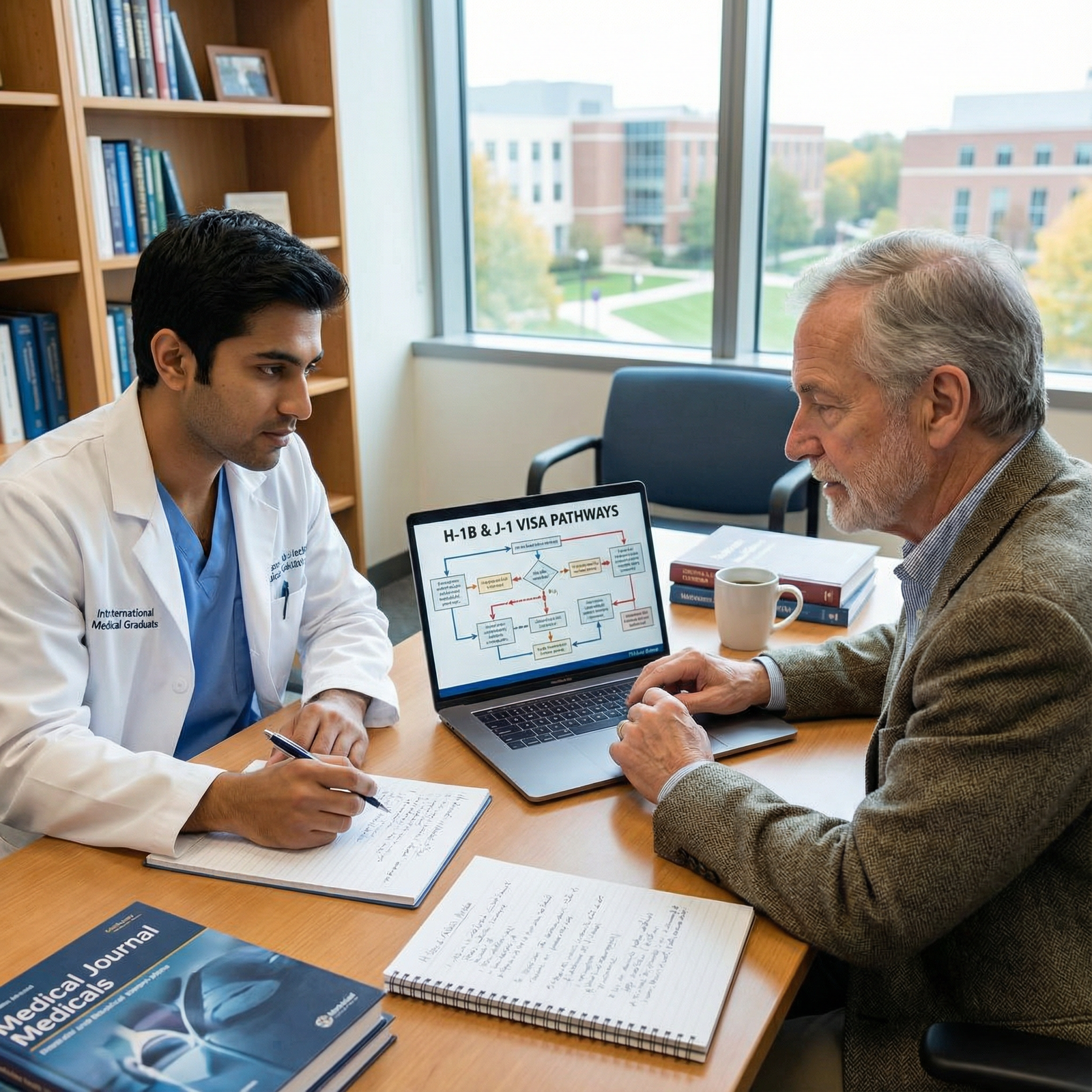
Residency training in the United States is already complex; adding immigration to the mix can feel overwhelming—especially on the Pacific Coast, where programs are competitive and policies can vary by institution. This IMG residency guide focuses on one crucial component: how to navigate visa options for residency in California, Oregon, Washington, and beyond along the Pacific Coast.
Whether you’re still abroad or already in the U.S. on another status (F-1, H-4, etc.), understanding your residency visa pathway early will make your application stronger and your transition smoother.
Understanding the Visa Landscape for IMGs on the Pacific Coast
Before comparing specific visa types, it helps to understand the overall framework that affects an international medical graduate’s options for west coast residency programs.
Core concepts for IMG visa options
You need ECFMG certification
- For both J-1 and H-1B clinical training visas, you must be ECFMG certified (or on track to be certified by the start of training).
- ECFMG is also the sponsor for all J-1 clinical training visas; hospitals do not sponsor J-1s directly.
Your visa must be aligned with “graduate medical education”
- Not all work visas permit direct patient care.
- J-1 (clinical) and H-1B (professional worker) are the two primary pathways for residency/fellowship.
Program policies matter as much as immigration law
- Two programs in the same city may have completely different visa policies.
- Many California residency programs sponsor only J-1, some sponsor both J-1 and H-1B, and a few sponsor no visas at all.
Immigration policy can change
- Rules for J-1 waivers, H-1B adjudication, and premium processing fees evolve.
- Always check the latest information directly from ECFMG, USCIS, and program websites.
West coast dynamics are unique
- High competition, large academic centers, and a high proportion of IMG applicants in some specialties.
- States like California have large underserved areas and J-1 waiver opportunities but also strict employer and licensing rules.
J-1 vs H-1B: Core Residency Visa Pathways for IMGs
The central decision for many international medical graduates is J-1 vs H-1B. Understanding both options is the foundation of effective visa navigation for residency.
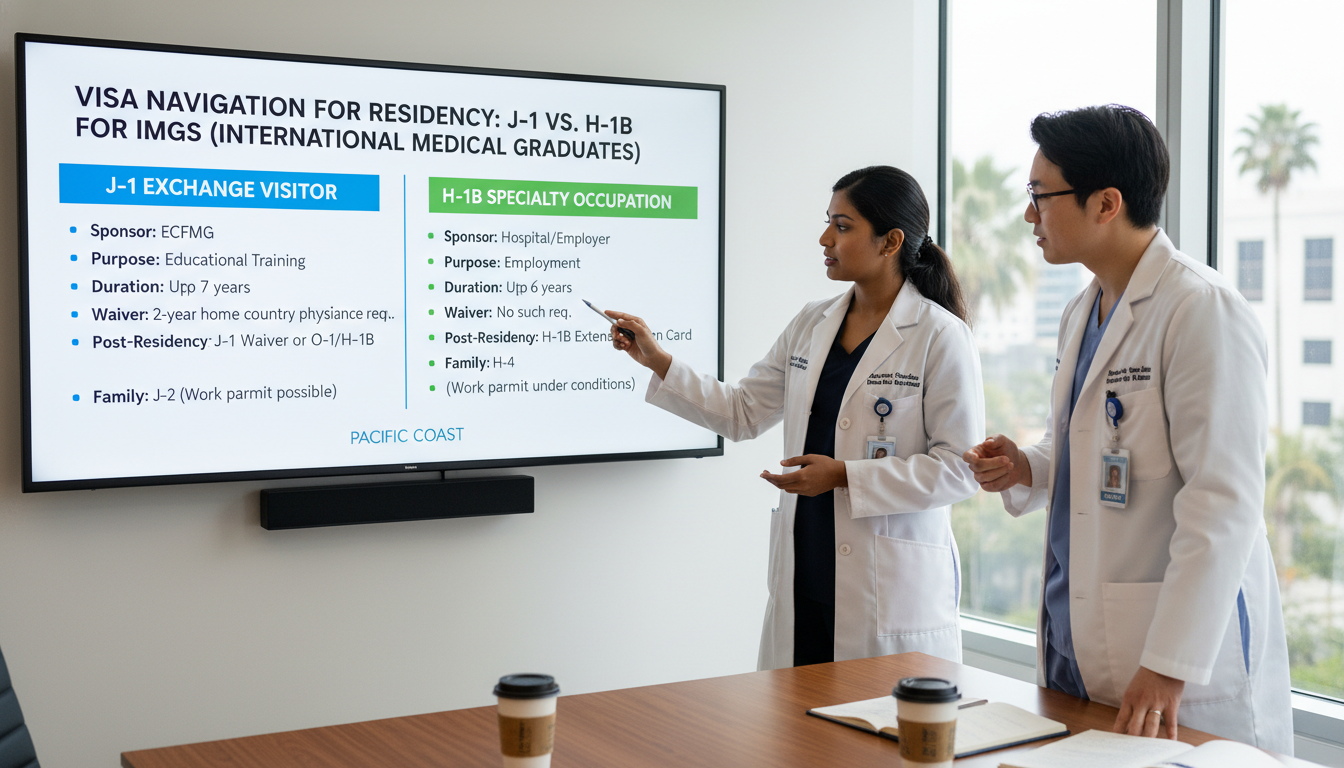
J-1 Clinical Visa (ECFMG-sponsored)
The J-1 “Alien Physician” category is the most common residency visa for IMGs in the U.S.
Key features:
- Sponsor: ECFMG (not the hospital).
- Purpose: Graduate medical education (residency/fellowship).
- Duration: Typically up to 7 years total of clinical training (with yearly extensions).
- Funding: Salary from the residency program is allowed.
- Dependents: J-2 for spouse/children (spouses may apply for employment authorization).
Advantages of J-1 for residency:
Widely accepted:
- Many west coast and California residency programs list “J-1 only” or “J-1 preferred” on their websites.
- Academic programs with large IMG cohorts (internal medicine, pediatrics, family medicine) often default to J-1.
Straightforward for hospitals:
- Programs are familiar with ECFMG processes.
- Less institutional legal overhead than petitioning an H-1B.
Easier timing with Match cycles:
- J-1 sponsorship through ECFMG is a well-defined process keyed to residency start dates (usually July 1).
Critical consideration: the 2-year home residence requirement
J-1 clinical physicians are usually subject to the INA 212(e) requirement:
- After finishing training, you must:
- Return to your home country (or country of last permanent residence) for 2 years, or
- Obtain a J-1 waiver (usually in exchange for serving in a U.S. underserved area).
Without satisfying or waiving this requirement:
- You cannot:
- Change to H-1B or L-1 status in the U.S.
- Obtain an H, L, or immigrant visa at a U.S. consulate.
This requirement is a central issue in visa navigation for residency and long-term career planning, especially for IMGs seeking to stay in the U.S. for practice or further training.
H-1B Visa for Residency (Professional Worker)
The H-1B is a temporary professional worker visa used for many professions, including physicians. Some west coast residency programs sponsor H-1B for residency or fellowship, but significantly fewer than sponsor J-1.
Key features:
- Sponsor: Individual residency program (employer) files a petition to USCIS.
- Requirements for residency:
- ECFMG certification.
- USMLE Step 3 passed before petition filing (critical requirement).
- Appropriate state medical license/permit (varies by state).
- Duration: Up to 6 years total in H-1B status (including any previous H-1B employment).
- Dependents: H-4 status for spouse/children (spouses may have work authorization in limited situations, e.g., if you later have an approved I-140).
Advantages of H-1B for residency:
- No 2-year home residence requirement.
- Generally more straightforward to:
- Transition to attending positions in the U.S.
- Start employment-based permanent residency (green card) processes.
- Many physicians on H-1B move from residency to attending within the same or nearby institution, simplifying transitions.
Limitations and challenges for H-1B:
Not all programs sponsor H-1B:
- On the Pacific Coast, especially in California, many programs explicitly state “H-1B not sponsored.”
- Sponsorship is more common in some university-based or well-resourced academic centers, large health systems, or community programs trying to attract applicants.
USMLE Step 3 timing:
- You must have Step 3 passed before the H-1B petition is filed, which typically needs to be well before your July start date.
- This restricts H-1B residency possibilities for:
- Students close to graduation abroad.
- Current F-1 students in U.S. without time to take Step 3.
Costs and legal workload for the program:
- Programs must pay certain fees and often hire immigration counsel, which deters some from sponsoring H-1B at all.
J-1 vs H-1B: Strategic Comparison for Pacific Coast IMGs
When considering west coast residency, use the following framework:
- If your top priority is to maximize the number of programs you can apply to, and you are open to a J-1 waiver job later:
- Be ready and comfortable with a J-1 path.
- If your long-term goal is to remain in the U.S. without a waiver obligation and you can:
- Pass Step 3 early, and
- Target a smaller list of programs that sponsor H-1B,
then an H-1B strategy may be worth the extra work and narrower application pool.
Pacific Coast Specifics: California, Oregon, and Washington
Program attitudes toward IMG visa options can vary significantly by region. For the Pacific Coast, certain patterns are common and should guide your planning.
California residency programs: what IMGs should know
California is a major target for many IMGs and has some distinctive characteristics:
High competition and IMG ratios:
- Prestigious institutions (UCSF, Stanford, UCLA, UCSD, etc.) are extremely competitive and often favor U.S. grads, especially in competitive specialties.
- Community and county programs (e.g., large safety-net hospitals) may be more IMG-friendly.
Visa policies often lean toward J-1:
- Many California residency programs explicitly list J-1 as the preferred or only visa option.
- If you search for “California residency programs” and review GME pages, you’ll notice repeated patterns:
- “We sponsor J-1 visas through ECFMG.”
- “We do not sponsor H-1B visas for residency training.”
State licensure nuances:
- California has its own Medical Board rules, which programs must follow to sponsor H-1B.
- Some institutions avoid H-1B because of the extra administrative burden.
Post-residency opportunities and J-1 waivers:
- California has both state-conrad 30 waivers and federal waiver programs (e.g., VA, underserved community clinics).
- However, the demand is high, and some specialties (like primary care, psychiatry, pediatrics) may have better waiver options than highly specialized fields.
Practical implications for the IMG residency guide in California:
- If you aim for California residency programs, you should:
- Be fully prepared to train on a J-1 visa.
- Begin researching California J-1 waiver options early if you hope to stay after training.
- Approach H-1B as a bonus rather than the default, unless a target program explicitly states they commonly sponsor it.
Oregon and Washington: Visa Climate Overview
Oregon and Washington share some characteristics as Pacific Northwest neighbors but have their own GME ecosystems.
Washington (e.g., Seattle, Spokane, Yakima, Tri-Cities)
- Major academic centers (e.g., University of Washington) and large systems (Swedish, Providence, MultiCare) host multiple residency programs.
- Some programs may be more willing than California counterparts to sponsor both J-1 and H-1B, particularly in specialties facing workforce shortages (family medicine, internal medicine, psychiatry).
Features to watch:
- J-1 remains standard for most IMGs.
- H-1B sponsorship can exist but is variable:
- Some university programs use H-1B more frequently for fellows.
- Community-based programs in underserved areas may use H-1B to retain physicians long-term.
- Washington offers J-1 waiver opportunities, especially in rural and underserved regions (eastern Washington, smaller cities).
Oregon (e.g., Portland, Eugene, smaller communities)
- Fewer residency positions overall than California or Washington.
- Many programs, particularly university-based, rely heavily on J-1 visas for IMGs.
- Oregon’s rural areas also need physicians, creating potential J-1 waiver roles post-residency.
For both states:
- Check each program’s GME website:
- Look specifically for a “Visa” or “Eligibility” section.
- Note whether they say “J-1 only,” “J-1 and H-1B,” or “No visa sponsorship.”
- Consider long-term practice goals:
- If you want to settle in the Pacific Northwest, understanding state J-1 waiver processes and shortage area maps early will help.
Step-by-Step Visa Navigation Strategy for IMGs Targeting the Pacific Coast
This section provides a practical, chronological framework you can follow from the time you start planning for the Match through the start of residency.
1. Pre-Application Phase (18–24 months before Match)
Clarify your visa priorities early
Ask yourself:
- Am I okay with a J-1 + potential waiver pathway?
- Do I absolutely need H-1B for personal/family/long-term immigration reasons?
- Am I currently in F-1, H-4, H-1B, or another status in the U.S.?
Your honest answers will shape your target list of California residency programs and other Pacific Coast options.
Plan your USMLE timeline strategically
- For J-1 only goals:
- Prioritize Step 1 and Step 2 CK with strong scores.
- Step 3 is not required before residency begins for J-1 sponsorship.
- For possible H-1B:
- Aim to pass Step 3 before December–January of the application year (the earlier, the better).
- Factor in exam seat availability and study time while doing rotations or work.
Research program visa policies systematically
Create a spreadsheet for west coast residency programs with columns like:
- Program name, city, state
- Specialty
- Visa policy (J-1 only / J-1 + H-1B / No sponsorship)
- Notes (e.g., “explicitly requires Step 3 for H-1B,” “IMG friendly,” “California residency programs preference U.S. grads,” etc.)
Use:
- Program websites (GME/FAQ/Eligibility pages).
- FREIDA and AAMC resources.
- Program coordinator emails if information is unclear.
2. Application Season (ERAS/NRMP Timeline)
Align your application narrative with your visa path
In personal statements and interviews:
If open to J-1:
- Emphasize your commitment to serving underserved communities, if true.
- Show awareness of how J-1 physicians often continue into primary care or shortage-area practice, especially relevant for Pacific Coast rural regions.
If strongly hoping for H-1B:
- Quietly target programs known to sponsor H-1B.
- Be prepared to discuss Step 3 status (taken, scheduled, or passed) clearly.
Communicate professionally about visas
- Avoid making the visa the centerpiece of your application—but don’t ignore it completely.
- During interviews, appropriate ways to raise the topic:
- “Could you share your program’s experience with J-1 and H-1B sponsorship for residents?”
- “Do you typically sponsor visas for IMGs, and if so, which categories?”
Take brief notes after each interview; this will be valuable when you build your rank list.
3. Rank List Strategy for West Coast IMGs
After interviews, your rank list should factor in visa realities:
Tier 1 (High priority):
- Programs that:
- You genuinely liked, AND
- Have visa policies that match your needs (e.g., J-1 acceptance or H-1B sponsorship).
- Programs that:
Tier 2 (Acceptable compromises):
- Programs with slightly less preferred location or training environment but clear visa sponsorship.
- Example: A Washington community internal medicine program that sponsors J-1 and possibly H-1B, versus a more prestigious but ambiguous California program.
Tier 3 (Backup options):
- Programs with:
- Less clarity on visas, or
- “J-1 only” if you were hoping for H-1B but are willing to adjust.
- Only rank these if you would actually attend under their visa terms.
- Programs with:
Remember:
- NRMP discourages ranking programs based solely on visa promises without understanding their formal policies.
- Be practical: a California residency program that doesn’t sponsor any visas is effectively not an option if you need sponsorship.

4. Post-Match: From Match Day to Residency Start
Once you match, your residency visa navigation becomes more concrete.
If you matched on a J-1 sponsoring program:
- Confirm ECFMG certification completion timeline.
- Your program’s GME office will initiate the ECFMG J-1 application process.
- You will submit:
- Proof of ECFMG certification (or pathway completion).
- Contract/offer letter.
- Passport, photographs, and other required documentation.
- ECFMG will issue a Form DS-2019, which you use to:
- Schedule a visa interview at a U.S. consulate (if abroad), or
- Apply for a change of status (if already in the U.S., when eligible).
If you matched at an H-1B sponsoring program:
- Immediately confirm Step 3 status with the program:
- They need your Step 3 pass result to proceed with H-1B.
- The employer’s attorney or HR team will:
- File a Labor Condition Application (LCA) with the Department of Labor.
- Prepare and file the H-1B petition with USCIS.
- Premium processing may be used to accelerate decisions, especially when July 1 start is close.
- If you are abroad, you will:
- Attend a consular interview to obtain an H-1B visa stamp.
- Enter the U.S. in H-1B status for the job.
For both visa types, plan ahead for:
- Delays in consular appointments (varies by country and political context).
- Document gathering (certificates, translations, police certificates, etc.).
- Family arrangements (dependents’ visas).
Long-Term Planning: After Residency on the Pacific Coast
Your residency visa choice affects what happens next. Think about post-residency years even while applying for residency.
If you train on a J-1 visa
You must plan for the 2-year home residence rule:
- Option A: Return home for 2 years
- Then you may apply again for H or L status or immigrant visas.
- Option B: Obtain a J-1 waiver through:
- State Conrad 30 programs in California, Oregon, Washington.
- Federal programs like:
- VA (Veterans Affairs),
- Health and Human Services,
- Appalachian Regional Commission (less likely for West Coast but possible for multi-state providers).
On the Pacific Coast, common J-1 waiver settings include:
- Rural or semi-rural primary care clinics.
- Community mental health centers.
- Federally Qualified Health Centers (FQHCs) in underserved urban neighborhoods.
- Hospitals serving shortage areas.
If staying in California is your dream:
- Understand that some of the most desirable metro areas (Bay Area, LA) may have limited waiver positions compared to need.
- Be flexible about geography and practice type in your early attending years.
If you train on an H-1B visa
You avoid the 2-year rule, but there are still considerations:
- You have a 6-year total H-1B limit (including residency and any fellowships/employment).
- Many physicians pursue:
- Employment-based green cards (e.g., EB-2, EB-2 NIW).
- Continued H-1B employment at the same or another institution.
Pacific Coast specifics:
- Large California institutions may have established physician immigration pipelines, guiding you from H-1B residency through attending and permanent residency.
- Smaller hospitals in Washington or Oregon may:
- Sponsor H-1B themselves, or
- Recruit you as a J-1 waiver physician if you later complete a J-1 waiver fellowship elsewhere (varies by path).
Even if you start residency on J-1, you might later pursue H-1B after satisfying/waiving the 2-year requirement, especially if you want to remain long-term on the Pacific Coast.
Practical Tips and Common Pitfalls for IMG Visa Navigation
Practical tips
Document organization:
- Keep a digital folder with:
- All exam scores.
- ECFMG letters.
- Passport pages and previous visas.
- Prior I-20s, DS-2019s, I-797 approvals (if applicable).
- This makes every visa application smoother.
- Keep a digital folder with:
Timely communication with programs:
- If your visa status changes (e.g., marriage, new H-4 status), inform the GME office.
- Respond promptly to any document requests for DS-2019 or H-1B petitions.
Use official resources:
- ECFMG website for J-1 details.
- USCIS for H-1B regulations.
- State health department sites for J-1 waiver overviews.
- Avoid relying solely on social media or anecdotal blogs.
Consider professional legal advice:
- Complex histories (multiple previous U.S. statuses, visa denials, overstay issues) warrant consultation with an immigration attorney.
- Many physicians find one-time consultations valuable for long-range planning.
Common pitfalls to avoid
- Assuming all programs sponsor all visas:
Always verify visa policies before relying on them. - Delaying Step 3 if you hope for H-1B:
Late Step 3 completion closes doors to H-1B-based residency options. - Ignoring the 2-year requirement until the last year of fellowship:
Early planning around J-1 waivers is crucial if you want to stay on the Pacific Coast. - Relying on verbal promises only:
Visa decisions depend on institutional policies and legal review; nothing is guaranteed until official documents are filed/approved.
FAQ: Visa Navigation for IMGs in Pacific Coast Residency Programs
1. Which visa is “better” for an IMG: J-1 or H-1B?
Neither is universally better; it depends on your goals:
- J-1 is more widely available, especially in California residency programs, and easier for many IMGs to access. The trade-off is the 2-year home country requirement or the need for a J-1 waiver job after training.
- H-1B avoids that requirement and can make the transition to long-term U.S. practice easier, but:
- Fewer programs sponsor it,
- You must pass Step 3 early, and
- Programs incur higher costs and administrative burdens.
Most IMGs on the Pacific Coast train on J-1 and then navigate the waiver process or return home for 2 years, depending on career plans.
2. Can I switch from J-1 to H-1B after residency without going home for 2 years?
Generally no, not unless you obtain a J-1 waiver:
- Without fulfilling the 2-year home residence requirement or securing an approved J-1 waiver, you cannot change status in the U.S. to H or L categories or obtain H/L visas abroad.
- The typical pathway for someone wanting H-1B after a J-1 residency is:
- Complete residency and possibly fellowship on J-1,
- Obtain a J-1 waiver position in a qualified underserved area,
- After waiver completion (usually 3 years), transition to other visa/green card options.
3. I’m currently on an F-1 visa in the U.S. Can I go directly into residency on H-1B?
It’s possible but challenging:
- You must:
- Graduate from medical school (U.S. or foreign, with ECFMG certification),
- Pass USMLE Step 3 before the program files H-1B,
- Be accepted by a program that sponsors H-1B for residents.
- Many F-1 IMGs pursue J-1 for residency first because:
- It’s more widely available,
- They may not have Step 3 completed in time.
- If H-1B is essential for you, plan your Step 3 timing and target list accordingly.
4. Do all west coast programs treat IMGs and visas the same way?
No. Policies differ substantially:
- Some California residency programs:
- Accept only J-1, or
- Do not sponsor any visas for residents.
- Some Washington/Oregon programs:
- May sponsor both J-1 and H-1B, especially in primary care or underserved-focused specialties.
- Always:
- Check the most current program website, and
- Confirm during interviews or via the GME office for any unclear details.
By understanding the differences between J-1 vs H-1B, researching Pacific Coast program policies, and planning your exams and documents strategically, you can approach visa navigation for residency as an international medical graduate with clarity and confidence. This preparation will not only increase your chances of matching into a west coast residency but also set you up for a sustainable, well-planned long-term career in the United States.