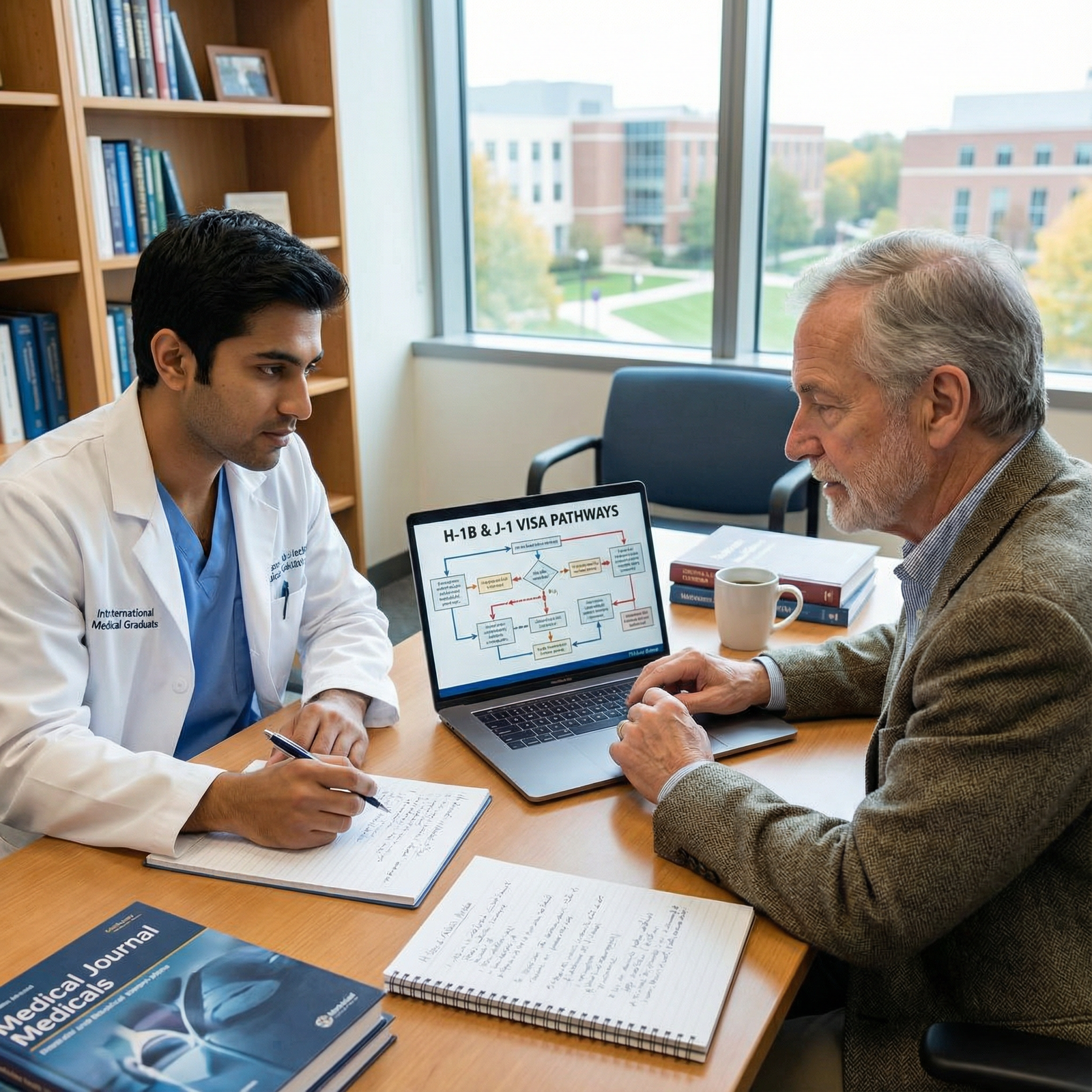
Understanding the Visa Landscape for IMGs in Philadelphia
For an international medical graduate (IMG), securing a residency position in Philadelphia means navigating two complex systems at once: the residency match and the U.S. immigration system. The good news is that Philadelphia is one of the most IMG‑friendly medical hubs in the United States, with large academic centers like the Hospital of the University of Pennsylvania (HUP), Thomas Jefferson University Hospital, Temple University Hospital, Einstein Medical Center, Cooper (across the river in Camden but part of the same job market), and multiple community programs.
This IMG residency guide focuses on what you need to know about visa navigation specifically for Philadelphia residency programs, with special attention to Penn residency programs and other major teaching hospitals in the region.
Below is a structured roadmap to help you:
- Understand core IMG visa options
- Compare J-1 vs H-1B for residency
- Anticipate how Philadelphia programs commonly handle visas
- Build a practical timeline and application strategy
- Prepare for residency and post-residency transitions (waivers, green card paths)
Throughout, remember: visa rules can change. Always verify with official sources (ECFMG, U.S. Department of State, USCIS) and the Graduate Medical Education (GME) office of each program.
Core Visa Options for IMGs Entering Philadelphia Residency
Residency in the U.S. is a full-time paid position, so you need work authorization, not just visitor or student status. For residency, almost all IMGs use one of the following:
- J-1 Exchange Visitor (ECFMG-sponsored)
- H-1B Temporary Worker (cap-exempt, sponsored by the hospital)
- Other statuses (rare but possible): EAD from pending green card, asylum, TPS, etc.
1. J‑1 Physician Visa (ECFMG-Sponsored)
The J-1 visa for physicians is the most common pathway for IMGs in U.S. residency, including in Philadelphia.
Key features:
- Sponsor: ECFMG (Education Commission for Foreign Medical Graduates), not the residency program.
- Purpose: “Graduate medical education or training.”
- Duration: Typically renewable annually, up to 7 years for residency + fellowship (combined), with some extensions for hardship or unusual training paths.
- Funding requirement: Must have adequate funding (usually your residency salary is sufficient).
- Home-residency requirement:
- Subject to the two-year home-country physical presence requirement (INA 212(e)).
- After training, you must either:
- Return to your home country (or country of last permanent residence) for two full years,
- Or obtain a J-1 waiver (e.g., Conrad 30 waiver job, hardship waiver, persecution waiver).
Pros for Philadelphia IMGs:
- Most Philadelphia residency programs and Penn residency programs default to J-1 for IMGs.
- The process is relatively standardized:
- You complete ECFMG forms (e.g., Form DS-2019 request).
- The program provides training contract and program information.
- ECFMG issues the Form DS-2019, which you use for your visa interview.
- Good fit for typical 3-year (IM, Peds) and 4-5-year (Surgery, OB/Gyn) programs, plus many fellowships.
Limitations:
- The two-year home-residency requirement can significantly influence:
- Fellowship options
- Job offers after training
- Permanent residency (green card) timing
- You cannot directly switch from J-1 to H-1B for a typical private job in Philadelphia without addressing the 212(e) requirement.
- Moonlighting and supplemental income may be restricted by ECFMG and program policies.
2. H‑1B Visa for Residency
The H-1B visa is a temporary worker visa used for “specialty occupations,” including physicians in residency programs.
Key features:
- Sponsor: The residency program or hospital (not ECFMG).
- Cap-exempt:
- Most Philadelphia teaching hospitals (e.g., Penn, Jefferson, Temple) are cap-exempt because they are non-profit academic or research institutions.
- That means no lottery and more flexible start dates.
- Initial duration: Up to 3 years, extendable to a total of 6 years in H-1B status (across all employers).
- Requirements:
- USMLE Step 3 often required before filing.
- Must meet Pennsylvania licensing requirements (training license).
- Employer must meet prevailing wage and labor condition filing.
- No automatic home-residency requirement (unlike J-1).
Advantages for IMGs:
- No 2-year home return rule; easier pathway to:
- Apply for a green card (EB-2, EB-3) during training or after.
- Move directly into H-1B employment with a Philadelphia hospital or private group after residency.
- You may have more flexibility to:
- Continue with an H-1B for a fellowship.
- Avoid the complexities of a J-1 waiver job in an underserved area (unless you choose that path).
Limitations / Challenges:
- Not all Philadelphia residency programs sponsor H-1B. Many prefer or restrict to J-1.
- More paperwork and cost for the program:
- Legal fees
- USCIS filing fees
- USMLE Step 3 timing:
- You must generally pass Step 3 early enough for visa processing before July 1.
- This is a critical planning point if you are still outside the U.S.
3. Other Residency Visa or Status Options (Less Common)
Some IMGs in Philadelphia may train under other forms of authorization:
- U.S. permanent residents (green card holders):
- No need for a residency visa; you are treated as a U.S. applicant for immigration purposes.
- Asylees / Refugees / TPS holders:
- Typically work using an Employment Authorization Document (EAD).
- Programs usually accept this, but you must confirm with each GME office.
- Spouses of H-1B (H-4 EAD), L-2, etc.:
- If you have a valid EAD, some programs will not need to sponsor a separate visa.
- Canadian citizens:
- Still require J-1 or H-1B for residency; TN status generally does not apply to residents.
These are not “IMG visa options” in the classic sense, but they can significantly simplify your path if applicable.
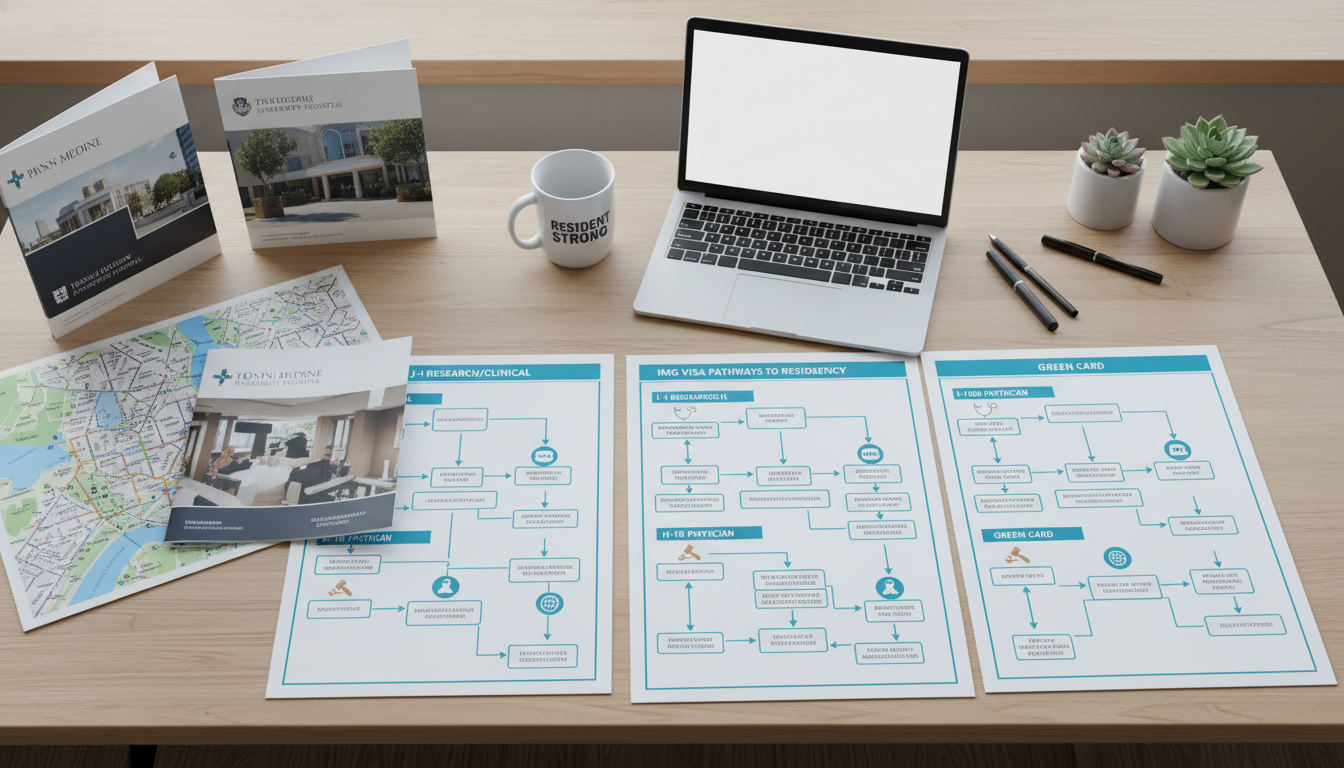
J‑1 vs H‑1B: Strategic Comparison for Philadelphia Residency
Understanding J-1 vs H-1B is central to planning your training and long-term career.
Eligibility and Timing
J-1 (ECFMG)
- USMLE: Requires passing Step 1, Step 2 CK and securing ECFMG certification. Step 3 not required.
- Timeline:
- After you match in March, your program’s GME office and ECFMG coordinate your DS-2019 application.
- You attend a visa interview in the spring/early summer.
H-1B
- USMLE: Must have Step 1, Step 2 CK, and Step 3 passed before petition filing (programs may set their own deadlines; some require proof by Match Day, others by early spring).
- Timeline:
- Employer submits Labor Condition Application (LCA) to the Department of Labor.
- Then files the H-1B petition with USCIS.
- Standard or premium processing; premium can be essential for late Step 3 passers.
Practical advice for IMGs targeting Philadelphia:
- If you strongly prefer H-1B, aim to:
- Pass Step 3 at least 4–6 months before July 1 of your PGY-1 year.
- Inform programs in your application and interview that you have Step 3 and are interested in H-1B.
- If Step 3 timing is uncertain, keep your mindset flexible—you may need to accept a J-1 even if you initially prefer H-1B.
Institutional Policies in Philadelphia
Different Philadelphia programs have different policies:
- Some only sponsor J-1:
- Common in many community and some academic programs;
- Simpler and standardized.
- Some sponsor both J-1 and H-1B, but with conditions:
- H-1B only for competitive specialties.
- H-1B only if Step 3 is passed and enough time remains for processing.
- H-1B possibly limited to certain departments (e.g., Internal Medicine but not Preliminary Surgery).
- Some Penn residency programs and other major academic centers:
- Are technically capable of sponsoring H-1B but do so selectively.
- Preference may still be for J-1 due to administrative burden.
Action step:
For every program you apply to in Philadelphia:
- Check the website under “International Medical Graduate” or “Visa sponsorship.”
- If it is unclear, email the program coordinator or GME office with a concise question:
- Example: “As an ECFMG-certified IMG, I’d like to ask whether your residency program sponsors J-1 visas, H-1B visas, or both for incoming residents.”
Training Duration and Future Flexibility
J-1:
- Maximum of 7 years for all training combined (residency + fellowship).
- If you plan:
- 3-year Internal Medicine + 3-year Cardiology fellowship, this is usually fine.
- Very long paths (Surgery + multiple fellowships) might require special consideration.
H-1B:
- Maximum 6 years total in H-1B status.
- However:
- If you start a 3-year residency and then a 3-year fellowship on H-1B, you can hit the 6-year limit.
- Ongoing green card process (I-140 approved) can allow H-1B extensions beyond 6 years.
Strategic implication:
- If you want long training plus possible academic employment at Penn or another Philadelphia institution, H-1B + early green card sponsorship can be a powerful combination.
Philadelphia-Specific Considerations for IMG Visas
Philadelphia’s healthcare ecosystem has distinctive features that matter for visa planning.
Major Academic Centers and Their Visa Culture
While policies can change, broad trends include:
University of Pennsylvania / Penn Medicine:
- Large, prestigious Penn residency programs in multiple specialties.
- Typically J-1 friendly.
- H-1B sponsorship possible at some departments but not universal; highly competitive.
Thomas Jefferson University Hospital:
- Long history of training IMGs.
- Typically sponsors J-1; H-1B sponsorship is case-dependent and specialty-dependent.
Temple University Hospital / Einstein / Cooper / Main Line and others:
- Many have robust IMG representation.
- Most sponsor J-1; some sponsor H-1B selectively. You must check each program individually.
Practical takeaway:
If you are open to J-1, you will have a broader pool of possible Philadelphia residency options. If you insist on H-1B only, your program list may shrink notably.
State Licensing and Visa Documentation in Pennsylvania
For both visa types, you will also need:
- Pennsylvania training license (graduate medical training license):
- Usually handled by your program’s GME office.
- Requires verified medical school transcripts, ECFMG certificate, and background check.
- Visa-related documents:
- For J-1: DS-2019 issued by ECFMG, SEVIS fee payment receipt, DS-160 form, appointment confirmation.
- For H-1B: USCIS approval notice (I-797), your petition copy, and supporting documents at the visa interview.

Step-by-Step Visa Navigation Timeline for IMGs
To make visa navigation less overwhelming, align your actions with the standard residency application and Match timeline.
1. 12–18 Months Before Match: Strategic Planning
- Decide your priorities:
- Are you open to J-1, or do you prefer H-1B?
- What are your long-term goals (stay in U.S., return home, academia, private practice)?
- Begin preparing USMLE Step 3 if aiming for H-1B.
- Research IMG-friendly Philadelphia programs:
- Check their visa policies.
- Look at past residents’ profiles (LinkedIn, program website) to see if IMGs with J-1 or H-1B matched.
Example:
You are an IMG from India, interested in Internal Medicine in Philadelphia, and you hope to stay in the U.S. long-term. You plan to take Step 3 early, so you shortlist programs that have historically sponsored H-1B. But you also apply widely to J-1 programs to maximize your match chances.
2. ERAS Season (September–January): Application and Interviews
- ERAS Application:
- In your CV or personal statement, you can subtly signal flexibility:
- “I am ECFMG-certified and currently in valid F-1/OPT status, open to J-1 or H-1B sponsorship.”
- In your CV or personal statement, you can subtly signal flexibility:
- During interviews:
- Ask visa questions tactfully near the end of the conversation or with the coordinator:
- “Could you please share your program’s policy regarding J-1 vs H-1B sponsorship for IMGs?”
- Take notes—this will guide ranking decisions and later visa planning.
- Ask visa questions tactfully near the end of the conversation or with the coordinator:
3. Post-Match (March–May): Visa Processing Preparation
Once you match in Philadelphia:
Contact your program’s GME office quickly:
- Confirm your visa classification (J-1 or H-1B).
- Ask for a list of documents and deadlines.
For J-1 (ECFMG):
- Complete online application forms via ECFMG OASIS or designated portal.
- Provide:
- Training contract/offer letter
- Proof of ECFMG certificate
- Proof of funding (your contract is usually enough)
- Passport copies, photographs
- ECFMG issues the DS-2019, and you schedule your consular interview.
For H-1B:
- Share Step 3 score report and all documents requested by GME and legal office.
- Ensure your passport is valid for the duration of the training year.
- Discuss premium vs. regular processing (if timelines are tight, premium may be needed).
4. Visa Interview and Entry to the U.S.
J-1:
- Attend the visa interview with:
- DS-2019
- DS-160 confirmation
- SEVIS fee receipt
- Appointment confirmation
- Financial documents, ECFMG certificate, and residency contract.
- J-1 entry is typically allowed up to 30 days before your program start date.
H-1B:
- Attend the visa interview with:
- I-797 approval notice
- H-1B petition copy
- Job offer/contract
- Credentials and licensing documentation.
- Entry is usually allowed up to 10 days before the start date.
Pro tip:
Arrive in Philadelphia at least 1–2 weeks before orientation to:
- Complete hospital HR and GME onboarding.
- Finish I-9 work authorization verification.
- Settle housing, banking, and transportation.
Post-Residency Planning: Waivers, Fellowships, and Long-Term Stay
Your residency visa choice affects your options after training, especially if you want to remain in Philadelphia or elsewhere in the U.S.
J-1 Waiver Options
If you train on a J-1, you are typically subject to the two-year home-country residence requirement. Common ways to avoid leaving the U.S. for two years include:
Conrad 30 Waiver Programs:
- Each U.S. state can sponsor up to 30 J-1 physicians per year, usually for underserved areas.
- Pennsylvania and New Jersey both participate.
- You must work full-time in a designated shortage area for 3 years on H-1B status.
- After this obligation, you can pursue a green card or other employment.
Interested Government Agency (IGA) waivers:
- Certain federal agencies (e.g., VA, HHS) can sponsor waivers for specific needs.
Hardship / Persecution waivers:
- If returning to your home country would cause extreme hardship to your U.S. citizen or permanent resident spouse/child, or expose you to persecution.
How this plays out for Philadelphia-based IMGs:
- You might complete residency at a Philadelphia tertiary center on J-1, then:
- Take a waiver job in a rural or underserved town in Pennsylvania, New Jersey, or another state.
- After completing your 3-year waiver obligation, you can return to a Philadelphia position on H-1B or as a permanent resident.
H-1B and Green Card Pathways
If you train on H-1B:
- You are not subject to the J-1 2-year rule.
- A Philadelphia hospital or practice may:
- Continue your H-1B for attending employment or fellowship.
- Sponsor your employment-based green card (EB-2 or EB-3).
Typical sequence:
- H-1B for residency.
- H-1B for fellowship or attending job.
- Employer files PERM (if needed) and I-140.
- Adjustment of Status (I-485) filed when your priority date becomes current.
This route is attractive if your long-term goal is to live and work in the U.S., possibly remaining in the Philadelphia medical community (e.g., at Penn, Jefferson, or local private groups).
Practical Tips and Common Pitfalls for IMGs
1. Be Honest and Consistent
- Never misrepresent your prior visa history or immigration issues.
- Inconsistencies between your ERAS application, DS-160, and visa interview answers can cause problems.
2. Keep All Documents Organized
Create digital folders for:
- Passport and previous visas
- USMLE scores and ECFMG certificate
- Medical diploma and transcripts
- Residency offer letter and contracts
- Visa-related forms (DS-2019, I-797, DS-160 confirmations, I-94 printouts)
This will make GME onboarding and any future applications smoother.
3. Monitor Status and Expiration Dates
- Always track:
- Visa expiration.
- DS-2019 or I-797 validity dates.
- I-94 records after every U.S. entry (download from CBP website).
- If you change rotations (e.g., away electives in another state or site), confirm with your GME office that it is allowed under your status.
4. Seek Professional Immigration Advice When Needed
- If your situation is complex (prior overstays, multiple status changes, inadmissibility issues, or long-term green card strategy), consider consulting a qualified U.S. immigration attorney.
- Many large Philadelphia institutions have in-house or contracted immigration counsel; ask your GME office how to access that support.
FAQ: Visa Navigation for IMGs in Philadelphia Residency
1. Which visa is better for an IMG – J-1 or H-1B?
“Better” depends on your goals:
- J-1 is simpler to obtain, widely supported by Philadelphia residency programs, and does not require Step 3. However, it imposes the two-year home-country requirement (unless you get a waiver) and can complicate long-term U.S. plans.
- H-1B offers more flexibility for staying in the U.S., pursuing a green card, and avoiding the 2-year return rule. But not all programs sponsor it, it requires USMLE Step 3, and is administratively more complex.
If your top priority is maximizing match chances, J-1 flexibility helps. If your priority is long-term U.S. practice, H-1B (when available) is often more advantageous.
2. Do Penn residency programs in Philadelphia sponsor H-1B for IMGs?
Many Penn residency programs can sponsor H-1B because Penn is a cap-exempt academic institution, but that does not mean every department routinely does so. Policies vary by specialty, year, and institutional priorities. Some Penn programs may:
- Default to J-1 and consider H-1B only in exceptional cases.
- Require Step 3 at the time of ranking or soon after the Match for H-1B consideration.
Always verify directly with the specific program coordinator or GME office for the most current policy.
3. Can I switch from J-1 to H-1B during or after residency in Philadelphia?
Switching from J-1 to H-1B is possible, but only if you first resolve the 212(e) two-year home-country requirement:
- Either:
- Complete 2 full years physically in your home country, or
- Obtain a J-1 waiver (e.g., Conrad 30 waiver job, hardship, persecution waiver).
Once the requirement is satisfied or waived, you can change to H-1B status, often to work in a waiver job first, and later to other employers. Direct “switching” without addressing 212(e) is not allowed.
4. I am currently on F-1 (or another status) in the U.S. How does that affect my residency visa?
Many IMGs are in the U.S. on F-1 (student) or another status when applying for residency:
- You still need a residency visa (J-1 or H-1B) to start training, because F-1 does not authorize full-time residency work.
- Having U.S. status may make some logistics easier (e.g., domestic travel for interviews), but it does not itself replace the need for proper work authorization.
- Your program’s GME office and ECFMG/USCIS will guide the change-of-status or consular processing steps depending on your situation and timing.
Navigating residency visa choices as an international medical graduate in Philadelphia is complex, but with early planning, careful research, and close coordination with programs and ECFMG, you can manage it successfully. Understanding your IMG visa options, especially the trade-offs of J-1 vs H-1B, will empower you to make decisions that align with both your training goals and your long-term career in the United States.