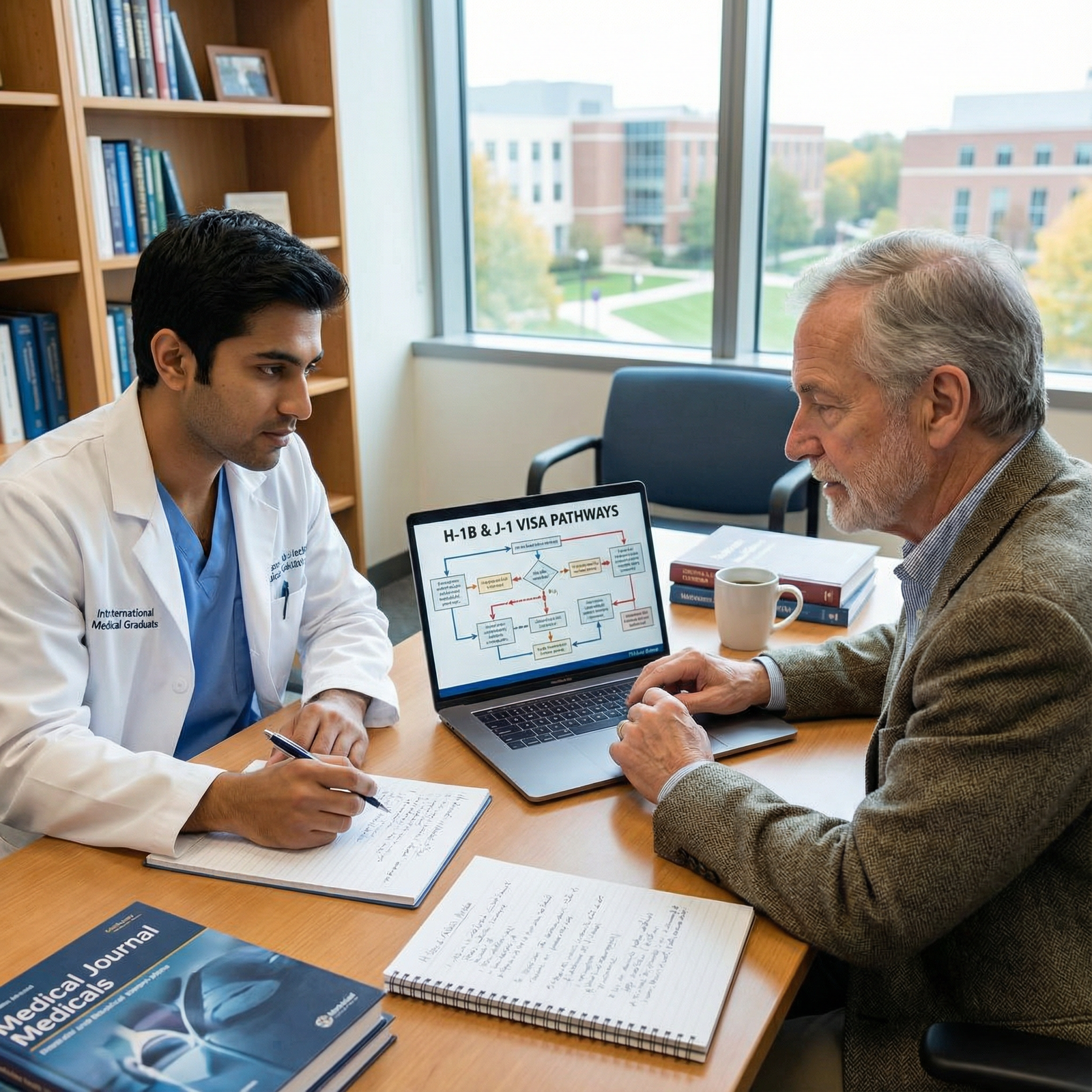
International medical graduates (IMGs) entering Physical Medicine & Rehabilitation (PM&R) face a dual challenge: mastering the physiatry match while successfully navigating U.S. immigration rules. Visa choices influence where you can apply, how programs view your file, what you can do after residency, and ultimately your long‑term career in the United States.
This IMG residency guide focuses specifically on visa navigation for PM&R. It explains your main IMG visa options, compares J-1 vs H-1B in depth, highlights PM&R‑specific realities, and offers a step‑by‑step strategy to integrate visa planning into your physiatry match preparation.
Understanding the Big Picture: How Visas Intersect with the Physiatry Match
Before diving into J-1 vs H-1B details, it’s important to understand how immigration status fits into your overall PM&R residency strategy.
The 3 Core Questions Every IMG Must Answer
- What visa will I use for residency training?
- This affects where you can apply and how PDs (program directors) view your application.
- How will this visa shape my options after residency?
- Fellowship, practice location, academic vs private practice, green card strategies.
- What is my long-term U.S. plan?
- Stay permanently? Return home? Work in multiple countries? Visa pathways differ.
For PM&R, these questions are especially important because:
- Many jobs are in suburban or rural rehabilitation facilities that may qualify for waiver or underserved programs.
- PM&R often involves a fellowship year (e.g., Pain, Sports, SCI, Brain Injury), which may require visa extensions or separate sponsorship.
- Some PM&R residents plan careers in academics or research, which can fit well with certain immigration pathways.
Core Visa Options for PM&R Residency: J-1 vs H-1B and Others
1. J-1 Exchange Visitor (ECFMG-Sponsored) – The Default for Most IMGs
The J-1 visa for physicians is the most common residency visa for international medical graduates. It is sponsored by ECFMG (Educational Commission for Foreign Medical Graduates), not directly by the residency program.
Key features:
- Purpose: Graduate medical education or training (residency/fellowship).
- Sponsorship: ECFMG, with program cooperation.
- Duration: Typically the length of residency (and fellowship if approved), up to 7 years in total (with some exceptions).
- Two-year home residency requirement (212(e)):
After J-1 training, you must either:- Return to your home country (or last country of residence) for 2 years, or
- Obtain a J-1 waiver (e.g., Conrad 30, VA, federal programs).
Pros for PM&R IMGs:
- Widely accepted: A large majority of PM&R programs that take IMGs sponsor or accept J-1.
- Simple for programs: Less institutional burden than H-1B, so more programs are open to it.
- Predictable process: ECFMG has a standardized, well-defined pathway.
Cons:
- 2-year home residency requirement (without a waiver).
- Waiver jobs may limit where you practice initially (often rural or underserved).
- You cannot moonlight in non-training positions; activities must align with training.
2. H-1B Temporary Worker – Less Common but Valuable for Some
The H-1B visa is a work visa for “specialty occupations” requiring at least a bachelor’s degree in a specific field. In residency, it is sponsored by the training institution (hospital/university), not by ECFMG.
Key features:
- Purpose: Employment in a specialty role (resident physician qualifies).
- Sponsorship: Program/hospital directly; more paperwork and legal involvement.
- Duration: Up to 6 years (often granted in 3-year increments).
- No automatic 2-year home requirement.
- Easier transitions to other H-1B jobs or permanent residency in many cases.
Pros for PM&R IMGs:
- No J-1 2-year return requirement.
- May simplify transition to fellowship (if the fellowship institution also sponsors H-1B) and long-term U.S. practice.
- Often viewed as more “immigration-stable” for those planning a U.S. career.
Cons:
- Not all PM&R programs offer H-1B; some explicitly accept only J-1.
- Requires passing all USMLE Steps (including Step 3) before filing the petition in most states.
- Cap issues can arise if the sponsoring institution is not “cap-exempt”; most academic centers are exempt, but not all hospitals are.
3. Other Statuses: Rare but Worth Knowing
- Green card / Permanent Resident:
If you already have a green card, you apply as a U.S. applicant; no residency visa issues, but you must list your citizenship/permanent residency correctly in ERAS. - EADs (e.g., F-1 OPT, J-2, H-4):
Some IMGs have Employment Authorization Documents through spouses or specific programs. These can complicate residency timelines and may or may not be sufficient for full four-year training. - O-1 (extraordinary ability):
Rare in residency; sometimes used in fellowship or attending roles for highly accomplished physician-scientists.
Most IMGs targeting PM&R will realistically choose between J-1 vs H-1B. This is the central decision in IMG visa options.
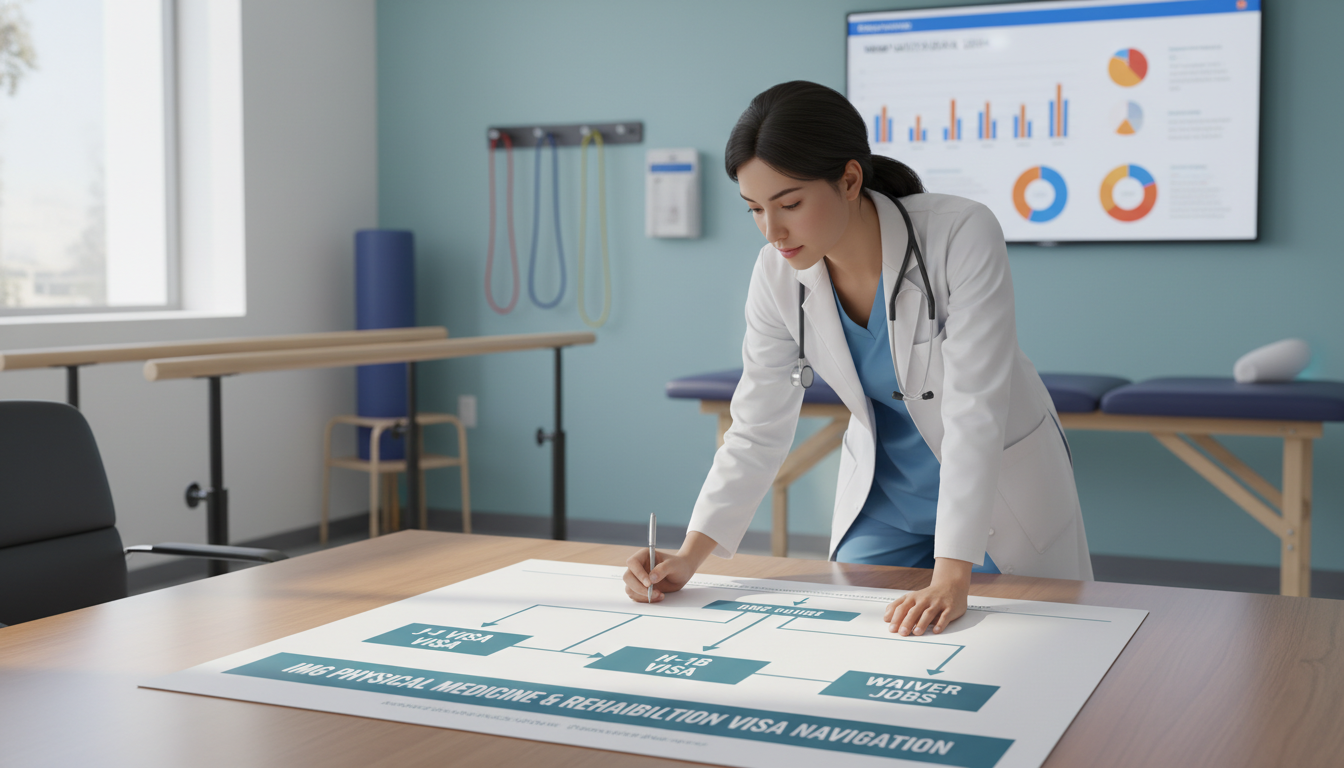
J-1 vs H-1B for PM&R: Detailed Comparison for Physiatry Applicants
Eligibility and Timing
J-1 (ECFMG):
- Requires:
- Valid ECFMG certification.
- Confirmed residency (or fellowship) position in an ACGME-accredited program.
- Proof of adequate financial support.
- Valid home country ties and intent to return (formal non-immigrant intent).
- USMLE Step 3 not required for the visa.
H-1B:
- Most programs require:
- USMLE Step 1, Step 2 CK, and Step 3 passed before filing petition.
- Unrestricted state medical training license or eligibility.
- Some states require full licensure before H-1B approval for residents, which may be hard to achieve pre-residency.
Practical takeaway for PM&R IMGs:
- If you aim for H-1B, finish Step 3 early (ideally before September ERAS submission or at least before rank lists are due).
- If Step 3 is not feasible in time, be open to J-1 and plan strategically for waiver jobs after residency.
Program Preferences in PM&R
Every program has its own visa policy. Common patterns:
- Some PM&R programs: “J-1 only”
- Some: “J-1 or H-1B, but H-1B on a case-by-case basis”
- A smaller minority: “H-1B only” (less common in PM&R than in some other specialties)
- Some community PM&R programs: Do not sponsor visas at all
As an IMG residency guide rule of thumb:
- Academic PM&R programs connected to large universities often:
- Are cap-exempt for H-1B,
- Have established J-1 sponsorship,
- May be more flexible but also more competitive.
- Community-based programs may:
- Prefer J-1 due to simpler administration,
- Be more limited in H-1B experience or legal support.
Action step:
Before applying, check each program’s website (or email the coordinator) about:
- Whether they sponsor J-1, H-1B, both, or none
- If H-1B is sponsored:
- Do they require Step 3 by the time of application or by rank list deadline?
- How many current residents are on H-1B?
Impact on Fellowship and Long-Term Plans in Physiatry
PM&R offers many fellowships:
- Pain Medicine
- Sports Medicine
- Spinal Cord Injury (SCI)
- Brain Injury/Neurorehabilitation
- Pediatric Rehabilitation
- Neuromuscular Medicine, etc.
Under J-1:
- You can usually continue to fellowship as long as your total J-1 clinical training time does not exceed the allowed limit.
- Fellowship requires additional DS-2019 issuance by ECFMG.
- After all training, you will face the 2-year home requirement unless you:
- Complete a J-1 waiver job, or
- Qualify for a rare exception (e.g., specific hardship or persecution waivers).
Under H-1B:
- Fellowship may require:
- H-1B transfer or new petition by the fellowship institution.
- No automatic 2-year return rule.
- Easier to transition to employment and permanent residency in many cases, especially in:
- Academic PM&R (research or teaching focus),
- Specialized rehab centers,
- Private groups willing to sponsor green cards.
Lifestyle and Working Limitations
J-1:
- Restricted to the program and site(s) listed on the DS-2019.
- Moonlighting:
- Usually not permitted unless considered part of the training and explicitly approved by ECFMG and your program.
- Any significant changes in location, duties or funding often require ECFMG notification and updated paperwork.
H-1B:
- Employment is limited to the employer and location in the H-1B petition.
- Some programs allow internal moonlighting if it is compatible with visa rules and licensure.
- Changes in employer (e.g., job after residency) require an H-1B transfer.
Summary Table: J-1 vs H-1B for PM&R IMGs
| Factor | J-1 (ECFMG) | H-1B (Employer-Sponsored) |
|---|---|---|
| Most common for IMGs? | Yes | Less common in PM&R |
| Sponsor | ECFMG | Hospital/university |
| USMLE Step 3 required? | No | Typically Yes (pre-petition) |
| 2-year home residency requirement? | Yes (unless waiver) | No |
| Max duration for training | Usually up to 7 years total | 6 years total in H-1B status |
| Fellowship flexibility | Possible within time limit & ECFMG approval | Possible if fellowship will sponsor H-1B |
| Post-residency options | Waiver job, then H-1B/green card paths | Direct transition to H-1B job/green card |
| Program administrative burden | Lower (ECFMG handles many steps) | Higher (legal fees, HR involvement) |
Strategic Planning: Matching Your Visa Approach to Your Career Goals
To create an intentional PM&R visa strategy, start from your end goals, then work backward.
Step 1: Clarify Your Long-Term Vision
Ask yourself:
- Do I intend to live and practice long-term in the U.S.?
- Am I open to working in underserved or rural areas for a few years after training?
- Am I interested in academic PM&R, research, or leadership roles?
- How certain am I that I want the U.S. to be my primary base vs working internationally?
If your strong priority is long-term U.S. practice:
- H-1B can simplify the path, but is more competitive and logistically demanding.
- J-1 remains viable if you are open to a waiver job (many PM&R jobs qualify).
If you’re more flexible geographically:
- J-1 with a waiver job can be an excellent route; you gain U.S. training, contribute in high-need areas, and can still grow a strong career.
Step 2: Map Visa Strategy to Application List
When building your ERAS list for PM&R:
Categorize programs by visa type:
- J-1 only
- J-1 or H-1B
- H-1B only (rare)
- No visa sponsorship
Decide where you sit on the spectrum:
- Visa-flexible strategy: Apply broadly to both J-1 and H-1B programs to maximize match chances.
- H-1B-focused strategy: Target programs offering H-1B, but recognize you may need more applications and stronger credentials, and Step 3 completed.
Consider regional labor markets:
- States with large academic centers and teaching hospitals (e.g., Northeast, Midwest, large Texas systems) may have more H-1B experience.
- States with high underserved need may be ideal for future J-1 waiver jobs (e.g., many parts of the South, Midwest, rural West).
Step 3: Align Exam Timeline with Visa Strategy
- If considering H-1B, schedule USMLE Step 3 early:
- During a research year in the U.S., or
- Soon after finishing Step 2 CK, ideally 6–12 months before residency start.
- If you prioritize J-1, Step 3 timing is less critical pre-match, but earlier completion is still helpful for:
- Faster licensure post-residency
- Future H-1B transitions (for waiver jobs or fellowships)
Step 4: Understand the Post-Residency Path Under Each Visa
If you train on a J-1:
- Plan ahead for a J-1 waiver job:
- Conrad 30 Waiver (state-level J-1 waiver programs),
- Federal waiver programs (e.g., VA, HHS, DoD).
- PM&R is often needed in:
- Rural hospitals,
- Veterans Affairs Medical Centers,
- Regional rehab centers that struggle to recruit.
- Many of these positions qualify for J-1 waivers, and some are willing to sponsor H-1B and green cards later.
If you train on H-1B:
- After residency/fellowship:
- You may continue in H-1B with the same or new employer (if cap-exempt or with an available cap slot).
- You can simultaneously start an employment-based green card process with your employer’s support.
- Academic PM&R jobs (university-affiliated rehab hospitals) often:
- Are cap-exempt,
- Have established immigration teams familiar with H-1B/EB-2/EB-1 processes.
Practical Tips for Visa Navigation During the Physiatry Match
1. Use ERAS Wisely: Signaling Your Visa Status Clearly
On ERAS, you’ll indicate:
- Citizenship,
- Current immigration status (if in the U.S.),
- Need for visa sponsorship.
Best practices:
- Be consistent across ERAS, personal statement, and CV.
- If you have Step 3 and are open to H-1B, you can mention briefly in your personal statement or CV summary:
“USMLE Step 3 passed; eligible for H-1B sponsorship if available.”
- If open to J-1 and waiver jobs:
- You need not emphasize this, but showing interest in underserved populations, rural health, or veterans is consistent with future waiver paths and aligns well with PM&R’s holistic, patient-centered ethos.
2. Communicating with Programs
Many IMGs hesitate to ask about visa policies, but clarity is essential.
When and how to ask:
- Before applying:
- Check program websites carefully; some have a “For IMGs” or “FAQ” section.
- If unclear, email the program coordinator, not the PD directly.
- Sample coordinator email:
“Dear [Name],
I am an international medical graduate interested in your PM&R residency program. Could you please confirm whether your program sponsors J-1 and/or H-1B visas for residents? Additionally, is USMLE Step 3 required by the time of application or by the time of ranking for H-1B sponsorship?
Thank you for your time,
[Your Name]”
During interviews:
- If not addressed, it’s appropriate to ask:
“Could you share how your program typically supports visa sponsorship for international graduates?”
3. Managing Timeline Pressures
Residency visa and physiatry match timelines overlap:
- September–February (Application & Interviews):
- Clarify program visa policies.
- Plan for Step 3 if needed.
- March (Match Day):
- Once matched, work closely with:
- GME office,
- ECFMG (for J-1),
- Institution’s immigration office (for H-1B).
- Once matched, work closely with:
- April–June:
- Submit required documents:
- ECFMG sponsorship forms for J-1,
- H-1B petition documents (as requested).
- Monitor DS-2019 or I-797 notice issuance.
- Submit required documents:
- June–July:
- Visa interview at U.S. consulate (if outside U.S.).
- Entry to the U.S. and start of orientation.
4. Common Pitfalls and How to Avoid Them
- Assuming every program sponsors your preferred visa:
- Always verify; many PM&R programs are J-1 only.
- Underestimating Step 3 timing:
- If you plan H-1B, treat Step 3 as a critical milestone, not an optional exam.
- Ignoring the 2-year rule (J-1):
- Know that it exists from day one; shape your expectations and career planning accordingly.
- Waiting too long to plan for waiver or post-residency jobs:
- Start networking and researching waiver-friendly PM&R employers during PGY-2/PGY-3, not in your final months of PGY-4.
PM&R-Specific Considerations for International Medical Graduates
The Nature of Physiatry Practice and Visa Strategy
PM&R integrates:
- Inpatient rehabilitation (stroke, SCI, TBI),
- Outpatient musculoskeletal and pain,
- EMG, spasticity management, procedures,
- Interdisciplinary team leadership.
This creates favorable elements for IMGs navigating visas:
Demand in underserved areas:
Many smaller communities struggle to recruit physiatrists, especially for:- Inpatient rehab units,
- Skilled nursing facility consults,
- VA hospitals. These settings are often J-1 waiver-friendly and open to visa sponsorship.
Flexible career paths:
- Hospital-employed,
- Academic affiliations,
- Large private groups. Multiple employer types can sponsor H-1B and green cards.
Opportunities for research/academics:
- Especially relevant if you aim for an academic PM&R career and potentially O-1 or EB-1 visas in the distant future.
Example Scenarios: Putting It All Together
Scenario 1: IMG on J-1 with academic interests
- Residency: J-1 in a large academic PM&R program.
- Fellowship: Brain Injury fellowship, still on J-1 (within 7-year limit).
- Post-training: J-1 waiver job at a VA medical center in a mid-sized city.
- Long-term: VA employer sponsors H-1B and then EB-2 green card; later move to academic PM&R with research.
Scenario 2: IMG on H-1B aiming for pain fellowship
- Pre-residency: Passes Step 3 while on an F-1 research program.
- Residency: H-1B at a university-based PM&R program (cap-exempt).
- Fellowship: Transfers H-1B to ACGME Pain Medicine program at same or another cap-exempt institution.
- After fellowship: H-1B at pain practice or academic center; starts EB-2 green card process.
Scenario 3: IMG flexible with geography, focused on practicing in the U.S.
- Residency: J-1 at a community PM&R program (J-1 only).
- Fellowship: Sports Medicine fellowship on J-1.
- Post-training: J-1 waiver-contracted job in a rural rehab hospital or multi-specialty group; 3-year service.
- Long-term: Transitions to preferred city after green card obtained.
Each path is viable; your choice of residency visa is only one component of a larger multi-year strategy.
Frequently Asked Questions (FAQ)
1. Is it harder for an international medical graduate to match PM&R on H-1B compared to J-1?
Yes, generally. Fewer PM&R programs sponsor H-1B, and those that do often have additional requirements (e.g., Step 3, stronger academic profile). You’ll have a smaller target list, so matching may be more competitive than if you accept J-1. However, if your application is strong and you plan meticulously (especially with Step 3), H-1B remains achievable.
2. If I start residency on J-1, can I switch to H-1B during residency?
Sometimes, but it’s complex and not guaranteed. Once you are subject to the J-1 2-year home residency requirement, changing to H-1B inside the U.S. is usually not permitted without first fulfilling or waiving that requirement. Some narrow exceptions exist, but most residents complete all training on J-1 and then move to H-1B after obtaining a J-1 waiver and leaving J-1 status. Always discuss with an immigration lawyer before attempting such a change.
3. Do PM&R fellowship programs sponsor their own visas, or can I reuse my residency visa?
- For J-1, your sponsorship continues through ECFMG; the fellowship program doesn’t “sponsor” a new visa but must support your continued ECFMG-sponsorship and training.
- For H-1B, the fellowship institution must be willing and eligible to file a new H-1B petition (transfer) or extension. Many academic fellowship programs are familiar with this; smaller or private programs may be less experienced.
4. If I’m undecided between J-1 vs H-1B, what is the safest approach during the application season?
Keep your options open:
- Take Step 3 as early as reasonable so H-1B remains possible.
- Apply to a broad mix of programs that sponsor J-1 and/or H-1B.
- Clearly state in your materials that you are eligible for either J-1 or H-1B if that’s true. After interviews, you can refine your ranking based on:
- Program quality and fit,
- Visa sponsorship clarity,
- Long-term geographic and career goals.
Visa navigation is not separate from your PM&R journey; it is woven into every stage of your training and career. By understanding your IMG visa options, thinking strategically about J-1 vs H-1B, and aligning them with your physiatry match strategy and long-term goals, you can build a realistic, sustainable path to practicing Physical Medicine & Rehabilitation in the United States.