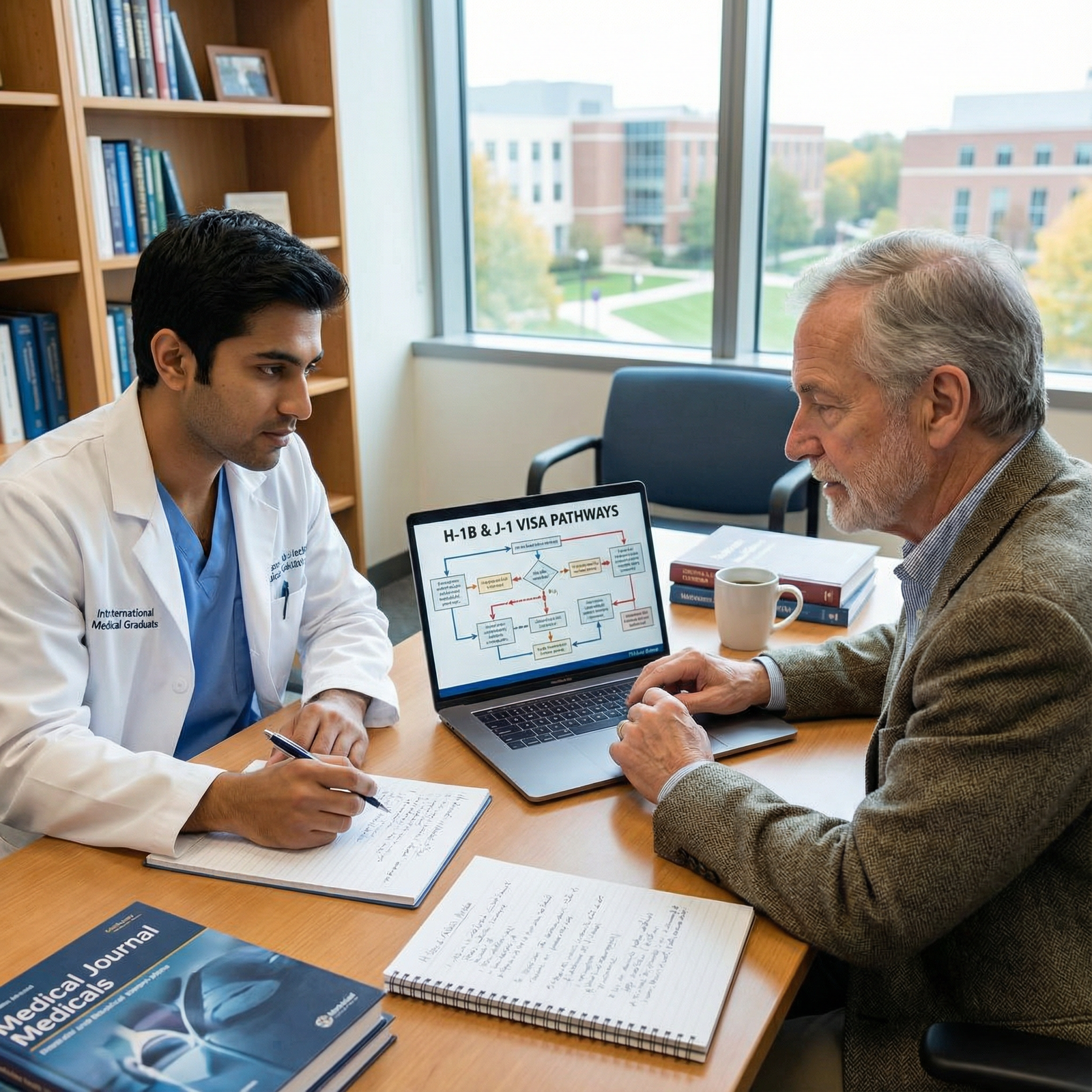
Understanding the Visa Landscape for IMGs in Preliminary Medicine
For an international medical graduate, pursuing a preliminary medicine year (prelim IM) in the United States is often a strategic step toward specialties like neurology, anesthesiology, radiology, dermatology, or physical medicine and rehabilitation. Yet, one of the most complex and anxiety‑provoking pieces of the journey is visa navigation for residency.
This IMG residency guide focuses on what you need to know about visa options and strategy specifically for a Preliminary Medicine year, including how choices now will affect your ability to complete categorical training later.
We’ll walk through:
- The main IMG visa options (J‑1 vs H‑1B vs others)
- How visa type affects prelim vs categorical training
- Common pitfalls and timing issues
- How to communicate with programs about visas
- Practical examples and strategies to improve your chances
Core Visa Options for IMGs in US Residency
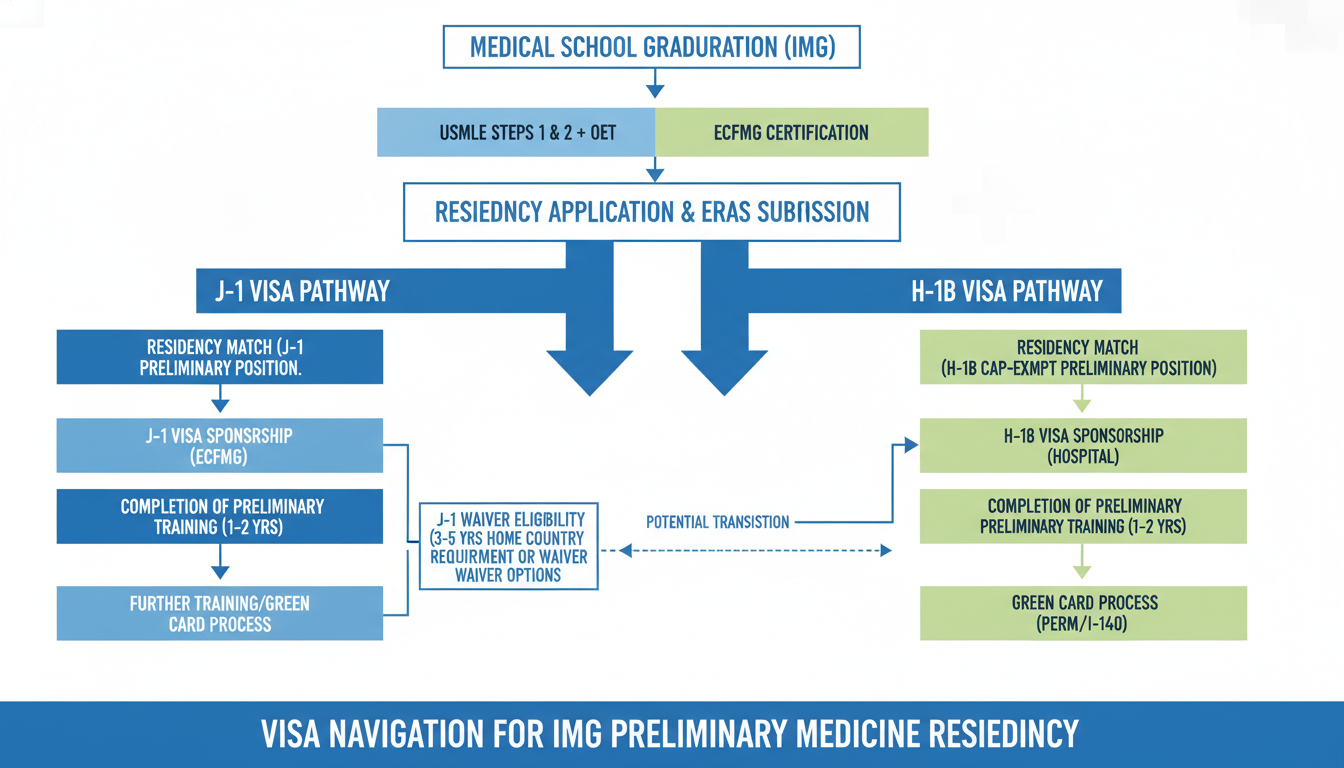
Most IMGs in US residency train on one of two visas:
- J‑1 Alien Physician visa (sponsored by ECFMG)
- H‑1B Temporary Worker visa (employer‑sponsored, specialty occupation)
A few also come with permanent residency (Green Card) or other special statuses, but for residency planning, understanding J‑1 vs H‑1B is essential.
1. J‑1 Visa for Clinical Training
The J‑1 Alien Physician category is the most common pathway for IMGs entering residency. It is not the same as a general J‑1 research or observer visa; it’s a specific category for graduate medical education, administered through ECFMG.
Key Features of the J‑1 for Residency
- Sponsor: ECFMG (not the residency program directly)
- Duration: Up to 7 years in total for graduate medical education
- Employment: You can work only at the approved training sites in your ECFMG‑sponsored program
- USMLE Requirement: Must have passed required Steps, obtained ECFMG certification
- Two‑Year Home Residence Requirement (2YHRR): After training, most J‑1 physicians must return to their home country for a total of two years before they can:
- Get H‑1B
- Obtain a Green Card
- Change to most other long‑term US statuses
This 2‑year requirement can be waived, but only through defined J‑1 waiver programs (e.g., Conrad 30, VA waivers, hardship, persecution).
Pros of J‑1 for an IMG in Preliminary Medicine
- Availability: Many prelim medicine programs are more willing to accept J‑1 than H‑1B.
- Predictable process: ECFMG has a well‑structured system; most academic programs are familiar with it.
- Timing: Often easier to finalize in time for residency start, since it’s not tied to H‑1B lottery or cap.
Cons of J‑1, Especially for a Prelim Year
- 2‑year home requirement: You may be subject even if you complete only a one‑year prelim IM program.
- Limits long‑term flexibility: If you switch specialties or need longer training (e.g., prelim + categorical + fellowship), you must stay within the 7‑year cap or apply for yearly extensions with justification.
- Waiver dependency: After training, your ability to stay and work in the US often depends on securing a J‑1 waiver job, which can be competitive and geographically limiting.
2. H‑1B Visa for Residency
The H‑1B is a temporary worker visa for “specialty occupations,” including residency positions.
Key Features of the H‑1B for Residency
- Sponsor: The residency program/employer directly
- USMLE Requirement: Must have passed USMLE Step 3 before H‑1B petition filing in most states
- Duration: Up to 6 years total, counting all past H‑1B time in the US (including non‑medical H‑1B jobs)
- No automatic 2‑year home requirement: Unlike J‑1, no built‑in 2YHRR
- Cap‑exemption: Most teaching hospitals (universities, nonprofit research entities) are cap‑exempt, so they can file H‑1B any time of year without lottery.
Pros of H‑1B for an IMG in Prelim IM
- No 2‑year home requirement: Freer movement into fellowships, jobs, or Green Card sponsorship later.
- Direct path to long‑term US practice: Often preferred by IMGs who plan to stay and pursue employment‑based permanent residency.
- Stability for long training paths: Especially attractive if you plan prelim medicine → advanced specialty residency → fellowship.
Cons of H‑1B for a Prelim Year
- Step 3 requirement: You must pass Step 3 early enough for petition filing—this is challenging if you finish medical school late or receive your ECFMG certificate close to Match.
- Program burden: More paperwork and cost for the institution, so some programs simply do not sponsor H‑1B, especially for one‑year prelim positions.
- Duration limits: If you use 1 year of H‑1B for prelim medicine, you only have 5 years left for all remaining training and employment before needing Green Card or other solution.
How Visa Type Interacts with a Preliminary Medicine Year
A preliminary medicine year is a one‑year, non‑categorical internal medicine residency. It satisfies the PGY‑1 requirement for many advanced specialties. Visa strategy becomes complex because:
- You may do prelim IM in one program, then advanced residency in another, possibly with a gap in between.
- Visa requirements may differ between prelim and advanced programs.
- Your choices now may limit or enable your future training and job options.
1. Scenario Mapping: Common Paths for IMGs in Prelim IM
Scenario A: Prelim IM (PGY‑1) + Already Matched Advanced Specialty (PGY‑2+)
Example: You match into a Prelim Medicine program + Neurology (categorical or advanced) in the same Match cycle.
- Visa implications:
- You’ll need a visa that can cover PGY‑1 and the following years.
- If both programs are at the same institution, they may issue one continuous J‑1 or H‑1B plan.
- If separate institutions, each will evaluate their own visa policy.
Strategic points:
- Before ranking, confirm both prelim and advanced programs’ visa policies.
- Understand if you can continue on the same visa type across the transitions.
Scenario B: Prelim IM Only, Planning to Re‑Apply to Match
Example: You accept a stand‑alone prelim medicine year while hoping to later match into an advanced or categorical residency (medicine, radiology, anesthesiology, etc.).
- Visa implications:
- For J‑1: The 1‑year prelim will use up 1 year of your 7‑year J‑1 limit.
- For H‑1B: You use 1 year of your 6‑year cap and may appear less desirable to some future programs who prefer a “fresh” 6‑year window.
Strategic points:
- Be sure you can maintain lawful status between PGY‑1 and any future position (e.g., by finding a research or non‑clinical role that can sponsor a visa, or by returning home and applying again).
- Consider whether starting on J‑1 vs H‑1B better fits your likelihood and timing of entering advanced training.
2. Visa Policies Specific to Preliminary Medicine Programs
Many prelim IM programs have stricter visa limitations than categorical internal medicine programs, because:
- They only commit to one year of training.
- Some hospital legal teams see less benefit in H‑1B sponsorship for a short‑term position.
- J‑1 sponsorship may be easier and cheaper for them administratively.
Common patterns:
- “J‑1 only”: Very common in prelim medicine programs.
- “J‑1 or H‑1B (with Step 3 by date X)”: Seen in more IMG‑friendly academic centers.
- “No visa sponsorship”: Some community hospitals or smaller institutions.
3. Effect on Future Specialty Training and Fellowship
Your choice during prelim year affects:
Total visa time left:
- J‑1: You’ll have roughly 6 more years (assuming a 1‑year prelim) for categorical residency and possibly fellowship.
- H‑1B: You’ll have 5 years left. For long paths (e.g., prelim IM → neurology (3 yrs) → 2–3 year fellowship), this may be tight unless you transition to a Green Card.
Post‑training employment:
- J‑1: Usually requires a waiver job in an underserved area after completing all training.
- H‑1B: You can move directly into H‑1B clinical employment or pursue permanent residency.
Detailed Comparison: J‑1 vs H‑1B for IMGs in Preliminary Medicine
This section synthesizes the IMG visa options with a focus on prelim IM.
Training Flexibility
J‑1:
- Designed specifically for education and training.
- More widely accepted by residency programs, especially for prelim slots.
- Annual extension requests required if training continues beyond initial period.
H‑1B:
- Grants more autonomy after training.
- Used by fewer prelim programs due to cost and complexity.
- Better for those certain they will stay in the US long‑term and have competitive portfolios.
Administrative Burden on Programs
J‑1:
- Program collaborates with ECFMG; process is familiar to GME offices.
- Less legal cost for the institution.
H‑1B:
- Requires institutional immigration attorneys, filing fees, and more documentation (LCA, prevailing wage, etc.).
- Many programs will prioritize H‑1B sponsorship for categorical residents they can keep for several years rather than for transitional pre‑PGY‑2 IMGs.
Risk Profile for the IMG
J‑1 risks:
- You may complete prelim IM and then struggle to match into advanced training, yet still carry a 2‑year home requirement.
- If you cannot obtain a waiver later, you may have to leave the US after all your training.
H‑1B risks:
- If Step 3 is delayed, you may miss the window for H‑1B petition filing.
- If your future program does not sponsor H‑1B, you may need to switch to J‑1, which requires starting a new process and can complicate timing.

Practical Strategies for Visa Navigation as an IMG Pursuing Prelim IM
1. Start Planning Early: During USMLE and ECFMG Certification
Action points:
Clarify your long‑term plans:
- Do you foresee living in the US long‑term?
- Are you open to practicing in an underserved or rural area to obtain a J‑1 waiver after training?
- Are you prepared for the financial and timing demands of Step 3 before Match?
Time your exams:
- If you want to keep H‑1B as an option, aim to pass Step 3 by:
- The fall or early winter before Match (so programs see your result in applications).
- Or at least by early spring (so sponsoring programs can file petitions in time for a July 1 start).
- If you want to keep H‑1B as an option, aim to pass Step 3 by:
Document everything:
- Keep organized files: passport, med school diploma, translations, ECFMG certificate, USMLE transcripts, prior visas, and any prior US status documents (I‑20s, DS‑2019s, I‑94s). These will be needed for any residency visa petition.
2. Use the Program Application Stage to Screen for Visa Compatibility
When using ERAS and reviewing programs:
Carefully read each program’s FAQ or “For IMGs” section:
- Look for explicit statements:
- “We sponsor J‑1 only”
- “We sponsor J‑1 and H‑1B”
- “We do not sponsor visas”
- Look for explicit statements:
For preliminary medicine programs, prefer:
- Programs that clearly accept IMGs.
- Institutions that feature current or former IMGs on their websites.
- Academic centers with large GME offices and documented experience with J‑1 and/or H‑1B.
If the website is unclear, consider a polite email to the program coordinator or GME office. Include:
- Your current status (e.g., abroad, on F‑1 OPT, etc.)
- Whether you will have Step 3 passed by a certain date
- A concise question:
- “Does your prelim medicine program sponsor J‑1, H‑1B, or both for international medical graduates?”
3. Ranking Strategy: Aligning Visa Options with Your Career Goals
If You Strongly Prefer H‑1B (to avoid the J‑1 2‑year rule)
Rank prelim programs that explicitly support H‑1B higher, but also:
- Ensure your advanced program (if already matched) also sponsors H‑1B.
- If re‑applying, consider whether future specialties of interest (e.g., radiology, anesthesia) at your target institutions usually use H‑1B or J‑1.
Be realistic: If your application is borderline and a strong J‑1‑sponsoring program is enthusiastic about you, that might be a better long‑term career move than over‑focusing on visa type.
If You Are Comfortable with J‑1 and Open to a J‑1 Waiver Job
- You can apply widely to prelim IM programs that sponsor J‑1 only, which broadens your options.
- Begin learning about Conrad 30, VA waivers, and other J‑1 waiver options early, so you understand what types of communities and job contracts you may later need to accept.
4. Communicating with Programs During Interviews
Residency programs expect IMGs to ask about visas; it does not harm you if asked professionally and at the right time.
During interview day (often at the end or with the coordinator/program director), you might say:
- “As an international medical graduate, visa sponsorship is important for me. Could you share what visa types your program commonly sponsors for preliminary medicine residents?”
- “If I match here for prelim medicine and later match into an advanced program at your institution, is it usually possible to remain on the same visa type?”
Avoid appearing as though you care only about the visa; show sincere interest in training quality, mentorship, and patient population as well.
5. Handling Gaps Between Prelim and Advanced Residency
Not all IMGs move directly from prelim to advanced training.
If you end your prelim IM year on:
J‑1:
- You must either:
- Continue on a new J‑1 clinical or non‑clinical position (with ECFMG or another sponsor), or
- Leave the US and re‑enter when your next program begins.
- Gaps may come with immigration complexity (e.g., limits on research roles, funding sources).
- You must either:
H‑1B:
- If you find a research or teaching position that can sponsor H‑1B, you may stay in the US between residency positions.
- If not, you may need to depart and re‑enter for your next job or training position, or change to another status if available.
Work with the GME office and an immigration attorney early (ideally 6–9 months before the end of prelim year) to plan your options.
Case‑Based Examples: Visa Choices for Common IMG Paths
Case 1: IMG Targeting Neurology via Prelim IM
- You match to:
- Prelim IM year at Hospital A (J‑1 only)
- Advanced Neurology (PGY‑2–4) at Hospital B (J‑1 or H‑1B)
Implications:
- If you start on J‑1 at Hospital A, your entire training path is likely to be J‑1 (easier administratively).
- You’ll complete 1 year of prelim IM + 3 years of neurology = 4 years of J‑1, leaving room for fellowship.
Strategy:
- Accept J‑1 as the practical solution.
- Begin learning about J‑1 waivers for neurologists, typically in underserved regions, so you understand post‑training obligations.
Case 2: IMG With US Master’s Degree and F‑1, Wants Long‑Term US Practice
- Currently in the US on F‑1 status.
- Plans to apply to prelim IM + radiology.
- Very motivated to avoid 2‑year home requirement.
Possible plan:
- Take USMLE Step 3 early (during final year of med school or research).
- Target programs that sponsor H‑1B for both prelim and radiology positions.
- Use F‑1 OPT strategically if needed to bridge any timing issues.
Risks:
- If Step 3 is delayed or you match into a J‑1‑only prelim, you may need to accept J‑1 and adjust your long‑term plans.
- Some radiology programs may be cautious about spending H‑1B years on prelim + residency + fellowship.
Case 3: IMG with Modest Scores, More Realistic J‑1 Path
- USMLE scores are acceptable but not extremely competitive.
- Aware that many programs that strictly prefer H‑1B also expect very strong applications.
Strategy:
- Apply broadly to IMG‑friendly prelim medicine programs that sponsor J‑1.
- Focus on building a strong clinical reputation, research output, and US letters of recommendation during prelim year.
- Accept that J‑1 + waiver route may be the most realistic and stable overall pathway.
When to Involve an Immigration Attorney
Residency programs often have institutional lawyers, but their priority is the institution, not necessarily your long‑term personal immigration plan.
You should consider consulting your own immigration attorney if:
- You have complex prior US immigration history (multiple statuses, prior overstay, J‑1 from research, etc.).
- You are switching between J‑1 and H‑1B or considering a change to another status (e.g., F‑1, O‑1).
- You are planning ahead for Green Card sponsorship and want to choose visas strategically.
Aim to have your own legal advice especially if:
- You are offered multiple positions with different visa types.
- You are deciding between a J‑1 prelim now vs waiting 1 year to strengthen your profile and possibly obtain H‑1B later.
Key Takeaways for IMGs Navigating Visas in Preliminary Medicine
- J‑1 vs H‑1B is the central decision for most IMGs entering US residency.
- For prelim IM, many programs are J‑1 only, and that may be the most practical choice, especially if Step 3 is not yet complete.
- H‑1B offers greater long‑term flexibility but is harder to secure, particularly for one‑year preliminary medicine spots and for applicants without early Step 3.
- Your visa during prelim year affects your training clock (7‑year J‑1, 6‑year H‑1B) and your eventual job options (J‑1 waiver vs direct H‑1B or Green Card).
- Plan early, ask programs clearly about their residency visa policies, and ensure your prelim and advanced programs’ visa options are compatible with your goals.
FAQ: Visa Navigation for IMGs in Preliminary Medicine
1. Is it worth delaying my application by a year to take Step 3 and aim for H‑1B instead of J‑1?
It depends on your competitiveness, priorities, and flexibility:
- Consider delaying if:
- You are highly competitive and likely to match to strong programs that already sponsor H‑1B.
- You are very committed to long‑term US practice and want to avoid the J‑1 2‑year home requirement.
- Consider applying now (even with J‑1) if:
- Your profile is borderline and an early match to a J‑1‑friendly prelim IM program is a significant opportunity.
- You are open to J‑1 waiver jobs after training.
Discuss this trade‑off with mentors and, if possible, an immigration attorney.
2. If I do a prelim year on J‑1 and later match into a categorical residency, can I switch to H‑1B?
Sometimes, but it can be complicated:
- A future program may be willing to file an H‑1B petition for you—but:
- You will still likely be subject to the J‑1 2‑year home requirement unless you obtain a J‑1 waiver or satisfy it by staying in your home country for 2 years.
- In many cases, IMGs stay on J‑1 for all training and then move into a waiver job rather than switching mid‑training.
3. Do residencies ever sponsor Green Cards directly during training?
This is rare for prelim IM positions. Some institutions may start Green Card processes for long‑term faculty or attending roles, but residency/GME offices generally:
- Focus on temporary training visas (J‑1 or H‑1B).
- Defer Green Card discussions until you are hired as independent staff or in a post‑residency role.
If you already have another basis for a Green Card (e.g., family sponsorship, DV lottery, EB‑1), consult a personal immigration attorney about timelines and how residency fits into that plan.
4. What if my prelim program says “no visa sponsorship,” but I am already in the US on another status?
Programs that state “no visa sponsorship” typically mean they will not file new petitions or DS‑2019 forms. However:
- If you are in a status that already legally permits work at that institution (e.g., certain dependent statuses or EAD‑eligible statuses), it might be technically possible, but:
- This is highly case‑specific and depends on the institution’s policy and your exact status.
- Always confirm directly with the GME office and, if needed, an immigration lawyer. Do not assume you can rely on an existing status without explicit institutional approval.
Navigating visas as an international medical graduate in preliminary medicine is complex but manageable with early planning, realistic expectations, and clear communication. Use the information in this IMG residency guide as a framework, then tailor your decisions to your own credentials, specialty goals, and willingness to commit to specific visa pathways such as J‑1 vs H‑1B.