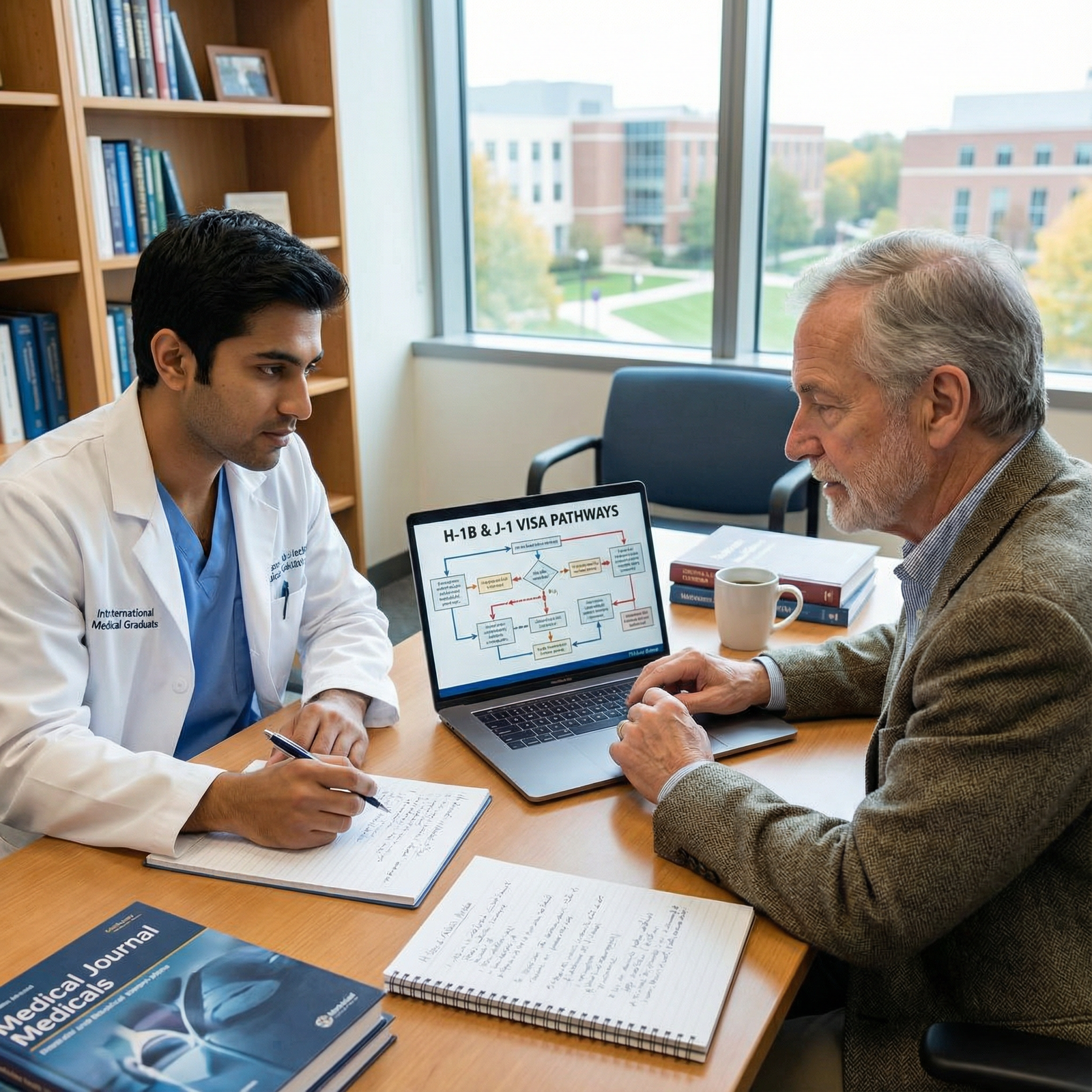
Understanding the Visa Landscape for IMGs in Southern California
Southern California is one of the most desirable regions in the United States for residency training: world‑class academic centers, diverse patient populations, and a strong community of international physicians. For an international medical graduate (IMG), however, the dream of SoCal medical training depends heavily on the right visa strategy.
This IMG residency guide focuses on visa navigation for residency in Southern California—what you need to know before you apply, while you interview and rank programs, and after you match.
We will cover:
- The main visa categories used for residency
- How J‑1 vs H‑1B decisions affect your career and family
- Unique aspects of Southern California residency programs
- Practical timelines, documents, and planning tips
- Common pitfalls and how to avoid them
Throughout, we’ll emphasize real‑world, actionable steps tailored to IMGs targeting residency in Southern California.
Core Visa Options for Residency: J‑1 vs H‑1B
For graduate medical education, IMGs almost always train on one of two visa types:
- J‑1 Exchange Visitor (ECFMG-sponsored)
- H‑1B Temporary Worker (employer-sponsored)
Understanding these thoroughly is the foundation of smart visa navigation.
The J‑1 Exchange Visitor Visa (ECFMG-Sponsored)
For most IMGs, especially those starting residency, the J‑1 is the default visa pathway.
Key features
- Sponsor: Educational Commission for Foreign Medical Graduates (ECFMG)
- Purpose: Graduate medical education (residency/fellowship)
- Duration: Typically up to 7 years total (covering most residencies + many fellowships)
- Work restriction: Only at the approved training program and any sites explicitly authorized
- Dependents: J‑2 status for spouse and unmarried children under 21 (J‑2 spouses can usually apply for work authorization)
The 2‑year home-country physical presence requirement
Most ECFMG-sponsored J‑1 physicians are subject to INA §212(e), commonly called the “2‑year home rule.” This means:
After finishing all training on J‑1, you must either:
- Spend a total of two years back in your home country (not necessarily continuous, but usually must be cumulative and documented), or
- Obtain a waiver of this requirement through an approved pathway (e.g., Conrad 30, hardship, persecution, or an interested government agency)
You generally cannot change to H‑1B or permanent resident (green card) status inside the U.S. until you:
- Fulfill the 2‑year requirement, or
- Successfully obtain a waiver
For many IMGs planning long-term U.S. careers, this is the single most important consideration.
Pros of J‑1 for residency
- Widely accepted:
- The vast majority of Southern California residency programs already work with ECFMG and are very familiar with J‑1 processes.
- Often simpler for programs:
- Programs don’t have to navigate complex H‑1B rules (prevailing wage, cap, etc.) for residents.
- Flexible for fellowship:
- Most fellowships in SoCal are also J‑1-friendly; extending ECFMG sponsorship for fellowship is usually straightforward if you have remaining J‑1 time.
- J‑2 work authorization:
- Your spouse may be able to work legally in the U.S. (subject to USCIS processing and approval).
Cons of J‑1 for residency
- The 2‑year home requirement is a major drawback if you want to:
- Transition directly to H‑1B or green card after residency/fellowship, or
- Stay continuously in the U.S. after training
- You must secure a J‑1 waiver job or plan for home-country return:
- In California, J‑1 waiver positions can be competitive and geographically limited (often rural or underserved).
- Restricted employment:
- You cannot moonlight or work outside the approved program sites unless specifically authorized and permitted by ECFMG and the program.
The H‑1B Temporary Worker Visa for Residents
The H‑1B is a work visa for specialty occupations and is sometimes used by residency programs for IMGs.
Key features
- Sponsor: The residency program (employer), sometimes via the institution’s central GME/HR office
- Purpose: Employment in a specialty occupation (residency can qualify)
- Duration: Up to 6 years total (initial period often 3 years, then extensions)
- Work restriction: Only with the sponsoring employer in the approved role
- Dependents: H‑4 status for spouse and unmarried children under 21
- H‑4 work authorization is limited; in many cases, H‑4 spouses cannot work unless they qualify through a separate route.
Important nuances for residency
- Not all Southern California residency programs sponsor H‑1B for residents.
- Some have institutional policies against it.
- Others will only sponsor H‑1B for “advanced” positions (e.g., PGY‑2+ after USMLE Step 3 is passed).
- USMLE Step 3 is typically required before filing H‑1B:
- This is a major bottleneck for many IMGs applying directly to PGY‑1 positions.
- Without Step 3, many programs cannot or will not file H‑1B petitions for residents.
Pros of H‑1B for residency
- No 2‑year home-country requirement:
- You can transition more directly to another H‑1B job or start a green card process after training.
- Potentially smoother path to long-term U.S. practice:
- Many employers and attorneys are more comfortable sponsoring green cards for H‑1B physicians.
- Standard employment status:
- Less tied to an “exchange” framework; more like a standard employee.
Cons of H‑1B for residency
- More complex and costly for programs:
- Legal fees, filing fees, prevailing wage analysis, and compliance.
- Some SoCal programs avoid H‑1B for this reason.
- Cap issues:
- Academic hospitals are usually cap‑exempt, but future non-academic jobs may be subject to the annual H‑1B lottery.
- H‑4 spouse work flexibility is limited compared with J‑2.
- Time limits:
- A long residency plus fellowship may approach or exceed the 6‑year H‑1B maximum, requiring strategic planning.
J‑1 vs H‑1B: Strategic Comparison for IMGs in SoCal
When J‑1 might make more sense
- You do not have USMLE Step 3 yet.
- You are applying to a variety of Southern California residency programs, many of which clearly state “J‑1 only” or “J‑1 preferred.”
- You are willing to:
- Return to your home country for two years or
- Pursue a J‑1 waiver job (often in a medically underserved area) after training.
- You want to keep fellowship options broad, including highly competitive academic programs that may prefer J‑1.
When H‑1B might be worth pursuing
- You already passed USMLE Step 3 and can provide scores before visa processing deadlines.
- You have a clear plan to remain in the U.S. long-term and want to avoid the 2‑year home-country rule.
- You target specific Southern California residency programs that explicitly offer H‑1B sponsorship for IMGs.
- You are prepared for more complex, sometimes slower, onboarding processes as the program handles H‑1B filings.
Practical advice
- Always check program websites and contact coordinators:
- Many SoCal programs clearly list “Visa sponsorship: J‑1 only” or “J‑1 and H‑1B considered.”
- Avoid assumptions:
- Just because a famous Southern California institution sponsors H‑1B for faculty does not guarantee they do so for residents.
- Be honest and consistent:
- If directly asked on interviews, be clear whether you are open to J‑1, pursuing H‑1B, or both.

Unique Considerations for Southern California Residency Programs
Southern California (SoCal) includes Los Angeles, Orange County, San Diego, Inland Empire, and surrounding areas. The region has distinctive features that shape visa strategy for IMGs.
High Competition and Program Selectivity
- SoCal residency programs are highly sought-after due to lifestyle, climate, and reputation.
- IMGs face intense competition:
- Many programs receive thousands of applications per year.
- Visa status becomes an additional filter.
Implication:
You must be proactive and precise about your visa plans to avoid being screened out for uncertainty or perceived risk.
Institutional Visa Policies
Southern California has:
- Large academic centers (e.g., university hospitals, major teaching hospitals)
- Community-based programs affiliated with universities
- County/public systems serving diverse and underserved populations
Each may have different visa sponsorship cultures:
- Some university programs:
- Comfortable with both J‑1 and H‑1B.
- Have in-house immigration counsel or dedicated HR teams.
- Some community-based programs:
- Prefer J‑1 due to simplicity and cost.
- May have strict policies: “No H‑1B for residents,” or “J‑1 only.”
- County/public hospitals:
- Often J‑1 friendly, sometimes H‑1B friendly, depending on local policies and funding.
Action step:
Create a personal spreadsheet of programs in SoCal, recording:
- Visa types accepted
- Step 3 requirement for H‑1B
- Notes from websites, emails, or phone calls
This becomes your personalized IMG residency guide for visa navigation in the region.
Cost of Living and Family Considerations
Southern California has a high cost of living (especially Los Angeles and coastal cities). Visa status can influence your financial planning:
- J‑1 with J‑2 spouse work authorization:
- If your spouse can successfully obtain and use J‑2 work authorization, dual incomes can significantly help with SoCal expenses.
- H‑1B with H‑4 spouse (typically no work):
- You may be the sole earner; budgeting becomes more critical.
- Daycare, housing, and transportation costs must be carefully planned regardless of visa type.
Long-Term Career Planning in California
California is a desirable state for physician practice, but:
- Competition is high, and
- J‑1 waiver options (to stay in California after training) can be limited.
Typical J‑1 waiver paths include:
- Conrad 30 program (California):
- Highly competitive; many applicants for a limited number of slots.
- Often requires working in designated underserved areas.
- Federal programs (e.g., VA, HHS, etc.), depending on specialty and setting.
For H‑1B holders:
- After residency/fellowship, you may:
- Seek H‑1B employment with a California employer (cap-exempt or cap-subject).
- Begin an employment-based green card process.
Strategic note:
If your ultimate goal is a long-term career in a major SoCal city (e.g., Los Angeles, Orange County, San Diego), you must start thinking early about how J‑1 vs H‑1B will shape your post-residency options.
Practical Timeline: From Application to Match and Visa Issuance
Visa navigation is deeply tied to timing. Below is a generalized timeline for IMGs applying for Southern California residency.
12–18 Months Before Residency Start
1. Clarify your visa goals
- Decide:
- Are you open to J‑1?
- Are you aiming strongly for H‑1B (and do you realistically meet requirements, especially Step 3)?
- Read up on J‑1 vs H‑1B with reputable sources (ECFMG, NRMP, institutional GME pages).
2. Complete exams and documentation
- Ensure you have:
- USMLE Step 1 and Step 2 CK completed.
- USMLE Step 3 completed if you intend to seriously pursue H‑1B sponsorship for PGY‑1 or PGY‑2.
- Keep passport valid for several years beyond your expected training end.
3. Research Southern California programs
- Identify:
- Which programs sponsor J‑1 only.
- Which sponsor both J‑1 and H‑1B.
- Any that explicitly do not sponsor visas (avoid these).
- Reach out to program coordinators with concise, respectful emails about visa policies if unclear.
ERAS Application Season (September–October)
4. Craft your application to minimize visa concerns
- In your personal statement and CV:
- Emphasize your readiness to navigate visa processes.
- Avoid appearing inflexible (e.g., “I will only accept H‑1B” can be risky unless you truly mean it and target only such programs).
- For the “visa” fields in ERAS:
- Be accurate about current status (if any) and needs.
- Some applicants mention “open to J‑1 and H‑1B” to maximize interview chances.
5. Prepare documentation for later
Begin gathering items that will be needed for future visa processing:
- Medical school diploma and transcripts
- ECFMG certificate (if available)
- Translations and notarization if required
- Valid passport copies
- Prior U.S. immigration documents, if any (I‑20, DS‑2019, I‑94, visas)
Interview Season (October–January)
6. Discuss visa options professionally during interviews
- If asked:
- Be clear but not demanding:
- “I am currently planning to pursue J‑1 sponsorship through ECFMG, and I’m also open to discussing H‑1B if your institution supports it and my Step 3 timing aligns.”
- Be clear but not demanding:
- Avoid surprises:
- Don’t claim to be fine with J‑1 during interviews and then later insist on H‑1B only.
7. Take notes on each program’s stance
- After each interview:
- Record what was said about visa sponsorship.
- If a program appears reluctant or vague about visas, think carefully about where it ranks on your list.
After the Match: Steps to Secure Your Residency Visa
Once you match into a Southern California residency program, your visa process becomes more concrete. This is where many logistical details arise.
Post-Match Overview
- Receive match letter and contract from the residency program.
- Confirm visa type with program’s GME/HR or international office.
- Start J‑1 or H‑1B paperwork as instructed by your program.
J‑1 Visa Process for Residents
1. Program initiates sponsorship
- Your program’s GME office will:
- Confirm your ECFMG certification status.
- Send instructions on how to apply for ECFMG sponsorship.
2. ECFMG application
- Typically done through the ECFMG OASIS/EVNet system.
- You’ll need to upload:
- Passport copy
- Medical school documentation
- ECFMG certificate (or proof you’re on track)
- Signed contract or appointment letter
- Completed forms from the program
3. DS‑2019 issuance
- Once ECFMG approves, they issue a Form DS‑2019 designating you as a J‑1 physician trainee.
- This is used to schedule a visa interview at a U.S. consulate/embassy if you are outside the U.S.
4. Visa interview and entry
- Complete the DS‑160, pay SEVIS and visa fees, and attend your consular interview.
- Once approved, you can enter the U.S. with your J‑1 visa and DS‑2019, typically up to 30 days before your program start date.
Important points for SoCal-bound IMGs
- Visa appointment wait times can vary by country; book early.
- Southern California programs often have strict orientation start dates; delays in J‑1 issuance can jeopardize your ability to start on time.
- Stay in close communication with your program coordinator about any issues.
H‑1B Visa Process for Residents
1. Confirm eligibility
- Ensure you have:
- USMLE Step 3 passed and reportable.
- A valid medical license or in some states a training license/permit (your program/attorney will guide this).
- All required documents (passport, diplomas, CV, etc.).
2. Employer and attorney work-up
- The residency program (employer) or institution:
- Engages an immigration attorney if not already in place.
- Files a Labor Condition Application (LCA) with the Department of Labor.
- Prepares an I‑129 petition for H‑1B classification.
3. Filing and approval
- The employer submits the I‑129 to USCIS.
- Processing times vary (premium processing may be used).
- Once approved:
- If you are outside the U.S., you attend a consular interview to obtain the visa stamp.
- If you are in the U.S. in another valid status, you may be able to change status without leaving.
4. Start of employment
- You can begin residency on the start date listed in your H‑1B approval, assuming licensure and all onboarding steps are completed.
H‑1B-specific cautions for SoCal residents
- Because residency salaries are often near prevailing wage thresholds, some institutions are cautious about ensuring wage compliance.
- Any change in site of employment, hours, or duties may require legal review and possibly an amended petition.
- Do not accept additional side work or moonlighting without explicit authorization from the employer and attorney.
Common Pitfalls and How to Avoid Them
Visa navigation for residency is manageable if you plan ahead. These are some of the most frequent issues IMGs encounter, with solutions tailored to Southern California contexts.
Pitfall 1: Assuming All Programs Sponsor H‑1B
Many applicants believe prestigious SoCal institutions will be flexible. In reality:
- Some programs have strict “J‑1 only” policies to standardize their processes.
- Others may only consider H‑1B in exceptional cases or only for upper-level transfers.
Avoid it by:
- Checking each program’s website and FREIDA listing.
- Emailing coordinators with a short, precise question:
- “Could you please confirm whether your program sponsors J‑1, H‑1B, or both for international medical graduates?”
Pitfall 2: Delaying USMLE Step 3 When Planning for H‑1B
Without Step 3, many SoCal programs cannot even start an H‑1B case.
Avoid it by:
- If H‑1B is a priority, schedule Step 3 well before ERAS submission, ideally with results available by interview season.
- If you cannot complete Step 3 in time, be realistic and remain open to J‑1.
Pitfall 3: Ignoring the 2‑Year J‑1 Home Requirement
Some IMGs accept J‑1 without understanding its long-term impact. Only during fellowship or job search do they realize:
- They cannot smoothly transition to H‑1B or green card.
- They must either seek a J‑1 waiver job or return to their home country.
Avoid it by:
- Reading ECFMG and government resources about the 212(e) requirement before accepting J‑1.
- Talking with older residents or fellows in SoCal about their waiver experiences.
- Discussing early with immigration counsel if you plan to stay in California long term.
Pitfall 4: Underestimating Processing and Appointment Delays
Late DS‑2019 issuance, long visa appointment waits, or slow H‑1B processing can cause delayed arrivals or, in rare cases, lost positions.
Avoid it by:
- Responding quickly to all document requests from your program and ECFMG.
- Checking consulate wait times right after match and scheduling interviews early.
- Asking your program whether premium processing will be used for H‑1B, and if not, ensuring enough buffer time.
Pitfall 5: Relying on Informal Advice Only
WhatsApp groups, forums, and social media can be helpful but often contain incomplete or outdated information.
Avoid it by:
- Using official sources:
- ECFMG website
- USCIS website
- State medical board sites (for licensure/training permits)
- Your institution’s GME/HR office
- When in doubt, seek advice from a qualified immigration attorney, particularly for complex histories (prior U.S. visas, status changes, gaps, etc.).
Frequently Asked Questions (FAQ)
1. As an IMG applying to Southern California residencies, should I prefer J‑1 or H‑1B?
It depends on your situation and priorities:
- J‑1 is more widely accepted, especially for PGY‑1 positions, and is often the only option at many SoCal programs. It is generally easier for programs to manage but comes with the 2‑year home-country requirement after training.
- H‑1B may better support long-term U.S. practice and green card plans but requires USMLE Step 3, more complex employer sponsorship, and is not offered by all programs.
If your goal is simply to secure a strong Southern California residency position, being open to J‑1 sponsorship usually maximizes your chances.
2. Can I switch from J‑1 to H‑1B during residency in Southern California?
In most cases, no. Once you are in the U.S. for graduate medical training on an ECFMG-sponsored J‑1:
- You are generally subject to the 2‑year home-country requirement.
- You cannot change to H‑1B or adjust to permanent residency inside the U.S. until:
- You complete the 2‑year home presence in your home country, or
- You obtain a J‑1 waiver.
Some very narrow exceptions and special cases exist, but they are uncommon and require expert legal guidance. For planning purposes, assume that J‑1 → H‑1B switch during residency is not feasible without first addressing the 2‑year rule.
3. Do most Southern California residency programs sponsor visas for IMGs?
Many SoCal programs do sponsor J‑1 visas, and a subset also sponsor H‑1B. However:
- A few programs do not sponsor any visas and require U.S. citizenship or permanent residency.
- Some programs will only consider H‑1B for certain specialties, specific tracks, or more senior residents.
You must check each program individually. Do not assume that all Southern California residencies are IMG or visa friendly, even within the same institution.
4. If my spouse wants to work in Southern California, which visa is better: J‑1 or H‑1B?
From a spouse work authorization standpoint:
- J‑1 primary + J‑2 spouse:
- J‑2 spouses are generally eligible to apply for employment authorization (EAD) and, once approved, can work for almost any employer.
- H‑1B primary + H‑4 spouse:
- H‑4 spouses usually cannot work unless they qualify separately (for example, as dependents of an H‑1B principal with an approved I‑140 in some circumstances).
Therefore, for spouse work opportunities during residency in Southern California, J‑1/J‑2 is often more favorable, although each family’s situation and long-term goals must be considered.
Navigating residency visa options as an international medical graduate is complex, but with early planning, accurate information, and program-specific research, you can align your immigration path with your training and career goals in Southern California. Understanding J‑1 vs H‑1B, program policies, timelines, and long-term implications will put you in a strong position to pursue the SoCal medical training experience you’re aiming for.