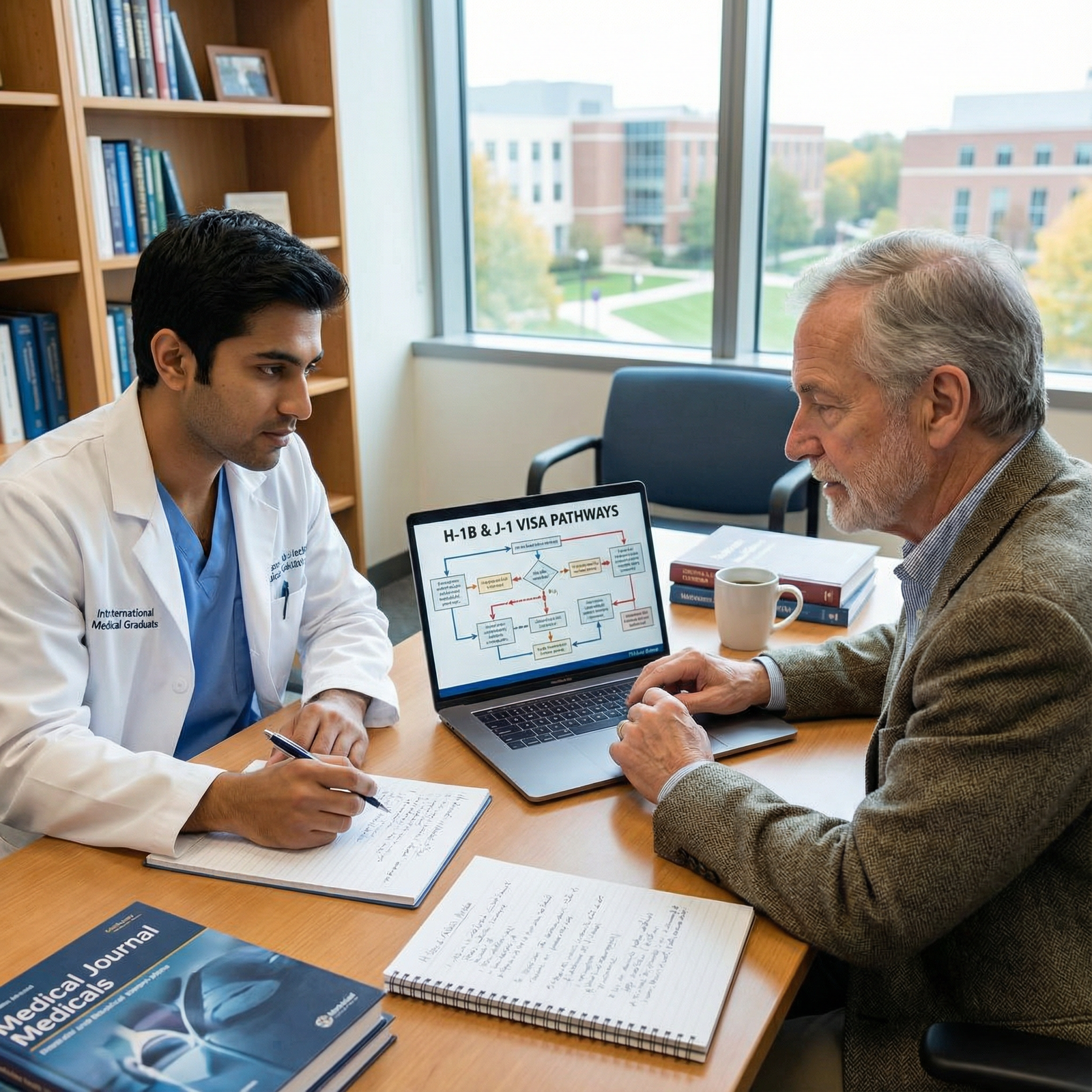
Understanding Visa Navigation for IMGs in the Great Lakes Region
Navigating the U.S. visa system as an international medical graduate (IMG) can feel as complex as the Match itself—especially if you’re targeting midwest residency programs in the Great Lakes region (Illinois, Indiana, Michigan, Minnesota, Ohio, Wisconsin, and nearby states). This IMG residency guide will help you understand which visas are available, how they affect your training and career, and what to do at each step of the residency application and Match process.
This article focuses on two main non‑immigrant visa categories used for residency training:
- J‑1 Exchange Visitor (ECFMG-sponsored)
- H‑1B Temporary Worker (hospital-sponsored)
We’ll compare J‑1 vs H‑1B in detail, with a specific focus on:
- Visa implications when applying to Great Lakes residency programs
- How visa choices influence fellowship options, long-term practice in the Midwest, and green card strategies
- What IMGs should do before ERAS, during interviews, and after Match Day to avoid surprises
1. Big-Picture Overview: How Visas Fit Into Your Residency Strategy
Before choosing between a J‑1 or H‑1B, you need to understand how visas intersect with your timeline as an IMG:
1.1 The core timeline
Pre‑ERAS (12–24 months before Match)
- Confirm USMLE/ECFMG certification timeline
- Clarify your graduation date (for recent grads) or current visa status (if already in the U.S.)
- Research which Great Lakes residency programs sponsor J‑1, H‑1B, or both
- Start thinking about long-term goals: academic vs community practice, interest in staying in the Midwest, green card aspirations
ERAS application season
- Be clear and consistent in your application about:
- Citizenship
- Current location
- Visa type requested or acceptable
- Tailor your list to include programs with compatible visa policies
- Be clear and consistent in your application about:
Interview season
- Ask targeted questions about visa sponsorship
- Clarify if the program:
- Sponsors J‑1 only
- Sponsors J‑1 and H‑1B
- Has restrictions or priority (e.g., H‑1B only for advanced years or certain specialties)
Post-Match
- If matched:
- For J‑1: work with ECFMG on sponsorship documentation
- For H‑1B: coordinate with program’s legal/HR team for petition filing
- If unmatched or partially matched:
- Consider research positions, observerships, or non‑clinical roles and what visas those may require
- If matched:
1.2 Why the Great Lakes region is unique for IMGs
The Great Lakes region is home to a wide variety of programs:
- Large academic centers (e.g., Chicago, Ann Arbor, Cleveland, Minneapolis)
- Mid‑sized university-affiliated hospitals in cities like Milwaukee, Grand Rapids, Toledo, Madison
- Smaller community and rural programs across Michigan’s Upper Peninsula, northern Wisconsin, Indiana, and Ohio
For an international medical graduate, these differences matter because:
- Academic centers often have robust immigration offices and may sponsor both J‑1 and H‑1B.
- Community programs may rely primarily on J‑1 visas, but often offer excellent J‑1 waiver job opportunities in the same state after residency.
- Rural and underserved settings in the Midwest are some of the most active users of J‑1 waiver programs, which can be a major advantage for IMGs planning to stay in the U.S.
2. Core Visa Pathways for Residency: J‑1 vs H‑1B
2.1 J‑1 Exchange Visitor (ECFMG-sponsored)
What it is:
A non-immigrant visa for physicians in U.S. graduate medical education (GME), sponsored by ECFMG, not the hospital directly.
Key features:
- Sponsor: ECFMG
- Duration: Typically 1 year at a time, up to 7 years (sometimes longer in limited cases, e.g., certain subspecialty fellowships)
- Purpose: Education and training (residency/fellowship)
Basic eligibility for J‑1
- ECFMG certification (including passing USMLE Steps required for certification)
- Offer of GME position in an ACGME-accredited residency or fellowship
- Proof of sufficient funding (salary from the program usually suffices)
- English proficiency
Advantages of J‑1 for IMGs
More widely available
- Many Great Lakes programs, especially community and mid‑sized academic centers, only sponsor J‑1.
- In some midwest residency programs, >70–80% of IMGs are on J‑1 visas.
Streamlined process
- ECFMG handles J‑1 sponsorship, and most GME offices are very familiar with the process.
- Typically faster to process than H‑1B in the residency context.
Easier for multiple fellowships
- J‑1 can be renewed annually and often covers residency plus fellowship if still within the 7‑year limit.
Supports IMGs who want to stay in the Midwest
- Great Lakes states are active users of the J‑1 waiver system, especially in primary care, psychiatry, pediatrics, and internal medicine.
- Many underserved or rural hospitals in Michigan, Wisconsin, Minnesota, and Ohio actively recruit J‑1 waiver candidates.
Disadvantages and obligations of J‑1
Two-year home residency requirement (INA 212(e))
- After completing training, most J‑1 physicians must either:
- Return to their home country for 2 years, or
- Obtain a J‑1 waiver (e.g., Conrad 30, VA, HHS programs) by working in an underserved U.S. location.
- This is a major long-term planning issue.
- After completing training, most J‑1 physicians must either:
Limited dual-intent
- J‑1 is technically not a dual-intent visa, making green card processing during training more complex than with H‑1B.
- For most J‑1 IMGs, green card steps are post-waiver.
Dependents (J‑2) restrictions
- J‑2 spouses can usually apply for work authorization, but timing and renewals need planning.
- Schooling for children (J‑2) is allowed but must be planned with each relocation.
2.2 H‑1B Temporary Worker (Specialty Occupation)
What it is:
A dual-intent work visa that allows temporary employment in a specialty occupation (medicine qualifies). For residency/fellowship, the hospital or institution sponsors the H‑1B.
Key features:
- Sponsor: The hospital or university (not ECFMG)
- Duration for training: Typically up to 6 years total, often in 1–3 year increments
- Dual-intent: Allows you to pursue permanent residency (green card) while in H‑1B status
Basic eligibility for H‑1B (residency context)
- USMLE Step 3 is usually required before H‑1B filing
- Must hold an unrestricted State Medical License or Graduate Medical Training License, depending on state
- Program must be willing to:
- Pay prevailing wage
- Cover legal and filing costs
- Navigate timing (cap-exempt vs cap-subject)
In the Great Lakes region, many large academic centers (e.g., in Chicago, Minneapolis, Cleveland) are cap-exempt H‑1B employers. Community hospitals may or may not be cap-exempt.
Advantages of H‑1B for IMGs
No J‑1 home residency requirement
- You can finish residency/fellowship and directly transition into another H‑1B job or a green card route without a 2‑year home return or J‑1 waiver.
Dual-intent is allowed
- You can start green card processing (EB‑2/EB‑3) during residency or early fellowship.
- This is helpful if you want a long-term academic career in a Great Lakes university system.
Flexible for future transitions
- Easier to move between employers in the same or different Great Lakes states.
- Attractive to some private groups or academic employers who are wary of waiver complexities.
Disadvantages and limitations of H‑1B
Fewer residency programs offer it
- Many midwest residency programs do not sponsor H‑1B for first‑year residents (PGY‑1).
- Some only offer H‑1B:
- For advanced positions (e.g., PGY‑2 in Neurology or Anesthesiology)
- For fellowships, not for residency
- You may need to limit your ERAS list if you require H‑1B.
USMLE Step 3 and timing constraints
- You must pass Step 3 early enough to get results before your H‑1B petition is filed (often by spring of the Match year).
- This can be challenging if you’re still outside the U.S. or finishing other exams.
Cost and administrative burden for programs
- Legal fees and filing costs are higher.
- Some programs set internal policies limiting H‑1B due to cost and complexity.
6-year max (for training + work)
- While extensions beyond 6 years are possible during green card processing, the combined total of all H‑1B time (residency, fellowship, and staff) needs thoughtful planning.
2.3 J‑1 vs H‑1B: Practical comparison for Great Lakes IMGs
| Factor | J‑1 (ECFMG) | H‑1B (Hospital) |
|---|---|---|
| Availability in Great Lakes | Very common, especially community + academic | Mostly at large academic centers, selective |
| Step 3 requirement | Not required for visa | Almost always required before filing |
| Home residency requirement | Yes, 2 years or waiver | No |
| Green card during training | Limited, usually deferred | More feasible during residency/fellowship |
| Good for multiple fellowships | Yes (within 7-year limit) | Possible but must watch 6-year limit |
| Common in which specialties | All, especially primary care, IM, peds, psych | More common in highly specialized or academic-focused paths |
| Long-term Midwest practice | Often via J‑1 waivers in underserved settings | Direct transition to faculty or private practice with H‑1B/green card |
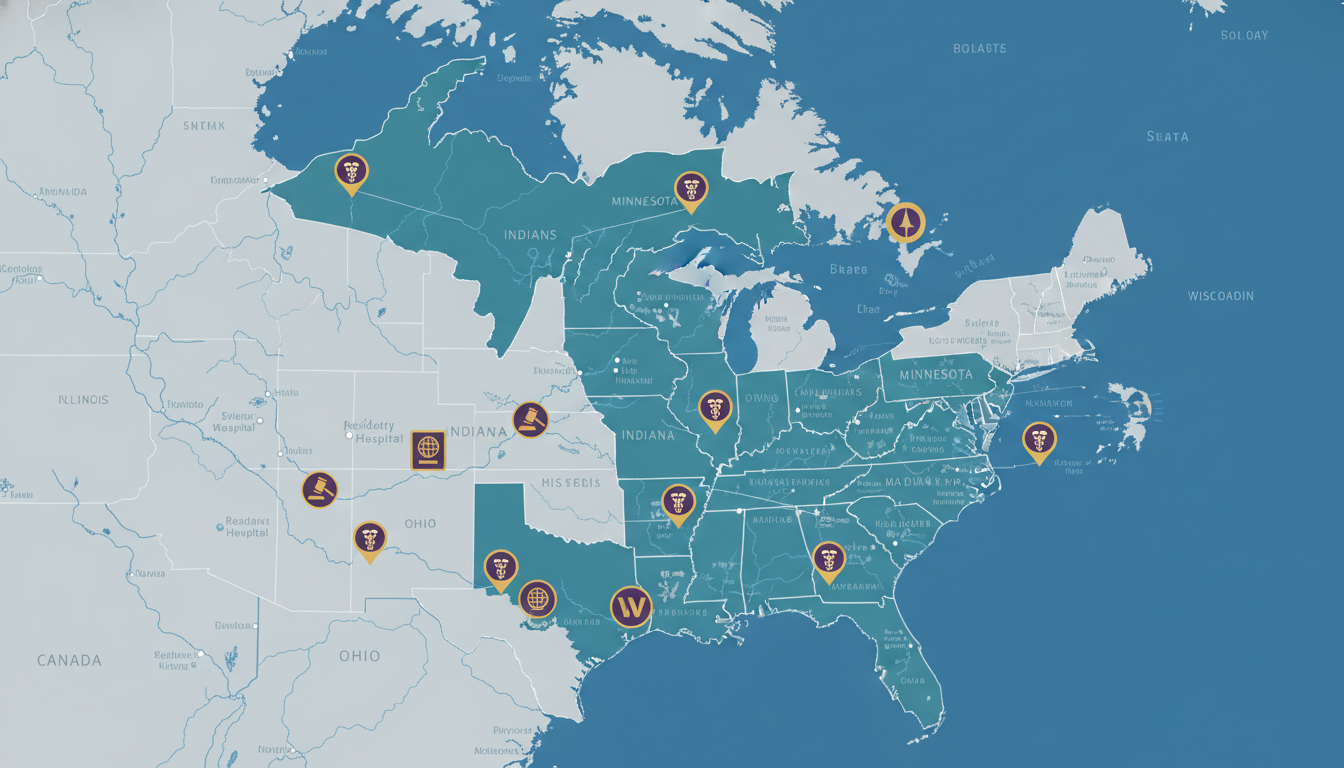
3. State-Specific Considerations in the Great Lakes Region
Each Great Lakes state has its own licensing rules, J‑1 waiver programs, and IMG residency patterns. While details change yearly, there are consistent themes that matter when choosing your residency visa and location.
3.1 Illinois (Chicago and beyond)
- Chicago hosts numerous academic centers that often sponsor both J‑1 and H‑1B, especially for competitive specialties and fellowships.
- Outside Chicago, many programs are J‑1 focused, particularly in family medicine, internal medicine, and pediatrics.
- Illinois uses Conrad 30 waivers, with strong demand in:
- Inner-city underserved areas
- Smaller cities and rural regions in central and southern Illinois
Strategy tip:
If your dream is academic medicine at a major Chicago institution and you can clear Step 3 early, H‑1B may be advantageous. If you want flexibility and are open to working in underserved areas after training, J‑1 remains a solid option.
3.2 Michigan
- Major academic centers (Ann Arbor, Detroit, Grand Rapids) often support IMGs and may sponsor both visas, though J‑1 is still the main residency visa.
- Michigan has a mix of urban underserved and rural northern areas with chronic physician shortages.
- The state’s Conrad 30 program is widely used for primary care, psychiatry, and hospitalist medicine.
Strategy tip:
Many IMGs do residency on J‑1 in Michigan and later secure a J‑1 waiver job in the same region or nearby. This is a strong path for IMGs planning long-term life in the Midwest.
3.3 Ohio
- Home to large academic systems in Cleveland, Columbus, Cincinnati, and multiple community programs.
- Like Michigan, Ohio uses its full share of Conrad 30 waivers most years.
- Many midwest residency programs in Ohio are accustomed to working with J‑1 physicians and sometimes H‑1B in academic centers.
Strategy tip:
If you want to stay in Ohio long-term, a J‑1 waiver plan through an underserved area is often realistic. H‑1B is more common when you are placed at or matched into a top-tier academic institution.
3.4 Minnesota & Wisconsin
- Strong academic centers (e.g., in Minneapolis-St. Paul, Madison, Milwaukee) with robust immigration infrastructure.
- Community and rural hospitals throughout Minnesota and Wisconsin have ongoing needs in primary care and psychiatry.
- Both states’ Conrad 30 programs are very relevant for IMGs, often with slightly less competition than some coastal states.
Strategy tip:
If you train in these states on a J‑1 and enjoy smaller community settings or rural life, you’ll find numerous J‑1 waiver opportunities. Academic institutions may offer H‑1B for fellowship or faculty roles.
3.5 Indiana and other neighboring Midwest states
- A mix of academic centers in Indianapolis and community programs throughout the state.
- Indiana’s physician shortages in rural counties make it an active state for J‑1 waivers.
- H‑1B sponsorship exists but is generally more limited at the residency level.
Strategy tip:
If you are willing to practice in rural or semi‑rural Indiana, a J‑1 waiver pathway often leads to long-term stability, sponsorship for permanent residence, and excellent clinical opportunities.
4. Practical Steps: How to Navigate Visa Choices Through the Match
4.1 Before ERAS: Building your visa strategy
Clarify your non‑negotiables
- Are you willing to accept J‑1 and later work in an underserved area for a J‑1 waiver?
- Is avoiding the 2-year home return requirement critical (e.g., due to family or political reasons)?
- Are you comfortable taking Step 3 early to be eligible for H‑1B?
Align with your career goals
- Strong interest in long-term academic career or subspecialty training in complex fields → H‑1B can be attractive.
- Openness to primary care, hospitalist work, or psychiatry in community settings → J‑1 plus J‑1 waiver may be ideal.
Research program visa policies
- Check program websites; many explicitly list IMG visa options (J‑1, H‑1B, both, or none).
- Use forums, NRMP/FRIEDA, and program emails to confirm policies.
- Create a spreadsheet noting:
- State, program
- Visa types supported
- Any special notes (e.g., H‑1B only for advanced years, Step 3 requirement deadlines)
4.2 During ERAS and interview season
Be transparent but strategic
- In your application, state your citizenship and current status accurately.
- If you are open to both J‑1 and H‑1B, say so. This flexibility increases your chances.
Ask precise questions on interviews
- Examples:
- “What visa types does your program typically sponsor for international medical graduates?”
- “Do you sponsor H‑1B for PGY‑1 or only for advanced positions?”
- “How many current residents are on J‑1 and H‑1B visas?”
- For Great Lakes targets, ask:
- “Do your graduates often stay in this region? How does the program support them with J‑1 waiver or H‑1B transitions?”
- Examples:
Factor in support infrastructure
- Programs with dedicated immigration/HR support reduce your stress.
- Ask if they have in-house legal counsel or use an experienced immigration firm.
4.3 After Match: Implementing your visa choice
If you match into a J‑1-sponsoring program
ECFMG documentation
- Program sends your contract and GME details to ECFMG.
- You complete Form DS-2019 application via ECFMG (online system).
- Prepare:
- Passport
- Medical school diploma
- ECFMG certificate copy
- Proof of funding (residency contract)
Visa interview
- Use the DS-2019 to schedule a J‑1 visa appointment at the U.S. Embassy/Consulate.
- Bring all ECFMG and residency paperwork, plus ties to home country (as required).
Plan ahead for the J‑1 waiver
- During the second half of residency, begin researching:
- State-specific J‑1 waiver programs in the Great Lakes region (Conrad 30)
- Employer needs in your specialty
- Application deadlines (often early in the final year of training)
- During the second half of residency, begin researching:
If you match into an H‑1B-sponsoring program
Step 3 timing
- Confirm that your Step 3 result is available in time for the hospital to file an H‑1B petition.
- If not, discuss contingency options (some programs may start you on J‑1 instead).
H‑1B petition
- The institution’s legal team files:
- Labor Condition Application (LCA)
- H‑1B petition (I-129) with supporting documents
- You provide:
- Passport, medical diploma, ECFMG certificate
- USMLE scores (including Step 3)
- Licensure documentation
- The institution’s legal team files:
Arrival and long-term outlook
- Once in H‑1B status, work with:
- GME office
- Potential employers or academic mentors
- To time your green card filing (PERM, I‑140, I‑485) based on your 6‑year H‑1B clock.
- Once in H‑1B status, work with:
5. Planning Beyond Residency: Waivers, Green Cards, and Staying in the Region
5.1 J‑1 waiver pathways in the Great Lakes
Most J‑1 IMGs looking to stay in the U.S. after residency or fellowship use one of several waiver options:
Conrad 30 State Waivers
- Each state (e.g., Illinois, Michigan, Ohio, Minnesota, Wisconsin, Indiana) can sponsor up to 30 J‑1 waiver slots per year.
- Requirements:
- Full-time clinical employment (often 3 years) in a Health Professional Shortage Area (HPSA) or underserved area.
- Contract with a hospital or clinic willing to support the waiver.
- Competitive but very realistic in many Great Lakes states, especially for:
- Internal medicine (hospitalists, primary care)
- Family medicine
- Psychiatry
- Pediatrics
Federal waiver programs
- Veterans Affairs (VA)
- Health and Human Services (HHS) for certain research or clinical roles
- Less common but relevant in large academic or research centers in the region.
Hardship or persecution waivers
- For IMGs who can prove severe hardship or risk if forced to return home.
- Complex and require expert legal guidance.
5.2 Green card strategies for IMGs in the Great Lakes
For J‑1 physicians:
- Usually begin green card processes after securing a J‑1 waiver job.
- Employer may sponsor through PERM/EB‑2/EB‑3, or some might qualify under NIW (National Interest Waiver), especially those working in underserved areas.
For H‑1B physicians:
- Can start PERM and I‑140 during residency/fellowship at a cap-exempt academic center, then port to cap-subject employers later.
- Many academic centers in Chicago, Cleveland, Minneapolis, etc., are experienced in sponsoring faculty green cards.
5.3 Lifestyle and career considerations
When thinking beyond visas:
- The Great Lakes region offers:
- Major academic hubs for subspecialty practice
- Numerous community and rural opportunities for primary care and hospitalists
- Generally lower cost of living than coastal cities
- Strong communities of IMGs from diverse countries
Your visa path should align with:
- Where you want to live (urban vs suburban vs rural)
- Whether you prioritize academic research and teaching or high-volume clinical work
- How quickly you aim to secure permanent residency and long-term stability
6. Actionable Checklist for IMGs Targeting the Great Lakes Region
Use this as a working roadmap:
24–18 months before Match
- Confirm graduation timeline and ECFMG certification plan.
- Decide initial preference: J‑1, H‑1B, or flexible.
- Start Step 3 preparation if considering H‑1B.
18–12 months before Match
- Research Great Lakes residency programs:
- Note which support J‑1 vs H‑1B.
- Identify academic centers vs community hospitals.
- Talk with recent IMGs in those programs about their residency visa experiences.
- Research Great Lakes residency programs:
ERAS submission
- Clearly state your citizenship and visa needs.
- Apply broadly to a mix of programs that actually support your preferred visa type(s).
Interview season
- Ask detailed questions about:
- Visa sponsorship (J‑1 vs H‑1B)
- Support for J‑1 waivers or green cards later
- Alumni career patterns in the Great Lakes region
- Ask detailed questions about:
Rank list
- Rank programs for overall fit, but:
- Double-check their visa policies.
- Ensure your top choices can realistically support your residency visa.
- Rank programs for overall fit, but:
Post-Match
- J‑1: Complete ECFMG sponsorship steps and prepare for the consular interview.
- H‑1B: Coordinate Step 3 proof and immigration paperwork with GME.
- Start thinking about waivers (for J‑1) or green card timing (for H‑1B), especially if you want to remain in the Great Lakes.
FAQ: Visa Navigation for IMGs in the Great Lakes Region
1. Is it easier to match into Great Lakes residency programs on J‑1 or H‑1B?
Most midwest residency programs, including those in the Great Lakes, predominantly sponsor J‑1 visas. H‑1B positions exist but are more often found at larger academic centers and may require Step 3 before Match. If you are flexible, being open to J‑1 significantly increases your options.
2. Should I rush to take Step 3 just to qualify for H‑1B?
Only if it fits your broader plan. Step 3 for H‑1B is valuable if:
- You are targeting specific academic centers known for H‑1B sponsorship.
- You urgently want to avoid the J‑1 home residency requirement.
However, a rushed Step 3 attempt that risks failure can hurt your overall profile. Balance the benefit of H‑1B against stress, timing, and your current exam readiness.
3. Can I switch from J‑1 to H‑1B after starting residency in the Great Lakes region?
In most cases, no. Once you begin residency on a J‑1 sponsored by ECFMG, your entire GME path is generally expected to be on J‑1, unless you fully exit J‑1 status and meet specific conditions. Switching mid-residency is rare and complex. If you strongly prefer H‑1B, you should plan for it before starting training.
4. If I complete residency on a J‑1 in the Great Lakes, is it realistic to stay in the region long-term?
Yes. Many IMGs complete residency on J‑1 and then obtain J‑1 waivers in Great Lakes states via Conrad 30 or other programs. These waiver jobs often lead to H‑1B status, and later, employer-sponsored green cards. Primary care, hospital medicine, psychiatry, and pediatrics are especially strong fields for this pathway in the Great Lakes region.
By understanding your IMG visa options, how J‑1 vs H‑1B impacts your residency and post-training life, and the specific landscape of midwest residency programs and Great Lakes residency opportunities, you can make informed decisions that support both your professional and personal goals.