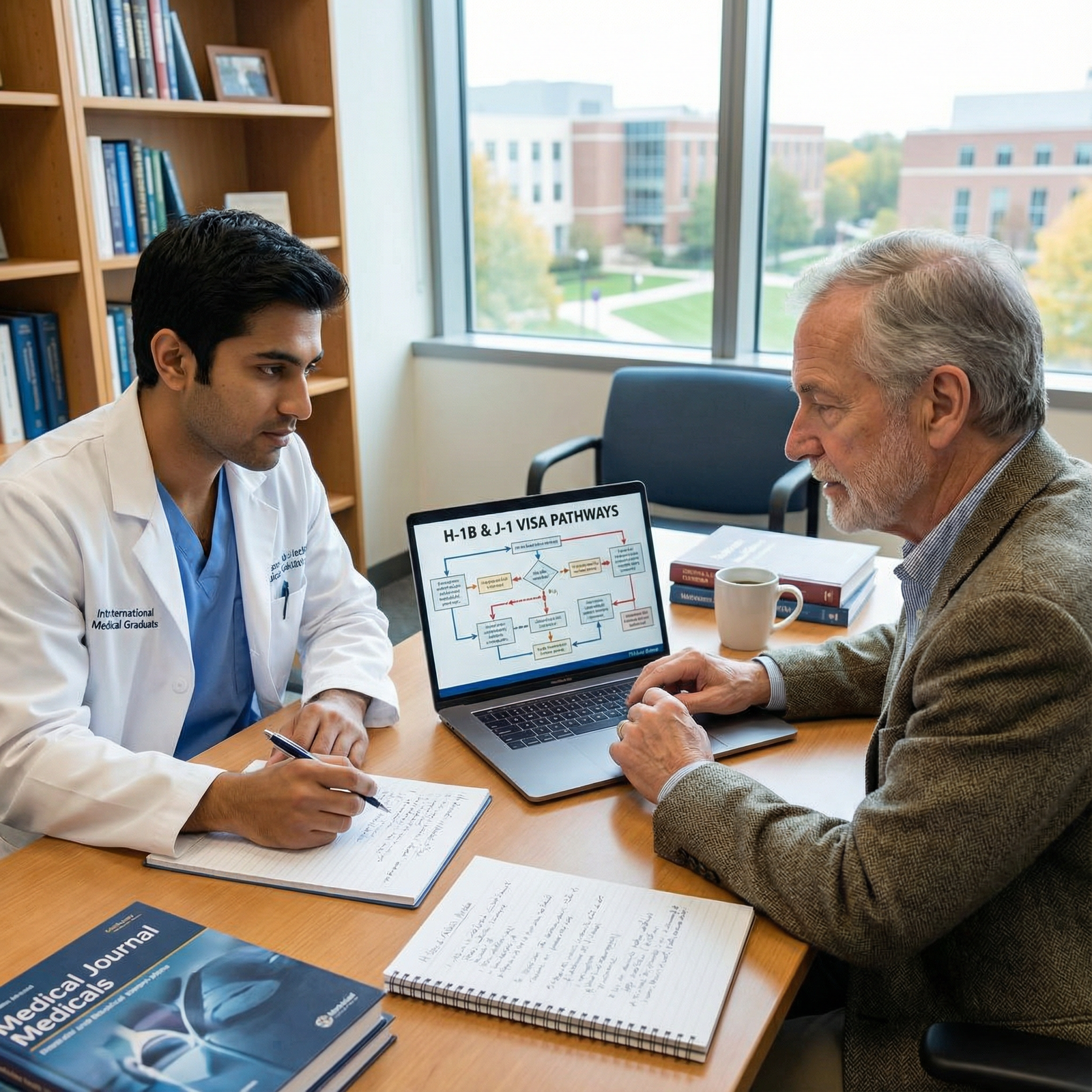
Navigating the U.S. visa system as a non-US citizen IMG while applying to Chicago residency programs can feel overwhelming. This guide focuses on the specific realities of training in Chicago and Illinois, breaking down residency visa options, how they affect your training and long-term plans, and what you should proactively do before and during the Match.
Understanding the Basics: Visas and Residency in Chicago
Chicago is one of the most popular destinations for international medical graduates. It has:
- Multiple major academic centers (e.g., University of Chicago, Northwestern, UIC, Rush)
- Large community-based Illinois residency programs in and around the city
- A longstanding history of accepting IMGs, including many foreign national medical graduates
If you are a non-US citizen IMG (no U.S. passport or green card) and you do not already have permanent residency or another independent work authorization, you will generally need one of the following visas to start residency:
- J-1 Exchange Visitor Visa (ECFMG-sponsored)
- H-1B Temporary Worker Visa (employer-sponsored)
Sometimes people informally call these “residency visas.” In reality, they are standard non-immigrant U.S. visas used for graduate medical education.
Key contextual points for Chicago and Illinois:
- Most Chicago residency programs sponsor only J-1, a smaller subset sponsors both J-1 and H-1B, and very few will sponsor H-1B only.
- Academic university-affiliated programs are more likely to have the infrastructure to process H‑1B than small hospital-only programs.
- Visa policy is program-specific; there is no single “Chicago rule.” Always check each program’s official website and confirm by email if unclear.
Major Visa Types for Residency: J-1 vs H-1B
This is the core decision most foreign national medical graduates face: J-1 vs H-1B. Understanding this deeply will shape your strategy, specialty choices, and long-term immigration planning.
J-1 Exchange Visitor Visa (ECFMG-Sponsored)
The J-1 is the most common residency visa for IMGs in the U.S.
Key characteristics
- Sponsored by ECFMG, not directly by the hospital.
- Category: “Alien Physician – Graduate Medical Education.”
- Valid for the duration of your ACGME-accredited training, usually up to 7 years total for all residency + fellowship(s) combined.
- Requires a 2-year home country physical presence requirement in most cases (INA 212(e)).
Eligibility basics
To get a J-1 for residency, you typically need:
- A valid ECFMG certification
- A contract or official offer letter from an accredited residency program
- Proof of adequate financial support (usually your residency salary suffices)
- No plans to abandon your home-country ties (you are a temporary visitor by design)
Advantages of the J-1 for residency in Chicago
- Widely accepted: Many Chicago and Illinois residency programs only sponsor J-1.
- Predictable process: ECFMG has an established, standardized system for processing J-1 applications, which Chicago programs are used to.
- Multiple specialties and fellowships: Most academic centers in Chicago are accustomed to having J-1 residents and fellows in various specialties.
Disadvantages / limitations
- 2-year home-country requirement (212(e))
- After training, you must either:
- Return to your home country for an aggregate 2 years, OR
- Obtain a J-1 waiver (e.g., Conrad 30, federal interest waiver, hardship/persecution waiver).
- After training, you must either:
- No “dual intent”
- J-1 is not formally dual intent like H-1B. Direct transition to a green card can be more complicated while on J-1.
- Limited moonlighting in many settings
- J-1 work is restricted to your approved training site(s); outside moonlighting is often not allowed or tightly controlled.
H-1B Temporary Worker Visa for Physicians
The H-1B is a work visa for “specialty occupations,” including physicians in residency and fellowship.
Key characteristics
- Sponsored by the employer, i.e., your residency program or sponsoring university/hospital.
- Dual intent: You can legally intend to immigrate permanently while on H‑1B.
- Requires:
- All USMLE Steps needed for full licensing in that state (often Step 3 required by many Illinois residency programs for H-1B sponsorship)
- A valid job offer and prevailing wage
- Typically granted for up to 3 years initially, renewable up to 6 years total (with some extensions in the green card process).
Advantages of the H-1B
- No 2-year home return requirement like the J-1.
- Easier to align with long-term U.S. immigration goals (e.g., eventual green card).
- Often more flexibility with moonlighting (subject to program and state rules).
- Potentially smoother transition to academic or private practice employment after residency in Chicago or elsewhere.
Disadvantages / limitations
- Not all Chicago residency programs sponsor H-1B. Many explicitly say “J-1 only.”
- Step 3 is usually required before H-1B petition filing, and sometimes before rank list or Match. This is a major timing pressure.
- Cap issues:
- Many university-affiliated hospitals are cap-exempt, but some community programs may be cap-subject, which creates timing and lottery constraints.
- Processing fees and administrative burden are higher for the program; some are reluctant to take this on.

How Visa Choice Interacts with Your Long-Term Plans
Your decision between J-1 and H-1B—when you have a choice—should be anchored to your career vision and personal circumstances.
If You Plan to Permanently Settle in the U.S.
For non-US citizen IMGs who aim to build a long-term life and career in the U.S.:
- H-1B is often more attractive because:
- No J-1 home-country requirement.
- Dual intent is recognized, simplifying future green card processing.
- Employers in Illinois (large hospital systems, academic centers) are used to hiring physicians on H‑1B.
However, you will need to align your entire application timeline to be competitive for H‑1B-friendly programs:
- Pass USMLE Step 3 early (ideally before applying or at least before rank list certification).
- Target Chicago residency programs that explicitly state “J-1 and H-1B” on their websites.
- Be ready for more stringent selection; some programs offering H‑1B have more competitive applicant pools.
If You Are Open to Returning Home or Working Abroad
If you are comfortable with the possibility of returning to your home country or practicing in a different region:
- The J-1 may be simpler:
- Many Illinois residency programs sponsor only J‑1, giving you more options and possibly increasing your chances of matching.
- You can still later obtain a J-1 waiver and stay in the U.S., often in an underserved area (potentially even within Illinois).
Conrad 30 and Illinois
- The Illinois Conrad 30 J-1 waiver program allows up to 30 waivers per year for physicians who agree to work in designated underserved areas (often primary care, but also some specialties).
- After your Illinois residency or fellowship under J-1, you could:
- Get a job in an underserved Illinois region.
- Convert to H‑1B for that job as part of your waiver.
- Eventually pursue a green card.
This path is common for IMGs training in Chicago who are initially on J-1 but wish to remain in the U.S. long-term.
Chicago-Specific Considerations for Non-US Citizen IMGs
Chicago has a rich ecosystem of residency programs, but visa policies vary widely. Understanding local patterns can help you tailor your application.
Types of Programs in Chicago and Visa Trends
Large University Programs
- Examples: Northwestern, University of Chicago, UIC, Rush.
- Often sponsor J-1 and H-1B (but check each specialty and sub-program).
- May have:
- Higher academic expectations (research, scores, letters).
- Earlier internal deadlines for Step 3 and visa paperwork.
- Attract a global applicant pool; competition for H‑1B spots is intense.
University-Affiliated Community Programs
- Examples: community hospitals that are teaching affiliates of the big universities.
- Many will accept J-1; some offer H‑1B for exceptional candidates or specific departments.
- Can be relatively IMG-friendly but may have limited administrative capacity for complex visa cases.
Community-Based Illinois Residency Programs in Greater Chicago
- Located in suburbs or nearby cities across Illinois.
- Frequently J-1 only due to resource constraints.
- Often highly IMG-friendly and can be excellent training environments, especially in Internal Medicine, Family Medicine, Pediatrics, and Psychiatry.
How to Research Visa Policies for Chicago Programs
Program Websites
- Look under:
- “International Medical Graduates”
- “Eligibility & Requirements”
- “Visa Sponsorship”
- Common wording:
- “We sponsor J-1 visas only via ECFMG.”
- “We sponsor J-1 and H-1B visas.”
- “We are unable to sponsor H‑1B visas.”
- Look under:
FREIDA & ERAS Descriptions
- Many programs indicate visa preferences in their official profiles.
- Use filters for “Sponsorship of J-1” and “Sponsorship of H-1B” where available.
Direct Email to Program Coordinators
- If information is unclear, send a concise email:
- Introduce yourself (non-US citizen IMG, ECFMG-certified or in progress).
- Ask specifically:
- “Does your program sponsor the J-1 visa?”
- “Does your program sponsor H-1B for residency?”
- Optional: ask if Step 3 is required by a specific date for H‑1B applicants.
- Keep it short, professional, and appreciative.
- If information is unclear, send a concise email:

Practical Timeline and Strategy for Visa Navigation
To successfully match and start residency in Chicago as a foreign national medical graduate, align your visa planning with the residency timeline.
1. Pre-Application Phase (12–18 Months Before Match)
Clarify your immigration priorities
- Decide your top goal:
- Maximize chance of matching anywhere in Chicago/Illinois → J-1 focus is usually safer.
- Prioritize long-term U.S. settlement and flexibility → Include H‑1B-capable programs and plan for Step 3.
Complete necessary exams
- USMLE Step 1 and Step 2 CK are essential for ECFMG certification.
- If you want H‑1B:
- Aim to complete USMLE Step 3 before ERAS opens or at least before rank list certification.
- Some Chicago programs won’t consider H‑1B without a passed Step 3 at the time of ranking.
Build a visa-aware program list
- Categorize Chicago and Illinois residency programs into:
- J-1 only
- J-1 + H-1B
- H-1B only (rare)
- Ensure diversity:
- Include a healthy number of J‑1-friendly programs to protect your overall chances.
- Sprinkle in H‑1B options if your profile is competitive (strong scores, U.S. clinical experience, research).
2. Application Season (ERAS Submission to Interview Invitations)
In your application
- You do not need to pick a visa type on ERAS as a rigid choice. Programs will infer from:
- Your citizenship.
- Whether you mention being ECFMG-certified and Step 3 status.
- You can:
- Highlight that you are a non-US citizen IMG and ECFMG-certified.
- Note Step 3 status clearly in the application and CV.
During interviews
- Be prepared for visa questions:
- “Do you need visa sponsorship?”
- “Are you applying for J-1, H-1B, or both?”
- Recommended approach:
- Be honest and flexible.
- If you are open to J‑1 and H‑1B, say so.
- If you specifically want H‑1B, explain briefly why (e.g., long-term career in the U.S., dual intent) but make clear you understand the administrative burden and are prepared with Step 3 and documents.
3. Post-Interview and Rank List Phase
Clarify any remaining ambiguity
- If visa policies were not discussed clearly:
- Email the program coordinator politely:
- Confirm whether they will sponsor your needed visa type if you match.
- Email the program coordinator politely:
- Remember: Rank programs based on:
- Training quality.
- Fit.
- Visa feasibility.
- Do not rank a program that:
- Cannot sponsor any visa you are eligible for.
- Is unwilling to support your needed visa type.
4. After Match: Visa Processing
Once you match into a Chicago residency program:
For J-1 (ECFMG-sponsored)
- Steps typically include:
- Program issues a contract and completes its section on the ECFMG system.
- You provide:
- ECFMG certification.
- Identity and education documents.
- Financial support details (usually your salary).
- ECFMG issues Form DS-2019.
- You schedule a U.S. Embassy/Consulate appointment for your J‑1 visa stamp (if outside the U.S.).
- Start the process early; Chicago programs often have strict start dates (late June or early July).
For H-1B (Program-sponsored)
- Program’s legal or HR office will:
- File a Labor Condition Application (LCA).
- Prepare and file the H‑1B petition with USCIS.
- You must:
- Ensure Step 3 and licensing requirements for Illinois are complete.
- Provide all requested documents quickly.
- If outside the U.S.:
- After petition approval, you apply for the H-1B visa stamp at a U.S. consulate.
- Time is tighter for H‑1B; delays can jeopardize your ability to start on time, so be extremely responsive.
Common Pitfalls and How to Avoid Them
1. Assuming All Chicago Programs Sponsor H-1B
Reality:
Many Chicago and Illinois residency programs are J‑1 only. If you refuse J‑1, you will drastically reduce your options.
Solution:
- Verify each program’s policy.
- Maintain flexibility if matching is your priority.
2. Delaying USMLE Step 3 If You Want H-1B
Without Step 3, many programs will not file H‑1B for residency.
Solution:
- Take Step 3 as early as realistically possible.
- If you cannot complete Step 3 before ranking, be prepared to accept a J‑1 if offered.
3. Underestimating the 2-Year Home Requirement on J-1
Some IMGs assume they can “skip” it later. It is legally significant.
Solution:
- Learn about J‑1 waiver pathways (Conrad 30 Illinois, federal waivers).
- If you choose J‑1, mentally plan for at least 2–3 years of underserved work after training if you want to remain in the U.S.
4. Poor Communication With Program About Visa Needs
If you fail to clearly indicate your status, you might face last-minute surprises.
Solution:
- Be transparent from the beginning that you are a non-US citizen IMG needing sponsorship.
- Ask for written confirmation of visa type if uncertain.
5. Not Factoring Family Considerations
Spouses and children will be on J-2 (for J‑1) or H‑4 (for H‑1B).
- J‑2 spouses can often apply for work authorization.
- H‑4 employment is more limited (with exceptions when the principal is far in the green card process).
Plan early for schooling, childcare, and your partner’s career in Chicago.
Frequently Asked Questions (FAQ)
1. As a non-US citizen IMG, which visa gives me a better chance of matching in Chicago—J-1 or H-1B?
For matching probability alone, being open to J‑1 usually gives you a better chance because many Chicago residency programs sponsor only J‑1. If you insist on H‑1B, your pool of programs shrinks, and competition for those limited H‑1B slots is higher. A balanced strategy is to remain open to J‑1 while targeting some H‑1B-capable programs if you are competitive and have Step 3 completed early.
2. Can I switch from J-1 to H-1B during or after residency?
Switching during residency is generally not allowed while you are under the J‑1 physician category (because of 212(e)). After you complete training, you can move to H‑1B only after:
- Fulfilling the 2-year home-country requirement, OR
- Obtaining a J‑1 waiver (e.g., Conrad 30 Illinois) and then taking a job willing to sponsor you for H‑1B.
So, you don’t simply “convert” J‑1 to H-1B inside the same training program; it is tied to completing or waiving the J‑1 obligation.
3. Do all specialties in Chicago offer H-1B equally for IMGs?
No. Visa options can differ by specialty and even within the same institution. For example:
- Internal Medicine or Family Medicine programs at a university hospital might be more experienced with H‑1B.
- Smaller subspecialties or highly competitive fields may be more restrictive or limited in H‑1B sponsorship. Always check the specific specialty program page and, if needed, confirm by email.
4. I already have a different U.S. status (e.g., F-1, F-2, H-4). Do I still need a residency visa?
Yes. Unless your current status independently authorizes full-time clinical work as a resident physician (which it usually does not), you will need a specific work or training visa such as J‑1 or H‑1B for residency. However, your current status might influence how you transition:
- F‑1 with OPT may allow some timing flexibility while your J‑1 or H‑1B is processed.
- H‑4 might allow you to stay in the U.S. while your new status is being arranged.
Discuss your particular case with an immigration attorney once you have a residency offer.
Visa navigation is a critical component of your residency journey as a non-US citizen IMG in Chicago. By understanding J-1 vs H-1B, researching each Illinois residency program’s policies, aligning your exam and application timeline, and planning for the long term, you can significantly reduce uncertainty and focus on what matters most—becoming an excellent physician.