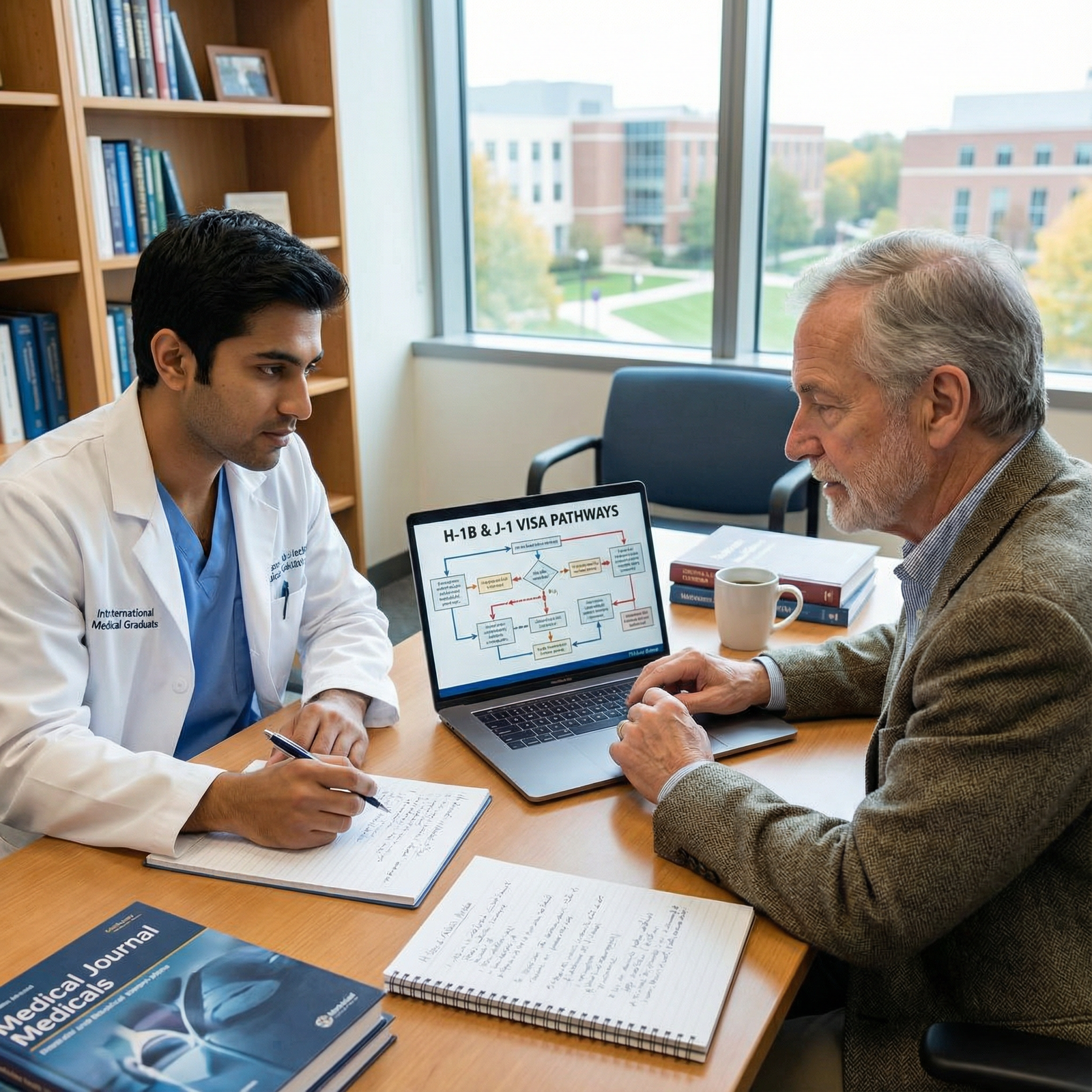
Understanding the Visa Landscape for Non-US Citizen IMGs in Preliminary Medicine
For a non-US citizen IMG planning a preliminary medicine year (prelim IM), visa strategy is as important as your ERAS application. Your visa choices will influence:
- Which programs you can apply to
- How competitive you appear to programs
- Whether you can do fellowships or categorical training later
- Your long-term ability to work in the United States
Because a preliminary medicine year is usually one year only and often used before advanced specialties (neurology, radiology, anesthesia, radiation oncology, PM&R, etc.), foreign national medical graduates must think about both short-term and long-term visa implications.
This guide walks you through the major IMG visa options, how they apply specifically to prelim IM, and how to make strategic decisions that protect your future training and career.
Key Visa Types for Residency: J-1 vs H-1B for a Preliminary Medicine Year
For most residency programs, the two main residency visa pathways are:
- J-1 Exchange Visitor Visa (ECFMG-sponsored)
- H-1B Temporary Worker Visa (employer-sponsored)
Understanding J-1 vs H-1B within the context of a preliminary medicine year is critical, because what seems like a “simple one-year decision” can affect your future categorical residency or fellowship options.
J-1 Visa: The Default for Most Non-US Citizen IMGs
The J-1 visa is the most common option for a non-US citizen IMG entering residency.
Key features:
- Sponsored by ECFMG, not by the hospital directly
- Usually easier and faster for programs to arrange
- Widely accepted: many community and university programs sponsor only J-1
- Typically valid for the duration of your ACGME-accredited training, including preliminary + categorical + fellowship (up to a maximum of 7 years in most cases, sometimes longer with extensions)
Pros for a preliminary medicine year:
- Broad access to programs: Many prelim IM programs sponsor only J-1, so choosing J-1 greatly increases your program list.
- Administrative simplicity: Programs are very familiar with J-1 residents; immigration offices know the process well.
- Guaranteed for training only: As long as you meet ECFMG requirements, the training visa is usually straightforward.
Crucial downside: The 2-year home-country requirement
Most J-1 physicians are subject to INA 212(e), the “two-year home residency requirement.” After completing all your J-1–sponsored training (including preliminary year, categorical, and fellowship years), you must:
- Either return to your home country (or country of last permanent residence) for a cumulative 2 years, or
- Obtain a J-1 waiver before you can:
- Change to H-1B
- Adjust status to a green card
- Get certain other work visas
This is less of a concern during your prelim IM year itself, but it becomes a major factor once you start categorical residency or fellowship and later seek long-term employment in the US.
Is J-1 appropriate for a preliminary medicine year?
For many non-US citizen IMGs seeking prelim medicine, yes, especially if:
- Your main goal is to secure any ACGME-approved preliminary year to start an advanced specialty
- You’re not yet sure about long-term US practice
- Your target advanced specialty primarily sponsors J-1 anyway (e.g., many academic neurology or radiology programs)
However, you should still ask: If I do my prelim year on J-1, how will this affect my future categorical position and eventual waiver options?
H-1B Visa: Less Common, but Sometimes Strategically Valuable
The H-1B is a work visa for “specialty occupations” requiring at least a bachelor’s degree (and in medicine, a medical degree + USMLE + state eligibility). For residency:
- Sponsored by the residency program/hospital, not ECFMG
- Requires you to have passed USMLE Step 3 at the time of visa filing in most states
- More complex and expensive for programs to handle than J-1
Pros for a preliminary medicine year:
- No automatic 2-year home residence requirement
- Can be a better foundation for long-term US career (easier transition later to employment-based green card for some)
- Attractive if you already see yourself settling in the US long-term and want to avoid complex J-1 waiver issues later
Cons (especially relevant to prelim IM):
- Many prelim IM programs do not sponsor H-1B at all, especially smaller community hospitals.
- Programs that do sponsor H-1B often reserve it for categorical residents, not prelims.
- You must typically have passed USMLE Step 3 before the hospital can file the H-1B petition. That can be difficult to time while still abroad.
- H-1B status is time-limited to 6 years (with certain exceptions related to green card processes). If you use 1 year for prelim and then do 3 years of categorical and 3+ years of fellowship, you may exceed the 6-year limit or require complex planning.
When might H-1B for a prelim year make sense?
- You already passed Step 3 and have strong applications to highly competitive programs that are known to sponsor H-1B even for prelims.
- You are planning an advanced specialty and eventual US-based long-term practice and want to avoid the J-1 home-country requirement entirely.
- You understand that some advanced programs may still prefer or require J-1.
J-1 vs H-1B: Strategic Considerations Specifically for Preliminary Medicine
For a prelim IM year, the decision is not only about this single year; it’s about the downstream sequence:
- Preliminary Medicine (1 year)
- Advanced/Categorical Residency (3–4 years)
- Optional Fellowship (1–3+ years)
- Post-training employment and immigration
Common scenarios for non-US citizen IMGs:
Scenario A: Prelim IM → Advanced Anesthesiology
- Many anesthesiology programs prefer J-1 but some sponsor H-1B.
- If your prelim year is J-1, your anesthesiology residency is likely J-1 too, and you’ll later need a waiver job.
- If you secure H-1B for prelim, you might still end up on J-1 later if your anesthesia program only sponsors J-1, creating a mixed-history that you need to navigate carefully.
Scenario B: Prelim IM → Neurology or Radiology
- Many big-name academic programs sponsor J-1 only.
- Choosing J-1 for prelim may align better with these programs’ visa policies and simplify your eventual match.
Scenario C: Uncertain long-term plans
- If you are not sure where you’ll ultimately practice or which specialty you’ll enter, J-1 for prelim might keep more doors open program-wise, but you must be aware of the eventual 2-year home rule implications.
For most non-US citizen IMGs in preliminary medicine, the practical reality is:
- J-1 is the default and often the only viable option
- H-1B, while appealing in theory, is usually limited to specific institutions, competitive applicants, and precise timing of Step 3

How Visa Policies Shape Your Prelim Medicine Application Strategy
Visa navigation must influence where and how you apply.
Step 1: Know Your Own Immigration Profile
Before building your ERAS list, clarify:
- Are you a non-US citizen IMG without any US permanent status?
- Do you already hold another status (F-1 from US medical school, J-2 as a spouse, H-4, etc.)?
- Have you previously been on a J-1 (research, observer, or clinical) that might trigger a 2-year home requirement already?
- Have you passed USMLE Step 3?
- What is your long-term goal: temporary US training or long-term US practice and immigration?
This baseline determines what visa options are realistic, not just ideal.
Step 2: Research Program Visa Policies Specifically for Prelim Positions
Many programs list visa policies on their websites, but often they:
- Do not differentiate clearly between categorical and prelim positions
- Are outdated or incomplete
- Are silent about H-1B
Your actions:
Use official program websites and FREIDA to identify:
- “J-1 only”
- “J-1 and H-1B”
- “No visa sponsorship”
When in doubt, email the program coordinator with a short, professional message:
- Confirm:
- Do you sponsor visas for preliminary medicine positions?
- If yes, which types (J-1, H-1B)?
- Are there extra requirements for H-1B (e.g., Step 3 deadline, timing)?
- Confirm:
Keep a spreadsheet with columns like:
- Program name
- Type (university / community / hybrid)
- Visa types supported (J-1 / H-1B / none)
- J-1 only or J-1 & H-1B
- Notes on prelim vs categorical
Step 3: Align Your Application List with Your Visa Reality
If you do not have Step 3 or know you won’t before match deadlines:
- Realistically, do not rely on H-1B.
- Focus on programs that openly support J-1 visas.
If you already have Step 3 and a strong CV:
- Apply broadly to J-1-sponsoring prelim programs.
- Add a subset of H-1B-friendly academic programs that historically sponsor H-1B for IMGs, making sure they actually consider H-1B for prelims.
Step 4: Communicate Clearly in Your Application and Interviews
In ERAS and interviews:
- Be honest about your citizenship and visa needs.
- Avoid vague phrases like “I’m open to any visa” if that is not realistic (for example, if you cannot meet Step 3 requirements for H-1B).
- If comfortable with J-1, say so:
- “As a foreign national medical graduate, I am fully prepared to train under ECFMG-sponsored J-1 status and understand the associated requirements.”
- If you have Step 3 and programs mention H-1B:
- You may state: “I have completed USMLE Step 3 and would be eligible for consideration for an H-1B, depending on program policy.”
Careful, transparent communication reduces the risk of rank list surprises because of visa misunderstandings.
Planning Beyond the Prelim Year: How Today’s Visa Choice Affects Tomorrow
Though your focus now is securing a preliminary medicine year, you must think ahead to advanced training and career.
Path 1: J-1 for Prelim + J-1 for Advanced/Categorical + Possible J-1 for Fellowship
This is the most common path for a non-US citizen IMG:
- Prelim IM year on J-1
- Advanced or categorical residency on J-1
- Optional fellowship(s) on J-1
- At the end of training, you are subject to the 2-year home residence requirement unless you obtain a waiver.
Key implications:
- You can complete all your training continuously within J-1 limits (often up to 7 years, plus possible extensions).
- After training, you must either:
- Go home for 2 years, or
- Obtain a J-1 waiver, often through service in an underserved area (e.g., Conrad 30 program) under an H-1B work visa.
- Green card and long-term stay in the US typically follow after the waiver service, not immediately post-residency.
This path is well-established and realistic, but you should be mentally prepared for the waiver stage from early in your training.
Path 2: H-1B for Training
A less common but important path:
- Prelim IM on H-1B (rare, but possible at some institutions)
- Advanced/Categorical residency also on H-1B, often at the same or another sponsoring institution
- Fellowship potentially on H-1B (if within 6-year limit or extended through green card process)
Considerations:
- You avoid the J-1 home-residence requirement.
- But you consume your limited H-1B time during training.
- If you want multi-stage training (e.g., preliminary year + categorical + 2–3-year fellowship), you may approach or exceed the 6-year H-1B maximum and require careful timing of green card sponsorship.
This path works best if:
- You have a clear single specialty trajectory (e.g., IM → cardiology fellowship)
- You match into programs that are comfortable with H-1B for the entire sequence
- You have advisers and lawyers to help navigate the 6-year limit and early green card process
Path 3: Mixed History (e.g., J-1 Prelim, H-1B Later, or Vice Versa)
It is possible to:
- Do a J-1 prelim year, then later obtain H-1B for advanced residency or fellowship.
- Or start on H-1B and later accept a J-1 position if that’s what your ideal advanced program offers.
However, mixed histories are complex:
- If you have ever been in clinical J-1 physician status subject to 212(e), that requirement remains, regardless of later H-1B status.
- Future changes of status, green card pathways, or waivers must account for your entire immigration history.
For most IMGs, it is better to plan a consistent path (all J-1 or all H-1B where possible), but reality may require flexibility.

Practical Tips and Common Pitfalls for Non-US Citizen IMGs in Prelim IM
1. Do Not Assume All Preliminary Medicine Programs Sponsor Visas
Some prelim-only programs, especially smaller or surgically oriented prelims, may not sponsor any visas.
Actionable advice:
- Filter programs early by visa policy before investing in applications.
- When unsure, confirm via email.
2. Step 3 Timing: Critical for H-1B Consideration
If your goal is to maximize your IMG visa options including H-1B:
- Plan Step 3 well before rank order list deadlines so that:
- Scores are available
- Programs can consider you for H-1B if they choose
If you cannot realistically pass Step 3 in time, accept that H-1B is unlikely for your prelim year and focus on strong J-1–accepting programs.
3. Coordinate with Your Advanced Specialty Plans
Because preliminary medicine is usually a stepping stone, you must align:
- Visa policies for prelim IM programs
- Visa policies for advanced specialty programs (e.g., anesthesia, neurology, radiology)
Example:
- If your top advanced neurology programs only sponsor J-1, then insisting on an H-1B prelim may not give you a meaningful advantage and could even complicate transitions.
- Conversely, if your advanced specialty prefers H-1B (e.g., some competitive academic radiology programs), passing Step 3 early and targeting H-1B-friendly prelim programs might strategically position you better.
4. Watch for Country-Specific Considerations
Some countries are on US government lists that may influence:
- Security screening
- J-1 or H-1B processing times
This does not usually prevent visa issuance but can slow things down. Start paperwork early and maintain prompt communication with your program and ECFMG.
5. Keep All Documentation Organized
You will repeatedly need:
- Medical diploma and transcripts
- ECFMG certificate
- USMLE score reports
- Passport identity pages and prior US visas
- Prior DS-2019 forms (if any)
- CV and employment history
As a foreign national medical graduate, missing or disorganized documents can delay visa processing—and in a one-year prelim position with a fixed start date, delays can be devastating.
Working with Program Offices and Legal Counsel
Graduate Medical Education (GME) Office Support
Every residency program is linked to a GME office that coordinates visas. Their expertise is invaluable, but they work with many residents and have strict timelines.
How to work effectively with them:
- Respond quickly and clearly to requests.
- Respect deadlines for forms, vaccinations, background checks, and visa paperwork.
- Ask questions early if you do not understand a form (e.g., DS-160, SEVIS fee, etc.).
Immigration Attorneys
Programs often work with institutional lawyers; you may also consider independent legal advice if:
- You have complicated prior US visa history
- You previously were on a J-1 (non-clinical or clinical)
- You are trying to switch from another status (e.g., F-1 with OPT, J-2, H-4)
A short consultation can clarify whether your chosen path—J-1 vs H-1B; preliminary then advanced; waiver options—is realistic.
Summary: Building a Smart Visa Strategy for a Prelim Medicine Year
For a non-US citizen IMG pursuing a preliminary medicine year:
- J-1 is the most common, accessible visa type and opens the largest number of prelim IM programs.
- H-1B can be attractive but is realistically limited by Step 3 timing, institutional policies, and long-term 6-year caps.
- Your visa choice today affects your advanced specialty match, fellowship opportunities, and eventual ability to work long-term in the US.
- Treat visa planning as a parallel track to your ERAS and interview strategy, not an afterthought.
By understanding residency visa structures, comparing J-1 vs H-1B, and aligning them with both preliminary medicine and your future specialty plans, you can navigate the system more confidently and avoid costly surprises later.
FAQ: Visa Navigation for Non-US Citizen IMGs in Preliminary Medicine
1. As a non-US citizen IMG, is J-1 or H-1B better for a preliminary medicine year?
“Better” depends on your goals:
- J-1: More available, easier for prelim IM positions, widely supported by programs. But it usually comes with the 2-year home residence requirement at the end of all training unless you secure a waiver.
- H-1B: No automatic 2-year home rule and can be better for long-term US immigration, but far fewer prelim programs sponsor it, and you generally need USMLE Step 3 before application.
For most foreign national medical graduates pursuing prelim medicine, J-1 is the realistic default, with H-1B as a niche option for a smaller subset.
2. Can I start my prelim IM year on J-1 and later switch to H-1B for advanced residency?
Sometimes, yes—but with important caveats:
- If your J-1 is subject to the 2-year home-country requirement, you cannot change to H-1B inside the US until you either:
- Complete the 2 years at home, or
- Obtain a J-1 waiver.
- Some physicians finish all training on J-1, then obtain a waiver job on H-1B afterward.
In other words, you usually do not simply move from J-1 to H-1B between training programs inside the US without addressing the 212(e) requirement.
3. Do all preliminary medicine programs sponsor visas for non-US citizen IMGs?
No. Visa policies vary widely:
- Some programs sponsor J-1 only
- Some sponsor both J-1 and H-1B (more often large academic centers)
- Some do not sponsor any visas and only accept US citizens or permanent residents
You must research each program and, when unclear, confirm with the coordinator whether they sponsor visas for preliminary medicine positions specifically.
4. If I’m not sure whether I will stay in the US long-term, how should that affect my visa choice?
If your plan is uncertain:
- J-1 may be perfectly appropriate, allowing you to gain US clinical training experience.
- If you later decide to settle in the US, you can explore J-1 waiver programs after residency and fellowship.
- If you strongly suspect you want permanent US practice from the start and can realistically secure Step 3 and H-1B support, you might explore an H-1B route, but this is often challenging for a prelim year.
In many cases, it’s reasonable to accept J-1 for prelim medicine while keeping your long-term options open and re-evaluating during your training.
By integrating visa planning into your residency match and applications strategy, you significantly improve your chances of not only matching into a preliminary medicine year, but also building a sustainable pathway through advanced training and onward to the career you envision in the United States.