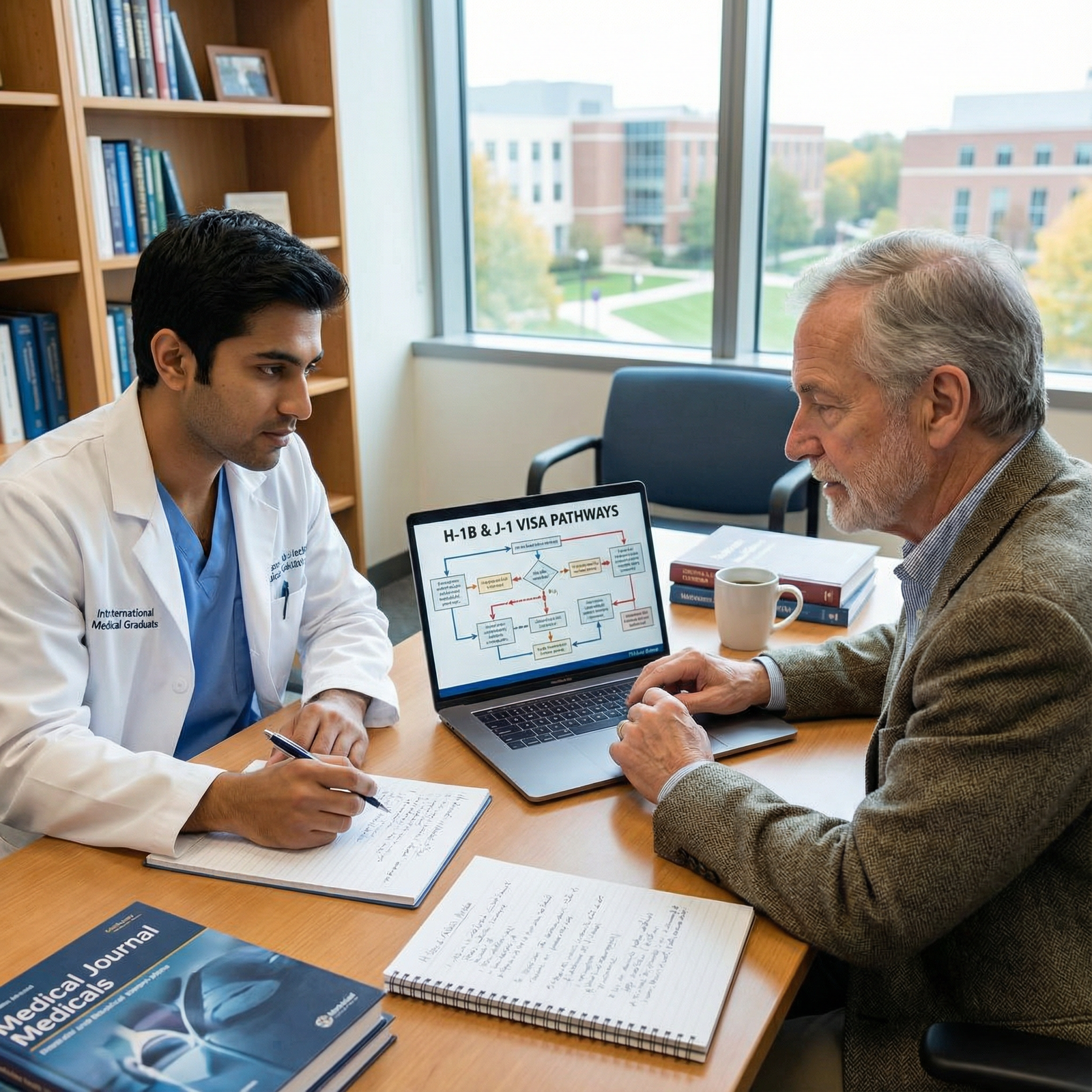
Understanding the J-1 Waiver Landscape in California’s Central Valley
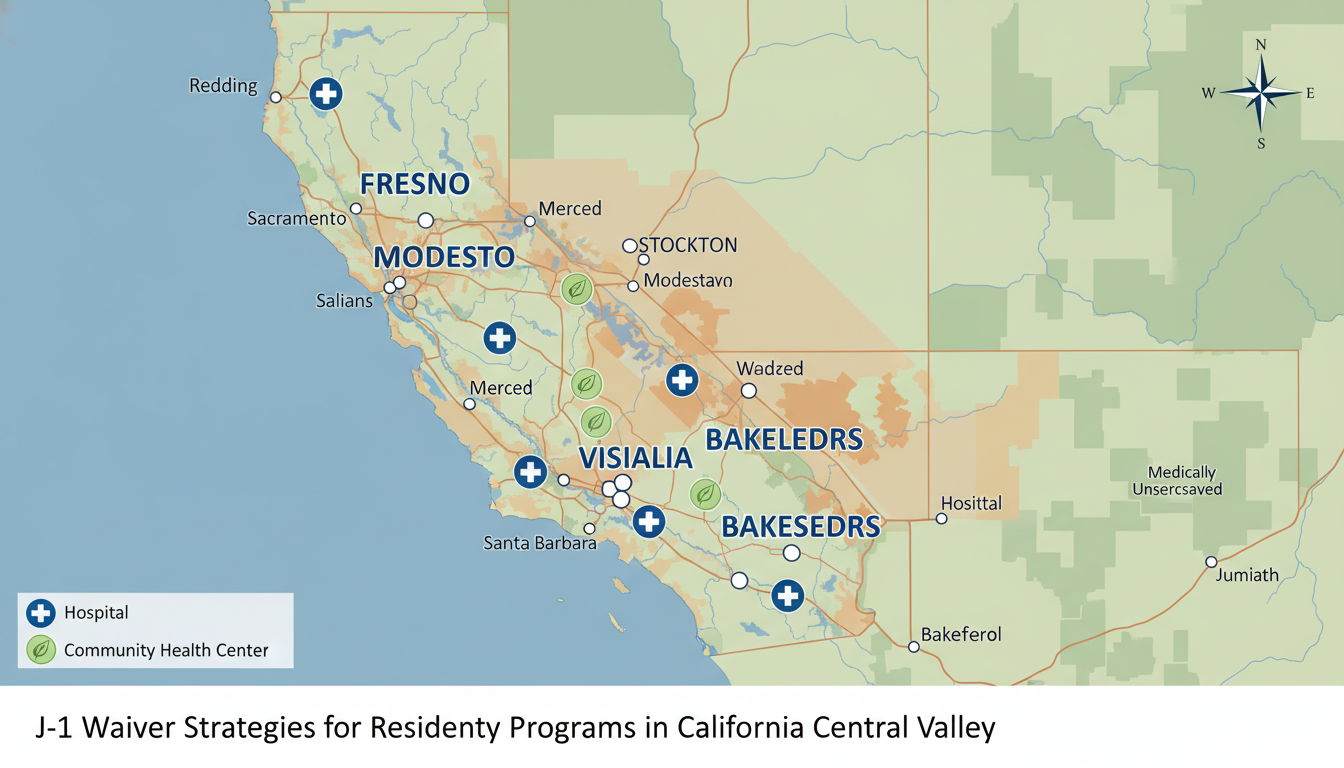
Residency programs in California’s Central Valley sit at a unique intersection of high clinical need, rich cultural diversity, and complex immigration policy. For many programs in Fresno, Bakersfield, Modesto, Stockton, Visalia, and surrounding communities, international medical graduates (IMGs) on J-1 visas are critical to staffing and service expansion—especially in primary care, psychiatry, and certain subspecialties.
However, a J-1 visa typically requires physicians to return to their home country for two years after training unless they obtain a J-1 home residency requirement waiver. For programs hoping to retain their graduates in the region, a clear strategy for J-1 waiver pathways—especially Conrad 30 and other underserved area waivers—is essential.
This article outlines practical, program-level strategies for leveraging J-1 waivers in the Central Valley, with special emphasis on:
- Using the Conrad 30 system effectively
- Aligning training and recruitment with underserved area waiver opportunities
- Coordinating with hospitals, health systems, and community clinics
- Supporting residents from Match Day through waiver approval and H-1B transition
While written for program directors, coordinators, and DIOs, residents and applicants interested in a Central Valley residency, including Fresno residency programs and neighboring institutions, will also find this roadmap invaluable.
Core J-1 Waiver Pathways Relevant to Central Valley Programs
Before building strategies, it helps to clarify the main waiver avenues relevant to the California Central Valley.
1. Conrad 30 State Program (California)
What it is:
The Conrad 30 program allows each state to sponsor up to 30 J-1 waivers per federal fiscal year (October 1 – September 30) for physicians who agree to practice in underserved areas.
Key points for Central Valley residency programs:
- California’s Conrad 30 slots are statewide but highly competitive.
- Many Conrad 30 placements historically go to primary care and psychiatry, but slots are also used for certain subspecialties in high-need areas.
- Most waivers require work in a Health Professional Shortage Area (HPSA), Medically Underserved Area (MUA), or serving a Medically Underserved Population (MUP)—all common in the Central Valley.
- Typical requirement:
- 3-year, full-time employment contract
- 40 hours/week of clinical work
- Site must demonstrate serving underserved patients (Medicaid, uninsured, language access, etc.).
For a Fresno residency, or other Central Valley programs, Conrad 30 is often the single most important post-residency visa pathway to keep graduating J-1 residents in the region.
2. Federal Agency Waivers
Residency programs in the Central Valley may also leverage a limited number of federal agency waivers:
- U.S. Department of Health and Human Services (HHS) – Primarily for research or clinical care in HHS-designated facilities; more often used by academic medical centers with significant research infrastructure.
- Appalachian or Delta Regional Commission – Not applicable to California but worth knowing conceptually.
- VA (Department of Veterans Affairs) – Possible if a physician will work full-time at a VA facility, but Central Valley VA positions may be geographically limited.
For the Central Valley, Conrad 30 and state-level underserved area waivers vastly overshadow federal agency options, but academic centers with research capacity in Fresno or nearby regions should at least consider HHS-designated opportunities.
3. Hardship and Persecution Waivers
A smaller share of J-1 physicians obtain waivers based on:
- Exceptional hardship to a U.S. citizen or permanent resident spouse/child
- Fear of persecution if returning home
These are highly individualized and not program-driven strategies, but programs still should be aware of them as occasional routes for valued graduates.
Building a Systematic J-1 Waiver Strategy at the Program Level
Residency programs that consistently retain J-1 graduates in the Central Valley treat J-1 waivers as a long-term workforce planning issue, not a last-minute paperwork emergency. Below is a structured approach to building an internal “waiver ecosystem.”
1. Start with Honest Internal Assessment
Programs should first answer:
- What proportion of our residents are IMGs on J-1 visas over the last 5 years?
- How many attempt to stay in the Central Valley after training?
- How many successfully secure a J-1 waiver job, and where?
- Which local employers (hospitals, FQHCs, private groups, academic affiliates) have a history of sponsoring Conrad 30 positions?
Compile this into a simple J-1 Waiver Outcomes Report shared internally with the GME office each year. Over time, this becomes a critical workforce planning tool.
2. Create a “J-1 Waiver Information Pathway” for Residents
Residents often receive inconsistent, incomplete, or late information about waivers. Programs should formalize:
Orientation session for incoming J-1 residents (PGY-1 or PGY-2):
- Basic explanation of J-1 vs. H-1B
- Why a J-1 waiver is needed
- California Conrad 30 timeline
- Underserved area definitions (HPSA/MUA)
- Examples of previous graduates’ waiver positions in Central Valley
Annual career/immigration workshop (PGY-2 and PGY-3/4):
- Invite immigration counsel experienced with California Conrad 30
- Review actual case examples from prior cohorts
- Discuss realistic timelines (more below)
Written guide or digital handbook for residents, covering:
- Common J-1 waiver myths
- Typical employment contract clauses
- How to assess if a site is “waiver-friendly”
This proactive approach makes J-1 issues less stressful and enhances the program’s reputation as supportive of IMGs.
3. Establish Institutional Relationships with Waiver Employers
In the Central Valley, waiver-friendly employers often include:
- Federally Qualified Health Centers (FQHCs) and FQHC Look-Alikes
- Rural health clinics
- County health departments and county hospital systems
- Safety-net hospitals and academic-affiliated teaching hospitals
- Behavioral health systems and community mental health centers
Residency programs should:
- Maintain a shared contact list of known waiver employers who have successfully sponsored Conrad 30 or underserved area waivers in the past.
- Schedule annual meetings (virtual or in-person) with each major employer:
- Ask how many J-1 waiver hires they anticipate in the next year or two.
- Share your anticipated graduating class profile (e.g., 8 IMGs on J-1 in internal medicine, 3 in psychiatry).
- Clarify the employer’s preferred specialties, languages, and locations.
This transforms waiver hiring from opportunistic to planned collaboration between GME and community partners.
4. Assign a J-1 Waiver Point Person
Designate a faculty member or coordinator as the J-1 Waiver Liaison:
- Tracks national and California-specific policy changes
- Serves as the first point of contact for residents with waiver-related questions
- Maintains an updated list of immigration attorneys who frequently work with Central Valley employers
- Coordinates educational sessions and employer outreach
This role does not replace legal counsel but provides organizational continuity and ensures institutional memory across graduating classes.
Timing and Tactical Planning for Central Valley Conrad 30 Success
Because Conrad 30 is time-limited and competitive in California, effective calendar management is as important as having an offer.
1. Understand the California Conrad 30 Cycle
Details can change, but California typically:
- Opens its Conrad 30 application window at the start of the federal fiscal year (October 1) or early in the cycle.
- Accepts applications on a first-come, first-served or rolling basis until slots are filled.
- Requires a complete application package at the time of submission (no place-holders).
Residency programs should annually review the California Department of Health Care Access and Information (HCAI) website (or successor agency) for:
- Exact opening date
- Eligibility criteria
- Required forms and documentation
- Special priorities (e.g., primary care, mental health, rural)
2. Backward Planning for PGY-3/PGY-4 Residents
Work backward from the resident’s anticipated graduation date and the Conrad 30 opening period.
For example, for a resident graduating in June 2027:
12–18 months before graduation (Jan–Jun 2026):
- Resident clarifies long-term plan: return home, fellowship, or waiver job.
- Program offers career counseling focused on California Central Valley options.
- J-1 Waiver Liaison connects resident with known waiver employers.
9–12 months before graduation (Jul–Sep 2026):
- Resident begins active job search in Central Valley waiver-eligible sites.
- Program shares a targeted list of FQHCs, rural clinics, county facilities, and safety-net hospitals.
- Early contract negotiations start once a position is identified.
6–9 months before graduation (Oct–Dec 2026):
- Employer finalizes offer letter/employment contract—contingent on waiver approval.
- Employer’s immigration counsel prepares Conrad 30 application in time for state opening.
- Program may provide letters of support or data showing local workforce needs.
4–6 months before graduation (Jan–Mar 2027):
- Conrad 30 application is already submitted; state review is underway.
- Once state recommends, the case goes to USCIS for waiver adjudication.
- Parallel planning for H-1B petition to begin employment on time after residency.
Programs can help by reinforcing to J-1 residents: waiting until late in PGY-3 or PGY-4 to “figure it out” is risky, especially in a competitive state like California.
3. Coordinating With Fellowships and Longitudinal Career Paths
Not all residents will move directly to waiver jobs; some pursue fellowship first. Central Valley residency programs can:
Provide early immigration counseling to fellowship-bound J-1 residents about:
- Whether the fellowship will also be on a J-1
- How many total years of J-1 status are likely
- When in their training trajectory they should start waiver job searching
Build relationships with Central Valley-based or California-wide fellowships that are:
- Willing to host J-1 fellows
- Located in or near underserved regions
- Historically connected to subsequent waiver employment
A well-informed J-1 resident planning on fellowship will be more competitive for eventual Central Valley residency plus waiver positions if they understand the full timeline early.

Aligning Program Curricula and Recruitment With Underserved Area Waivers
Residency programs in the Central Valley can make themselves and their graduates more waiver-competitive by explicitly aligning training experiences with underserved community needs.
1. Emphasize Rotations in Underserved and Rural Sites
Increase exposure to clinics and hospitals that are:
- In HPSAs or MUAs
- FQHCs or safety-net facilities
- County/municipal systems with large uninsured or Medicaid populations
Benefits:
- Residents gain first-hand experience with the exact practice environment where most J-1 waiver jobs exist.
- Employers see residents as “known quantities”, making them more comfortable extending waiver-backed offers.
- It reinforces the program’s mission alignment with Central Valley’s workforce needs.
Practical steps:
- Develop a longitudinal continuity clinic in an FQHC or county clinic for primary care specialties.
- Partner with community mental health centers for psychiatry rotations.
- Create a rural health track with extended rotations in smaller Central Valley towns.
2. Highlight Language and Cultural Competency
The California Central Valley has large Spanish-speaking, Hmong, Punjabi, and other immigrant communities. Conrad 30 and underserved area waivers place weight on service to medically underserved populations, where language skills and cultural competency are critical.
Programs can:
- Encourage bilingual J-1 residents to highlight their language skills in CVs and interviews, especially for roles in Fresno residency–affiliated clinics or surrounding communities.
- Incorporate cultural humility and community medicine curricula tailored to Central Valley demographics.
- Provide workshops on documenting language proficiency and community engagement, which can be strong selling points in waiver job applications.
3. Prioritize Candidates With a Genuine Commitment to Underserved Practice
During recruitment:
- Ask applicants about long-term career goals, especially those related to underserved populations and the Central Valley.
- Look for evidence of:
- Prior work in rural or low-resource settings
- Volunteering in free clinics or public health initiatives
- Personal ties or interest in California or similar regions
Programs gain more stable post-residency workforce when they attract IMGs who truly see the Central Valley as a long-term home, not just a stepping stone.
4. Ensure Transparent Communication During Interview Season
Given the importance of waivers, IMGs will often choose between programs based on how supportive they perceive the GME office to be.
Without giving legal advice, programs can:
- Describe historical patterns:
- “Over the last 5 years, X of our J-1 graduates pursued Conrad 30 in the Central Valley; Y successfully obtained waivers.”
- Outline available career guidance:
- “We host annual immigration seminars and maintain contacts with J-1 waiver employers in the region.”
- Clarify limitations honestly:
- “We cannot guarantee a waiver slot or job but can help connect you to typical pathways.”
Transparency builds trust and can attract strong candidates committed to a Central Valley residency and subsequent waiver service.
Practical Do’s and Don’ts for Central Valley Residency Programs
This section summarizes actionable guidance for program leaders.
Do’s
Track Outcomes
- Maintain statistics on J-1 graduates, waiver job placement, and retention in the Central Valley.
Build Employer Networks
- Proactively know which hospitals, FQHCs, and clinics routinely sponsor Conrad 30 waivers in Fresno, Bakersfield, Modesto, Stockton, Merced, Visalia, and nearby communities.
Offer Structured Education
- Annual immigration and career planning workshops for J-1 residents.
- A clear written guide available from PGY-1 onward.
Coordinate with Legal Experts
- Maintain a referral list of immigration attorneys experienced with California Conrad 30 and underserved area waivers.
- Encourage employers (not residents) to retain legal counsel for waiver filings.
Integrate Waiver Strategy into Workforce Planning
- Align residency growth, especially in primary care and psychiatry, with local communities able to hire J-1 graduates under waiver programs.
Don’ts
Don’t Provide Legal Advice
- Program staff should avoid interpreting detailed immigration regulations.
- Always encourage residents to consult personal immigration counsel.
Don’t Wait Until Late PGY-3/4
- Purely reactive planning often results in missed Conrad 30 cycles or rushed, suboptimal job choices.
Don’t Overpromise
- No program can guarantee a J-1 waiver or H-1B approval.
- Promise education, support, and networking, not specific outcomes.
Don’t Ignore Non–Conrad 30 Options
- Some residents may pursue hardship, persecution, or non–California jobs with easier waiver availability.
- Being aware of these options helps you counsel realistically, even if they lead residents out of state.
Frequently Asked Questions (FAQ)
1. How common is it for J-1 residents in the California Central Valley to obtain a waiver and stay in the region?
Outcomes vary by specialty, year, and labor market conditions, but many programs report that a substantial proportion of J-1 graduates who actively pursue a waiver job can obtain one, particularly in high-need fields like primary care and psychiatry. Success is higher when:
- The resident begins planning at least 12–18 months before graduation.
- The program has established relationships with waiver-friendly employers (FQHCs, county systems, safety-net hospitals) in the Central Valley.
- The resident is flexible regarding location and practice type within the region.
However, because California’s Conrad 30 slots serve the whole state and can be competitive, having good timing and a complete file is critical.
2. What can a program director say to applicants who ask, “Will you help me get a J-1 waiver after residency?”
A balanced response might be:
- Acknowledge the importance of the question to IMGs.
- Clarify that the program cannot guarantee any specific waiver or visa outcome.
- Describe concrete support structures, such as:
- annual immigration seminars
- connections with underserved employers in the Central Valley
- historical placement of graduates in waiver jobs
- assistance with letters of support and scheduling flexibility for interviews
- Emphasize transparency and your commitment to helping residents explore all available options.
This maintains honesty while demonstrating that the program takes J-1 issues seriously.
3. Can a Central Valley residency program directly sponsor a J-1 waiver position for its own graduates?
Typically, no—residency and fellowship training itself is done under the J-1 program, and the waiver applies to post-training employment in an underserved area. However, if your institution:
- Operates a safety-net hospital or
- Manages outpatient clinics in HPSA/MUA-designated areas
it may be able to employ graduates in waiver-eligible positions, particularly if it functions as a public or nonprofit employer serving underserved populations. In such cases, the institution (not the residency program per se) works with legal counsel to become a Conrad 30 sponsoring employer, and the residency program can facilitate internal matching of graduates to those roles.
4. What is the difference between a Central Valley residency and a Central Valley J-1 waiver job?
A Central Valley residency (such as a Fresno residency or a program in Bakersfield, Modesto, Stockton, etc.) is a GME training position under a J-1 visa sponsored by ECFMG. Its:
- Primary focus is education and supervision.
- Funding typically comes through Medicare/Medicaid GME support and institutional sources.
- Visa category during residency is almost always J-1 (alien physician) for IMGs.
A J-1 waiver job is a post-residency, independent practice position (attending physician role) that:
- Requires a 3-year commitment in an underserved area (for Conrad 30 and many similar waivers).
- Involves a transition from J-1 to another status (commonly H-1B).
- Is governed by an employment contract between physician and employer (FQHC, county system, hospital, group practice, etc.).
Residency programs influence waiver outcomes primarily by education, connections, and planning support, rather than directly controlling the waiver process itself.
By treating J-1 waivers as a strategic component of workforce planning, Central Valley residency programs can strengthen their mission, improve retention of talented IMGs, and expand access to care in some of California’s most underserved communities. Thoughtful coordination among GME leadership, local employers, immigration counsel, and residents can turn a complex legal requirement into a powerful tool for building a stable, committed physician workforce in the region.