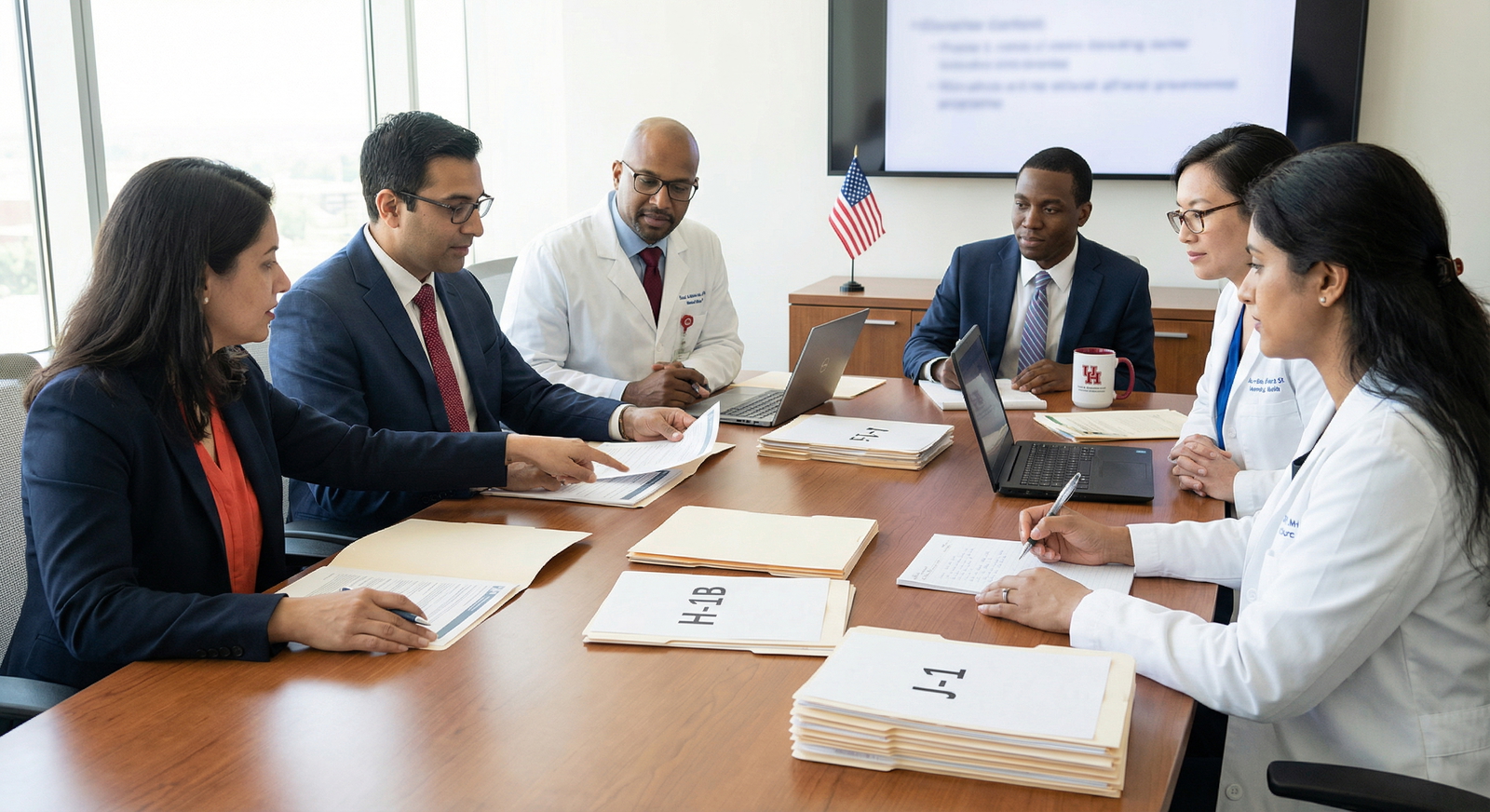
Understanding the J-1 Waiver Landscape in Emergency Medicine
For international medical graduates (IMGs) in emergency medicine, the J-1 visa can feel like a double-edged sword: it opens the door to high-quality residency and fellowship training in the United States, but it also comes with the strict two‑year home-country physical presence requirement. For many EM residents, securing a J-1 waiver is the key to staying in the U.S. to practice after training rather than having to leave for two years.
Emergency medicine is particularly well positioned for J-1 waiver opportunities because EM physicians are critically needed in many rural and underserved urban communities. However, planning for a J-1 waiver in emergency medicine requires strategy, early preparation, and a clear understanding of the major pathways: Conrad 30, federal interest waivers, underserved area waivers, hardship and persecution waivers, and academic options.
This guide walks through the main J-1 waiver options for emergency medicine residency graduates, how the EM match timeline affects your planning, and practical steps to maximize your chances of successfully obtaining a waiver and launching your EM career in the U.S.
Core J-1 Waiver Pathways for Emergency Medicine Physicians
1. Conrad 30: The Primary Pathway for EM J-1 Waivers
The Conrad 30 program is the most common pathway for J-1 waiver jobs in emergency medicine. Each state can sponsor up to 30 J-1 physician waivers per federal fiscal year, often prioritizing high-need specialties like emergency medicine.
Basic Requirements
In most states, Conrad 30 waivers for EM require that you:
- Have completed or be near completion of ACGME-accredited emergency medicine residency training (or fellowship, if applicable)
- Hold a full and unrestricted state medical license (or be eligible and in process)
- Have a permanent, full-time job offer for at least:
- 3 years in a qualifying location, and
- Typically 40 hours per week of clinical care (many EM contracts express this as a number of shifts, but the state will benchmark to a full-time equivalent)
- Agree to begin work within a specified timeframe after waiver approval (often within 90 days of waiver approval or J-1 status end, depending on the state)
Conrad 30 and Emergency Medicine Practice Settings
Emergency medicine jobs that qualify for Conrad 30 are often in:
- Rural hospitals with low physician density
- Critical access hospitals
- Community hospitals serving medically underserved populations
- Safety-net hospitals with a high percentage of Medicaid/uninsured patients
Some states will only sponsor waivers in Health Professional Shortage Areas (HPSAs) or Medically Underserved Areas/Populations (MUAs/MUPs). Others allow a limited number of “flex” slots where the hospital is not in a shortage area but demonstrates that it serves underserved patients (for example, a busy urban ED seeing a large volume of Medicaid and uninsured patients).
For EM specifically, flex slots can be particularly important for:
- Urban trauma centers that function as safety-net hospitals
- Regional referral centers that serve wide catchment areas, including rural communities
Timing: How EM Residents Should Plan Around the EM Match and Waiver Cycle
Conrad 30 slots are linked to the federal fiscal year (usually Oct 1–Sep 30), and many states open their application windows early in the year before your graduation. Slots can fill quickly—especially in “desirable” states—so EM residents must plan accordingly.
A typical timeline for an EM resident on a J-1 visa:
PGY-2 (early–mid year):
- Start learning about state Conrad 30 programs
- Identify preferred states and compare rules (e.g., flex slots, EM-friendly policies, timelines)
- Network with EM attendings, alumni, and recruiters familiar with J-1 waiver positions
PGY-3 (early):
- Begin a focused job search for J-1 waiver-eligible EM positions (12–18 months before graduation)
- Narrow down states strategically—not every state is equally EM-friendly or IMG-friendly
- Start collecting immigration documentation (CV, training certificates, USMLE/COMLEX results, J-1 DS-2019s, etc.)
PGY-3 (mid–late):
- Secure a signed employment contract for a J-1 waiver job
- Coordinate with your employer and immigration attorney to file state waiver packets as soon as the state opens its Conrad 30 window
- Consider backup states if your first-choice state has a history of filling quickly
Because the EM match timeline is earlier in your training, you often know your graduation date and career trajectory early enough to plan ahead—but you must be organized and proactive.
2. Federal Interest Waivers: VA, HHS, and Other Federal Options
Beyond Conrad 30, several federal agencies can sponsor J-1 waivers based on “public interest” or federal interest. These waivers are often called federal interest waivers and can be highly relevant for emergency medicine physicians.
Veterans Affairs (VA) Waivers
The Department of Veterans Affairs can sponsor J-1 waivers for physicians working at VA hospitals. For EM:
- Many VA hospitals have emergency departments or urgent care centers
- VA positions may be more likely in urban or suburban areas, which can appeal to some physicians
- VA institutions are “federal” employers; they typically do not use Conrad 30 state slots
Pros for EM physicians:
- You can sometimes work in locations that are not HPSA/MUA but are still high-need for veteran care
- More structured work environment; often better benefits and work–life balance than some private EM groups
Cons and considerations:
- Limited number of EM-specific roles compared with primary care
- Competitive hiring; you need to fit VA staffing needs and often be comfortable with veterans’ specific medical and psychosocial needs
Department of Health and Human Services (HHS) Waivers
Historically, the HHS J-1 waiver program has focused mostly on primary care (internal medicine, pediatrics, family medicine, etc.), but some subprograms (especially those focused on facilities like community health centers or certain hospital-based programs) may occasionally involve EM roles or hybrid positions.
Realistically, for pure emergency medicine positions, HHS is a less common route compared to Conrad 30 or VA. However, combined roles (e.g., EM plus urgent care or primary care in an HHS-funded facility) might sometimes qualify, depending on the current HHS rules.
Other Federal Agencies
Occasionally, other federal agencies (e.g., the Appalachian Regional Commission, Delta Regional Authority) have historically had limited waiver programs, but their policies change frequently and often target primary care. Emergency medicine might be eligible in specific contexts, particularly where an ED is the primary point of care for underserved communities.
3. Hardship and Persecution Waivers: Narrow, Case-Based Options
While most EM physicians will rely on Conrad 30 or federal interest waivers, two additional J-1 waiver options exist:
- Exceptional hardship waiver to a U.S. citizen or permanent resident spouse/child
- Persecution waiver based on fear of persecution in your home country
These are individual-based rather than job-based, and they can be extremely complex and heavily evidence-driven. They are not specific to emergency medicine but can be relevant if:
- Your home country is unsafe or unstable for political, religious, or other protected reasons
- You have a U.S. citizen/permanent resident immediate family member who would suffer exceptional hardship if you had to leave for two years
Pros:
- Not tied to a specific underserved area or 3-year service requirement (though you still need immigration status to stay and work in the U.S.)
- Can sometimes be pursued when J-1 waiver job options are very limited
Cons:
- High evidentiary burden; approvals are far from guaranteed
- Long processing times and high emotional and legal complexity
- Not a routine or strategic option in the same sense as Conrad 30
In emergency medicine, where national demand is strong, most IMGs still find it more practical to target employment-based waivers (Conrad 30, VA, etc.) rather than hardship or persecution waivers unless there is a particularly strong personal basis.
Strategizing Your J-1 Waiver Job Search in Emergency Medicine

Understanding Demand and Market Realities in EM
Emergency medicine has historically had strong job demand, particularly in rural and underserved settings. However, market dynamics are shifting in some metropolitan areas, with:
- Increased residency graduate numbers
- Consolidation of EM staffing groups
- Greater use of advanced practice providers
Despite these trends, rural and smaller community hospitals, as well as some mid-size urban safety-net EDs, continue to struggle to recruit and retain EM physicians, making them prime sites for J-1 waiver employment.
Key implications for your EM job search:
- Be geographically flexible—many J-1 waiver opportunities are not in major coastal cities.
- Consider smaller cities, regional hubs, and rural communities where your skills are highly valued.
- Leverage your EM training in trauma, critical care, and resource-limited settings—these can be major selling points for under-resourced hospitals.
Selecting Target States: Not All Conrad 30 Programs Are Equal
Each state administers its own Conrad 30 program with different:
- Application timelines
- Priority specialties
- Rules on flex slots
- Attitudes toward EM and hospital-based specialties
For emergency medicine, when comparing states, look for:
Historical EM-friendliness
- Does the state’s website, reports, or unofficial “word of mouth” indicate prior EM approvals?
- Has the state explicitly stated hospital-based specialties are eligible?
Flex slot availability
- If you prefer an urban or suburban ED that serves an underserved population, a state with generous flex slot policies can make a big difference.
Application timing and speed
- Some states open applications on Oct 1 and fill within days.
- Others accept rolling applications and never fill all 30 slots.
- The more competitive states require you to be ready the moment their window opens.
Service requirement details
- Some states require 3 years; some may allow a bit of flexibility if you change employers (with approval).
- Some have additional reporting requirements, retention incentives, or penalties for early departure.
Work with both an immigration attorney and your potential employer’s credentialing/HR team to interpret state rules correctly. A misread rule can cost you a slot.
Finding J-1 Waiver Jobs in Emergency Medicine
Sources include:
- Hospital and health system recruiters in rural/underserved areas
- National EM staffing groups that regularly place IMGs in underserved area waiver positions
- State Conrad 30 offices (sometimes they maintain lists of sites seeking J-1 physicians)
- Professional contacts and alumni from your emergency medicine residency program
- Specialty job boards and IMG-focused recruitment firms
Practical tips:
- Explicitly state in your CV and initial emails that you are seeking a J-1 waiver position and specify your graduation date.
- Ask directly whether the employer has experience with J-1 waivers and which states they usually sponsor in.
- Clarify whether the job is:
- Located in a HPSA/MUA
- Eligible for a flex slot
- A VA or federal facility (which might use federal interest waivers)
A red flag is an employer who seems unclear about J-1 rules or promises “we’ll figure it out later.” You cannot afford uncertainty with strict waiver timelines.
Negotiating Contracts in the Context of J-1 Waivers
Your employment contract for an underserved area waiver or Conrad 30 position needs to satisfy both:
- Immigration requirements, and
- Your professional and personal needs
Key contract items for EM J-1 waiver jobs:
- Duration: Minimum three-year term clearly specified.
- Location: The primary work site (and any satellites) should be explicitly listed and be waiver-eligible under the relevant program.
- Schedule and workload: For EM, this often translates to a minimum number of clinical hours or shifts per month. It should align with full-time expectations under the state’s Conrad 30 rules.
- Call and coverage expectations: If there’s hospitalist cross-coverage, trauma call, or additional responsibilities, they should be clear.
- Moonlighting/secondary employment: Understand whether moonlighting inside or outside the system is allowed; immigration status and state rules may restrict this.
- Early termination terms: You must know what happens if:
- The employer cannot maintain the ED
- The hospital is acquired or closes
- The relationship deteriorates
- Some states allow “transfer” of a Conrad 30 waiver under strict conditions; others are more rigid
Always have an attorney with immigration and contract experience review the agreement. Waiver-eligible contracts are not the place for casual or verbal understandings.
J-1 Waiver vs. Other Status Options: Long-Term Career Strategy in EM

J-1 Waiver vs. H-1B Pathway for EM Residents
Some EM residents may have the option to train on an H-1B visa instead of a J-1. While this article focuses on J-1 waiver strategies, your long-term plan should acknowledge the trade-offs:
J-1 visa
- Pros: Easier to obtain for residency; many programs are more comfortable sponsoring J-1 via ECFMG.
- Cons: Two-year home residency requirement unless you secure a waiver (e.g., Conrad 30, underserved area waiver, etc.).
H-1B visa
- Pros: No two-year home requirement; more direct transition to employment-based permanent residency (green card).
- Cons: Cap issues (in non-cap-exempt jobs), higher cost/complexity for residency programs; some EM programs won’t sponsor H-1B.
If you are already on a J-1 for EM residency, your immediate challenge is to secure the waiver. But as you plan your career, you should think beyond the first three years.
Green Card Strategy After the J-1 Waiver Period
Emergency medicine physicians often seek permanent residency (green card) while or after serving in their waiver obligation in an underserved area. Common routes:
Employer-sponsored PERM (EB-2 or EB-3)
Many hospitals or health systems sponsoring J-1 waiver jobs are willing to start the PERM process early in your three-year term.National Interest Waiver (NIW) under EB-2
- While classic physician NIWs are often associated with primary care, some EM physicians practicing long-term in underserved areas and contributing to public health, research, or policy may build a strong NIW case.
- The NIW does not replace your J-1 waiver requirement, but it can complement your long-term immigration strategy.
Extraordinary ability (EB-1A) or Outstanding researcher/Professor (EB-1B)
Applicable to emergency medicine physicians with significant academic, research, or leadership credentials.
Planning tips:
- Ask potential employers early how they handle green card sponsorship for J-1 waiver hires.
- Consider how an underserved area waiver job aligns with your broader career goals (academia, research, leadership, trauma, critical care, administrative EM, etc.).
- Maintain strong documentation of your clinical work, quality improvement projects, and any leadership roles. These can support future immigration petitions.
Balancing Career Goals with Underserved Area Waiver Obligations
An underserved area waiver position can be both your immigration solution and a powerful career foundation. In emergency medicine, practicing in a high-need setting often means:
- Broad exposure to undifferentiated, high-acuity patients
- Significant independence and responsibility
- Opportunities to lead ED process improvement, EMS integration, and hospital throughput initiatives
Consider how you can:
- Shape the role to include education (precepting residents or APPs), administration, or telemedicine elements
- Use the three-year period to build a track record of leadership and quality improvement work
- Keep connections with academic EM departments through adjunct appointments, conferences, and research collaborations if academia interests you down the line
Practical Tips and Common Pitfalls for EM J-1 Waiver Applicants
Start Earlier Than You Think
Because of how quickly some Conrad 30 programs fill, EM residents should treat waiver planning like a second “match process.” Concrete steps:
- PGY-2: Identify 3–5 potential states and read their most recent Conrad 30 guidance carefully.
- PGY-3 early: Begin serious interviewing; involve an immigration attorney to flag red flags in job offers.
- PGY-3 mid: Prepare application materials; know when each target state opens its Conrad 30 window.
Align Your Personal and Professional Priorities
Choosing a J-1 waiver job is not just an immigration decision. Consider:
- Lifestyle: shift patterns, night/weekend burden, distance to major airports, community resources
- Family needs: schooling, spouse employment, cultural/community support
- Long-term viability: is this somewhere you might stay beyond the three-year obligation if it suits you?
Emergency medicine lends itself to mobility, but the first three years after residency will deeply shape your professional trajectory.
Work with Experienced Counsel and Employers
J-1 waivers in EM are high-stakes and time-sensitive. Common mistakes include:
- Misjudging a state’s eligibility rules or timelines
- Submitting incomplete or inconsistent documentation
- Accepting a job in a location that doesn’t actually qualify as an underserved area waiver site
- Missing the deadline to start work as required by the waiver terms
To avoid these:
- Retain an immigration attorney with specific experience in physician J-1 waivers, not just general immigration.
- Ask potential employers, “How many J-1 waiver physicians have you sponsored in the past, and how did that process go?”
- Keep meticulous personal records: DS-2019s, evaluations, contracts, license documents, etc.
Have a Backup Plan
Even with careful planning, external factors can disrupt your ideal scenario:
- State programs change rules or close early
- Hospital funding shifts; positions are restructured
- Personal circumstances evolve
Realistic backup strategies might include:
- Targeting multiple states with different application windows
- Considering VA or federal-interest roles as alternatives to state Conrad 30 programs
- Keeping abreast of hardship or persecution waiver possibilities if relevant to your situation
- Being open to a broader geographic search than initially planned
FAQs: J-1 Waiver Strategies in Emergency Medicine
1. When should I start looking for a J-1 waiver job during my emergency medicine residency?
Most EM residents on J-1 visas should start actively exploring J-1 waiver options in early PGY-2, ramping up the search by early PGY-3. Because Conrad 30 slots in some states fill very quickly after their application windows open, having a job offer and documents ready several months before those windows open is essential. Waiting until the final months of residency is too late in many states.
2. Can I get a J-1 waiver for an emergency medicine job in a large city?
Yes, but it depends on state policy and the specific hospital. Many large cities are not designated HPSA/MUA in their core areas, but some hospitals qualify for flex slots because they serve a high proportion of underserved patients. Another option is working at a VA medical center or certain federal-interest sites in larger cities. However, your chances are generally higher if you are open to mid-size cities and rural or regional hubs.
3. Do all Conrad 30 programs accept emergency medicine physicians?
No. While many states view emergency medicine as critical to underserved communities and sponsor EM J-1 waivers, some states limit waivers to primary care or a narrow range of specialties, or they give clear priority to those fields. Before targeting a state, read its most recent Conrad 30 guidance carefully and, if possible, ask the state office or an experienced immigration attorney whether EM has been approved there in recent years.
4. After I complete my three-year J-1 waiver obligation as an emergency physician, can I move anywhere in the U.S.?
From an immigration standpoint, once you have:
- Completed your obligated three years in the designated underserved area waiver position under J-1 waiver terms, and
- Transitioned into another valid status (e.g., ongoing H-1B, permanent residency)
you are no longer restricted to underserved area jobs and may move anywhere in the U.S., provided you maintain lawful work authorization. However, your visa type and green card process may still impose some practical constraints (e.g., H-1B cap issues or employer-specific sponsorship). Planning your post-waiver transition with your attorney and employer well before the three-year period ends is crucial.
Navigating the J-1 waiver process as an emergency medicine physician is demanding but manageable with early planning, informed strategy, and the right support. By understanding Conrad 30, federal options, and underserved area waiver strategies—and aligning them with your EM career goals—you can transform a visa obligation into an opportunity to build a high-impact, rewarding practice in communities that need your skills most.