
Understanding the J-1 Pathway in Internal Medicine
For many international medical graduates (IMGs), an internal medicine residency in the United States begins with an Educational Commission for Foreign Medical Graduates (ECFMG)-sponsored J-1 visa. This is a non-immigrant, exchange visitor visa that allows you to train, but it comes with a critical requirement: the two-year home residence rule (also called the “212(e) requirement”).
Key concepts you must understand early:
J-1 visa purpose: To allow you to complete graduate medical education (GME) in the U.S. as a temporary exchange visitor.
Two-year home residence requirement (212[e]):
After completing training, you must return to your home country (or country of last permanent residence) for an aggregate of two years before you can:- Apply for H-1B or L visas
- Apply for permanent residency (green card)
- Change to many other non-immigrant statuses inside the U.S.
What a J-1 waiver does:
A successful J-1 waiver removes the two-year home residency requirement, allowing you to stay in or return to the U.S. in another status (most commonly H-1B), often tied to a service obligation in an underserved area.
Why J-1 Waivers Matter for Internal Medicine Residents
Internal medicine residents are uniquely positioned in the J-1 waiver landscape because:
- Internal medicine is in high demand in rural and underserved urban communities.
- Many waiver programs (especially Conrad 30) are tailored to primary care and general internal medicine.
- Hospitalist and primary care positions are common in settings that qualify as Health Professional Shortage Areas (HPSA), Medically Underserved Areas (MUA), or serving Medically Underserved Populations (MUP).
If you are on track for an internal medicine residency or fellowship on a J-1, it is essential to understand waiver options as early as PGY-1 or PGY-2, not just in your final year.
Major J-1 Waiver Options for Internal Medicine Graduates
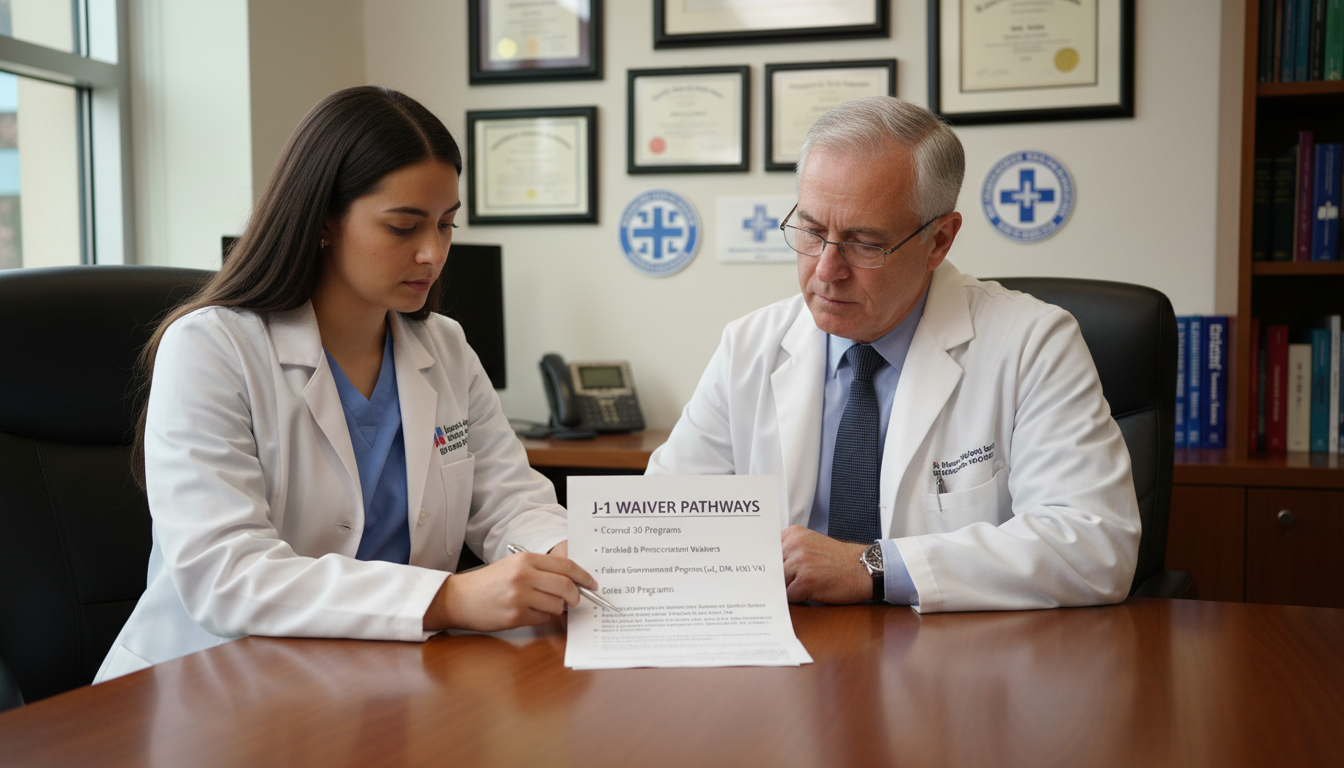
There are several pathways through which internal medicine physicians can seek a waiver of the J-1 home residence requirement. Each option has its own eligibility rules, timing, and strategic pros and cons.
1. Conrad 30 Program
Overview:
The Conrad 30 program is the most common J-1 waiver route for IMGs after internal medicine residency. Each U.S. state (plus some territories) can sponsor up to 30 J-1 waiver physicians per year to work in an underserved area, typically in exchange for a 3-year full-time service commitment.
Core requirements (typical, but states vary):
- Offer of a full-time position (usually 40 hours/week) for at least 3 years
- Work in a facility located in or serving a:
- Health Professional Shortage Area (HPSA), and/or
- Medically Underserved Area (MUA), or
- Medically Underserved Population (MUP)
- Employment contract that:
- Is not “at will” (or limits termination without cause)
- Specifies location(s), duties, and schedule
- Includes a clause agreeing to submit periodic service reports
- You agree to start work by a specified deadline (often within 90 days of waiver approval)
- Employer agrees to pay prevailing wage and meet other federal and state conditions
Advantages for internal medicine:
- Many states explicitly prioritize primary care physicians, often including general internal medicine.
- Hospitalist roles are accepted in many states as long as they serve an eligible area/population.
- Internal medicine physicians can often find multiple potential employers in rural hospitals, FQHCs (Federally Qualified Health Centers), and community health centers.
Challenges:
- Competition is intense in states that are popular among IMGs (e.g., NY, CA, TX, FL, MA, WA).
- Some states allocate many of their 30 slots to primary care only and may limit or exclude pure subspecialty roles.
- Application timelines and rules differ widely between states; missing a filing window may cost you a full year.
Example scenario:
You are finishing a categorical internal medicine residency and want to work as a hospitalist. A 150-bed community hospital in a rural area of State X (HPSA score 18) offers you a hospitalist job. The state Conrad 30 program opens on October 1. You and your future employer prepare a contract meeting state and federal requirements, submit the Conrad application early in the cycle, and if approved, your J-1 home residency requirement is waived in exchange for 3 years of service at that hospital.
2. Underserved Area Waiver Variants (States and Local Flex Slots)
While Conrad 30 is the umbrella name, there are strategic nuances relevant to internal medicine applicants:
Standard HPSA/MUA Positions
Many Conrad 30 slots must be directly in a designated HPSA or MUA. Internal medicine roles that often qualify:
- Outpatient internal medicine at a community health center
- Hospitalist at a rural critical access hospital
- Internal medicine physician at a safety-net hospital in a medically underserved urban neighborhood
Flex Slots (Non-HPSA / Non-MUA Facility, Serving Underserved)
Some states allow “Flex slots” (often up to 10 of the 30) that:
- Do not require the facility to be physically in a HPSA/MUA, but
- The employer must prove the physician will treat a significant number of patients from underserved areas/populations (e.g., by zip-code analysis, referral patterns, Medicaid/uninsured rates).
For internal medicine, this can be powerful if:
- You want to work in a larger city or suburban hospital that serves patients from surrounding rural or underserved regions.
- You join a large health system that can demonstrate strong service to an underserved population.
Action point: When you receive an offer, explicitly ask about:
- Whether the site is in a HPSA/MUA
- Whether the state Conrad 30 program has flex slots and how competitive they are
- Whether the employer has successfully sponsored J-1 waiver physicians before
3. Federal Agency Waivers (VA, HHS, ARC, DRA, Others)
Several federal agencies can also sponsor J-1 waivers. For internal medicine, some of the most relevant include:
Veterans Health Administration (VA)
- The VA can sponsor waivers for physicians who will work at VA facilities.
- Internal medicine physicians and hospitalists are in demand in many VA hospitals.
- VA positions are often in metro or near-metro areas that might not qualify under Conrad 30 HPSA criteria, which is an advantage if you prefer those locations.
Considerations:
- You serve primarily veterans, often with complex chronic diseases – a strong match with internal medicine training.
- VA waiver opportunities may be less transparent; networking and early communication are essential.
U.S. Department of Health and Human Services (HHS) Clinical Waivers
HHS waiver programs historically focused on research and, more recently, on clinical primary care in very high-need areas.
- Focus areas can change; often tied to community health centers, FQHCs, or facilities in high HPSA score regions.
- Internal medicine physicians may qualify if the role is defined as primary care internal medicine.
Appalachian Regional Commission (ARC) and Delta Regional Authority (DRA)
- These regional federal agencies can sponsor waivers if you work in their designated geographic regions (Appalachia for ARC; Mississippi Delta region for DRA).
- They focus on economically distressed communities, often rural or semi-rural.
- Many positions are primary care internal medicine or hospitalist roles in small hospitals or clinics.
Strategic angle for internal medicine residents:
- If Conrad 30 slots are saturated in a state, but the state includes ARC or DRA regions, an internal medicine position in those areas may be more accessible via federal waiver routes.
- These options can sometimes be less well-known, so you may face less competition.
4. Hardship and Persecution Waivers
Besides employment-based waivers, you may seek a J-1 waiver based on:
Exceptional Hardship Waiver
You must show that your departure from the U.S. would cause exceptional hardship to your U.S. citizen or permanent resident spouse or child.
- Hardship could be medical (e.g., spouse with serious illness needing ongoing U.S. care), educational, financial, or security related.
- Requires strong documentary evidence and legal guidance.
- Does not require a specific job in an underserved area, but you still need an immigration status (often H-1B) after waiver approval.
Persecution Waiver
Applies if you can demonstrate that you would likely be persecuted in your home country based on:
- Race
- Religion
- Political opinion
- Nationality
- Membership in a particular social group
This pathway is complex, often overlaps with asylum considerations, and usually requires specialized immigration counsel.
Key point for internal medicine graduates:
Hardship and persecution waivers are more about your personal and family circumstances than your specialty. Internal medicine training won’t directly affect eligibility, but your stable employment and contributions can strengthen the equities in your favor.
5. J-1 Waivers via Research or Academic Roles
Some physicians on J-1 research categories (separate from clinical J-1) may access other waiver options. However, for clinical internal medicine residency/fellowship, the main practical strategies are:
- Conrad 30
- Federal agency waivers (VA, HHS, ARC, DRA)
- Hardship or persecution waivers
Research waivers are less common after a standard internal medicine clinical training path.
Strategic Planning Timeline: From Residency to Waiver Position
To maximize your IM match and J-1 waiver success, planning should start before you even begin residency, and then continue deliberately throughout training.

Stage 1: Before and During the IM Match
Even as you focus on the IM match, keep the J-1 implications in mind.
Questions to consider when ranking programs:
- Does the residency program have a strong track record with IMGs on J-1 visas?
- Do their graduates successfully secure Conrad 30 or other J-1 waiver positions?
- Do they have affiliated hospitals or networks in underserved areas that routinely hire graduates for J-1 waiver positions?
- Are program leadership and GME office familiar with:
- J-1 waiver basics
- H-1B transitions after waiver approval
- Timeline constraints
If you already know you want a hospitalist or primary care internal medicine career, programs with strong community hospital affiliations and rural rotations can be especially valuable.
Stage 2: PGY-1 to Early PGY-2 – Laying the Foundation
Use your first 12–18 months to build a competitive profile and gather information:
Clinical performance: Strong evaluations and board pass rates make you a more desirable candidate in competitive Conrad 30 states.
Networking:
- Ask faculty and graduates how they managed their IM match and J-1 waiver transition.
- Attend informational sessions by your institution’s immigration office, if available.
- Join IMG or visa-focused forums and professional societies.
Research your target states:
- Look up Conrad 30 policies for 3–5 states where you might want to practice.
- Note eligibility rules for internal medicine vs subspecialties.
- Compare how many internal medicine or hospitalist waivers they granted in previous cycles (many states publish this data).
Actionable step:
Create a simple spreadsheet tracking:
- State name
- Application opening date
- Internal medicine/hospitalist eligibility rules
- HPSA/MUA requirements vs flex slots
- Whether they consider subspecialty internal medicine (e.g., cardiology, GI)
- Historical competition level (e.g., “30/30 filled by November 15”)
Stage 3: Late PGY-2 to PGY-3 – Active Job and Waiver Search
This is the critical period for most internal medicine residents on J-1 visas.
Key tasks:
Clarify your post-residency plan:
- General internal medicine outpatient?
- Hospitalist?
- Fellowship first, then waiver later?
- Academic internal medicine with teaching responsibilities?
Start job applications early:
- For direct employment after residency (no fellowship), many residents start searching 12–18 months before graduation, especially for waiver-friendly positions.
- If planning a fellowship, understand that you will likely delay the waiver until after fellowship, but some states or employers may be open to pre-matching a waiver position for later.
Target waiver-savvy employers:
- FQHCs, rural hospitals, community health centers, and some academic-affiliated hospitals in underserved regions.
- Ask directly: “Do you sponsor J-1 waivers, such as Conrad 30 or federal waivers?”
- Prioritize employers with a history of successful J-1 waiver sponsorships.
Coordinate with immigration counsel early:
- Many employers will provide their own attorney; however, having an independent immigration lawyer can be extremely valuable.
- Ensure your job offer and contract meet both state-specific Conrad 30 rules and federal requirements.
Time your applications:
- Many states open their Conrad 30 application windows between September and October, but some have rolling admissions.
- In high-demand states, slots can be filled in weeks or even days. Apply as early as rules allow.
Stage 4: After Residency (and/or Fellowship) – Service Commitment
Once your J-1 waiver is approved and your H-1B (or other status) is granted, you enter your service obligation, typically:
- 3 years of full-time service in the approved position
- Often at the same site(s) and under the terms specified in your waiver application and employment contract
Practical issues for internal medicine physicians:
- Hospitalist schedules: Even though you might work 7 on/7 off or similar, ensure your contract clearly demonstrates that you average 40 hours/week (or meet state requirements).
- Multiple sites: If your position covers several facilities (e.g., multiple hospital campuses), all locations may need to be listed in the waiver application and contract.
- Moonlighting:
- Some states allow limited moonlighting outside the waiver site; others restrict it.
- Make sure any additional work does not conflict with the terms of your waiver and H-1B.
Completion of service:
- After 3 years, you are free from the J-1 two-year home residency requirement, and you can:
- Continue in H-1B with the same employer
- Change employers (with proper H-1B transfer)
- Pursue permanent residency through employment, NIW, or other pathways
Choosing Among J-1 Waiver Strategies in Internal Medicine
Selecting the best J-1 waiver path depends on your career goals, geographic priorities, and personal circumstances.
1. If You Want Maximum Geographic Flexibility
You might prioritize:
- Popular or urban states with flexible Conrad 30 “flex slots”
- Federal waivers (e.g., VA) that allow work in metro areas not qualifying as HPSA/MUA
Strategic tips:
- Start your search earlier; competition will be higher.
- Maintain excellent credentials and strong references — these matter when a single hospital in a metro area receives many applications from J-1 physicians.
- Consider broadening your search to nearby states with less competition but reasonable access to urban centers.
2. If You Value a Specific Clinical Niche in Internal Medicine
If your goal is hospitalist medicine, chronic disease management, or a specific patient population:
- Look for waiver-eligible hospitals or clinics that match that niche (e.g., safety-net hospitals with high complexity).
- Explore fellowship first vs. waiver first:
- Some internal medicine residents pursue fellowship with continued J-1 sponsorship, then seek a waiver as a subspecialist.
- Others secure a waiver job as a hospitalist or general internist first, then explore fellowship later via H-1B or after obtaining permanent residency.
Caution: Some states are less flexible about subspecialists in their Conrad 30 programs; verify rules early if you plan to be, for example, a cardiologist or GI specialist.
3. If Family Circumstances Are Complex
If you have a U.S. citizen or permanent resident spouse/child with significant:
- Medical issues
- Educational needs
- Other special circumstances
Then it may be wise to consult an immigration attorney about hardship waiver viability alongside employment-based plans. In some cases, it may be strategically better to:
- Pursue hardship/persecution waiver paths
- Or blend them with employment-based strategies
Use a dual-track planning mindset: hope for a strong waiver job while exploring personal-based waiver options if your situation warrants it.
Practical Tips and Common Pitfalls for IMGs in Internal Medicine
Practical Tips
Document everything early.
Keep copies of:- Contracts, correspondence, and job descriptions
- GME completion letters
- Recommendation letters and evaluations
These can be helpful both for job searches and potential hardship or other waiver arguments.
Stay flexible about geography.
If you are very rigid about state or city, you may drastically limit your Conrad 30 or federal waiver options. Many IMGs secure waivers in:- Midwestern or Southern states with lower competition
- Smaller cities or rural towns
Leverage your internal medicine strengths.
Highlight experience in:- Chronic disease management (diabetes, heart failure, COPD)
- Working with underserved, diverse, or low-resource populations
- Quality improvement or hospital throughput (for hospitalist roles)
These are highly attractive to underserved area employers and federal agencies.
Coordinate timing of exams and licensing.
Delays in:- Step 3
- State medical license
- Credentialing
can jeopardize your ability to start the waiver job on time, which may threaten your waiver and status.
Common Pitfalls
Waiting too long to start the job search.
Beginning serious outreach only 4–6 months before residency ends is often too late for the most desirable waiver positions.Assuming any hospitalist job can be turned into a waiver job.
The site must meet HPSA/MUA/underserved criteria or fit into a flex or federal program.Not reading state Conrad 30 requirements carefully.
Every state is different. Some require physicians to be board-certified/eligible by a specific time, restrict practice sites, or mandate particular contract wording.Over-relying on informal advice.
Advice from co-residents is helpful but may be outdated or specific to another state. Always double-check with official state program resources and qualified immigration counsel.
FAQs: J-1 Waiver Strategies in Internal Medicine
1. Can I complete a fellowship on a J-1 visa and then apply for a waiver?
Yes. Many internal medicine physicians:
- Complete a categorical IM residency on J-1
- Then do a fellowship (e.g., cardiology, GI, nephrology) on continued J-1 sponsorship
- Only then seek a J-1 waiver as a subspecialist
However, you must confirm:
- Whether your desired states accept subspecialists under Conrad 30 (some reserve slots primarily for primary care/internal medicine).
- Whether there are existing positions in your subspecialty in underserved areas.
If your long-term goal is a specific subspecialty, plan well ahead and discuss with both your program leadership and immigration counsel.
2. Is H-1B better than J-1 for internal medicine residency if I want to avoid the waiver process?
Using an H-1B for residency can avoid the J-1 two-year home residency requirement entirely, but:
- Not all programs sponsor H-1B for residency.
- H-1B has its own limitations:
- Time cap (6 years, unless extended via green card processes)
- Prevailing wage and other employer obligations
- Complexity if you want to change programs or proceed to fellowship
If you have a choice, weigh:
- Your long-term goals (academic vs community, fellowship vs direct practice)
- The availability of H-1B sponsorship at your preferred programs
- Your comfort with navigating the more complex early immigration pathway
Many IMGs still successfully train on J-1 and use the J-1 waiver and Conrad 30 or underserved area waiver strategies to build a long-term U.S. career.
3. How early should I start looking for a J-1 waiver job during internal medicine residency?
For most internal medicine residents:
- Begin information gathering in PGY-1.
- Start active networking and exploring states and employers during PGY-2.
- Aim to begin serious job applications 12–18 months before graduation (late PGY-2 into early PGY-3).
In highly competitive states or if you have narrow geographic preferences, earlier is better. Waiting until the final 6–9 months of residency usually leaves you with fewer options.
4. Do hospitalist positions qualify for Conrad 30 and underserved area waivers?
Often yes, but with conditions:
- The hospital or health system usually must be located in a HPSA/MUA or justify underserved service via flex slot rules.
- The role must be full-time, and your contract should clearly document that your schedule meets the required hours.
- Some states explicitly accept hospitalists for Conrad 30; others may prioritize outpatient primary care internal medicine.
When discussing hospitalist roles, always ask:
- Has the hospital previously sponsored J-1 waivers for hospitalists?
- Does the state’s Conrad 30 policy explicitly mention hospitalists?
- Are there any specific limitations (e.g., no locums-only work, restrictions on multiple sites)?
By understanding the landscape of J-1 waiver strategies in internal medicine – including Conrad 30, federal waivers, hardship options, and the nuances of underserved area waivers – you can move from simply hoping to stay in the U.S. after training to actively shaping a sustainable, compliant, and fulfilling career path. Early planning, informed decision-making, and targeted job searching are your greatest assets as you navigate this critical phase of your journey.