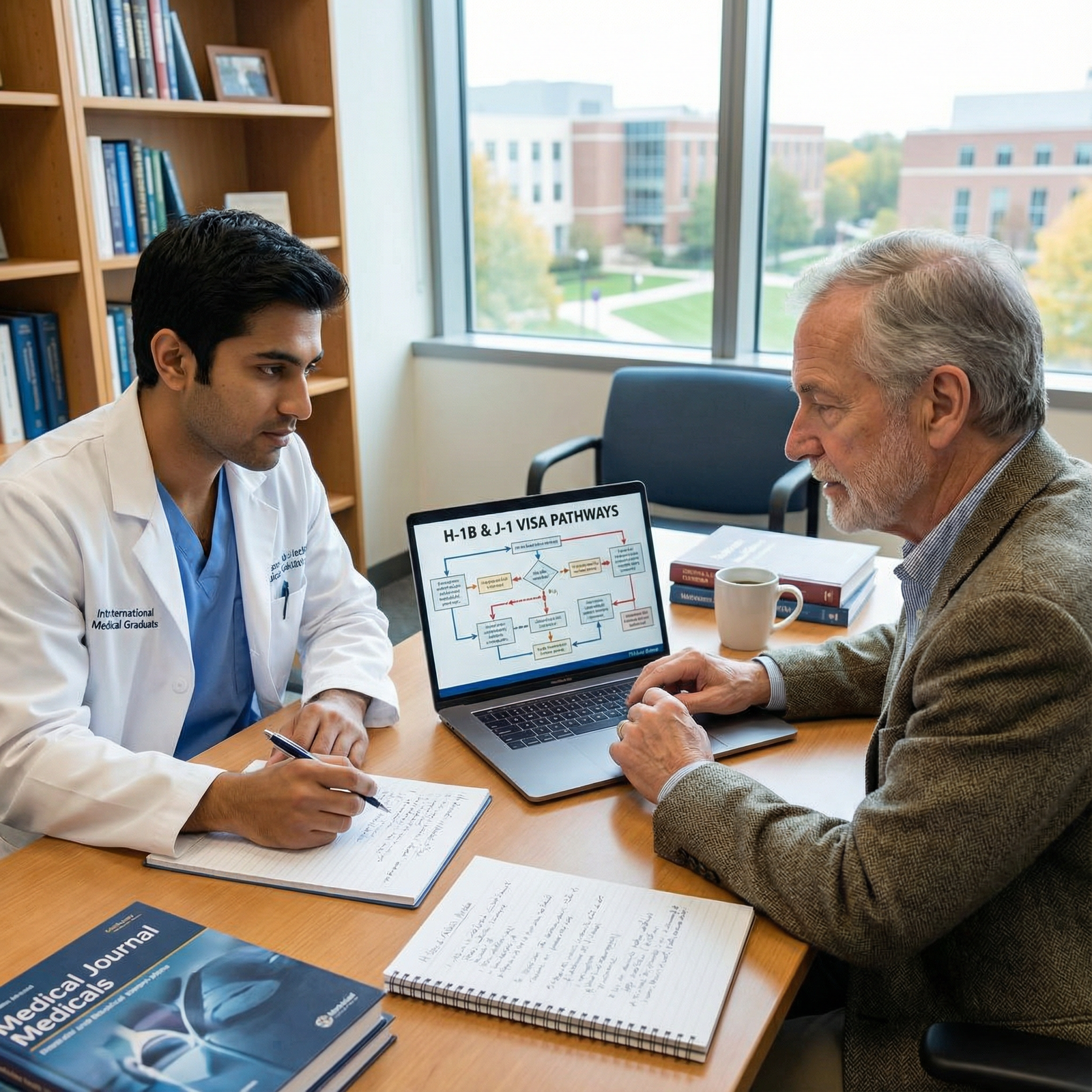
Understanding the Landscape: Internal Medicine, J-1 Visas, and the Central Valley
For international medical graduates (IMGs) pursuing an internal medicine residency in the United States, the California Central Valley offers a unique combination of strong clinical training, high patient need, and real-world pathways to long-term practice through J-1 waiver options.
If you are aiming for an internal medicine residency in places like a Fresno residency program or other Central Valley residency sites, you need two parallel strategies:
- Match strategy – maximizing your chances in the IM match.
- Post-residency visa strategy – planning early for a J-1 waiver (including Conrad 30 and other underserved area waiver paths).
This guide focuses on the second track: how to strategically position yourself for a J-1 waiver while you plan, select, and complete an internal medicine residency in the California Central Valley.
We’ll walk through:
- Key definitions and J-1 basics for IMGs
- Why California’s Central Valley is pivotal for waiver opportunities
- Step-by-step J-1 waiver strategies tailored to internal medicine residents
- How to leverage Fresno and other Central Valley programs specifically
- Practical timelines, pitfalls, and frequently asked questions
J-1 Waiver Basics for Internal Medicine Residents
Before you start targeting California Central Valley programs, you need a clear understanding of the J-1 system and why waivers are so critical.
What Is the J-1 Visa for Medical Residents?
Most IMGs entering U.S. graduate medical education use either:
- J-1 visa (sponsored by ECFMG), or
- H-1B visa (sponsored directly by the residency program).
For internal medicine, the majority of IMG residents are on J-1 status. A J-1 visa allows you to:
- Complete ACGME-accredited residency and (typically) fellowship
- Remain in the U.S. for the length of your approved training (with ECFMG sponsorship each year)
The Two-Year Home Residence Requirement
The catch is the two-year home residence requirement (212(e)):
- After completing your training on a J-1, you must either:
- Return to your home country for a total of two years, or
- Obtain a J-1 waiver that forgives this requirement.
Without a waiver (or fulfilling the two years abroad), you cannot:
- Change to H-1B inside the U.S.
- Obtain a permanent resident (green card) pathway
- Receive most employment-based immigration benefits
This is where J-1 waiver strategies become essential. For internal medicine graduates who want to stay and practice in the U.S., navigating waiver options is almost as important as matching into residency in the first place.
Key J-1 Waiver Pathways Relevant to IMGs
For internal medicine graduates, the most commonly used waiver pathways include:
Conrad 30 Waiver Program
- Each state can sponsor up to 30 waivers per year (hence “30”).
- Focus is on physician shortage areas, often called underserved areas or Health Professional Shortage Areas (HPSAs)/Medically Underserved Areas (MUAs).
- Typically requires:
- Full-time, three-year employment contract
- Clinical work primarily in an underserved area
- Need documentation from the employer and local community
Federal Agency Waivers
(e.g., VA, Department of Health and Human Services, ARC)- Some federal agencies can sponsor waivers if your work meets their mission (e.g., serving veterans, rural health).
- Less common than Conrad 30 but very important in certain niches.
Hardship or Persecution Waivers
- Based on extreme hardship to a U.S. citizen or permanent resident spouse/child, or risk of persecution if you return home.
- Legally complex; not “planning” tools in the same way as Conrad 30.
For IMGs in internal medicine aiming to stay in California—especially the Central Valley—Conrad 30 and related underserved area waivers are usually the core strategic focus.
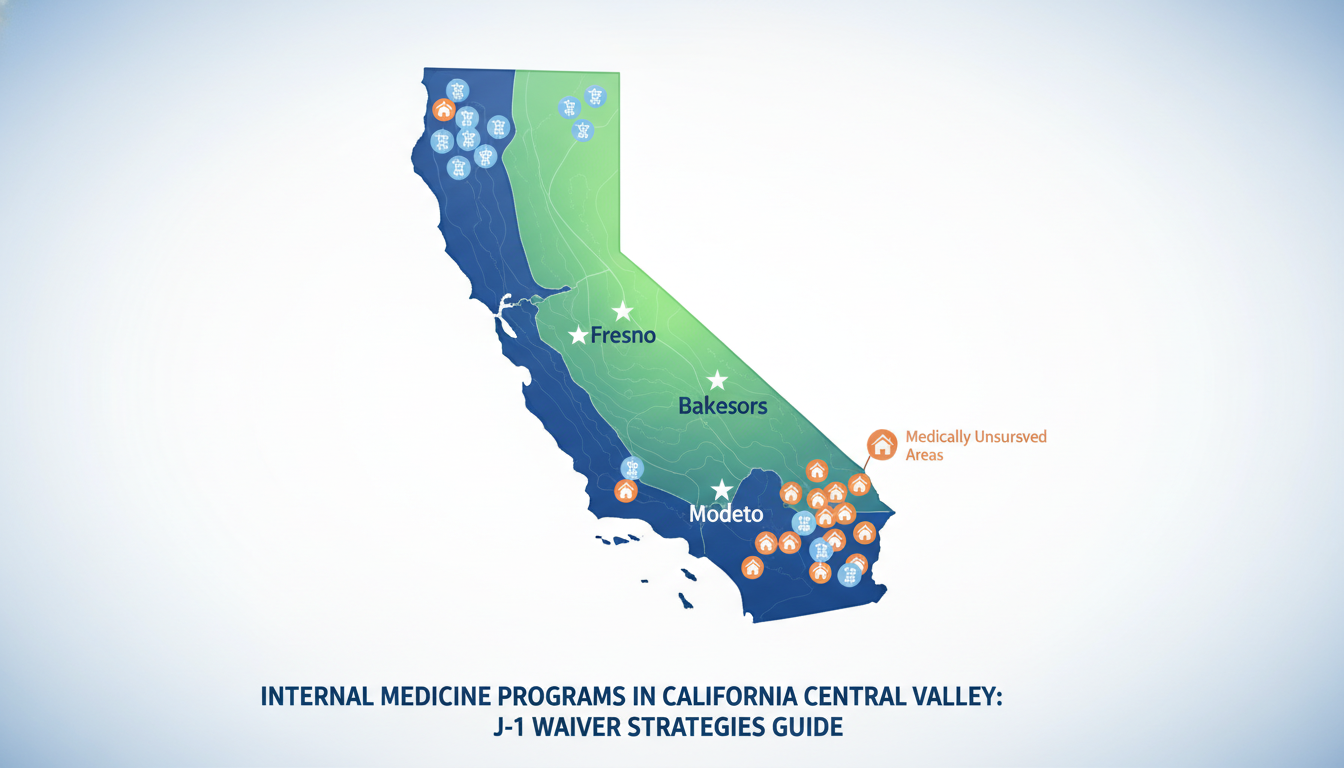
Why the California Central Valley Matters for J-1 Waiver Plans
The California Central Valley—including cities like Fresno, Bakersfield, Modesto, Merced, Visalia, and Stockton—is one of the most medically underserved and rapidly growing regions in the state. For internal medicine trainees and graduates, that creates both clinical opportunities and visa strategy advantages.
Underserved Area Waiver Potential
Many locations in the Central Valley are designated as:
- Health Professional Shortage Areas (HPSAs)
- Medically Underserved Areas/Populations (MUAs/MUPs)
- Rural or “frontier” communities with limited physician access
These designations are exactly what federal and state waiver programs prioritize. When you see terms like:
- underserved area waiver
- Conrad 30 site
- J-1 waiver clinic
they are often referring to positions located in areas much like those in the Central Valley.
Internal Medicine Demand in the Central Valley
The region has chronic shortages of:
- Primary care internists
- Hospitalists
- Outpatient general internal medicine physicians
- Subspecialists (especially in smaller cities and rural areas)
For you, this translates into:
- Greater likelihood of job openings that are waiver-eligible
- Employers more willing to sponsor J-1 waivers and sometimes H-1B transitions
- Potential for negotiating supportive terms in employment contracts
Alignment with Training: Fresno and Other Central Valley Programs
Several Central Valley residency programs, especially in and around Fresno, provide:
- High-volume, high-acuity training
- Direct exposure to the communities that later host waiver positions
- Faculty and alumni networks who already understand and use waiver pathways
If you train in a Fresno residency program or another Central Valley internal medicine residency, you often:
- Build relationships with clinics, hospitals, and networks that hire J-1 physicians.
- Gain experience in underserved settings that make your waiver applications stronger.
- Learn from co-residents and graduates who have successfully navigated Conrad 30 or similar waivers.
Step-by-Step J-1 Waiver Strategy for Internal Medicine Residents
To use your internal medicine residency in the California Central Valley as a springboard to a stable U.S. career, you need a structured plan starting before you enter the IM match.
Step 1: Decide Early on J-1 vs H-1B Mindset
Even before applying to the IM match, ask yourself:
- Am I comfortable with a J-1 + waiver path?
- Do I want to prioritize programs that offer H-1B sponsorship instead?
In California, especially the Central Valley, many internal medicine programs favor J-1 sponsorship because it is more streamlined and widely used for IMGs. If you are open to J-1 plus eventual waiver:
- You can target Central Valley residency programs with strong track records for IMG training (e.g., Fresno area institutions).
- You can plan for Conrad 30 or equivalent waiver options after training.
If you insist on H-1B only, your program list will be more restricted and you may miss some of the best Central Valley residency options.
Step 2: Target Programs with Built-In Underserved Care Exposure
In your ERAS applications and rank list, strategically consider:
- Internal medicine residency programs in Fresno and neighboring Central Valley cities.
- Programs that explicitly emphasize:
- Safety-net hospitals
- FQHCs (Federally Qualified Health Centers)
- Rural or underserved rotations
- Community-based continuity clinics
These experiences:
- Strengthen your CV for waiver jobs (Conrad 30 programs love candidates with prior underserved work).
- Help you network with potential waiver employers early.
- Demonstrate a genuine commitment to these communities, which often shows in recommendation letters and personal statements later.
Step 3: Learn the California Conrad 30 Rules Early
Each state operates its Conrad 30 program differently. California’s policies have evolved over time, so you must:
- Check the most recent guidance from the California Department of Public Health (CDPH) or equivalent state agency.
- Understand:
- Eligibility criteria (HPSA/MUA requirements, specialty priorities)
- Application cycles and deadlines
- Whether internal medicine primary care or hospitalist roles are prioritized
- Required service commitments and clinic hours
By PGY-1 or early PGY-2, you should have:
- A basic understanding of California’s J-1 waiver options (Conrad 30 plus any state-specific modifications).
- Awareness of whether your target roles (outpatient internal medicine vs hospitalist vs subspecialist) are supported.
Step 4: Build Your “Waiver-Focused” CV During Residency
While you complete your internal medicine residency in the Central Valley, shape your training profile to signal that you are a strong waiver candidate:
Clinical Experience:
- Seek continuity clinics or electives in truly underserved Central Valley communities.
- Volunteer with local free clinics, mobile units, or community health initiatives.
- Consider community-based research or QI projects (e.g., diabetes control in rural populations, readmission reduction for uninsured patients).
Relationships & Mentors:
- Identify faculty who:
- Have worked under a J-1 waiver.
- Are connected to safety-net clinics, county systems, or FQHCs.
- Ask about:
- Typical job placements for graduates.
- Employers known to sponsor Conrad 30 or other waivers.
Professional Branding:
- Present yourself (in your CV and narrative) as someone who:
- Intentionally seeks underserved work.
- Is committed to long-term community-based internal medicine.
- Understands the realities of practicing in the Central Valley (language barriers, socioeconomic challenges, cultural humility).
These elements are especially important if you hope to secure a waiver job in the Fresno residency catchment area or nearby Central Valley communities.
Step 5: Start the Job + Waiver Search by Early PGY-3
The J-1 waiver process is time-sensitive. Delays can cost you a year or more and may disrupt your training-to-practice transition.
By early PGY-3 (or earlier if doing a short residency or going straight into practice):
Clarify Your Priorities
- Location: Are you open to smaller towns surrounding Fresno, Bakersfield, or Stockton?
- Practice type: Outpatient internal medicine, hospitalist, or hybrid?
- Academic vs community: Do you want to stay near a teaching hospital or move fully into community practice?
Identify Waiver-Friendly Employers Focus on:
- FQHCs and community health centers in HPSA/MUA areas.
- County hospitals or health systems serving large uninsured/Medi-Cal populations.
- Hospitalist groups that staff rural or underserved hospitals.
Ask Directly About J-1 Waiver Support When exploring opportunities, be very clear:
- “Do you have experience sponsoring J-1 waivers, including Conrad 30?”
- “Do you currently employ any J-1 waiver physicians in internal medicine or hospitalist roles?”
- “Do you work with immigration counsel familiar with California’s program?”
Strong employers in the Central Valley often have established processes and timelines. Your goal is to align your graduation date with their waiver application calendar.
Step 6: Align Job Offer, Contract, and Waiver Application
A J-1 waiver cannot move forward without:
- A signed employment contract (typically three years full-time)
- Evidence that:
- The job is in a qualifying area (HPSA/MUA, underserved area waiver criteria)
- The employer has tried to recruit U.S. physicians (depending on program rules)
- You will be providing direct patient care as an internal medicine physician
Key points to monitor in your contract:
- Location(s): Are all your clinics/hospitals within qualifying areas?
- Schedule: Does the contract meet minimum hour requirements for a waiver (usually full-time, 40 hours/week clinical)?
- Scope: If you’re an internist, ensure the description clearly states outpatient internal medicine or hospitalist responsibilities consistent with the waiver guidelines.
- Start Date: Must coordinate with your training completion and visa timelines.
Once the contract is aligned:
- The employer (often with an immigration attorney) submits the Conrad 30 or other waiver application to the relevant state or federal entity.
- After state recommendation, U.S. Department of State and USCIS finalize the waiver.
- You transition from J-1 to H-1B (or other status) to start your job.

Special Considerations for Fresno and Central Valley Internal Medicine Programs
If you’re specifically looking at a Fresno residency or similar Central Valley residency in internal medicine, you can incorporate local dynamics into your J-1 waiver strategy.
Leveraging Fresno and Nearby Training Sites
Fresno is one of the major medical hubs of the Central Valley with:
- Large teaching hospitals and community partners
- Residency and fellowship programs that draw a high proportion of IMGs
- Natural referral and recruitment networks to smaller surrounding communities
During your residency:
- Use electives to rotate through clinics and hospitals in rural Central Valley towns.
- Attend job fairs, grand rounds, or alumni events where community employers recruit.
- Maintain a running list of potential waiver employers you encounter in clinic, on rounds, or through faculty referrals.
Staying in the Central Valley Post-Residency
Many IMGs choose to remain in or near the region where they trained because:
- They are already credentialed in regional hospital systems.
- They understand local patient needs and referral patterns.
- They have built personal and professional lives in the area.
From a waiver standpoint, this can be powerful:
- Employers often prefer graduates of nearby residency programs (e.g., a Fresno residency graduate filling a hospitalist role in a nearby underserved town).
- Your program director and faculty can advocate for you with potential employers or even help shape positions to be waiver-eligible.
Balancing Waiver Needs with Career Goals
Some internal medicine graduates want:
- Pure hospitalist roles
- Outpatient-only practice
- Subspecialty-heavy clinics
You may need to be flexible, especially for your first post-residency job. A common path in the Central Valley looks like:
- 3-year waiver job (often general internal medicine or hospitalist in an underserved community).
- Transition to your ideal mix of practice settings (possibly still in the Central Valley, possibly elsewhere) once the waiver obligation is fulfilled and your immigration status is more secure.
Remaining open to this staged career approach often provides the most secure visa outcomes.
Common Pitfalls and How to Avoid Them
Even strong candidates in well-positioned internal medicine residency programs can run into trouble if they ignore the visa strategy side. Avoid these frequent mistakes:
1. Waiting Too Long to Start Planning
If you only start thinking about J-1 waivers in late PGY-3:
- Conrad 30 caps may already be filled in some states.
- Ideal positions might have been offered to others.
- HR and legal departments might not have enough time to prepare your case.
Action: Begin learning about waiver options in PGY-1, start serious job search discussions in early PGY-3.
2. Assuming Any Job in the Central Valley Is Automatically Waiver-Eligible
Not all positions in the Central Valley:
- Are in HPSA/MUA areas.
- Meet state-specific criteria for an underserved area waiver.
Action: Always verify the exact site’s designations and ensure the contract is structured to satisfy waiver requirements. Ask for confirmation from the employer and their immigration counsel.
3. Ignoring State-Specific Nuances
California’s Conrad 30 program:
- Has its own deadlines, documentation standards, and policy trends.
- May prioritize certain specialties or practice settings in a given year.
Action: Review official state guidelines annually and work with immigration counsel who actively handle California waivers.
4. Relying on Verbal Promises
Handshake agreements or informal assurances are not enough.
Action: Ensure that:
- Your employment contract explicitly supports a waiver application.
- The employer commits to sponsoring the waiver and associated H-1B.
- Timelines are written down and realistic.
Practical Tips and Example Scenarios
Example Scenario 1: Outpatient Internist in a Rural Central Valley Town
- You complete an internal medicine residency at a Fresno residency program.
- During PGY-2, you rotate in a small town FQHC that badly needs a full-time internist.
- In early PGY-3, the clinic offers you a three-year full-time position, primarily outpatient care, in a HPSA-designated area.
- The employer has sponsored several Conrad 30 waivers previously.
Outcome:
- You sign a well-structured contract.
- The employer files for a California Conrad 30 waiver in the fall.
- By the time you complete residency, your waiver is approved, you transition to H-1B, and work begins smoothly.
Example Scenario 2: Hospitalist Role in a County Hospital
- You’re drawn to inpatient medicine and want a hospitalist position.
- A county hospital serving a majority Medi-Cal/uninsured population, in a designated MUA, offers you a hospitalist spot.
- The state’s program confirms that hospitalist internal medicine positions in that hospital are waiver-eligible.
Outcome:
- You accept the position, recognizing that it fulfills your waiver and matches your hospitalist career goals.
- After three years, with visa status stabilized, you explore academic, administrative, or hybrid roles.
Frequently Asked Questions (FAQ)
1. Can I get a J-1 waiver and still subspecialize after internal medicine residency?
If you train on a J-1 visa and move directly into fellowship, the two-year home requirement continues to apply after all training is finished. Many IMGs complete:
- Internal medicine residency on J-1
- Fellowship on J-1
- Then pursue a waiver job as a subspecialist (e.g., cardiology, GI) in an underserved area
However, subspecialty waiver positions can be more limited than general internal medicine roles. If your long-term goal is subspecialty practice, build a waiver strategy that includes fellowship plans and be flexible about location (including smaller Central Valley cities).
2. Is it easier to get a J-1 waiver if I complete residency in the Central Valley?
There is no formal preference, but practically:
- Employers in the Central Valley prefer physicians who understand the region.
- You have more networking opportunities during training.
- You are likely to have mentors and faculty connections that facilitate introductions.
So while there is no guaranteed advantage, a Central Valley residency (such as a Fresno residency in internal medicine) often makes it more realistic to find strong waiver-eligible positions locally.
3. What if California’s Conrad 30 slots are all taken?
If California’s Conrad 30 cap fills before your employer can apply:
- Explore federal agency waivers (e.g., VA, HHS) if your role may qualify.
- Consider whether another state with reciprocal needs could be an option if you’re willing to relocate from the Central Valley.
- In some cases, employers may hold a position for the next waiver cycle, but that introduces timing gaps.
This is why early planning and aligning with experienced employers is crucial.
4. Who should I talk to during residency about J-1 waiver planning?
Key contacts include:
- Program Director and Associate Program Directors – for career planning and local employer connections.
- GME Office – for general guidance on visas and past alumni trajectories.
- Senior residents and recent graduates (especially IMGs) – for real-world experiences with Conrad 30 or other waivers.
- Immigration attorney – ideally one retained by your future employer, and possibly a separate independent counsel for personalized advice.
Navigating the J-1 waiver landscape while pursuing an internal medicine residency in the California Central Valley can feel complex, but it is absolutely manageable with early, deliberate planning. If you align your IM match strategy with a realistic post-residency visa plan—especially leveraging opportunities in Fresno residency programs and other Central Valley residency sites—you can build a stable, long-term career serving communities that genuinely need you.