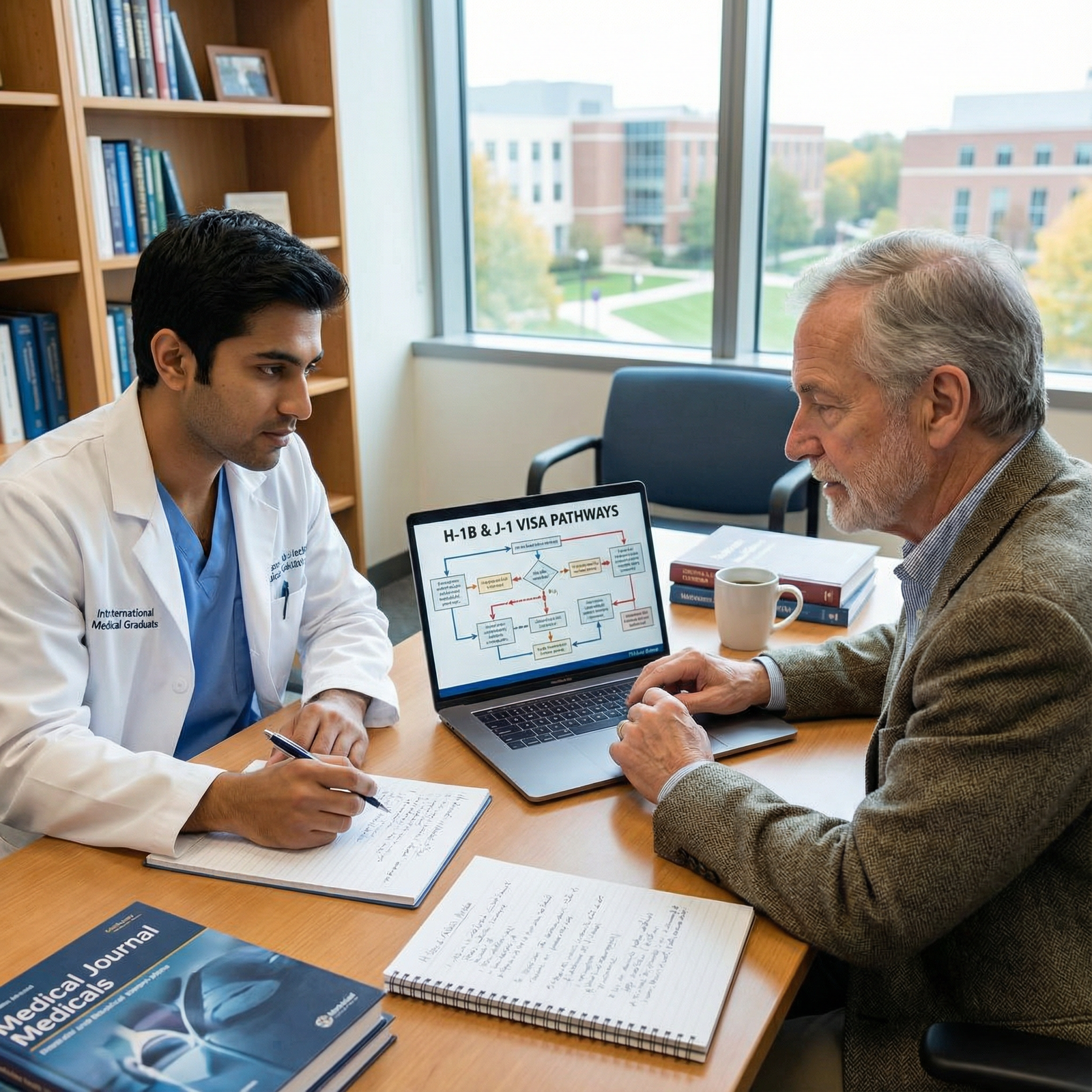
Understanding the J-1 Waiver Landscape in the Rural Midwest
Residency programs in the rural Midwest—especially in Iowa, Nebraska, the Dakotas, Kansas, and surrounding states—depend heavily on international medical graduates (IMGs). Many of these IMGs train on J-1 visas and must return to their home country for two years after training unless they obtain a J-1 waiver. For rural institutions, implementing smart J-1 waiver strategies is no longer optional; it is central to long-term physician workforce planning.
This article focuses on practical, program-level strategies for leveraging the J-1 waiver system—especially the Conrad 30 and other underserved area waiver programs—to:
- Improve recruitment to rural Midwest residency programs
- Support trainees’ post-residency planning
- Convert graduating residents into long-term rural physicians
- Align institutional planning with state and federal waiver policies
While the specifics may vary slightly by state, the overall structure and best practices will be very similar for any rural Midwest residency program.
Core Concepts: How J-1 Waivers Work for Residency Graduates
Before designing strategies, residency leaders must understand the basic framework of J-1 waivers and how it intersects with residency training.
The J-1 Home Residency Requirement
Most IMGs in U.S. graduate medical education (GME) programs hold J-1 exchange visitor visas sponsored by the Educational Commission for Foreign Medical Graduates (ECFMG). A J-1 physician is subject to the “two-year home-country physical presence requirement,” meaning:
- After completing training, the physician must return to their home country for at least two years,
- Unless they receive a waiver of this requirement through an approved pathway.
For rural Midwest programs that want to retain graduates, this two-year requirement is the core barrier that J-1 waiver strategies must address.
The Main Waiver Pathways Relevant to Rural Programs
For residency graduates in the rural Midwest, the most commonly used waiver mechanisms are:
Conrad 30 Program (State Health Department Waivers)
- Each state can sponsor up to 30 J-1 waivers per fiscal year.
- Focus is typically on Health Professional Shortage Areas (HPSAs) or Medically Underserved Areas/Populations (MUAs/MUPs).
- Employer-based: a physician signs a three-year full-time contract in a qualifying site, and the state submits the waiver request.
- Iowa and Nebraska residency programs frequently rely on this route to keep IMGs in the region.
Federal Underserved Area Waiver Programs
- Appalachian Regional Commission (ARC) and Delta Regional Authority (DRA) (relevant in parts of the Midwest).
- U.S. Department of Health and Human Services (HHS) for certain primary care and mental health placements.
- Also employer-based and focused on shortage areas.
Other Less Common Routes
- VA waivers, hardship waivers, and persecution waivers, which are more individualized and less program-strategy driven.
For a rural Midwest residency program, the most actionable strategies will revolve around the Conrad 30 and similar underserved area waiver programs.
Why Programs Must Care: Strategic Benefits
Rural Midwest residency programs benefit from a proactive J-1 waiver strategy in several ways:
- Recruitment value: A clear, supportive J-1 waiver plan makes the program more attractive to high-caliber IMGs.
- Retention of graduates: Rural Midwest communities often rely on IMGs as long-term core faculty and community physicians.
- Pipeline sustainability: As more U.S. graduates choose urban or suburban locations, IMGs increasingly anchor the rural physician workforce.
- Institutional reputation: Programs that successfully guide residents through J-1 waivers become known as IMG-friendly, driving ongoing recruitment strength.

Building an Institutional J-1 Waiver Strategy
Transforming J-1 waivers from an ad hoc process into a strategic institutional asset requires planning at multiple levels: policy, communication, and relationships with state agencies and rural employers.
1. Establish a Clear Institutional Philosophy on IMGs and Waivers
Residency applicants quickly sense whether a program is committed to supporting IMGs on J-1 visas. Program leadership should:
- Explicitly state in recruitment materials that J-1 physicians are welcome.
- Clarify that the program understands and supports J-1 waiver and long-term visa planning.
- Align GME leadership, hospital administration, and legal/HR departments around this commitment.
For example, a rural Midwest internal medicine residency could include on its website:
“We are proud to train and support international medical graduates. Our program actively assists J-1 physicians in exploring Conrad 30 and other underserved area waiver options in Iowa, Nebraska, and neighboring states.”
2. Develop Internal Expertise and Designated Point People
Relying solely on outside immigration attorneys is risky if no one internally understands the basics. Best practice for rural Midwest residency programs:
- Designate a J-1 liaison (often the program coordinator or an associate program director) who becomes the in-house reference point.
- Provide targeted training on:
- Conrad 30 basics
- State-specific rules for Iowa, Nebraska, and adjacent states
- HPSA/MUA designation and how to look up facility eligibility
- Maintain a J-1 waiver resource folder (digital) with:
- State health department guidelines
- Sample employment contracts for waiver positions
- Timeline checklists for residents by PGY level
- A vetted list of immigration attorneys familiar with rural Midwest placements.
3. Form Strong Relationships with State Health Departments
In the rural Midwest, your J-1 waiver strategies will live or die based on your relationship with state health departments and their Conrad 30 programs.
Action steps:
- Identify the Conrad 30 program contacts for Iowa, Nebraska, and nearby states where your residents may work.
- Schedule an annual call or meeting with each to:
- Understand evolving priorities (e.g., preference for psychiatry, family medicine, or certain counties).
- Clarify any unwritten expectations, like how early to submit, preferred formats, or common pitfalls.
- Advocate for rural Midwest residency graduates as a key workforce source.
Programs can also host a virtual session for residents each year featuring a representative from the Iowa or Nebraska Conrad 30 office. This not only educates your trainees but also reinforces your program’s commitment and builds mutual visibility.
4. Align Training Sites With Waiver-Eligible Practice Locations
Residency programs in the rural Midwest often train across a system of small hospitals and clinics. Strategic alignment means:
- Ensuring at least some teaching sites are in HPSAs or MUAs, or in counties recognized as underserved.
- Encouraging affiliated hospitals and clinics in shortage areas to:
- Become comfortable hiring J-1 waiver physicians,
- Establish model contracts that meet Conrad 30 requirements,
- Build internal processes for timely waiver filings.
An Iowa or Nebraska residency that regularly rotates residents through a critical access hospital in a designated shortage area is perfectly positioned to convert that site into a natural first job for its graduates under a J-1 waiver.
Program-Level Support Across the Training Timeline
Residency programs must think about J-1 waiver strategies not only at graduation, but from recruitment through each PGY year. A staged approach helps residents plan and reduces last-minute crises.
Recruitment Stage: Setting Expectations Transparently
For rural Midwest residencies, especially family medicine, internal medicine, psychiatry, and pediatrics, IMGs on J-1 visas are often the backbone of applicant pools.
During interviews and informational sessions:
- Clearly explain that the program supports J-1 visas and understands Conrad 30 pathways.
- Highlight prior success stories:
- “In the last three years, 8 J-1 graduates have successfully obtained J-1 waivers in Iowa and Nebraska, mostly in rural primary care.”
- Provide a simple one-page overview of:
- The J-1 home residency requirement
- Typical routes to waivers in the rural Midwest
- General timelines (e.g., need for job offers by early PGY-3).
This reassures applicants considering an Iowa or Nebraska residency that they won’t be isolated in navigating the process.
PGY-1: Early Education and Long-Term Vision
By the end of PGY-1, IMGs should:
- Understand the basics of J-1 visa rules and the home residency requirement.
- Be introduced to:
- Conrad 30 programs for the state(s) where the program is located,
- The concept of HPSA/MUA designations,
- The three-year full-time service commitment.
Program strategies:
- Host an annual J-1 informational session for all international residents, ideally co-led by:
- The GME office’s J-1 liaison, and
- An immigration attorney familiar with rural Midwest placements.
- Provide case illustrations:
- Resident A: Matched at an Iowa program, obtained a Conrad 30 waiver in a rural family medicine clinic in northwest Iowa.
- Resident B: Trained in Nebraska, used a Conrad 30 slot in a small-town hospital internal medicine position near the Kansas border.
PGY-2: Career Planning and Site Exploration
PGY-2 is the critical period for aligning career plans with waiver-eligible opportunities.
Residency programs should:
- Encourage residents to identify preferred regions (e.g., specific parts of rural Iowa, central Nebraska, or border communities) where they might want to settle.
- Help them determine whether those regions:
- Are in HPSAs or MUAs, or
- Typically receive Conrad 30 placements.
- Facilitate networking with alumni who used underserved area waivers in the rural Midwest:
- Invite alumni physicians with J-1 waivers to speak about their experiences.
- Share honest perspectives on the pros and cons of working in a rural Midwest community.
At this stage, program leadership can subtly steer residents toward fields and locations for which the Iowa Nebraska residency pipeline historically achieves strong waiver outcomes—for example, outpatient primary care, general internal medicine in critical access hospitals, or psychiatry in rural behavioral health clinics.
PGY-3 and Beyond: Concrete Job Search and Application Support
In the final year (or two, for longer specialties like psychiatry or internal medicine-pediatrics), programs should offer structured, timeline-based support:
Key elements:
Early Job Search
- Encourage J-1 residents to begin job searches 12–18 months before graduation.
- Provide guidance on CVs and cover letters that emphasize their interest in rural underserved practice.
Directory of Known Waiver-Friendly Employers
- Maintain and regularly update a list of rural hospitals, FQHCs, and clinic systems in the Midwest that have:
- Previously hired J-1 waiver physicians, or
- Expressed interest in doing so.
- Include contact details for recruiters and notes on past success with Conrad 30 placements.
- Maintain and regularly update a list of rural hospitals, FQHCs, and clinic systems in the Midwest that have:
Contract and Site Review
- Teach residents what to look for in job offers that may be used for a J-1 waiver:
- Full-time requirement (often defined as 40 hours/week).
- Three-year minimum commitment.
- Acceptable practice locations and any call expectations.
- Salary and benefits that are consistent with local standards (to avoid concerns by state reviewers).
- Teach residents what to look for in job offers that may be used for a J-1 waiver:
Coordination With Employers and Attorneys
- Encourage residents to promptly engage an immigration attorney once they receive a likely job offer.
- Program leadership can:
- Confirm training completion dates and visa status for the employer.
- Provide any necessary letters or documentation promptly.
Timeline Reinforcement
- Many state Conrad 30 programs in the rural Midwest operate on a first-come, first-served basis early in the fiscal year.
- Programs should remind PGY-3 residents of key dates:
- When Iowa or Nebraska typically open their application windows.
- When slots historically fill.
- Encourage job decisions early enough to submit in the first few weeks of the application cycle.

Collaborating With Rural Employers and Health Systems
Residency programs do not grant J-1 waivers themselves; employers do. For programs in the rural Midwest, the most powerful strategy is to co-develop a robust ecosystem of J-1 waiver–friendly employers.
Identify Priority Partner Sites
Start by mapping:
- Critical access hospitals within 1–3 hours of your residency base.
- Federally Qualified Health Centers (FQHCs) and Rural Health Clinics.
- County or regional behavioral health centers for psychiatry graduates.
Then:
- Check HPSA/MUA status using HRSA’s online tools.
- Note which counties or zip codes align with Conrad 30 priorities in Iowa and Nebraska.
Develop a short list of priority partner sites where your residents frequently rotate or where your alumni already work.
Educate Employers About Waiver Opportunities
Many rural hospitals in the Midwest are chronically understaffed yet unfamiliar or hesitant about recruiting J-1 physicians. Residency programs can:
- Offer joint educational sessions with immigration attorneys for hospital administrators and recruiters.
- Provide “J-1 waiver recruitment” guides that explain:
- The benefits for employers (three years of committed service, improved recruitment in difficult-to-staff specialties).
- The basics of Conrad 30 and other underserved area waiver requirements.
- Typical timelines and cost responsibilities.
When rural employers see that the local residency program has a pipeline of highly trained J-1 graduates and can help simplify the process, they are more likely to engage.
Encourage Employer Readiness and Recurrent Use
Over time, programs can cultivate certain sites as “go-to” J-1 waiver destinations:
- Help employers develop standard contract templates that already meet Conrad 30 rules.
- Encourage them to:
- Start recruitment early (mid-PGY-2 to early PGY-3).
- Coordinate with the state health department to clarify any site-specific questions.
- Track recurring recruitment patterns:
- For instance, a Nebraska FQHC that reliably hires one family medicine graduate each year using the underserved area waiver.
Once a site successfully navigates the process with one resident, it is far easier for them to repeat it with future graduates.
Common Pitfalls and How Rural Programs Can Avoid Them
Despite good intentions, rural Midwest residency programs can run into predictable obstacles when supporting J-1 waiver strategies. Anticipating these can save residents and institutions significant stress.
1. Waiting Too Long to Start the Process
Issue: Residents begin their job search late (e.g., early spring of final year), leaving too little time to:
- Secure an offer in an underserved area,
- Finalize a contract,
- Prepare and submit a Conrad 30 application before state slots fill.
Program Solution:
- Formalize J-1 waiver planning timelines in your resident handbook.
- Start structured support no later than the beginning of PGY-3.
- Communicate clear “soft deadlines” for job offers relative to state application windows.
2. Misunderstanding State-Specific Rules
Issue: Each state has unique nuances—for example:
- Whether “flex slots” are allowed (using some of the 30 waivers outside a designated shortage area when serving underserved populations).
- Specialty priorities (e.g., primary care and psychiatry may be favored; hospitalists may have different rules).
- Limits on employers or geographic regions.
Program Solution:
- Maintain a state-by-state reference sheet for common destination states (Iowa, Nebraska, the Dakotas, Kansas, Missouri, etc.).
- Encourage residents to discuss multi-state options with attorneys early if they are unsure whether to stay in the same state as residency.
3. Inadequate Employer Experience or Follow-Through
Issue: A small rural hospital offers a J-1 resident a position but:
- Is slow to engage an attorney,
- Doesn’t understand the paperwork burden, or
- Misses state deadlines.
Program Solution:
- Before strongly encouraging a resident toward a specific site, confirm that:
- The employer is aware this will be a J-1 waiver hire, and
- They are willing to move quickly on the process.
- Offer to connect the employer with other local institutions or alumni who have successfully sponsored J-1 waivers.
4. Residents Feeling Alone or Overwhelmed
Issue: J-1 residents often experience high anxiety about their future. Without structured support, they may:
- Avoid discussing their concerns until it is late,
- Rely on rumors rather than accurate information,
- Make suboptimal job choices out of fear.
Program Solution:
- Normalize open discussion of visa and waiver issues early.
- Create a peer support network or IMG affinity group within the residency.
- Involve the wellness team or mentoring structures to integrate visa planning into broader career and life planning conversations.
Frequently Asked Questions (FAQ)
1. How early should residency programs in the rural Midwest start talking to J-1 residents about waivers?
Programs should provide a basic orientation to J-1 rules and underserviced area waiver options during PGY-1, with more structured planning and career exploration starting by mid-PGY-2. Formal job search and J-1 waiver planning should be well underway by the start of PGY-3 (or the equivalent final 12–18 months for longer programs like psychiatry), especially in states like Iowa and Nebraska where Conrad 30 slots may fill quickly.
2. Do all J-1 residents from our program need to use Conrad 30 waivers in Iowa or Nebraska?
No. While Conrad 30 is the most common route and many graduates choose to remain in the same state (e.g., Iowa Nebraska residency pathways), residents may:
- Apply for Conrad 30 in neighboring states if they find suitable positions in underserved communities there.
- Use federal programs (e.g., HHS, VA, ARC, DRA) where applicable.
- In rare cases, pursue hardship or persecution waivers.
However, programs in the rural Midwest are wise to build especially strong relationships with their own state’s Conrad 30 offices, because that is where they have the most leverage and local knowledge.
3. What specialties are most likely to succeed with underserved area waivers in the rural Midwest?
While it varies by state and year, the following are typically in strong demand in rural Midwest communities:
- Family Medicine and general primary care
- Internal Medicine, especially hospitalist or outpatient generalist roles in small towns
- Pediatrics, particularly in combined primary care/community settings
- Psychiatry, including outpatient and community mental health centers
- Obstetrics and Gynecology in regions with significant maternal care shortages
Programs should regularly consult state guidance to see if specific specialties receive preference under Conrad 30 or other J-1 waiver programs.
4. What concrete steps can a residency leadership team take this year to improve J-1 waiver outcomes?
Practical steps include:
- Appoint a J-1 liaison and build a small internal knowledge base on waivers.
- Schedule a virtual Q&A with your state’s Conrad 30 program (e.g., Iowa Department of Public Health, Nebraska Department of Health and Human Services) for residents and faculty.
- Create a contact list of rural employers known to be J-1 waiver–friendly and share it with senior residents.
- Develop a standard annual presentation for PGY-2/PGY-3 residents on job search timelines and waiver basics.
- Reach out to a handful of key rural hospitals and FQHCs to explore long-term pipelines from your residency to their J-1 waiver positions.
By adopting these steps, rural Midwest residency programs can transform J-1 waiver planning from a last-minute scramble into a structured, predictable pathway that benefits residents, programs, and underserved communities alike.