
Understanding the Visa Landscape for Med-Peds Residency
Visa navigation is one of the most complex—and often stressful—parts of applying for a med peds residency in the United States, especially for international medical graduates (IMGs). On top of learning the nuances of the medicine pediatrics match, you must understand federal regulations, institutional policies, and how visa status affects your training and long-term career plans.
This guide walks through the key visa options (primarily J-1 and H-1B), how they interact with combined Medicine-Pediatrics training, and what IMGs need to know to strategically plan their applications, interviews, and post-residency pathways.
We’ll focus on:
- How visa types affect your ability to match into med-peds
- J-1 vs H-1B for combined internal medicine–pediatrics training
- Residency visa policies and how to interpret them
- Common scenarios and strategies for IMGs
- Long-term planning, including fellowships and waivers
While regulations can change, the underlying principles and strategies described here are stable and broadly applicable.
1. Core Visa Options for Med-Peds Applicants
Before looking specifically at Medicine-Pediatrics, it’s important to understand the main types of visas commonly used in residency training.
1.1 Major Visa Categories for Residency
For clinical residency training in the U.S., the most relevant options are:
- J-1 Exchange Visitor Visa (ECFMG-sponsored)
- H-1B Temporary Worker Visa (institution-sponsored)
- U.S. Permanent Resident (“green card”) or U.S. Citizen
- Other limited categories (rare for direct GME entry)
Most residency programs categorize applicants into three broad groups:
- No visa needed: U.S. citizens, green card holders, asylees/refugees
- J-1 eligible: Typical IMG visa pathway sponsored by ECFMG
- H-1B eligible: Requires strict criteria and institutional support
If you are an IMG, visa navigation is essentially about understanding J-1 vs H-1B and how each shapes your training and career.
1.2 The J-1 Exchange Visitor Visa (for Physicians)
For most IMGs in a med peds residency, the J-1 physician visa is the default option.
Key features:
- Sponsor: Educational Commission for Foreign Medical Graduates (ECFMG)
- Purpose: Graduate medical education and training
- Duration: Up to 7 years total for clinical training (sometimes more with specific waivers)
- Program-based: You are authorized for a specific GME program (e.g., internal medicine-pediatrics at a particular hospital)
- Two-year home residency requirement (212(e)): After finishing training, you must either:
- Return to your home country (or last residence) for 2 years, or
- Obtain a J-1 waiver (often via serving in an underserved area)
Pros:
- Widely accepted for residency positions, including med peds
- Streamlined via ECFMG; most programs familiar and comfortable with it
- Typically easier to obtain than H-1B for first-time trainees
Cons:
- The two-year home country requirement can limit your ability to:
- Transition directly to H-1B or permanent residency in the U.S.
- Start certain fellowships without a waiver or home-country return
- Limited ability to moonlight (often not allowed)
- Restricted to educational/training roles, not general employment
1.3 The H-1B Temporary Worker Visa for Physicians
The H-1B is a work visa sponsored directly by your employer (the residency program or its institution).
Key features:
- Sponsor: Hospital or training institution (not ECFMG)
- Basis: Specialty occupation requiring at least a bachelor’s; for physicians, requires completion of USMLE Steps (typically Step 3 before start)
- Duration: Up to 6 years total (may be extended in certain green card processes)
- No automatic 2-year home requirement: Unlike J-1, there is no 212(e) obligation
Pros:
- Greater flexibility for long-term U.S. career planning, especially:
- Transition to fellowship within the U.S.
- Pursue permanent residency (green card) more directly
- Sometimes more flexibility for moonlighting (depends on institutional policies and visa specifics)
- Avoids the J-1’s mandatory home-country return or waiver process
Cons:
- Not all med peds residency programs sponsor H-1B (many do J-1 only)
- Requires passing USMLE Step 3 before starting residency (time pressure)
- Higher cost and administrative burden for institutions
- Subject (in many cases) to complex immigration rules and potential processing delays
1.4 Other, Less Common Pathways
Occasionally, applicants enter med peds training under other statuses:
- Green card pending: If already in the U.S., perhaps on another visa, and employer-sponsored permanent residency is in process
- Other work visas (e.g., O-1 for extraordinary ability): Rare in first-time GME positions
- Dependent visas (e.g., H-4, L-2): In some cases, individuals may train under a dependent status if allowed by law and institution
However, for almost all IMGs targeting the medicine pediatrics match, residency visa decisions revolve around J-1 vs H-1B.
2. How Visa Type Interacts with Med-Peds Training
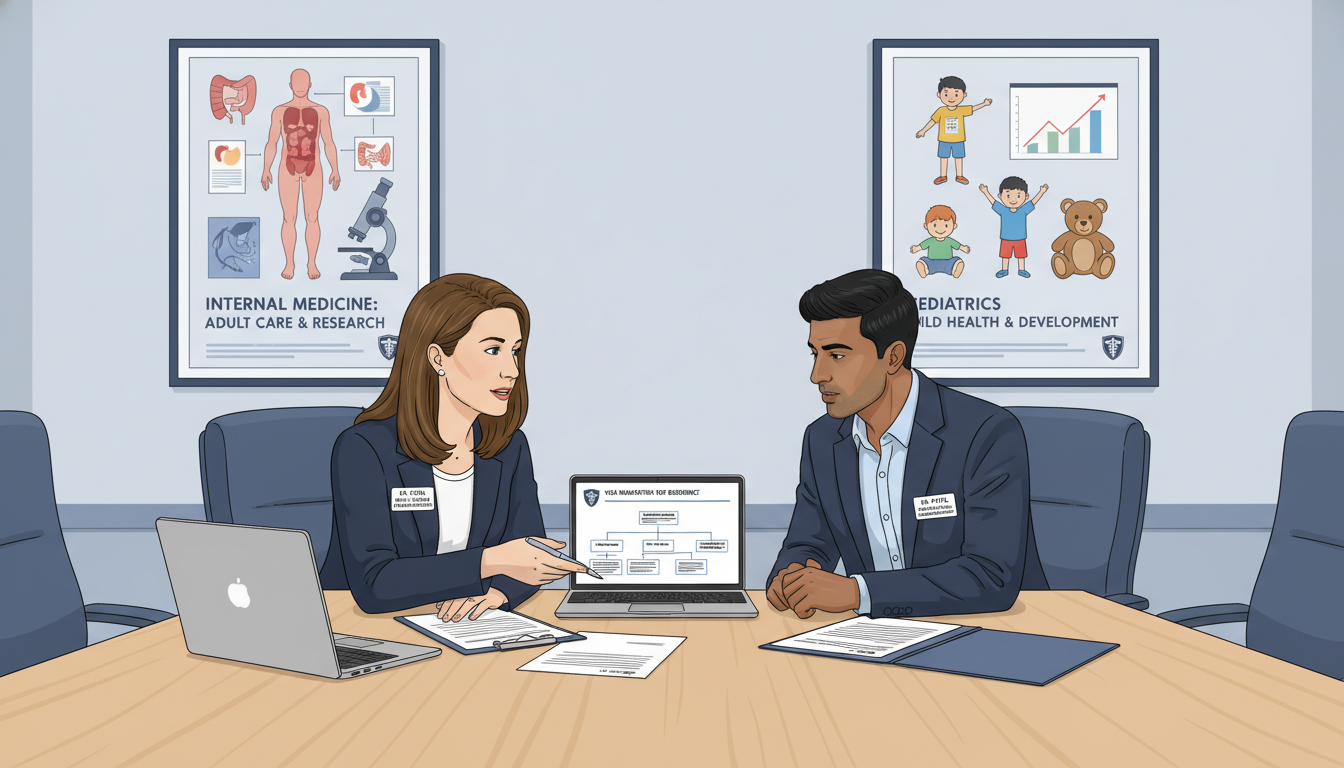
Medicine-Pediatrics is a four-year combined residency that leads to board eligibility in both Internal Medicine and Pediatrics. Visa considerations are slightly more complex than in a standard three-year categorical program.
2.1 Duration of Training and Visa Limits
- Med-Peds duration: 4 years (48 months)
- J-1 maximum clinical training: 7 years (may be combined across programs)
- H-1B maximum: 6 years (extendable with certain green card processes)
For most applicants:
- A J-1 physician visa comfortably covers the 4-year med peds residency.
- An H-1B visa also covers the 4-year training period, leaving room for fellowship time within the 6-year cap.
The main challenge is not the length of training but the transition after residency (fellowship, practice, or waiver service).
2.2 J-1 in a Med-Peds Residency: Practical Implications
If you pursue a med peds residency on a J-1:
You will be sponsored by ECFMG for the entire 4-year combined program.
After completion, you will generally face three options:
Return home for 2 years:
- Then return to the U.S. for fellowship or practice (using H-1B or other status).
- This is more common for those planning careers partly outside the U.S.
Pursue a J-1 waiver job:
- Typically in a medically underserved or rural area in the U.S.
- Most commonly requires at least 3 years of full-time service in that area.
- For Med-Peds graduates, this can be particularly attractive because:
- You can negotiate roles combining adult and pediatric care.
- You are eligible for waiver jobs designated for Internal Medicine, Pediatrics, or sometimes “primary care” positions that value dual training.
Pursue a fellowship on J-1:
- If still within the 7-year cap and consistent with your training pathway.
- However, ECFMG and certain subspecialty fellowships may be more cautious after extended training; you must plan carefully.
Strategic tip: As a Med-Peds J-1 resident, start exploring waiver programs (Conrad 30, federal programs, or VA) by PGY-2 or PGY-3 if you know you want to stay in the U.S. Many waiver positions specifically appreciate med-peds graduates for comprehensive community care.
2.3 H-1B in a Med-Peds Residency: Practical Implications
If you secure an H-1B for med peds residency:
- You will typically be on H-1B status for 4 years, all tied to your training institution.
- After graduation, you can:
- Enter fellowship on H-1B (if the fellowship sponsor is willing and able).
- Transition to practice positions that sponsor H-1B or green card.
- Avoid the J-1 two-year home requirement entirely.
However:
- Not all med peds programs sponsor H-1B. Many are “J-1 only” or “J-1 preferred.”
- You must usually:
- Have passed USMLE Step 3 before residency starts.
- Meet any institutional wage and HR requirements (e.g., prevailing wage, faculty appointment status in some systems).
- Some institutions categorize residents as “trainees” rather than “employees” for H-1B purposes, complicating sponsorship.
Strategic tip: If you are strongly focused on long-term U.S. practice and subspecialty fellowship without interruption, prioritize med peds programs that explicitly mention H-1B sponsorship in their residency visa policies, and be sure your Step 3 timing aligns with application cycles.
2.4 Switching Visa Types During or After Med-Peds
A common question is whether you can switch from J-1 to H-1B:
- While on J-1 physician status, you are usually subject to the two-year home-country requirement (212(e)).
- You cannot typically change to H-1B or permanent residency inside the U.S. without:
- First fulfilling the 2-year requirement or
- Obtaining a J-1 waiver.
That means:
- If you start med peds on a J-1, you should assume you will complete training and then either:
- Return home for 2 years, or
- Enter a waiver job allowing transition to H-1B.
Switching mid-residency from J-1 to H-1B in the U.S. is usually not feasible unless 212(e) does not apply to you (rare for clinical J-1 physicians).
By contrast:
- Switching from H-1B to J-1 is possible but uncommon, and would involve:
- Ending your H-1B role,
- Obtaining ECFMG sponsorship and a new DS-2019,
- Re-entering the U.S. under J-1 status.
Most IMGs commit to one primary pathway (J-1 or H-1B) for the entire med peds residency.
3. Program Policies: How to Read and Use Them Strategically
Every med peds residency program must decide which visa types it will support. These policies vary widely—even within the same institution.
3.1 Common Program Stances on Visas
When browsing programs for the Medicine-Pediatrics match, you will see descriptions such as:
- “We sponsor J-1 visas only via ECFMG.”
- “We sponsor J-1 and H-1B visas; H-1B sponsorship is considered on a case-by-case basis.”
- “We do not sponsor visas; applicants must already be U.S. citizens or permanent residents.”
- “We accept applicants requiring J-1; at this time we do not sponsor H-1B.”
These are crucial for IMGs. For example:
- A J-1–only program may still be a great fit if you are comfortable with the two-year requirement and/or waiver paths.
- If your long-term aim is seamless fellowship plus U.S. practice without home-country return, you may specifically target H-1B–friendly programs.
3.2 Where to Find Residency Visa Information
Look in the following places:
Program website → “International Medical Graduates” or “Visa Information” section
Often under “How to Apply,” “FAQ,” or a dedicated IMG tab.Institution’s GME (Graduate Medical Education) office website
Sometimes visa policies are determined at the hospital or university level, not by the individual program.FREIDA (AMA) and program directories
These may have basic fields listing visa types sponsored, although not always up to date.Direct email to program coordinator or GME office
If information is unclear or outdated, a short, professional email can clarify.
Example inquiry email:
Dear [Coordinator/Dr. X],
I am an international medical graduate planning to apply to your Medicine-Pediatrics residency. Could you please confirm which visa types your program is currently able to sponsor (e.g., J-1, H-1B)?
Thank you very much for your time and assistance.
Sincerely,
[Your Name], MD
3.3 How Visa Policies Affect Your Application Strategy
Visa constraints should shape your ERAS list:
- If you require a residency visa, avoid applying to programs that:
- Say “no visa sponsorship,” or
- Accept only U.S. citizens/green card holders.
- If you are targeting H-1B, filter for:
- Programs or institutions explicitly stating H-1B sponsorship.
- A realistic ability to complete USMLE Step 3 before the residency start date.
For med peds specifically, where positions are relatively limited compared to categorical internal medicine or pediatrics, it’s important to:
- Balance ideal visa situation with overall competitiveness and fit.
- Consider applying to a mix of J-1–only and potentially H-1B–sponsoring programs, especially if you are open to either pathway.
4. Long-Term Career Planning: Fellowships, Waivers, and Beyond
Choosing between J-1 vs H-1B in your med peds residency has ripple effects on your post-residency opportunities, including fellowships and permanent practice options.
4.1 Fellowship Planning from a Med-Peds Background
Many med peds graduates pursue subspecialty training, such as:
- Adult Cardiology, Pulmonology, Endocrinology, Infectious Disease (via Internal Medicine)
- Pediatric Cardiology, Endocrinology, Pulmonology, etc. (via Pediatrics)
- Combined or transition-focused fields (e.g., adult congenital heart disease, cystic fibrosis, adolescent/transition care)
If you are on J-1:
- You can often continue to a fellowship on J-1, assuming you:
- Remain within the ECFMG training time limits,
- Secure a fellowship that accepts J-1 physicians.
- At the end of all training, you still face the home-country requirement or waiver.
- Some highly competitive fellowships may prefer or only accept J-1 or H-1B depending on institutional policy, so research early.
If you are on H-1B:
- You can apply for fellowships that are willing to sponsor or extend H-1B.
- You may also coordinate with employers to start green card processes during or after fellowship.
- Your transition is simpler in many cases because you are not bound by the 212(e) rule.
Action step: During PGY-2/PGY-3 of med peds, identify:
- Which subspecialty you might pursue,
- Whether that fellowship commonly accepts J-1, H-1B, or both,
- Institutional visa policies at your target fellowship sites.
4.2 J-1 Waiver Paths for Med-Peds Graduates
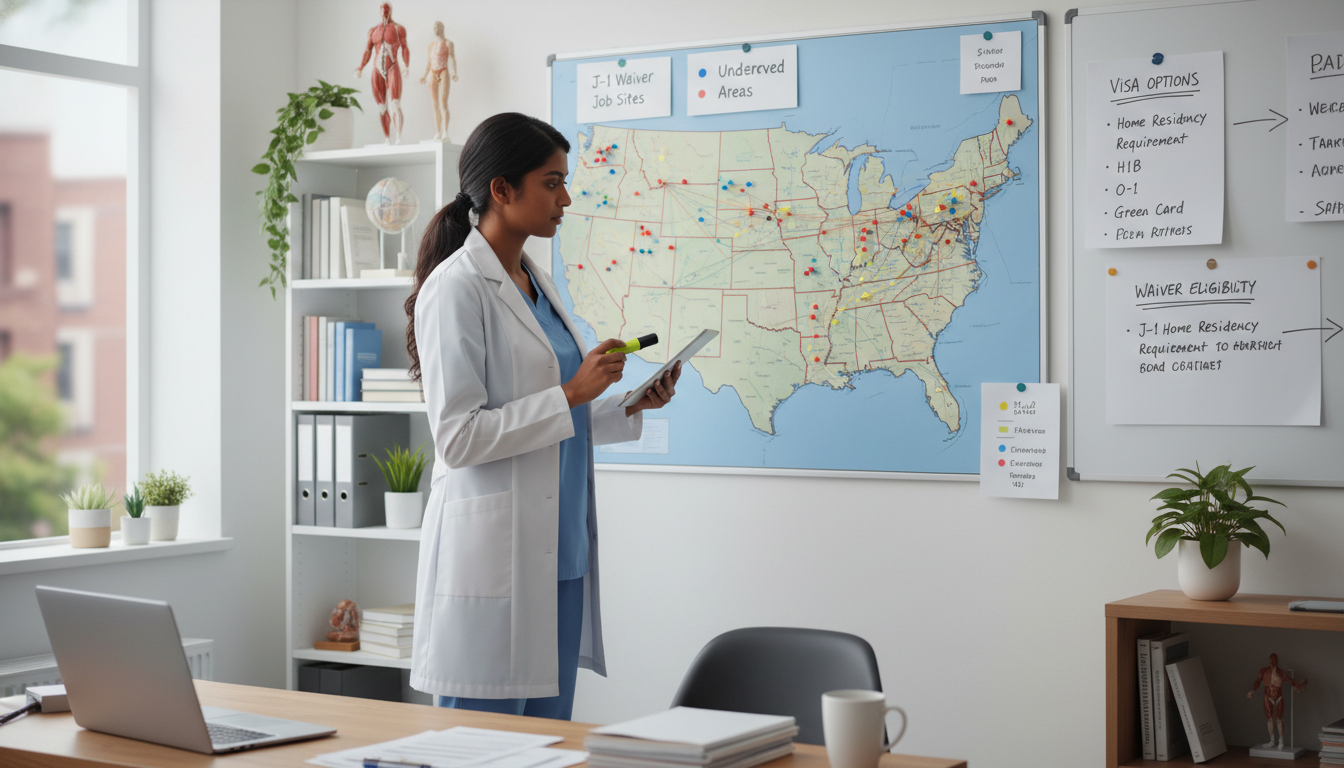
If you complete med peds training on a J-1 and want to stay in the U.S. without returning home for two years, you’ll likely pursue a J-1 waiver job:
Common waiver routes include:
Conrad 30 Waiver (State-based)
- Each U.S. state can sponsor up to 30 J-1 physicians per year.
- Typically requires:
- A 3-year full-time contract in a Health Professional Shortage Area (HPSA) or similar underserved location.
- Employment on H-1B status once the waiver is approved.
- Many states value primary care and Med-Peds physicians highly, because they can care for adults and children in one community.
Federal Waivers
- E.g., VA (Veterans Affairs), Department of Health and Human Services (HHS) for certain facilities, Appalachian Regional Commission (ARC), Delta Regional Authority.
- Requirements and eligibility criteria vary.
Hardship or Persecution Waivers
- Based on hardship to a U.S. citizen/permanent resident spouse or child, or fear of persecution in your home country.
- Legally complex and often requires immigration counsel.
Med-Peds graduates are uniquely positioned for community and rural waiver roles:
- They can cover adult, pediatric, and often inpatient or outpatient roles.
- They may be especially attractive for small hospitals or clinics that need broad coverage.
Planning tip: Start talking with mentors and alumni (especially former J-1 med peds residents) around PGY-3 about how they navigated waiver jobs. Learn which states and employers are med-peds friendly.
4.3 Permanent Residency and Long-Term Security
No matter which training visa you start with, many IMGs eventually aim for U.S. permanent residency (green card).
From H-1B:
- Common to move to employer-sponsored permanent residency:
- EB-2 or EB-3 via PERM labor certification.
- For physicians in underserved areas, EB-2 National Interest Waiver (NIW) may be an option (with similar 5-year service requirements).
- Common to move to employer-sponsored permanent residency:
From J-1 with waiver:
- Typically:
- J-1 → H-1B (via waiver job) → Green card (through same or subsequent employer).
- Time in a J-1 waiver position often aligns with NIW requirements.
- Typically:
Med peds physicians are often strong candidates for NIW, especially if they serve vulnerable populations (complex chronically ill, rural communities, transition programs) where there is clear national interest.
5. Common IMG Scenarios and Practical Strategies
To make all of this more concrete, here are some typical IMG visa scenarios for med peds residency and how you might plan around them.
Scenario 1: IMG Just Finishing Medical School Abroad, No U.S. Status
- You have ECFMG certification or are on track to obtain it.
- You do not have U.S. citizenship or permanent residency.
- You have not yet taken USMLE Step 3.
Likely pathway:
- Focus on J-1–sponsoring med peds programs.
- Prepare documentation for ECFMG-sponsored J-1 (financials, medical diploma, etc.).
- During residency, think proactively about:
- Subspecialty interests and J-1 compatibility.
- Long-term plans: home-country return vs J-1 waiver.
You may still take Step 3 during residency and consider H-1B for later fellowship or waiver jobs.
Scenario 2: IMG With Strong Scores Aiming for H-1B from the Start
- You are confident in your competitiveness and want to minimize visa constraints on fellowship and long-term practice.
- You plan to complete USMLE Step 3 before residency starts.
Strategy:
- Build your ERAS list heavily around med peds programs that state H-1B sponsorship is available.
- Communicate your Step 3 timeline clearly in your applications and, if pending, during interviews.
- Have a backup plan:
- Be ready to accept a J-1 position if H-1B options are not available or if Step 3 timing becomes an obstacle.
- Consider combining med peds programs + categorical IM or peds programs that sponsor H-1B, to keep options open.
Scenario 3: Current Non-Clinical Visa Holder in the U.S. (e.g., F-1 Student)
- You may be completing a master’s or research degree in the U.S. on F-1 or another status.
- You want to enter med peds residency.
Options:
- Switch to J-1 via ECFMG for residency.
- In some cases, change of status to H-1B may be possible if a program sponsors it and you meet all requirements.
Considerations:
- Be mindful of change-of-status vs consular processing (staying in the U.S. vs leaving and re-entering).
- Some applicants choose J-1 for simplicity and then plan for J-1 waiver and eventual green card.
- Others aggressively pursue H-1B–friendly institutions.
In all of these scenarios, early consultation with an experienced immigration attorney—ideally one familiar with physician visas—can be invaluable, especially if your status history is complex.
6. Actionable Steps for Med-Peds Applicants Navigating Visas
To translate this into a practical plan, here’s a step-by-step approach for IMGs targeting a med peds residency.
Step 1: Clarify Your Long-Term Goals
Ask yourself:
- Do I plan to live and practice long-term in the U.S., or am I open to returning to my home country?
- Am I likely to pursue a subspecialty fellowship? Which one?
- Am I willing to work in a rural or underserved area for a few years (if that helps with waivers/green card)?
Your answers will shape whether you prioritize J-1 simplicity or H-1B flexibility.
Step 2: Assess Your Eligibility Profile
Key factors:
- USMLE timeline: Can you finish Step 3 before residency starts?
- Competitiveness: Strong CV, research, U.S. clinical experience—helps for H-1B–friendly academic centers.
- Financial/Family Constraints: Are you able to return home for 2 years if needed? Do you have dependents whose status is linked to yours?
Step 3: Build a Visa-Conscious Program List
For the medicine pediatrics match:
- Identify:
- J-1–only med peds programs that you like.
- H-1B–friendly med peds programs (through websites, FREIDA, or direct contact).
- Consider including a reasonable mix:
- If H-1B is your priority, still have enough J-1 programs to maintain match safety.
- Track these in a simple spreadsheet:
- Program name, location, visa types supported, notes from email/website.
Step 4: Prepare Documentation Early
For J-1:
- Ensure your ECFMG certification and DS-2019 processing timelines are realistic.
- Gather financial proof, passport validity, and any prior visa documents.
For H-1B:
- Complete Step 3 as early as feasible.
- Be ready to supply:
- Medical school diploma and translations,
- ECFMG certificate,
- Detailed CV,
- Any prior U.S. immigration records.
Step 5: Use Interviews to Clarify Visa Nuances
During interviews (or second looks), it is appropriate to ask:
- “Does your program currently sponsor H-1B visas for residents, and if so, under what conditions?”
- “Have any recent med-peds residents been on H-1B or transitioned to waiver jobs/fellowships? How did that process work here?”
- “Are there institutional constraints that might limit visa flexibility during fellowship applications?”
Program directors appreciate well-informed, concise questions. Keep them professional and focused.
Step 6: Plan Ahead for Post-Residency Options
From PGY-2 onward:
- Explore:
- Fellowship visa policies in your field of interest.
- J-1 waiver programs and med-peds-friendly underserved employers.
- Build mentorship:
- Connect with med-peds faculty and alumni who were on J-1 or H-1B.
- Ask specifically how they navigated the transition from training to practice.
FAQs: Visa Navigation for Med-Peds Residency
1. Is it harder to get an H-1B for a med peds residency than for categorical internal medicine?
It can be, but not necessarily. The main limiting factor is institutional policy, not the specialty itself. Because med peds slots are fewer, your overall options may be more constrained compared with a large internal medicine program that sponsors many H-1B residents. However, institutions that already sponsor H-1B for IM or peds often extend similar policies to their med peds program. The key is to identify such programs early and align your Step 3 timing.
2. Can I do a fellowship in the U.S. after a J-1 med peds residency without going home for two years?
Yes, often you can. Many J-1 residents complete a fellowship on J-1 as long as they remain within ECFMG time limits and secure an accepting fellowship program. However, at the end of all J-1 training (residency + fellowship), you still face the two-year home-country requirement unless you obtain a waiver. So you may postpone—but not avoid—the 212(e) issue without a waiver.
3. As a med-peds graduate with J-1, are J-1 waiver jobs harder or easier to find compared with single-specialty graduates?
In many states, med peds graduates are actually highly attractive for J-1 waiver positions because they can care for both adults and children, covering more of a community’s needs. Some employers specifically look for med-peds physicians for rural or underserved clinics and small hospitals. The challenge is not availability, but matching your personal preferences (geography, practice type) with waiver requirements.
4. Should I delay applying to the medicine pediatrics match until I have passed Step 3 if I want H-1B?
If H-1B sponsorship is a top priority, having Step 3 passed before applying strengthens your position and increases the number of programs that can realistically consider you for H-1B. However, delaying application by a full cycle can have downsides (time away from clinical practice, visa expiration risks, etc.). A balanced approach is to:
- Attempt Step 3 early enough that results are available during interview season.
- Apply broadly to both J-1–friendly and H-1B–friendly med peds programs.
- Use interviews to clarify whether a pending Step 3 is acceptable for H-1B sponsorship at that institution.
Thoughtful planning around residency visa options—especially understanding J-1 vs H-1B in the context of a four-year med peds residency—will help you approach the medicine pediatrics match with clarity and confidence. By aligning your visa strategy with your long-term goals and being proactive about information gathering, you can build a sustainable career path in combined internal medicine and pediatrics in the United States.