Understanding the Landscape: Neurosurgery Residency and Visas for IMGs
Neurosurgery is one of the most competitive and demanding specialties in the United States. For international medical graduates (IMGs), navigating both the neurosurgery residency application and the U.S. immigration system can feel like running two marathons at the same time.
You must excel in the match process and choose the right residency visa pathway—often under strict timelines and with incomplete information. This guide focuses on the immigration side of the equation for neurosurgery applicants: how to think about J-1 vs H-1B, how visas affect training, research, and fellowship plans, and how to avoid common pitfalls that can derail even the strongest application.
Throughout, we’ll assume you already understand the basics of neurosurgery residency (7-year training, research years common) and focus primarily on visa navigation specifically for neurosurgery.
Core Visa Options for Neurosurgery Residency (IMG-Focused Overview)
For IMGs entering a U.S. neurosurgery residency, two visa types are overwhelmingly the most relevant:
- J-1 Alien Physician Visa (via ECFMG sponsorship)
- H-1B Temporary Worker Visa (employer-sponsored)
Other statuses (F-1 with OPT, O-1, green card, etc.) may become relevant later, but for residency start, most neurosurgery programs expect either J-1 or H-1B eligibility.
1. The J-1 Visa: Most Common Pathway for IMGs
The J-1 visa for physicians is sponsored by ECFMG, not by individual hospitals directly. It’s designed for graduate medical education (GME) and is:
- The default visa at many academic neurosurgery programs
- Often simpler and faster to process
- Typically easier for programs and GME offices to support
Key features of the J-1 for neurosurgery residency:
- Purpose: Graduate medical education (residency and fellowship)
- Duration: Year-to-year, renewable up to the maximum allowed for training (usually enough to cover a full neurosurgery residency and standard fellowships if properly planned)
- Sponsorship: ECFMG is the official sponsor; the training program provides supporting documentation
- Work Limitation: Generally restricted to the approved training site(s) and activities
The J-1 is especially common in neurosurgery because:
- Many neurosurgery departments are in large academic centers that have streamlined J-1 processes
- GME offices are familiar with ECFMG procedures
- It avoids some of the complexities and costs of H-1B sponsorship
2. The H-1B Visa: More Flexibility, More Barriers
The H-1B is a work visa for “specialty occupations,” which includes physicians. It allows residents to be treated as employees rather than “exchange visitors.”
For neurosurgery, H-1B can be attractive because:
- It does not carry the J-1 2-year home residency requirement
- It may simplify the transition to fellowships or early attending positions
- It offers somewhat more flexibility for moonlighting (when institutionally permitted and consistent with visa conditions)
However, many neurosurgery programs do not sponsor H-1B visas for residents, or sponsor them only in specific circumstances.
Common program-level barriers:
- Higher legal and filing costs
- More complicated immigration compliance
- Institutional policies that restrict resident visas to J-1 only
If you see a neurosurgery residency program listing, “Visa: J-1 only,” they are generally not open to negotiating H-1B for incoming residents, regardless of your profile.
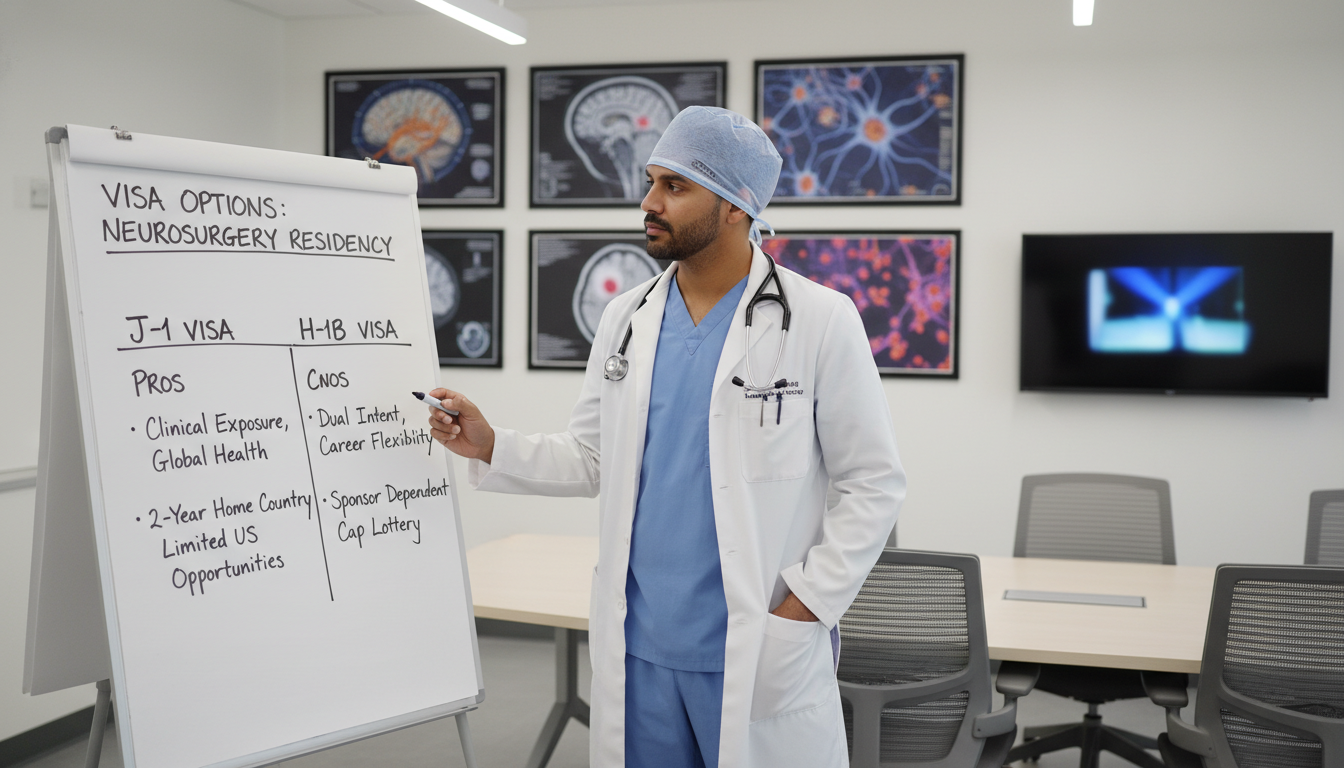
J-1 vs H-1B in Depth: What Matters Specifically for Neurosurgery
Understanding J-1 vs H-1B is critical in neurosurgery because of:
- The long training duration (often 7 years)
- Frequent research years or enfolded fellowship experiences
- The need for post-residency fellowships (e.g., spine, vascular, skull base)
- Long-term career goals in the U.S. vs abroad
A. Training Length and Structure
Neurosurgery residency typically spans:
- 7 years total (usually PGY-1 through PGY-7)
- Often includes 1–2 protected research years
- May involve rotations at multiple hospital sites
J-1 implications:
- ECFMG sponsorship generally covers full neurosurgery training, including approved research years, provided:
- Your program certifies the need
- Each year remains within allowable maximum GME duration
- Research years must be:
- Formally part of the ACGME-accredited residency
- Clearly documented to ECFMG as part of your educational plan
H-1B implications:
- H-1B is usually granted in 3-year increments (up to 6 years total by default; sometimes extended under specific circumstances, often related to green card processes)
- For a 7-year neurosurgery residency, the program may need:
- Multiple extensions
- Legal planning to ensure sufficient H-1B time covers all years
- Complexities can increase if:
- You have prior H-1B time in the U.S.
- You need additional time for research or dual-degree work (e.g., PhD)
In practice, many programs find the J-1 more straightforward for full-length neurosurgery training.
B. Post-Residency Plans: Practice vs Fellowship
Neurosurgery graduates often pursue:
- Subspecialty fellowships (endovascular, spine, functional, tumor, pediatrics)
- Academic positions with heavy research
- Positions in underserved or rural areas
On a J-1:
- You are generally subject to the two-year home country physical presence requirement after finishing all J-1-sponsored training.
- You usually cannot:
- Change to H-1B
- Obtain a green card
- Change to most other nonimmigrant statuses
…until you either: - Fulfill the 2-year home country requirement, or
- Obtain a waiver.
This affects your fellowship and job strategy:
- Fellowships after neurosurgery residency on J-1:
- You can remain on J-1 for additional ACGME-accredited fellowships if ECFMG and the program approve.
- The 2-year home residency requirement clock starts only after your final J-1 training (residency + any J-1 fellowships).
- Post-training practice in the U.S. often requires:
- A J-1 waiver job (usually in a medically underserved or shortage area) under federal or state programs (e.g., Conrad 30)
- Typically on H-1B after the waiver is approved
On an H-1B:
- No built-in 2-year home residency requirement.
- Easier to:
- Transition to fellowship (if that fellowship program sponsors H-1B)
- Move directly into an attending role
- Begin employment-based green card processes earlier
However, many neurosurgery fellowships (like residency programs) may also prefer or limit to J-1 sponsorship, so H-1B post-residency transitions still require careful planning.
C. Long-Term Immigration Goals
If your goal is long-term practice in the U.S., you must weigh:
- J-1
- Pros:
- Widely accepted by neurosurgery residencies
- Easier for academic GME offices to administer
- Generally predictable through entire training
- Cons:
- 2-year home residency requirement by default after training
- Requires a waiver job or actual return home to overcome the requirement
- Pros:
- H-1B
- Pros:
- No 2-year home requirement
- Often smoother path to permanent residency if employer-sponsored
- Cons:
- Fewer neurosurgery programs willing to sponsor
- More complex and costly for programs
- Cap and timing issues in some contexts (though many large academic centers are cap-exempt)
- Pros:
Most IMGs in neurosurgery ultimately accept a J-1 for residency and plan to navigate the post-residency waiver and H-1B transitions later.
Step-by-Step Visa Planning Timeline for Neurosurgery Applicants
Think of visa navigation as part of your overall residency strategy, not a last-minute detail. Below is a practical timeline aligned with the residency match and applications cycle for a brain surgery residency.
1. 18–24 Months Before Match: Clarify Your Status and Goals
- Confirm your citizenship, current U.S. immigration status, and any previous U.S. visa history.
- Decide your priority:
- “Match into neurosurgery anywhere, regardless of visa”
OR - “Match into neurosurgery but strongly prefer/require H-1B”
- “Match into neurosurgery anywhere, regardless of visa”
- Research:
- Neurosurgery programs’ published visa policies
- Historical patterns: which programs have sponsored H-1B for residents before (if any)
Actionable advice:
- Create a spreadsheet of target neurosurgery programs with columns:
- J-1 sponsorship
- H-1B sponsorship
- “J-1 only” vs “H-1B considered”
- IMGs accepted in prior years
- Email a small number of programs (politely and briefly) if their visa policy is unclear on their website or FREIDA.
2. 12–15 Months Before Match: Align Exams and Documentation
To be eligible for ECFMG-sponsorship (for J-1), you must:
- Be ECFMG certified (or on track)
- Have passed:
- USMLE Step 1
- USMLE Step 2 CK
- OET (or other current communication requirement as per ECFMG rules at the time)
For H-1B eligibility for residency, typical expectations include:
- A passed USMLE Step 3 before H-1B filing (program-specific, but commonly required)
- Unrestricted state temporary or training license eligibility
Actionable advice:
- If you strongly want an H-1B, schedule and plan to pass Step 3 early, ideally before interviews.
- If you are open to J-1, focus on completing the exams required for ECFMG certification early in the cycle.
3. Application and Interview Season: Communicating About Visas
During application:
- In ERAS, indicate your visa needs accurately (don’t misrepresent).
- Consider a brief note in your personal statement or CV if:
- You already hold a non-immigrant status that may be relevant
- You have Step 3 completed (which hints at H-1B readiness)
During interviews:
Do not let visas overshadow your clinical and academic strengths.
Ask targeted, professional questions near the end of the interview or to the program coordinator:
- “Does your institution sponsor J-1, H-1B, or both for neurosurgery residents?”
- “Are there any visa restrictions that IMGs should be aware of for research years or off-site rotations?”
- “Have you had IMG residents on H-1B in recent years?”
Red flags:
- Program says, “We usually do J-1 only” → assume J-1 only.
- Answer is vague or “case-by-case” → treat as uncertain and get clarification via email from GME or program administrator.
4. After Match: From Offer to Visa Processing
Once you match into a neurosurgery residency:
- The GME office and program coordinator will explain their standard visa process.
- If J-1:
- You’ll work with ECFMG and the program to submit:
- Form DS-2019 sponsorship application
- Proof of ECFMG certification, contract, financial support, etc.
- Then you’ll apply for a J-1 visa at a U.S. consulate (unless you’re changing status within the U.S.)
- You’ll work with ECFMG and the program to submit:
- If H-1B:
- The institution’s legal team will usually file:
- Labor Condition Application (LCA)
- H-1B petition with USCIS
- You then attend a consular visa interview if outside the U.S.
- The institution’s legal team will usually file:
Timing considerations:
- Start the process as soon as your program contacts you.
- Provide documents promptly—delays on your side can risk:
- Late arrival
- Inability to start on July 1
- Stay in close communication with:
- Program coordinator
- GME office
- ECFMG (for J-1)
Special Considerations for Neurosurgery: Research, Away Rotations, and Fellowships
Because neurosurgery training is long, research-intensive, and frequently multi-institutional, IMGs must understand how visas interact with these aspects.
A. Research Years and Advanced Degrees
Many neurosurgery programs include:
- 1–2 dedicated research years
- Optional master’s degrees (e.g., MPH, MSc, clinical research)
- Lab work funded via grants
On a J-1:
- Research must be:
- Explicitly recognized as part of the residency training plan
- Supported with updated documentation to ECFMG
- Paid research positions outside of GME structures may be problematic unless:
- Integrated into the residency timeline and contracts
- Approved by ECFMG
On an H-1B:
- Changes to duties or employer (e.g., switching from clinical to pure research position with a different sponsor) may require amended petitions.
- You must avoid:
- Unauthorized work outside the parameters of your H-1B petition.
Practical advice:
- Before committing to multi-year research tracks, ask:
- “How have previous IMG residents handled visas during research years?”
- “Does the program coordinate J-1/H-1B status through the entire research period as part of residency?”
- Keep all visa-related correspondence and approvals in a dedicated folder.
B. External Rotations, Away Rotations, and Visiting Electives
Some neurosurgery residents rotate:
- To partnered institutions
- To trauma centers or cancer centers
- To pediatric hospitals not under the primary GME sponsor
Visa implications:
- J-1 and H-1B both require:
- Proper listing of all training sites
- Compliance with institutional and immigration rules
- For J-1 in particular:
- ECFMG must be aware of and approve all clinical sites where you train.
If you are still a student IMG considering visiting electives (before residency):
- You may use B-1/B-2, F-1, or other statuses depending on the program’s policy.
- These pre-residency electives are separate from J-1/H-1B GME visas, but:
- Strong U.S. clinical exposure can strengthen neurosurgery applications.
- You must not engage in unauthorized clinical work.
C. Post-Residency Fellowships on J-1 or H-1B
Common neurosurgery fellowships include:
- Spine surgery
- Cerebrovascular / endovascular
- Functional / epilepsy
- Pediatric neurosurgery
- Neuro-oncology / skull base
On a J-1:
- You can often continue on J-1 sponsorship for:
- ACGME-accredited neurosurgery fellowships
- Each fellowship:
- Extends your J-1 training
- Delays the start of your 2-year home requirement (or waiver obligation)
On an H-1B:
- Fellowship institutions must be willing and able to:
- Sponsor H-1B for subspecialty training
- If your H-1B time is nearing maximum duration, careful planning is needed to:
- Avoid gaps
- Align with permanent residency processes if desired
Practical Strategies for IMGs Targeting Neurosurgery in the U.S.
1. Be Realistic but Strategic About Visa Types
- If a program clearly states “J-1 only”, don’t waste energy trying to negotiate H-1B.
- If you insist on H-1B:
- Your realistic program list will be much smaller.
- You must have Step 3 and often very competitive credentials to justify the extra work for the program.
Balanced approach:
- For most IMGs, an effective strategy is:
- Accept a J-1 for neurosurgery residency if offered
- Focus on strong clinical performance and research during training
- Plan early for:
- J-1 waiver routes (e.g., Conrad 30, VA, HHS research)
- H-1B and green card strategies with future employers
2. Use Official and Reliable Sources
Always cross-check visa information with:
- ECFMG (for J-1 physician sponsorship)
- Your matched program’s GME office
- Official USCIS resources for H-1B rules
- A qualified immigration attorney, especially when making long-term career decisions
Avoid relying solely on:
- Online forums or social media anecdotes
- Second-hand stories from other residents (use them as illustrations, not legal authority)
3. Keep Documentation Organized
During your neurosurgery residency journey, maintain a secure, backed-up folder with:
- Passports and prior visas
- USMLE transcripts and ECFMG certificate
- Residency contract and offer letters
- All DS-2019 forms (if on J-1)
- I-797 approval notices (if on H-1B)
- Copies of all correspondence with ECFMG, GME, and attorneys
This will simplify:
- Visa renewals
- Applications for fellowships
- J-1 waiver filings
- Future immigration petitions
4. Avoid Status Violations
Status violations can completely derail your trajectory.
- Follow all rules about:
- Moonlighting
- Working outside approved sites
- Extending or changing programs
- Inform your GME office before:
- Changing addresses (for required registration)
- Traveling internationally near visa expiry or renewal times
- Allow enough buffer time before:
- Visa expiries
- Planned international travel (e.g., conferences, family visits)
FAQs: Visa Navigation for Neurosurgery Residency
1. Is it possible to complete a full neurosurgery residency on a J-1 visa?
Yes. Many IMGs complete the entire 7-year neurosurgery residency (including research years) on J-1 sponsorship, often followed by J-1 fellowships. ECFMG and your program must document that the full training—from PGY-1 through PGY-7—is part of your structured GME. The main consequence is the 2-year home country requirement at the end of all J-1 training unless you obtain a waiver.
2. Should I delay applying to neurosurgery until I pass Step 3 so I can get an H-1B?
Only if an H-1B is absolutely central to your long-term plan and you are willing to narrow your program list significantly. Many excellent neurosurgery residencies will accept only J-1 for IMGs, and taking extra years just for Step 3 might weaken your overall profile. For most applicants, it is better to apply when your neurosurgery application is otherwise strongest and be open to J-1.
3. How does the J-1 2-year home residency requirement affect my ability to stay in the U.S. after training?
By default, after finishing all J-1-sponsored training (residency and any fellowships), you must either:
- Spend 2 years physically present in your home country, or
- Obtain a waiver (e.g., by working in a designated underserved area under programs like Conrad 30, or other federal waiver programs).
You usually cannot change to H-1B, get a green card, or switch to most other nonimmigrant statuses until the requirement is satisfied or waived.
4. Can I switch from J-1 to H-1B during neurosurgery residency?
This is uncommon and complex. In theory, switching from J-1 to H-1B might be possible only after you have obtained a J-1 waiver of the 2-year home residency requirement. During residency, such waivers are rarely available. In practice, most neurosurgery IMGs stay on J-1 throughout residency (and often fellowship), then move to H-1B when they take a waiver-qualifying attending job.
Visa navigation in neurosurgery is not just about choosing between J-1 vs H-1B; it is about aligning your visa pathway with your training length, subspecialty plans, and long-term career goals. Start early, get accurate information, keep your documents organized, and work closely with your program and trusted immigration experts. With thoughtful planning, your visa will support—not limit—your journey through neurosurgery residency and beyond.