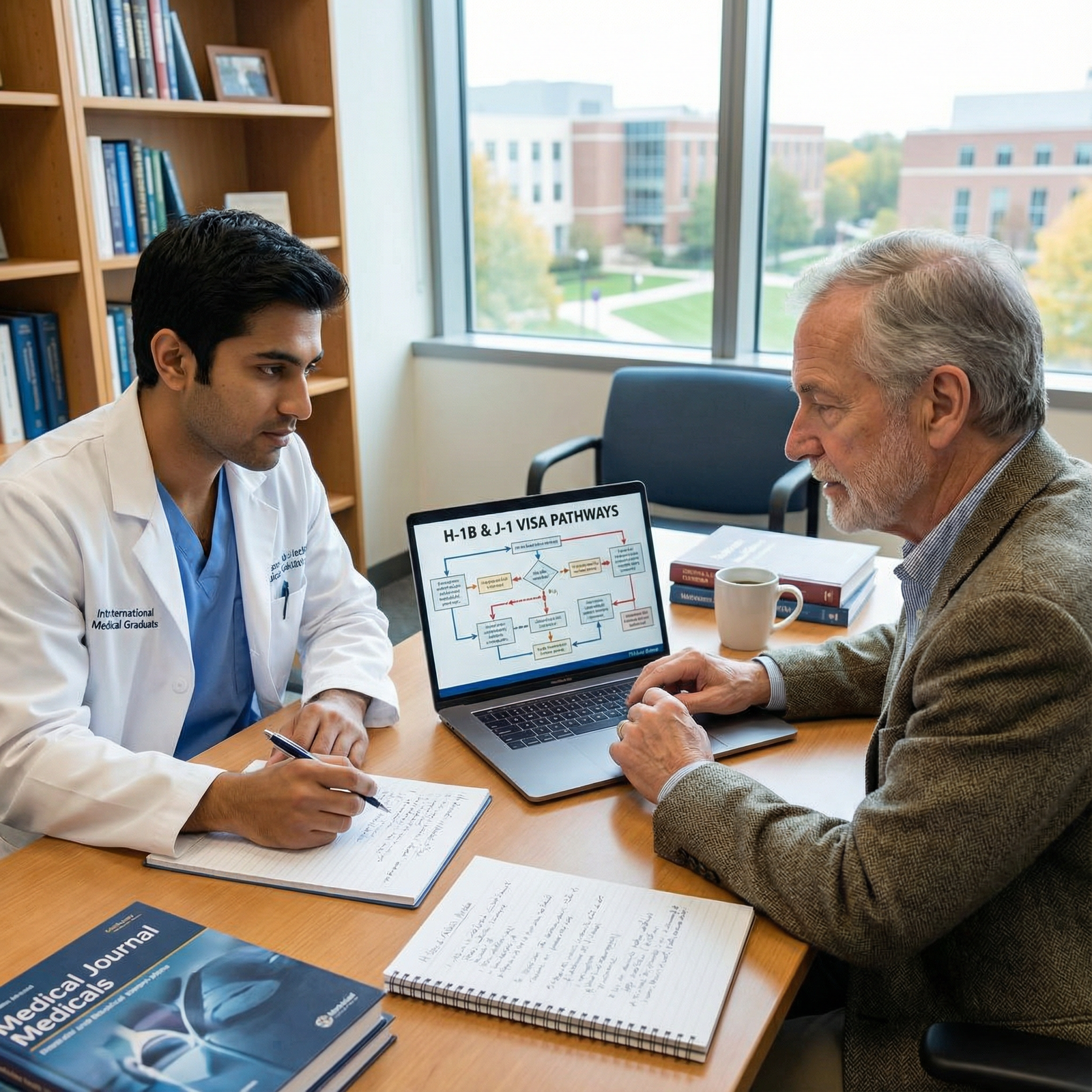
Navigating the U.S. visa system as a non-US citizen IMG while targeting a San Francisco residency can feel like doing an extra degree in immigration law. The Bay Area adds its own layer of complexity: highly competitive programs, tech-driven healthcare systems, and institutions with varying levels of experience sponsoring visas. This guide breaks down what you need to know—specifically as a foreign national medical graduate aiming for San Francisco or broader Bay Area residency programs.
Understanding Your Starting Point as a Non-US Citizen IMG
Before comparing IMG visa options, clarify your baseline situation. Programs, immigration attorneys, and ECFMG will all ask some variation of the same questions:
1. What Is Your Current Status?
Common scenarios for a non-US citizen IMG:
- You are outside the U.S. and have never held a U.S. visa.
- You are in the U.S. on a B-1/B-2, F-1, or other non-immigrant status.
- You are on OPT or STEM OPT after a U.S. degree (e.g., MPH, MS, PhD).
- You previously held J-1 clinical or non-clinical status and may have a two-year home residency requirement (212(e)).
Your path to a residency visa will differ depending on which category you fall into. For residency training in the Bay Area, you will almost always need one of these:
- J-1 Exchange Visitor (ECFMG-sponsored)
- H-1B Temporary Worker (hospital/program-sponsored)
Green cards or other non-immigrant categories (e.g., O-1) do occasionally appear, but they are not the routine entry point into graduate medical education.
2. What Are Your Long-Term Plans?
Your ideal visa pathway also depends on:
- Do you want to stay in the U.S. long-term after training?
- Are you willing to work in an underserved or rural area after residency?
- How important is it that you moonlight (if allowed) during fellowship or later training?
- Are you willing and able to pay for USMLE Step 3 early, if needed for H-1B?
You do not need all the answers now, but clarity helps you choose strategically between J-1 vs H-1B.
Core Visa Options for Bay Area Residency Programs
Most San Francisco and Bay Area residency programs work with two visa categories. Understanding the differences is critical.
J-1 Exchange Visitor Visa: The Standard IMG Path
For a non-US citizen IMG, the J-1 visa is the most common route into a U.S. residency, including in the Bay Area.
Key features:
- Sponsored by ECFMG (not the hospital directly).
- Intended only for graduate medical education (residency/fellowship).
- Has a two-year home-country physical presence requirement (the 212(e) rule) for many IMGs.
- Requires you to return to your home country for two years after training OR obtain a waiver before changing to certain statuses (e.g., H-1B, permanent resident).
Typical eligibility for J-1 in residency:
- ECFMG certification (USMLE Step 1 + Step 2 CK + credentials verified).
- A valid contract or offer letter from an accredited U.S. residency program.
- Sufficient proof of funding (program stipend usually meets this).
- No other conflicting immigration bars or ineligibilities.
Advantages of J-1 for Bay Area residency:
- Widely accepted: Many San Francisco residency and Bay Area residency programs default to J-1.
- Less institutional burden: The hospital does not have to file an I-129 petition—ECFMG manages sponsorship.
- More predictable timeline: ECFMG processes thousands of J-1 applications annually and has standardized procedures.
- Available even if you haven’t completed Step 3.
Disadvantages:
- Two-year home residency requirement (for most IMGs), which can limit your ability to:
- Immediately pursue H-1B employment in the U.S.
- Immediately apply for a green card category that requires status like H-1B.
- No dual intent: Technically, J-1 expects you to plan to return home (though many eventually adjust via waiver routes).
- More complex if you want to stay in the U.S. long-term after training, especially in competitive markets like the Bay Area.
H-1B Temporary Worker Visa: Less Common, More Flexible
The H-1B is an employment-based visa. Some San Francisco/Bay Area programs sponsor it for residency, but many either:
- Do not sponsor H-1B at all, or
- Restrict it to fellowships or certain specialties.
Key features of H-1B in residency:
- Sponsored by the hospital or institution, not ECFMG.
- Requires:
- ECFMG certification.
- USMLE Step 3 passed before filing.
- State medical training license or eligibility for it.
- Initially granted for up to 3 years, extendable to a total of 6 years (time spent in certain J statuses does not count toward H-1B cap years).
Advantages:
- No two-year home residence requirement (unlike J-1; unless you previously had J-1 subject to 212(e)).
- Dual intent: You can have an intention to stay permanently; easier to pursue employment-based green cards after training.
- Often more straightforward for transitioning to attending roles in the U.S., especially in high-demand specialties.
Disadvantages:
- Many Bay Area residency programs do not sponsor H-1B due to:
- Legal/administrative cost.
- Internal policies limiting H-1B to fellows or faculty.
- Requires USMLE Step 3 before Match (ideally before ranking), which can be challenging for IMGs applying from abroad.
- More complex if you later change jobs or programs.
J-1 vs H-1B: How to Decide as a Non-US Citizen IMG
Think of the choice as a matrix of program policy, your timeline, and your career goals:
If you can take Step 3 early, and:
- You aim to stay long-term in the U.S., and
- You identify Bay Area programs that clearly sponsor H-1B,
then H-1B is worth pursuing.
If:
- You cannot take Step 3 before Match,
- Or your target San Francisco residency programs are J-1 only,
then you should prioritize J-1 and plan your long-term strategy around J-1 waivers.
In practice, many non-US citizen IMGs matching into San Francisco Bay Area residencies begin with J-1 due to program policies and competitive pressure, then address waivers and future immigration during or after residency.
How Visa Policies Vary Across San Francisco Bay Area Programs
Visa sponsorship is not uniform across the Bay Area. Understanding institutional differences can significantly shape your application strategy.
Types of Institutions in the Bay Area
Broadly, you’ll encounter:
Large Academic Medical Centers
- Examples: University-affiliated hospitals, major teaching systems in San Francisco and the East Bay.
- More likely to:
- Accept J-1 routinely.
- Have clearly stated policies on H-1B, though often restrictive.
- Pros: Established GME offices, immigration lawyers, and experience with IMGs.
- Cons: Extremely competitive; policies may change year to year.
County and Safety-Net Hospitals
- Often associated with academic centers but with a strong public service mission.
- Typically more open to J-1.
- Occasionally sponsor J-1 waiver jobs for attendings after training (helpful when planning long-term).
Community-Based or Smaller Residency Programs
- Some may be less experienced in visa matters.
- More likely to:
- Be J-1 only, or
- Limit or avoid H-1B sponsorship due to cost and complexity.
- Always verify current visa policy directly on the program’s website or by contacting the GME office.
Where to Find Accurate Visa Policy Information
As a foreign national medical graduate, you should not rely on rumors or outdated forum posts. Check:
- Official program websites: Look for “Eligibility & Visa” or “Requirements” pages.
- FREIDA (AMA): Many programs list whether they sponsor J-1 and/or H-1B.
- NRMP/ERAS program descriptions: Sometimes include explicit notes on visa policies.
- Direct communication:
- Email the program coordinator or GME office with a concise question:
- “I am a non-US citizen IMG. Do you sponsor J-1 and/or H-1B visas for incoming residents?”
- Email the program coordinator or GME office with a concise question:
Keep track of responses in a spreadsheet as you build your Bay Area residency application list.
Planning Your Application Strategy Around Visa Issues
Your ERAS and NRMP strategy as a non-US citizen IMG targeting San Francisco must integrate visa feasibility from the beginning.
Step 1: Build a Visa-Aware Program List
For each program, capture:
- Location (San Francisco proper vs broader Bay Area: Oakland, San Jose, etc.).
- Visa policy this cycle:
- J-1 only
- J-1 and H-1B
- No visa sponsorship
- History with IMGs:
- % IMGs in recent classes.
- Any mention of IMGs on their website or social media.
- Competitiveness & fit:
- USMLE score expectations.
- Research profile (especially important in academic centers).
- Your clinical and personal fit.
If you are a non-US citizen IMG without Step 3:
- Focus on programs that accept J-1.
- Apply broadly across the Bay Area and beyond; San Francisco alone is extremely competitive.
If you have Step 3 and are competitive:
- Prioritize programs that sponsor both J-1 and H-1B.
- In your communication and interviews, you can safely indicate flexibility:
- “I am eligible for both J-1 and H-1B and would be happy to discuss whichever works best with your institution’s policies.”
Step 2: When and How to Talk About Visa in Interviews
You want to project confidence and preparation, not anxiety.
Guidelines:
- Do not open the interview with visa concerns. Focus on your training fit, experience, and goals.
- When asked, “Do you have any questions for us?” you can ask:
- “Could you share your current policies and experience with residency visa sponsorship for non-US citizen IMGs, particularly J-1 vs H-1B?”
- Be concise and upfront about your situation:
- “I am a non-US citizen IMG currently living in [country/status]. I am ECFMG certified and will be relying on either J-1 or H-1B sponsorship depending on program policy.”
Programs appreciate clarity. You are not “less desirable” simply because you need a residency visa—many Bay Area programs are used to this.
Step 3: Timing Considerations for Visa Processing
For a San Francisco residency starting in July:
- J-1 timeline:
- Match Day: March.
- Program issues contract and ECFMG documents: March–April.
- ECFMG J-1 sponsorship application: Spring.
- Visa interview at U.S. consulate: Typically late spring/early summer.
- H-1B timeline:
- More institution-dependent.
- Requires earlier completion of:
- USMLE Step 3.
- State training license paperwork.
- Petition filing may need to occur months before July 1.
As a non-US citizen IMG outside the U.S., you must factor in U.S. consulate appointments, security checks, and potential processing delays. Applying early and staying organized is essential.
Long-Term Planning: After Residency in the Bay Area
Your residency visa choice directly shapes what happens after you finish training in San Francisco or the Bay Area.
If You Trained on a J-1 Visa
Most non-US citizen IMGs will face the two-year home-country physical presence requirement (212(e)). To stay in the U.S. after finishing residency/fellowship, you typically must:
- Return home for two years, or
- Obtain a J-1 waiver, then:
- Change to H-1B, and
- Work in a designated, usually underserved area for a set period (often 3 years).
Common J-1 waiver routes:
- Conrad 30 program (state-based, often in underserved or rural areas).
- Federal agencies (e.g., VA, HHS, ARC, DRA) in specific roles.
- Hardship or persecution-based waivers (less common, higher legal complexity).
Important Bay Area–specific reality:
- Many J-1 waiver jobs are not in central San Francisco. They are more often in:
- Smaller cities,
- Rural or semi-rural areas,
- Underserved communities outside major metros.
- However, some counties and healthcare systems in broader Northern California do sponsor J-1 waiver positions, particularly in primary care and psychiatry.
If your dream is to stay in the San Francisco Bay Area long-term as an attending, planning might involve:
- Completing residency/fellowship in SF/Bay Area on J-1.
- Taking a J-1 waiver job elsewhere in California or another state.
- Later moving back to the Bay Area once immigration status is more stable (e.g., after permanent residency).
If You Trained on an H-1B
After residency or fellowship:
- You can continue on H-1B in an attending role (subject to H-1B rules and employer willingness).
- Many employers value H-1B physicians because:
- No J-1 waiver requirement.
- Possible path to employment-based green card.
Challenges:
- H-1B transfer or extension must be managed carefully:
- New employer must file a new petition.
- Caps and exemptions may be relevant depending on employer type.
- Some desirable Bay Area hospitals prefer or require permanent residents or citizens for long-term positions, particularly in certain specialties or leadership tracks.
For an IMG who wants to be permanently based in the Bay Area, H-1B during residency can simplify the later steps, but it is not strictly necessary. Many J-1 IMGs still eventually settle in or near major metropolitan areas after navigating waivers and green cards.
Practical Tips and Common Pitfalls for Non-US Citizen IMGs
Actionable Tips
Start early with Step 3 (if aiming for H-1B).
- If you are still deciding between J-1 vs H-1B, having Step 3 in hand gives you flexibility.
- Schedule Step 3 as soon as you are eligible and can realistically prepare.
Keep immigration and training documentation perfectly organized.
- Passport, prior visas, DS-2019s or I-20s, I-94 records.
- ECFMG certificate, USMLE score reports.
- Copies of all residency and fellowship contracts.
Be honest with programs about your needs.
- Programs appreciate clarity: “I will need visa sponsorship and am open to J-1; I have not yet taken Step 3,” or “I have Step 3 and would be eligible for H-1B.”
Use official sources for immigration information.
- ECFMG website (for J-1).
- USCIS website (for H-1B and other statuses).
- Reputable immigration attorneys—especially once you are in residency.
Connect with current residents in the Bay Area.
- Ask IMGs in your target programs:
- What visa are they on?
- How supportive is the GME office?
- How was their transition to residency and, if relevant, to waiver or attending roles?
- Ask IMGs in your target programs:
Common Pitfalls to Avoid
- Assuming all Bay Area residency programs sponsor H-1B.
- Many do not; never assume. Always confirm.
- Waiting too long to address visa issues.
- Do not wait until after Match to understand your likely visa pathway.
- Ignoring the two-year home residency rule on J-1.
- If you are subject to 212(e), it will affect not just your first job but your entire long-term immigration strategy.
- Relying solely on online forums or anecdotes.
- Visa policies change frequently; always cross-check with official and current sources.
FAQs: Visa Navigation for Non-US Citizen IMGs in the Bay Area
1. As a non-US citizen IMG, can I match into a San Francisco residency on any visa I choose?
No. Your visa will depend on program policy and your own eligibility. Most San Francisco residency and Bay Area programs accept J-1. Some additionally sponsor H-1B, but many do not. You cannot unilaterally choose; the program must be willing and able to sponsor the visa category.
2. Is J-1 always worse than H-1B for an IMG?
Not always. J-1 is:
- More widely accepted by residency programs.
- Often easier to obtain for residency (no Step 3 requirement).
H-1B is more flexible long-term (no 212(e) home residency requirement), but harder to get for residency due to Step 3 and program policies. Many successful IMGs in the Bay Area trained on J-1 and later navigated waivers and permanent residency.
3. I already have a non-clinical J-1 or F-1 from a previous U.S. degree. Does that affect my residency visa?
It can. If you had a J-1 subject to the two-year home residency rule, you may still be bound by 212(e), even if you want to switch to a clinical J-1 or H-1B. An F-1 is generally more flexible, but you must still maintain legal status until your residency visa begins. In complex cases, consult an immigration attorney familiar with medical training visas.
4. How early should I start planning my visa strategy if I want a Bay Area residency?
Ideally 12–18 months before the Match:
- Understand J-1 vs H-1B basics.
- Take USMLE Step 3 early if you want H-1B.
- Build an application list of Bay Area residency programs based on their visa policies.
- Reach out to program coordinators or GME offices if policies are unclear.
Visa navigation is part of your overall residency strategy. For a non-US citizen IMG targeting San Francisco and the Bay Area, informed planning and clear communication can make the difference between confusion and a smooth path into training.