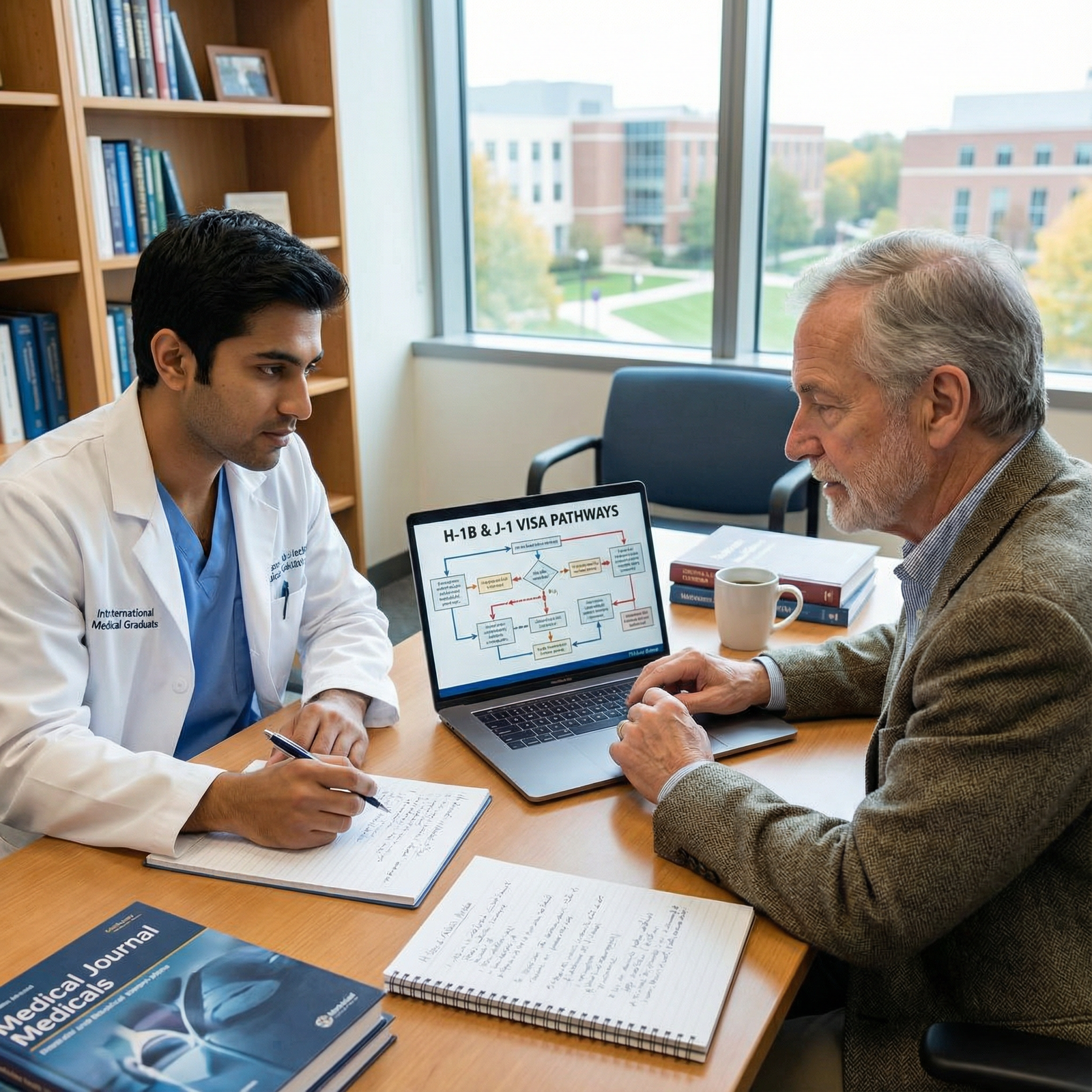
Understanding the Visa Landscape for Non-US Citizen IMGs in the US-Mexico Border Region
For a non-US citizen IMG or foreign national medical graduate, the path to residency in the United States is complex—even more so if you are specifically targeting a Texas border residency or other programs in the US-Mexico border region. Visa navigation becomes just as critical as board scores, clinical experience, and letters of recommendation.
This article breaks down residency visa options, practical steps, and border-region–specific considerations to help you make informed, strategic decisions. The focus is on what matters most for your Match prospects and your long-term career in the US.
We will cover:
- Core visa types for residency (J-1 vs H-1B and others)
- Unique features of border region residency programs
- How your visa choice affects your Match strategy
- Step-by-step planning from pre-application to post-residency
- Common pitfalls and frequently asked questions
Core Visa Options for Residency: J-1 vs H-1B and Beyond
For the vast majority of non-US citizen IMGs entering US residency, the realistic options are:
- J-1 Exchange Visitor Physician Visa
- H-1B Temporary Worker Visa (specialty occupation)
Other statuses (F-1 with OPT, TN, green card) may be relevant for a small subset but do not replace these as the main residency visa categories.
J-1 Visa for IMGs: The Default Path for Most
The J-1 Exchange Visitor visa—sponsored for physicians by the Educational Commission for Foreign Medical Graduates (ECFMG)—is the most common visa for residents and fellows.
Key features of the J-1 for residency:
- Sponsor: ECFMG (not the residency program directly)
- Duration: Typically up to 7 years total for graduate medical education
- USMLE requirement: Usually at least USMLE Step 1 and Step 2 CK passed and ECFMG certification
- Home-country physical presence requirement:
After completing training, you must return to your home country (or last country of permanent residence) for at least 2 years before you can:- Get an H-1B or L-1 visa
- Get a green card (in most categories)
- Change to many other longer-term statuses
Advantages of the J-1 Visa
- Broad acceptance: Many community and university-affiliated programs—especially in the US-Mexico border region—accept or even prefer J-1 visas because:
- The bureaucracy shifts from the hospital to ECFMG.
- The process is more standardized.
- Predictable process: ECFMG has clear timelines and requirements.
- No USMLE Step 3 requirement for entry: Unlike H-1B, you can start residency without having Step 3 passed (though some programs still prefer it).
Disadvantages of the J-1 Visa
- 2-year home residence requirement:
This is the biggest drawback. To avoid returning home for two years, you usually need a J-1 waiver job after training. - Limited flexibility for spouse/partner:
A J-2 spouse may apply for work authorization, but processing takes time, and it’s not guaranteed instantly. - Less control over long-term immigration plan:
J-1 is designed as a training visa, not a pathway to permanent residence. Your green card strategy usually begins after residency, not during.
H-1B for Residency: Attractive but Harder to Get
The H-1B is a work visa for “specialty occupations.” Residents are employees of the hospital, so in theory, residency can qualify.
Key features for residency:
- Employer sponsor: The residency program must directly sponsor your H-1B.
- USMLE Step 3 required in most states before H-1B approval (or at least before start date).
- Duration: Up to 6 years total (including all prior H-1B time in the US).
- No 2-year home residency rule: Unlike J-1, there is no automatic home-return requirement.
Advantages of the H-1B Visa
- Better for long-term immigration planning:
- You can often transition more easily into a job that supports a green card.
- No J-1 waiver requirement.
- Spousal benefits:
H-4 dependents cannot automatically work, but if you later start a green card process and reach certain stages, your H-4 spouse may qualify for an EAD (Employment Authorization Document). - Perception: Some IMGs feel H-1B status is more stable or prestigious; however, in residency, the main benefit is the lack of a J-1 home-return rule.
Disadvantages of the H-1B Visa for Residency
- Not all programs sponsor H-1B:
In fact, many border region programs explicitly state “J-1 only”. - Requires USMLE Step 3:
This must be planned early, especially if you are applying from abroad or from Mexico. - More complex for programs:
Hospital HR and legal departments must manage:- Prevailing wage requirements
- Petition filings and government fees
- Timing around Match Day and start dates
- Cap issues:
Most residency programs are cap-exempt (because they are non-profit or academic institutions), but if you later move to a private practice in the border region, H-1B cap rules could apply.
Other Less Common Statuses
While this article focuses on J-1 vs H-1B, some non-US citizen IMGs may be in other categories:
- F-1 (student) for medical school or master’s programs in the US
- You may use OPT for short-term work but not for full 3-year residency.
- TN (for Canadian/Mexican citizens)
- Not typically used for residency; TN is more relevant for fully-trained physicians or faculty roles, not GME trainees.
- Green card holders
- No visa barrier for residency, but this is uncommon for IMGs before Match.
For most foreign national medical graduates targeting Texas border residency or other US-Mexico border region programs, the practical choice remains J-1 vs H-1B.

Border Region–Specific Considerations for Visa Strategy
Residency programs in the US-Mexico border region—especially Texas border residency programs in cities like El Paso, Laredo, McAllen, Brownsville, Harlingen, and the Rio Grande Valley—have unique characteristics that influence visa navigation.
1. High IMG Representation and J-1 Familiarity
Many border-region programs have:
- A high proportion of IMGs, including many from Latin America.
- Longstanding experience with ECFMG J-1 sponsorship.
- Program websites that clearly state: “We sponsor J-1 visas through ECFMG” and sometimes “We do not sponsor H-1B visas.”
Implication for you:
If you are a non-US citizen IMG focused on border-region training, you must be prepared for the strong likelihood that J-1 is your only realistic visa option at many programs.
2. Service to Underserved, Medically Underserved, and Border Communities
US-Mexico border programs are often located in:
- Medically underserved areas (MUAs)
- Health Professional Shortage Areas (HPSAs)
- Areas with high Spanish-speaking populations and cross-border care dynamics
This impacts visa navigation in two ways:
J-1 waiver opportunities after residency:
Because these areas are medically underserved, they may offer:- Conrad 30 Waiver positions sponsored by the state
- Federal programs like VA, Appalachian Regional Commission (ARC), or Delta Regional Authority (DRA) (not all apply to Texas/border, but similar safety-net concepts exist)
- Other rural or underserved area incentives
Program mission alignment:
Programs in the border region may prefer candidates willing to:- Commit long-term to serving the border population
- Stay in the region after graduation, often via J-1 waiver jobs
If you plan to stay and work in the border region long-term, this can actually strengthen your application—especially if you can articulate your understanding of border health challenges.
3. Proximity to Mexico and Cross-Border Logistics
Living and training near the US-Mexico border has some unique practical aspects:
- You might have family in Mexico and cross the border for visits.
- Certain clinical rotations may involve binational public health issues (e.g., tuberculosis, maternal health, infectious diseases, migrant health).
From a visa standpoint:
- Your entry visa stamp in your passport (J-1 or H-1B) must be valid for re-entry.
- If you travel to Mexico for a short trip with an expired visa stamp but valid status, automatic visa revalidation sometimes applies, but this is nuanced; you must understand it in detail with an immigration lawyer.
- Border-region residents often cross frequently, but as a non-US citizen IMG you must be especially careful not to assume you have the same flexibility as green card holders or citizens.
Choosing Between J-1 vs H-1B: Strategic Factors for Border-Region IMGs
For a non-US citizen IMG focused on border-region programs, your choice of residency visa (if you even have a choice) has long-term consequences. Use these factors to guide your thinking.
1. Realistic Availability at Target Programs
Before planning your entire career around an H-1B or J-1, first answer:
Does my target program even sponsor H-1B?
Steps:
- Check program websites:
Look under “Eligibility & Requirements,” “International Medical Graduates,” or “Visa Information.” - Email program coordinators if unclear:
Politely ask:- “Do you sponsor J-1 visas through ECFMG?”
- “Do you sponsor H-1B visas for non-US citizen IMGs?”
- Track answers in a spreadsheet:
- Column for J-1: Yes/No
- Column for H-1B: Yes/No
- Notes on any conditions (e.g., “H-1B only for exceptional candidates,” “must have Step 3 at time of ranking”)
You may find that:
- Most Texas border residency programs = J-1 only.
- A smaller number of university-affiliated centers in larger cities (e.g., San Antonio, Houston, Dallas) sponsor both.
If your list is heavily border-focused, you should mentally accept that J-1 is your primary path, even if you personally prefer H-1B.
2. Timing of USMLE Step 3 and Application Cycle
For H-1B, Step 3 is a bottleneck:
- If you are in Mexico or another country:
- You may need to obtain a B-1/B-2 visa or some other US entry to take Step 3.
- Processing times can be unpredictable.
- If you’re already in the US (e.g., on F-1 or another status):
- You still need to schedule and pass Step 3 well before residency start, and ideally before rank lists are made.
If you cannot realistically complete Step 3 on time, J-1 becomes the only viable option for that Match cycle.
3. Long-Term Career and Immigration Goals
Ask yourself:
- Do I see myself permanently living in the US, potentially in the border region?
- Am I open to serving in an underserved area after residency (which many border IMGs are already planning)?
- How important is a faster path to a green card?
Typical patterns:
- If you are comfortable committing to an underserved border-region job after residency:
- J-1 + J-1 waiver (e.g., through Texas Conrad 30 or other programs) can lead to a green card eventually.
- If you want maximum flexibility to work anywhere immediately after residency (including top metro private groups):
- H-1B during residency may be more attractive—but only if available and feasible.
In the border region context, many hospitals actively recruit J-1 waiver physicians. Choosing J-1 for residency can actually align smoothly with your long-term plan if you see yourself staying in the Rio Grande Valley, El Paso area, or other border communities.

Step-by-Step Visa Navigation Timeline for Border-Region Residency
To make the process concrete, here is a timeline and checklist from early planning through residency and beyond, with a focus on the US-Mexico border region.
Phase 1: 18–24 Months Before Residency Start (Pre-ERAS)
Clarify your status and goals
- Are you a non-US citizen IMG abroad (e.g., in Mexico, Latin America, Asia)?
- Or already in the US on another status?
- Decide if you are aiming primarily for:
- Border region residency, or
- National search with border region as one of many options.
Map your visa options
- If 70–100% of your target programs are Texas border residency or similar:
- Assume J-1 will be your main option.
- If most are larger academic centers:
- Investigate H-1B policies for each.
- If 70–100% of your target programs are Texas border residency or similar:
Plan USMLE Step 3
- If you aspire to H-1B:
- Schedule Step 3 early enough to be passed before rank lists.
- If you are leaning J-1 due to border programs’ policies:
- Step 3 is less urgent but still helpful for your competitiveness.
- If you aspire to H-1B:
Start building a border-region–focused profile
- Strengthen your application to match border programs’ missions:
- Spanish language skills (if not native).
- Rotations or observerships in border or underserved clinics.
- Research or volunteer work related to migrant health, public health, or primary care in underserved areas.
- Strengthen your application to match border programs’ missions:
Phase 2: ERAS Application and Interview Season
Tailor your program list
- Categorize programs as:
- Border region / Texas border residency (e.g., Rio Grande Valley, El Paso)
- Broader Texas and Southwest US
- National academic centers
- Record their visa policies clearly.
- Categorize programs as:
Make your visa situation clear when appropriate
- In ERAS:
- You don’t need a detailed visa essay, but be consistent in your documents.
- During interviews:
- Be honest and concise:
- “I am a non-US citizen IMG; I am eligible for ECFMG sponsorship for the J-1 visa.”
- If relevant: “I have passed Step 3 and am also eligible for H-1B, if your program sponsors it.”
- Be honest and concise:
- In ERAS:
Highlight alignment with border-region needs
- Discuss:
- Comfort with Spanish or bilingual communication.
- Understanding of border-region public health challenges.
- Willingness to build a long-term career in the area.
- Programs may view your long-term commitment as an asset, especially for future J-1 waiver recruitment.
- Discuss:
Phase 3: Post-Match to Residency Start – Visa Processing
Once you match:
If J-1:
- ECFMG coordinates paperwork with you and the program.
- You submit required forms (e.g., DS-2019 request, proof of funding, passport copies).
- You schedule a J-1 visa interview at a US consulate (e.g., in Mexico City, Ciudad Juárez, Monterrey) if you are abroad.
- Upon approval, you enter the US close to residency start date.
If H-1B:
- Program HR and legal initiate the H-1B petition.
- You gather documents:
- Diploma, ECFMG certificate
- Step 3 score report
- CV, passport
- USCIS approves the petition (change of status if you are in the US, or consular processing if abroad).
- If consular processing, you attend a visa interview at a US consulate.
- You enter the US with an H-1B visa and begin residency.
Border-specific note:
If you are in Mexico, factor in consular appointment wait times and cross-border travel logistics. Start early and stay in close contact with your residency program’s GME office.
Phase 4: During Residency – Planning Ahead
Regardless of J-1 or H-1B:
Keep documents organized
- Save all:
- DS-2019 forms (J-1)
- H-1B approval notices (I-797)
- I-94 records, pay stubs, contracts
- Save all:
Minimize risky travel early in residency
- Until you fully understand:
- Your status
- Visa stamp validity
- Re-entry requirements
- Be especially cautious with frequent short trips across the border.
- Until you fully understand:
Start exploring post-residency options by PGY-2
- For J-1:
- Research J-1 waiver programs in Texas and neighboring states.
- Look for hospitals and clinics in border regions that regularly sponsor J-1 waivers.
- For H-1B:
- Consider employers that can:
- Continue your H-1B
- Start a green card process relatively early.
- Consider employers that can:
- For J-1:
Phase 5: Post-Residency – J-1 Waivers and Long-Term Status
For many non-US citizen IMGs who trained in the border region, the J-1 waiver job is where you transition from trainee to attending and start your green card strategy.
Common pathways:
Conrad 30 Waiver (state-based)
- Each state can sponsor up to 30 J-1 physicians per year in underserved areas.
- Texas often includes border communities in their shortage-area designations.
- Typically requires a 3-year full-time service commitment in a qualifying area.
Federal waivers
- Some federal programs (like VA or certain rural initiatives) can act as J-1 waiver sponsors.
- Often located in high-need areas similar to or overlapping with border communities.
After completing the 3-year J-1 waiver service:
- You are usually considered to have satisfied the 2-year home-residency requirement.
- You can then:
- Continue on H-1B with the same or new employer
- Adjust status to permanent residence (green card), if sponsored
- Gain more freedom to move and practice across the US
For H-1B residents:
- You may already be on a path to a green card during or just after residency.
- However, be aware that:
- Non-undeserved urban jobs can be more competitive.
- Employers may or may not be willing to sponsor permanent residency immediately.
Practical Tips and Common Pitfalls for Non-US Citizen IMGs
Practical Tips
Maintain a visa-focused spreadsheet
- Track:
- Program name
- Location (border vs non-border)
- Visa types supported (J-1, H-1B, both)
- Notes from conversations/emails
- Track:
Have a Plan A and Plan B
- Plan A: Ideal combination of visa type and program.
- Plan B: Acceptable alternative (e.g., J-1 instead of H-1B, or a broader geographic scope).
Be proactive, not reactive
- Don’t wait for Match Day to start thinking about visa logistics.
- Contact GME offices early after Match to start the paperwork.
Consult a qualified immigration attorney for personalized advice
- Program GME staff can help with forms, but they do not represent you.
- An independent lawyer can:
- Analyze your long-term strategy
- Clarify nuances like dual intent, waiver rules, and consular issues
- This is especially valuable if you have prior US immigration history (denials, overstays, multiple statuses).
Common Pitfalls to Avoid
- Assuming all US programs treat visas the same
Visa policies vary widely; border region programs are often J-1 only. - Underestimating Step 3 timing for H-1B
- Ignoring the 2-year home-residency rule
If on J-1, you must have a realistic J-1 waiver plan or be prepared to return home. - Frequent cross-border trips without understanding your status
Border proximity can create a false sense of security—always check your I-94 and current visa stamp status before travel. - Relying on friend or forum advice instead of official sources
Use:- ECFMG website and J-1 visa guidelines
- Official GME and program documentation
- USCIS and Department of State sites
- Licensed immigration attorneys
FAQs: Visa Navigation for Non-US Citizen IMGs in the US-Mexico Border Region
1. I am a non-US citizen IMG from Mexico. Is J-1 my only option for a Texas border residency?
Not necessarily, but often yes in practice. Many Texas border residency programs sponsor only the J-1 visa through ECFMG and do not sponsor H-1B. A few larger academic institutions may support H-1B, but if your program list is focused on smaller border communities, expect J-1 to be the primary option. Always confirm directly with each program.
2. If I do residency on a J-1, can I still stay and work in the US-Mexico border region afterwards?
Yes. In fact, border-region communities are often ideal locations for J-1 waiver jobs because they are medically underserved. You would:
- Complete residency on J-1.
- Secure a J-1 waiver position (often via Conrad 30 or similar) in an underserved area—frequently the same border region.
- Work there for typically 3 years.
- After that, you can usually transition to a green card pathway and have more geographic flexibility.
3. Should I delay applying to residency until I pass Step 3 so I can get H-1B instead of J-1?
It depends on your priorities and target programs:
- If your top-choice programs are border-region and J-1 only, delaying for H-1B may not give you any real advantage.
- If you are targeting academic centers that strongly support H-1B and you want maximum freedom right after residency, taking time to pass Step 3 before ERAS might be worth it.
You must weigh:
- Lost time (and income) due to delay
- Your competitiveness in the Match
- The actual visa policies of your preferred programs
4. How risky is it to travel to Mexico during residency on J-1 or H-1B?
Travel is possible, but you must:
- Ensure your visa stamp is valid for re-entry.
- Understand that automatic visa revalidation has strict rules and may not apply if you apply for a new visa while abroad.
- Check with:
- Your GME office
- Your immigration lawyer (if you have one)
- Factor in:
- Consulate appointment availability
- Security checks
- Potential delays in processing
Because the US-Mexico border is geographically close, residents sometimes feel more relaxed about crossing. As a foreign national medical graduate, you should be more cautious, not less, when it comes to border travel.
With a clear understanding of J-1 vs H-1B, the specific dynamics of Texas border residency programs, and a structured timeline, you can navigate residency visa decisions with far more confidence. The border region offers rich clinical experiences and strong demand for committed physicians—if you align your visa strategy with your long-term goal to serve and grow your career there, it can be an excellent launchpad for your future in US medicine.