
Understanding the Big Picture: Visas and Residency in the Texas Triangle
For a non-US citizen IMG planning to enter the Match in Houston, Dallas, San Antonio, or Austin, visa navigation is often as important as scores, letters, and research. The Texas Triangle offers a large number of residency positions, many of which are IMG-friendly—but visa policies vary significantly by program, specialty, and hospital system.
This guide focuses specifically on visa navigation for residency for the non-US citizen IMG who is a foreign national medical graduate targeting Texas residency programs in the Texas Triangle. You’ll learn how J-1 and H-1B visas work in the residency context, what is realistic in Houston–Dallas–San Antonio–Austin, and how to build a strategy that maximizes your chances of matching—and eventually staying in the US to practice.
We’ll cover:
- The visa landscape for IMGs in US GME
- J-1 vs H-1B for residency (advantages, limitations, and myths)
- How Texas Triangle programs typically handle visa sponsorship
- Application strategies tailored to non-US citizen IMGs
- Transition to fellowship and long-term planning from Texas
The Visa Landscape for IMGs in US Graduate Medical Education
Who is this article for?
You are likely a:
- Non-US citizen IMG or foreign national medical graduate
- Graduated from a medical school outside the US or Canada
- Currently living abroad or in the US on another status (F-1, B-1/B-2, H-4, etc.)
- Planning to apply to Houston, Dallas, San Antonio, Austin and surrounding programs during the Match
- Unsure which residency visa pathway to target (J-1 vs H-1B, or both)
Visa navigation determines more than just whether you can start residency. It affects:
- Which programs will interview and rank you
- Your flexibility after training (fellowship, job options)
- Where you can work after residency (especially for J-1 waiver jobs)
- Your timeline toward permanent residence (green card)
The primary residency visa categories for IMGs
For clinical residency and fellowship, realistically there are two main IMG visa options:
- J-1 Alien Physician (ECFMG-sponsored)
- H-1B Temporary Worker (employer-sponsored)
Other categories (O-1, TN, E-2, etc.) are rare and usually not used for standard residency training.
J-1 Alien Physician Visa (ECFMG-sponsored)
- Most common visa category for IMGs in residency and fellowship
- Sponsored by ECFMG, not the individual hospital
- Valid for the duration of training (usually up to 7 years total for GME)
- Requires:
- Valid ECFMG certification
- A contract/offer letter from an ACGME-accredited program
- Passing USMLE Step exams required by ECFMG and state licensing board
- Statement of Need from your home country’s Ministry of Health/authorized body
Two-year home residency requirement (212(e)):
After J-1 training, you must either:
- Return to your home country for a total of two years, or
- Obtain a J-1 waiver (commonly via a Conrad 30, VA, or federal waiver) and then change to H-1B or other status
H-1B Visa for Residency
- Employer-sponsored temporary worker visa
- Tied to a specific employer, location, and position
- Maximum of 6 years in most circumstances (with some exceptions)
- For residency, the program must:
- Be willing and able to sponsor H-1B
- Pay attorney and filing fees (often substantial)
- Demonstrate that you meet all licensing and exam requirements before filing
- Typically requires USMLE Step 3 passed before the H-1B petition is filed (and often before ranking or contract signing)
In Texas, a subset of programs—especially in major academic centers—sponsor both J-1 and H-1B, but many sponsor J-1 only. A small minority sponsor no visas at all.
J-1 vs H-1B for Residency: What Non-US Citizen IMGs Need to Know
The J-1 vs H-1B decision is central to your residency strategy. You do not get to “choose” in isolation; your options depend on:
- Your USMLE timeline
- Your specialty competitiveness
- Each individual program’s policy
- Your long-term US immigration goals
Side-by-side comparison: J-1 vs H-1B for residency
1. Sponsorship and availability
J-1
- Widely accepted in US GME, including most Texas residency programs
- Common in internal medicine, pediatrics, psychiatry, family medicine, neurology, and many others
- ECFMG handles the sponsorship process uniformly across institutions
H-1B
- Offered by a subset of programs; often large academic centers or university-affiliated hospitals
- Less common in community-based programs
- More likely for less competitive specialties than for ultra-competitive ones, but policies vary
Practical consequence:
If you insist on H-1B only, you drastically reduce your target list—especially in the Texas Triangle.
2. Exams and licensing requirements
J-1
- Must meet ECFMG certification criteria (usually Step 1, Step 2 CK, OET, etc.)
- Step 3 is not required for J-1 sponsorship
H-1B
- Most states (including Texas) require Step 3 for an independent physician license
- Many Texas programs require Step 3 passed before an H-1B can be filed (practically before start of PGY-1)
- Some programs require Step 3 before ranking you if you’re seeking H-1B
Practical advice:
If your Step 3 will not be ready by the application/interview season, it is safer to remain open to J-1 sponsorship.
3. Post-residency flexibility
J-1
- You become subject to the two-year home residency requirement (212(e))
- To stay in the US and work clinically, you typically need a J-1 waiver job (often in an underserved area for 3 years on H-1B)
- Waiver spots can be competitive, but Texas has an active Conrad 30 program and multiple federal waiver options
H-1B
- No 2-year home residency requirement by default
- You can move directly into a job (if another employer sponsors your H-1B transfer) or fellowship
- Pathway to permanent residence can be more straightforward in some cases
4. Fellowship training
J-1
- You can usually continue on J-1 for fellowship, as long as total GME time stays within ECFMG limits (commonly up to 7 years)
- Popular for subspecialty training in Texas: cardiology, GI, critical care, heme/onc, etc.
H-1B
- Fellowships must also be willing to sponsor H-1B and comply with timing and exam requirements
- Your 6-year H-1B clock continues ticking, which can limit long training paths (e.g., internal medicine → fellowship → advanced fellowship)
5. Institutional perspective
J-1
- Administratively simpler for most programs
- ECFMG handles credentialing and visa-specific oversight
- Predictable processes and fees
H-1B
- Requires institutional legal review, employer-specific petitions, wage requirements, and more
- More time-consuming and costly for the hospital
- Some Texas hospitals have strict policies limiting or prohibiting H-1B for residents
Understanding these differences allows you to frame realistic expectations when contacting programs and planning your residency visa strategy.
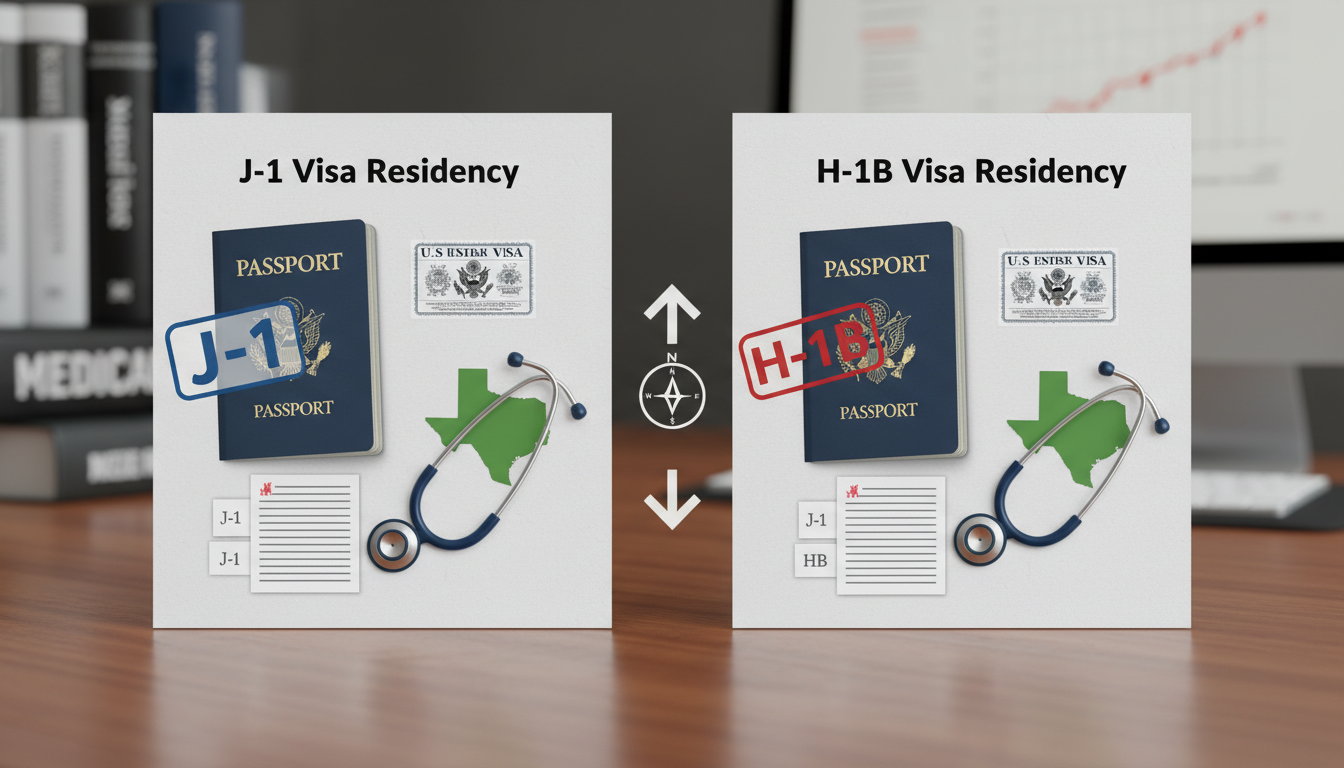
Visa Realities in the Texas Triangle: Houston, Dallas, San Antonio & Austin
The Texas Triangle (Houston–Dallas–San Antonio–Austin corridor) is one of the most active GME regions in the US, with a large volume of residency and fellowship positions across major hospital systems.
General trends for non-US citizen IMGs in Texas
Texas is relatively IMG-friendly overall.
Internal medicine, family medicine, pediatrics, psychiatry, and several other specialties regularly match non-US citizen IMGs, especially in academic and large community settings.Most institutions are J-1 friendly; H-1B availability is variable.
- Many university and teaching hospitals participate in ECFMG J-1 sponsorship without hesitation.
- H-1B sponsorship is more selective; some major programs sponsor H-1B only for highly competitive candidates or specific specialties.
Visa policies differ not just by city but by individual program and hospital system.
Even in the same city, one internal medicine program might be J-1 only, while another offers both J-1 and H-1B. You must verify each program’s website and/or contact their coordinators.
City-by-city overview (high level; policies change frequently)
Houston
- Home to the Texas Medical Center, the largest medical complex in the world
- Multiple large residency programs in internal medicine, surgery, pediatrics, neurology, pathology, etc.
- Common pattern:
- Many programs accept J-1 widely
- Select programs offer H-1B, usually with strict Step 3/ECFMG requirements and sometimes higher competitiveness
- Houston-area programs often have many non-US citizen IMGs already in their training cohorts.
Dallas–Fort Worth
- Major urban and suburban teaching hospitals
- Mix of university-based and community-based programs
- Visa pattern:
- J-1 typically accepted, especially at larger academic centers
- H-1B sponsorship sometimes available, often published clearly on websites
- Some community-based programs may prefer J-1 only or no visa sponsorship
San Antonio
- A combination of university-affiliated and VA-affiliated programs
- Historically a significant number of IMGs in internal medicine, pediatrics, FM, and psychiatry
- Many programs are comfortable with J-1; H-1B availability is present in some institutions but must be researched individually
Austin & surrounding areas
- Rapidly expanding medical education footprint, with new residencies forming in recent years
- Some new or smaller programs may be less flexible with H-1B due to limited administrative capacity
- J-1 is usually the more accessible option here, but policies vary
How to research specific Texas residency visa policies
For each program you are considering in Houston, Dallas, San Antonio, or Austin:
Check the program website:
- Look for sections labeled “International Medical Graduates,” “Visa Policy,” or “Eligibility Requirements.”
- Confirm if they sponsor:
- J-1 only
- J-1 and H-1B
- No visas
- Note if there is a Step 3 requirement for H-1B.
Review institutional GME office pages:
- Many universities (e.g., UT systems, large academic centers) have a central GME page describing visa sponsorship policies for all affiliated programs.
Politely email or call the program coordinator if unclear:
- Introduce yourself as a non-US citizen IMG interested in their program.
- Ask a concise, specific question:
“Could you please confirm whether your program sponsors J-1 visas, H-1B visas, or both for incoming residents?”
Use this information to triage your application list:
- Mark programs as:
- “J-1 friendly”
- “H-1B possible”
- “No sponsorship” (skip unless you already have work authorization like a green card or EAD)
- Mark programs as:
Strategy for Non-US Citizen IMGs: Planning Your Visa Path
Step 1: Clarify your priorities and constraints
Ask yourself:
What is my exam status?
- Step 1, Step 2 CK, OET: completed?
- Step 3: will I realistically finish before the ERAS season or Match list deadline?
How competitive is my profile and specialty?
- Are you applying to highly competitive programs (e.g., big-name academic centers) and specialties (e.g., derm, plastics, ophtho—noting some are outside NRMP)?
- Or more IMG-friendly areas (IM, FM, pediatrics, psychiatry, neurology, pathology)?
How important is it for me to stay in the US long-term?
- Am I comfortable with the J-1 two-year home requirement + waiver route if necessary?
- Or do I strongly prefer a path that avoids 212(e), if possible?
Step 2: Decide how to approach J-1 vs H-1B in your applications
Most non-US citizen IMGs targeting the Texas Triangle will fall into one of these broad strategies:
Strategy A: “J-1 first, H-1B opportunistically”
Best if:
- You do not have Step 3 yet or may not have it in time
- You prioritize maximizing interviews and match chances
- You’re flexible about pursuing a J-1 waiver path later
How to implement:
- Apply broadly to all J-1 sponsoring programs that fit your profile in Houston, Dallas, San Antonio, and Austin
- If any programs offer H-1B and your Step 3 timing allows, indicate you’d be open to H-1B as well, but don’t restrict yourself
- In interviews, you can say you are comfortable with J-1 sponsorship and also open to H-1B if the program supports it
Strategy B: “H-1B strongly preferred, but J-1 acceptable”
Best if:
- You will have Step 3 completed early in the season
- Avoiding 212(e) is a high priority, but not absolutely mandatory
How to implement:
- Target Texas programs known to sponsor H-1B (especially in Houston and Dallas) and make sure they know you will have Step 3
- Still apply to J-1-only programs that otherwise fit your goals
- During interviews, you can say:
“My preference would be H-1B if available, but I fully understand and am willing to accept a J-1 position if that’s the visa your program sponsors.”
This keeps doors open while gently signaling your interest in H-1B where it is viable.
Strategy C: “H-1B only”
Best if:
- You already have Step 3 and want to avoid the J-1 path completely
- You are willing to apply to fewer programs and accept a more competitive process
- You have a strong application (high scores, US clinical experience, strong letters, research)
How to implement:
- Filter your list to H-1B sponsoring programs only, especially within the Texas Triangle
- Explicitly state in your application or in pre-interview emails (if appropriate) that you seek H-1B sponsorship
- Recognize that some programs may still prefer J-1 and not offer H-1B even if they have in the past
Be cautious: for many non-US citizen IMGs targeting the Texas Triangle, Strategy A or B is more realistic and safer.
Step 3: Optimize your application as a foreign national medical graduate
Visa-friendly or not, programs still prioritize overall strength of your application:
- USMLE scores and attempts:
- Competitive scores are especially important when asking for H-1B, since programs invest more resources.
- US clinical experience (USCE):
- Texas programs value real hands-on US experience, especially at teaching hospitals.
- Letters of recommendation:
- At least 2–3 from US faculty who can comment on your clinical performance.
- Personal statement:
- Briefly mention your interest in training in Texas, your long-term career goals, and your flexibility regarding visa types (if appropriate).
- Communication skills:
- Especially in interviews, clearly articulate your plan and understanding of residency visa issues without sounding demanding.

Life After Match: J-1 Waivers, H-1B Transitions, and Staying in Texas
Your residency visa is only the first step. For many non-US citizen IMGs in the Texas Triangle, the goal is not just to match, but to build a long-term career and possibly settle in Texas.
If you train on a J-1 visa
You will need to address the 212(e) two-year home residency requirement after training:
Go home for two years
- Spend a cumulative total of two years in your home country before returning to the US in certain immigration categories
- Not ideal if your primary goal is to stay in the US long-term
Obtain a J-1 waiver and convert to H-1B for work
Common pathways include:- Conrad 30 state waiver programs (including Texas):
- Work 3 years in a designated underserved area (often primary care, psychiatry, some specialties in shortage areas)
- VA facilities
- Federal programs (e.g., HHS, ARC, DRA, etc., depending on specialty and location)
- Conrad 30 state waiver programs (including Texas):
Texas has a relatively active Conrad 30 program, but you must:
- Plan early (during residency or fellowship)
- Network with prospective employers in underserved areas
- Work closely with an immigration attorney
If you train on H-1B
You do not automatically incur a 2-year home requirement, but you must manage:
- Your 6-year H-1B clock
- Future transitions to:
- Fellowship (possibly on H-1B or J-1)
- Employer-sponsored green card
- Academic or private practice employment in Texas or elsewhere
Many physicians work with their employers to start a PERM-based green card process during early attending years, which can extend H-1B beyond 6 years once certain milestones are met.
Long-term planning tips for Texas-based IMGs
Network regionally.
- Attend state conferences, Texas specialty society meetings, and local hospital events.
- Build connections in Houston, Dallas, San Antonio, and Austin during rotations and electives.
Understand Texas workforce needs.
- Primary care, psychiatry, and some subspecialties have demand in rural and underserved areas that frequently sponsor J-1 waivers.
Work with an experienced immigration attorney.
- Do not rely solely on hearsay or peers; policies change, and each case is different.
- Start consultations by PGY-2 or PGY-3 if you’re on J-1 and plan to remain in the US.
Stay informed on immigration policy changes.
- J-1, H-1B, and waiver programs can be impacted by federal and state policy shifts.
Frequently Asked Questions (FAQ)
1. As a non-US citizen IMG, can I match into a Texas residency program if I only have J-1 eligibility?
Yes. Many Texas residency programs in Houston, Dallas, San Antonio, and Austin are J-1 friendly and sponsor ECFMG J-1 visas routinely. If you do not plan to complete Step 3 before applications, focusing on J-1-sponsoring programs is a sound strategy. Just be sure you understand the two-year home residency requirement and the need for a future J-1 waiver if you want to remain in the US after training.
2. Is it realistic to get H-1B sponsorship for residency in the Texas Triangle?
It is possible but competitive. Some major academic centers and large teaching hospitals in the Texas Triangle sponsor H-1B for residents, especially in internal medicine and certain other specialties. However:
- You will almost always need USMLE Step 3 completed before they can file the H-1B petition.
- Not all programs that accept IMGs are willing to sponsor H-1B, even if they support J-1.
- Your pool of potential programs is smaller if you insist on H-1B only.
A balanced approach—being open to both J-1 vs H-1B—often maximizes your chances.
3. If I choose J-1 for residency, can I later change to H-1B for fellowship?
Yes, but only after resolving the 212(e) requirement. In most cases, this means:
- Either returning to your home country for two years, or
- Obtaining a J-1 waiver, then changing to H-1B for employment or possibly fellowship (depending on the situation and sponsoring institution)
However, you cannot simply “switch” from J-1 to H-1B for training without first dealing with the home residency requirement. That’s why long-term planning—especially regarding J-1 waiver jobs—is critical.
4. How should I state my visa preferences in ERAS and interviews for Texas programs?
In general:
- Indicate that you are a non-US citizen IMG and specify that you will require visa sponsorship.
- If you do not have Step 3, do not present yourself as H-1B dependent; instead, express comfort with J-1.
- If you have Step 3 and prefer H-1B, you can say:
“I am eligible for and would prefer H-1B if available, but I am also open to J-1 sponsorship depending on your institution’s policy.”
Always be honest, clear, and flexible. Programs appreciate transparency and realistic expectations regarding residency visa options.
By understanding the nuances of IMG visa options, the reality of J-1 vs H-1B in the Texas Triangle, and how Texas residency programs manage sponsorship, you can design an application strategy that balances immigration goals with Match success. For a non-US citizen IMG targeting Houston, Dallas, San Antonio, and Austin, informed planning now can open doors not only to residency, but to a long and stable career in Texas.