
Understanding the Landscape: Nuclear Medicine Residency and Visas
Nuclear medicine is a highly specialized field that combines radiology, internal medicine, and physics to diagnose and treat disease using radiopharmaceuticals and advanced imaging technology (like PET/CT and SPECT/CT). For many international medical graduates (IMGs), entering a nuclear medicine residency in the United States means navigating not only the residency application process but also complex U.S. immigration rules.
This guide is designed to help you understand visa navigation for residency in nuclear medicine, with a particular focus on the nuclear medicine match, IMG visa options, and the practical implications of J-1 vs H-1B sponsorship. While this article focuses on the U.S., many concepts (like training vs employment visas) are relevant to other countries as well.
Important disclaimer: Immigration rules change frequently. Always confirm current requirements on official government and ECFMG/NRMP websites and—when possible—consult an immigration attorney. This article is an educational overview, not legal advice.
Step 1: How Nuclear Medicine Training Pathways Affect Your Visa Strategy
Before diving into visas, you need clarity on how nuclear medicine training is structured, because the right visa path can depend on the type and length of training you pursue.
A. Standalone Nuclear Medicine Residency vs Radiology Pathways
In the U.S., there are a few major pathways involving nuclear medicine:
Dedicated Nuclear Medicine Residency (ACGME-accredited)
- Typically 2–3 years after at least one preliminary year of clinical training.
- Some programs accept:
- Graduates of foreign medical schools with ECFMG certification.
- Physicians who have already completed some residency abroad.
- You match via ERAS/NRMP into Nuclear Medicine as a primary specialty.
Diagnostic Radiology Residency with Nuclear Medicine Exposure
- 4-year Diagnostic Radiology residency includes some nuclear medicine rotations.
- Additional 1-year Nuclear Radiology or Nuclear Medicine fellowship may follow.
- Visa strategy often starts with what the DR program supports (J-1 vs H-1B).
Fellowships in Nuclear Medicine / Nuclear Radiology
- For those who completed a primary residency (e.g., internal medicine, radiology, or certain foreign equivalents).
- Typically J-1 clinical or research visas, or H-1B for those already in the U.S. in a compatible status.
B. Why Training Structure Matters for Visas
Your visa plan must align with:
- Training length: J-1 clinical visas are time-limited and cover only the duration of training plus any approved extensions; H-1B also has time caps (6-year maximum in most cases).
- Future plans: If you want to stay in the U.S. for advanced fellowships or practice, you must understand:
- J-1’s two-year home-country physical presence requirement.
- H-1B’s dual intent and flexibility for later employment.
Example:
- Applicant A wants a standalone nuclear medicine residency, then potentially a PET/CT-focused fellowship and long-term academic career in the U.S.
- Applicant B wants to train in nuclear medicine, then definitely return home to build local nuclear medicine capacity.
Applicant A may prioritize programs with H-1B options to keep future U.S. employment smoother. Applicant B may be comfortable with J-1, especially if they expect to return home (thereby easily satisfying J-1’s 2-year home-country rule).
Step 2: Core Visa Options for IMGs in Nuclear Medicine Residency
Most IMGs entering the nuclear medicine match encounter three primary visa categories:
- J-1 Exchange Visitor (ECFMG-sponsored)
- H-1B Temporary Worker (employer-sponsored)
- Other “stepping-stone” visas (F-1, J-2, H-4, etc.) that may convert into J-1 or H-1B later
A. J-1 Clinical Visa (ECFMG-Sponsored)
For most IMGs in clinical residency or fellowship, the J-1 visa is the default route.
Key features:
- Sponsor: ECFMG (Educational Commission for Foreign Medical Graduates)
- Purpose: Graduate medical education (residency/fellowship)
- Duration: Length of the ACGME-accredited program, with a total typical cap of 7 years (exceptions sometimes possible for subspecialty training)
- Two-year home-country requirement (212(e)):
- After training, J-1 physicians must spend two years physically present in their home country OR
- Obtain a waiver (e.g., Conrad 30 waiver, hardship waiver, persecution waiver).
Pros for nuclear medicine residency:
- Widely accepted: Many nuclear medicine residency programs sponsor only J-1, not H-1B.
- Streamlined: ECFMG provides structured guidance, forms, and coordination.
- More flexible for short fellowships: Good for a 1–3 year training block.
Cons:
- Two-year home-country rule limits immediate U.S. practice options unless you get a waiver.
- Less control over future immigration pathways.
- Some employer-based roles (after training) may be harder to secure on time due to waiver or return requirements.
Practical implication in nuclear medicine:
If your goal is a short training period followed by returning home to establish a nuclear medicine service, J-1 is often ideal. If your long-term goal is to practice in the U.S. (especially in private practice PET/CT, theranostics, or hybrid imaging), you must think ahead about waiver opportunities in states that recruit nuclear medicine physicians.
B. H-1B Visa (Specialty Occupation – Physician in Training)
The H-1B is an employment-based visa where the residency program is your employer.
Key features:
- Sponsor: The residency institution (not ECFMG).
- Duration: Up to 6 years total (often initially 3 years, then extensions).
- Dual intent: You can pursue permanent residency (green card) without violating H-1B status.
- No automatic 2-year home-country requirement like the J-1.
Pros for nuclear medicine residency:
- Favored by IMGs who plan to stay in the U.S. long-term.
- Easier transition to:
- Post-residency jobs,
- Further fellowships (if time remains under 6-year cap),
- Green card sponsorship (e.g., via an employer or NIW).
Cons:
- Not all programs sponsor H-1B; in nuclear medicine, many smaller or academic programs are J-1 only.
- Requires:
- ECFMG certification,
- USMLE Step 3 (in most states) completed before visa filing.
- May be subject to prevailing wage requirements and institutional policy limitations.
Practical implication in nuclear medicine:
If you’re targeting H-1B, you must:
- Prioritize programs that explicitly state “H-1B considered” or “J-1 and H-1B” on their websites or in FREIDA.
- Complete USMLE Step 3 early enough (ideally by the time of ranking or shortly thereafter).
- Confirm whether the duration of your training (e.g., 3 years nuclear medicine + potential fellowship) fits within the H-1B 6-year cap.
C. Other Relevant Statuses and “Stepping-Stone” Options
While nuclear medicine residency is almost always J-1 or H-1B, some IMGs reach that point through other statuses:
- F-1 (Student Visa):
- IMGs in U.S. MPH, MS, or PhD programs may be in F-1.
- After graduation, they may use Optional Practical Training (OPT), then switch to J-1 or H-1B for residency.
- J-2 (Dependent of a J-1):
- Spouses of J-1 holders.
- May obtain work authorization (EAD) and sometimes move into residency (often transitioning later to J-1 clinical or H-1B).
- H-4 (Dependent of H-1B):
- Some may apply for residency while on H-4 and then change to J-1 or H-1B.
These paths affect timing and paperwork but do not fundamentally change the core choice between J-1 vs H-1B for clinical training.
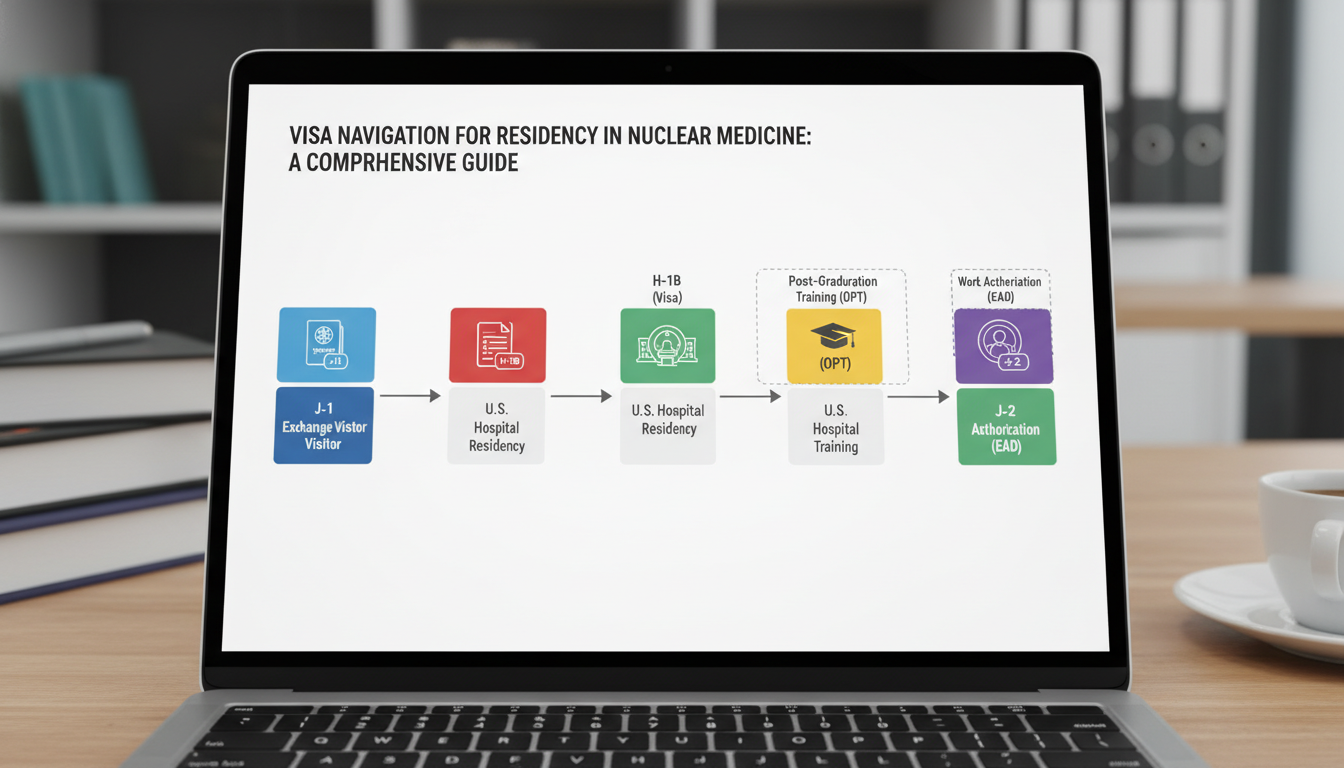
Step 3: J-1 vs H-1B for Nuclear Medicine – Deep Dive Comparison
Choosing between J-1 vs H-1B is one of the most important immigration decisions in your nuclear medicine career. Understanding the trade-offs early helps you align your preferences, program list, and long-term goals.
A. Comparison Table
| Factor | J-1 Clinical (ECFMG) | H-1B (Physician in Training) |
|---|---|---|
| Sponsor | ECFMG (for GME) | Residency program/hospital |
| Exam Requirements | USMLE Steps 1 & 2, ECFMG cert | Usually USMLE Step 3 + ECFMG cert |
| Intent | Purely temporary (non-immigrant) | Dual intent (can pursue green card) |
| Time Limit | Typically up to 7 years training | 6 years total in H-1B status |
| 2-Year Home Requirement | Yes (unless waived) | No (unless prior J-1 with 212(e)) |
| Availability in Nuclear Medicine | Very common, default option | Limited; only some programs sponsor |
| Ease of Transition to U.S. Practice | Requires waiver or 2-year return | Generally smoother transition to job/green card |
B. Evaluating Your Long-Term Goals
Ask yourself:
Do I intend to live and practice in the U.S. long-term?
- If yes, H-1B is often more favorable, but not always available.
- If J-1 is the only option, you must plan for a J-1 waiver job afterward.
Am I open to working in an underserved area or specific state post-training?
- Many J-1 waivers (like Conrad 30) require working in a designated underserved area.
- Nuclear medicine positions with waiver eligibility exist, but they may not be in major metropolitan centers or may require hybrid roles (diagnostic radiology + nuclear).
What is my risk tolerance for complex immigration steps?
- J-1 with waiver → often multi-step, time-sensitive, state-specific.
- H-1B → simpler for employment but may involve cap issues (less common in academic hospitals, which are often cap-exempt).
C. Common Scenarios in Nuclear Medicine
Scenario 1: Direct Nuclear Medicine Residency on J-1
- You match into a 3-year nuclear medicine residency on J-1.
- After training, you:
- Return home for at least 2 years, working as a nuclear medicine consultant.
- Or seek a U.S. J-1 waiver opportunity in an underserved area, possibly combining nuclear medicine with general radiology.
Scenario 2: Diagnostic Radiology → Nuclear Medicine Fellowship on H-1B
- You complete a Diagnostic Radiology residency in H-1B status.
- You still have 2–3 years of H-1B time left.
- You match into a 1-year nuclear radiology/nuclear medicine fellowship.
- After fellowship, you transition to an attending role on continued H-1B or employer-sponsored green card.
Scenario 3: Limited H-1B Sponsorship in Nuclear Medicine
- Some nuclear medicine residencies may accept H-1B only if:
- You already have Step 3 done, and
- You are currently in a compatible status (like H-4 or F-1 with OPT).
- You target those specific programs in your ERAS list.
- For the rest, you list them as backups on J-1.
The bottom line: Your choice is shaped not just by your preference, but by which programs are willing and able to sponsor which visa—and by timing of your exam completion.
Step 4: Strategizing Your Application and Match with Visa in Mind
Visa navigation should influence how you approach the nuclear medicine match from day one: research, exams, program list, and interviews.
A. Researching Programs’ Visa Policies
Start early (12–18 months before application season) by:
- Checking FREIDA, program websites, and specialty society sites (e.g., SNMMI).
- Looking for clear statements like:
- “We sponsor J-1 visas only.”
- “We sponsor J-1 and H-1B visas for qualified candidates.”
- “We do not sponsor visas.”
If the website is unclear, send a polite, concise email to the program coordinator:
Dear [Coordinator’s Name],
I am an international medical graduate interested in applying to your nuclear medicine residency program for the [Year] match. Could you please let me know which visa types your program sponsors for residents (e.g., J-1, H-1B)?Thank you for your time,
[Your Name]
Record responses in a spreadsheet to guide your program selection.
B. Timing of Exams and Documentation
For residency visa processing, timing is crucial:
- USMLE Step 1 & 2 + ECFMG certification
- Needed for J-1 sponsorship and most residency positions.
- USMLE Step 3
- Usually required before H-1B petition filing.
- Ideally completed by January–February of your match year if you’re seriously aiming for H-1B.
Also prepare:
- Valid passport (with enough remaining validity).
- Police clearance or background documentation if required.
- Translations and notarizations of key documents.
C. Visa Questions During Interviews
During nuclear medicine residency interviews, you may be asked about your visa needs. Answer clearly and confidently:
- If you are flexible (open to J-1 or H-1B), say so.
- If you strongly prefer H-1B, but the program sponsors only J-1, you must decide whether to rank them.
You may also ask targeted questions at the end of the interview:
- “Does your institution currently sponsor H-1B visas for nuclear medicine residents, or do you use J-1 exclusively?”
- “In recent years, how many IMGs in your program have been on J-1 vs H-1B?”
- “If I were on a J-1, have previous graduates from your program successfully obtained waiver positions afterwards?”
Step 5: After the Match – Visa Processing, Training, and Future Plans
Once you’ve matched into nuclear medicine residency, your focus shifts to executing the visa process and planning ahead for your career trajectory.
A. Post-Match Visa Steps
If J-1 (ECFMG):
- Program sends your information to ECFMG.
- You complete ECFMG’s online application:
- Upload required documents.
- Pay applicable fees.
- ECFMG issues Form DS-2019.
- You schedule a visa interview at the U.S. consulate.
- After approval, you enter the U.S. and report to your program by the required date.
If H-1B:
- Program’s GME/HR office gathers documentation:
- Degree, ECFMG certificate, exam scores.
- License/permit requirements as per the state.
- They file a Labor Condition Application (LCA) with the Department of Labor.
- Then file Form I-129 with USCIS for H-1B classification.
- After USCIS approval, you may need a consular interview (if outside the U.S.).
- Enter the U.S. in H-1B status and start residency.
B. During Residency: Maintaining Status
Regardless of J-1 or H-1B:
- Keep your passport valid.
- Report address changes as required (e.g., to SEVIS for J-1).
- Follow institutional rules for duty hours and moonlighting (note: J-1 physicians are typically restricted from moonlighting; H-1B may permit limited additional activity if properly authorized).
If your nuclear medicine residency extends or your training plan changes:
- J-1 extensions need ECFMG coordination and updated DS-2019.
- H-1B extensions require new filings and timely submission before the current status expires.
C. Planning for Life After Nuclear Medicine Residency
1. Returning Home
If your plan is to return home:
- J-1 is straightforward—you satisfy the 2-year home-country requirement by practicing nuclear medicine in your home country.
- Your U.S. training can be a major career accelerant; consider:
- Building connections with U.S. mentors.
- Seeking collaborative research or telemedicine partnerships.
2. Staying in the U.S. on J-1 (Waiver Path)
If you trained on J-1 but want to stay:
- Explore J-1 waiver programs:
- Conrad 30 (state-based) – historically more common for primary care and general radiology, but some states and employers will sponsor nuclear medicine or hybrid roles.
- Federal waivers via agencies like the VA or HHS.
- You usually must:
- Get a job offer in a qualifying area,
- Fulfill 3 years of service in H-1B status (after J-1),
- Then can move to other employers or adjust to permanent residency later.
3. Staying in the U.S. on H-1B
If you trained on H-1B:
- Look for attending positions in academic centers, large radiology groups, or hospitals that:
- Can continue H-1B sponsorship,
- May sponsor an employment-based green card (EB-2/EB-3 or National Interest Waiver if you have strong academic credentials).
For nuclear medicine physicians, terranostics, PET/CT, and hybrid imaging are growth areas—highlight this expertise when negotiating roles.
Practical Tips and Common Pitfalls for IMGs in Nuclear Medicine
A. Practical Tips
Align your CV and visa story.
Show a consistent narrative: e.g., “I want to develop expertise in PET imaging for oncology and then serve in my home country’s cancer center” (if J-1), or “I aim for a long-term academic career in nuclear cardiology research in the U.S.” (if seeking H-1B and future green card).Keep copies of every document.
Visas, DS-2019s, approval notices, passport entries, I-94s—these may be needed years later for green card or waiver applications.Stay informed about policy changes.
J-1, H-1B rules, and waiver programs can change. Follow:- ECFMG and NRMP updates,
- Specialty societies (e.g., Society of Nuclear Medicine and Molecular Imaging),
- Institutional GME communications.
Network with senior IMGs in nuclear medicine.
They can share real-life experiences about:- Which programs are truly IMG-friendly,
- What J-1 waiver jobs look like in nuclear medicine,
- How they navigated J-1 vs H-1B decisions.
B. Common Pitfalls
Assuming you can “switch visas later” easily.
Changing from J-1 (with 212(e)) to H-1B is complex without a waiver or fulfilling the 2-year home requirement.Waiting too long to take Step 3 if you want H-1B.
Delays here can force programs to default to J-1 or even withdraw an offer if paperwork cannot be completed in time.Ignoring the training length vs visa cap.
If you’re planning multiple residencies/fellowships on H-1B, do the math carefully so you don’t run out of time before reaching attending level.Not checking individual program policies.
“Nuclear medicine residency” is not homogeneous—some programs are extremely visa-friendly; others do not sponsor visas at all.
FAQs: Visa Navigation for Nuclear Medicine Residency
1. As an IMG, which visa is more common for nuclear medicine residency—J-1 or H-1B?
For IMGs in nuclear medicine residency, the J-1 clinical visa sponsored by ECFMG is more common. Many nuclear medicine programs, especially smaller or academic ones, only sponsor J-1 due to institutional policy and administrative simplicity. H-1B is available at some programs but is less frequent and usually requires that you have USMLE Step 3 completed before the H-1B petition.
2. If I train in nuclear medicine on a J-1 visa, can I still stay in the U.S. afterward?
Yes, but not automatically. J-1 clinical physicians are generally subject to the 2-year home-country physical presence requirement. To stay and work in the U.S. immediately after training, you typically need a J-1 waiver (e.g., Conrad 30, federal waiver) and then must work for about 3 years in a qualifying position (often in an underserved area) on H-1B. Some nuclear medicine physicians find such positions, but availability is more limited than for internal medicine or family medicine, so planning ahead is essential.
3. Do nuclear medicine residency programs sponsor H-1B visas for IMGs?
Some do, but many do not. H-1B sponsorship depends on institutional policy and resources. Programs that accept H-1B usually:
- Require Step 3 completed by a certain date,
- Limit H-1B to a certain number of years or positions,
- May prioritize candidates already in the U.S. in a compatible status (e.g., F-1/OPT, H-4).
When researching programs, specifically look for “H-1B sponsorship” information or ask the coordinator directly.
4. If I plan to return to my home country after training, which visa should I choose?
If you are sure you plan to return home after training—perhaps to lead a nuclear medicine unit or expand PET/CT services—then the J-1 visa is usually a good fit. Its 2-year home-country requirement aligns with your plans and is easily satisfied by working in nuclear medicine back home. The J-1 route is often more widely available in nuclear medicine residency and offers structured sponsorship through ECFMG.
By understanding how visa options intersect with the nuclear medicine residency pathway, you can build a realistic, strategic plan that aligns with both your professional goals and immigration possibilities. Start early, research carefully, and keep your long-term career—and location—goals at the center of your decisions about IMG visa options and J-1 vs H-1B sponsorship.