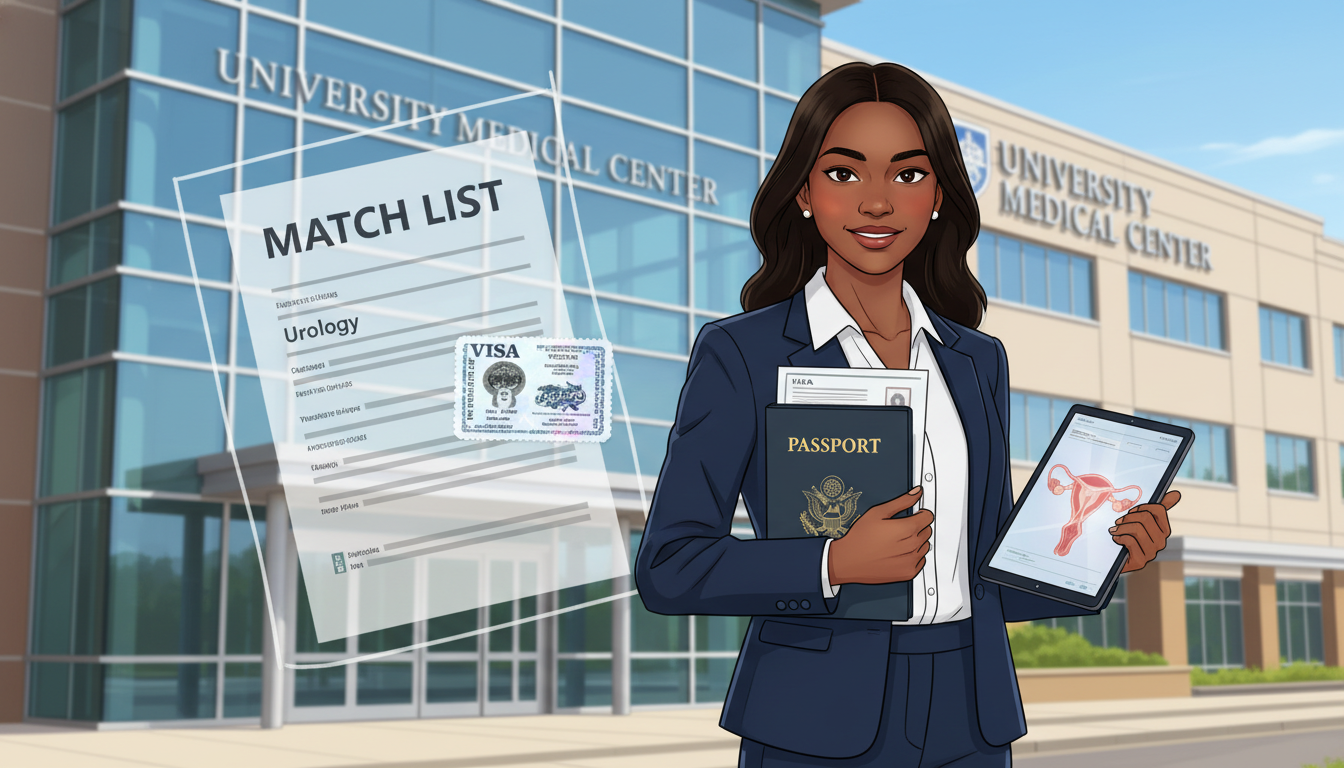
Understanding the Visa Landscape for NYC Residency Programs
New York City is one of the most IMG-friendly regions in the United States, with a large number of hospitals and training sites that regularly sponsor visas for international medical graduates. However, the visa process can be confusing, especially when comparing J-1 vs H-1B, understanding timelines, and aligning immigration strategy with your career goals.
This guide focuses specifically on visa navigation for residency in New York City, with practical advice tailored to NYC residency programs. It is written for IMGs, including those currently abroad and those already in the U.S. on other visa types (F-1, B-1/B-2, etc.).
We will cover:
- The most common residency visa categories (J-1 and H-1B) and how they work in New York City
- How NYC residency programs typically approach visa sponsorship
- Step-by-step application and timeline guidance
- Special considerations for long-term career planning in the U.S.
- Common pitfalls and practical strategies for IMGs targeting New York City residency positions
Core Visa Options for Residency in New York City
New York City institutions almost universally use two main visa types for residency training: the J-1 (ECFMG-sponsored) and the H-1B (employer-sponsored). A few other categories may apply in special circumstances, but the majority of NYC residency programs will speak in terms of J-1 vs H-1B.
1. The J-1 Visa for Clinical Training
The J-1 physician visa is the most common route for IMGs entering U.S. residency nationwide—and especially in NYC. It is sponsored not directly by the hospital, but by the Educational Commission for Foreign Medical Graduates (ECFMG).
Key features of the J-1:
- Purpose: For graduate medical education (residency and fellowship)
- Sponsor: ECFMG (not the hospital)
- Typical use in NYC: Widely accepted; most NYC academic and community programs sponsor J-1 for IMGs
- Duration: Valid for the duration of an ECFMG-approved training program, renewable annually
- Home residency requirement: Usually a two-year home-country physical presence requirement after training
Basic Eligibility Requirements
To pursue a J-1 for New York City residency programs, you generally must:
- Have passed at least USMLE Step 1 and Step 2 CK (or equivalent for some pathways)
- Have a valid ECFMG certification at the time ECFMG issues your DS-2019
- Have a contract or official offer letter from an accredited U.S. residency program
- Demonstrate adequate financial support (usually via the residency contract)
- Meet English language proficiency standards (typically covered via ECFMG certification)
Two-Year Home Residency Requirement
The most significant long-term issue with the J-1 is the two-year home residency requirement (INA §212(e)):
- After completing training, you are expected to return to your home country for a total of two years before being eligible for:
- H-1B visas
- L-1 visas
- Lawful permanent residency (green card), in most pathways
- You can apply for a waiver, often through:
- Conrad 30 waivers (state-based, usually underserved areas)
- Federal government agencies (e.g., VA, HHS, etc.)
- Hardship or persecution-based waivers (more complex)
For many IMGs in NYC, a common path is:
- J-1 for residency (and sometimes fellowship)
- Apply for a J-1 waiver job (often outside major metros, though occasionally in outer NYC boroughs or nearby)
- Transition later to H-1B and/or permanent residency via employment-based sponsorship
Advantages of J-1 for NYC Residents
- Widely available: Many NYC residency programs accept and are very experienced with J-1 trainees.
- Less administrative burden on hospitals: ECFMG handles core sponsorship logistics, making programs more comfortable sponsoring IMGs.
- Consistent annual renewals: Structured, standardized process across the country.
Disadvantages to Consider
- Two-year home requirement: A major long-term planning issue for those hoping to stay in NYC immediately post-training.
- Dependence on ECFMG policies: Any changes in ECFMG rules directly affect your status.
- Limited moonlighting flexibility: Policies vary by institution; some J-1 holders can moonlight if ECFMG and hospital approve, others cannot.
2. The H-1B Visa for Residency (Employer-Sponsored)
The H-1B is a temporary worker visa in a specialty occupation, commonly used for physicians in training and attending roles. In residency, the hospital (or sometimes the university) is the sponsor.
Key features of the H-1B:
- Sponsor: The employing institution (hospital or affiliated university)
- Typical use in NYC: Available in a subset of programs; not universal
- Duration: Up to 6 years total (often granted in 3-year increments)
- No automatic 2-year home residency requirement
- Exempt from the H-1B cap in most teaching hospitals and academic centers
Eligibility Requirements for H-1B in Residency
These can be more demanding than J-1:
- Most NYC residency programs require USMLE Step 3 passed before H-1B petition filing (often before Rank List deadline).
- Must hold a valid state training license or limited permit, or be eligible for one.
- Must be paid at or above the prevailing wage for the occupation.
- Program must be willing to take on the extra administrative and financial burden (filing fees, attorney fees, documentation).
Many NYC programs prefer J-1 for first-year residents and reserve H-1B for fellows or faculty, but some are H-1B friendly even for PGY-1. You must check each program’s website and confirm directly with their GME or program coordinator.
Advantages of H-1B
- No two-year home residency requirement typical of J-1.
- Clearer pathway to long-term employment in the U.S. directly after training.
- Often easier to transition to attending roles in NYC or elsewhere without needing a J-1 waiver position.
Disadvantages and Limitations
- Not all NYC programs offer H-1B sponsorship. Many explicitly say “J-1 only.”
- Step 3 and documentation must be ready early, often by the time rank lists are finalized.
- Legal and filing costs can be high, which may make some programs reluctant.
- Limited total duration (6 years) that must cover:
- All residency years on H-1B
- Any fellowship time (if also on H-1B)
- Time as attending before green card
This can become tight for long training paths (e.g., Internal Medicine → Cardiology → Interventional Cardiology).
3. Other Visa Situations and Transitions
While J-1 and H-1B are the core residency visa routes, many IMGs come to NYC with different existing statuses.
Common starting points:
- F-1 (Student Visa): For U.S. medical school or other graduate studies.
- B-1/B-2 (Visitor): Often for USCE (observer-ships, short research stints).
- Spouse or dependent status (H-4, F-2, etc.).
- Green card / U.S. citizen: In this case, you are treated as a U.S. graduate for visa purposes.
In most residency scenarios, you will eventually need to switch into J-1 or H-1B if you are not already a permanent resident or citizen.

How NYC Residency Programs Approach Visa Sponsorship
New York City has a high concentration of academic medical centers and community hospitals, each with its own policies regarding international trainees. Understanding how they think about visas will help you target your applications more strategically.
1. Typical Policies You Will See
When researching NYC residency programs, check their websites and ERAS program descriptions. You will often find language like:
- “We sponsor J-1 visas only.”
- “We sponsor J-1 and H-1B visas for eligible candidates.”
- “We do not sponsor visas.” (less common in NYC, but still present)
- “Visa sponsorship is considered on a case-by-case basis.”
For NYC specifically:
- Large academic centers (e.g., those affiliated with major universities) almost always sponsor J-1 and may sponsor H-1B for certain specialties or levels.
- Many community hospitals in NYC are J-1 only because it is administratively simpler and cheaper.
- A small number of programs may not sponsor any residency visa, but these are in the minority compared to many other parts of the U.S.
2. How Programs Decide Between J-1 vs H-1B for You
Even in “J-1 or H-1B” programs, they may not automatically offer H-1B to every IMG. Common decision factors include:
- Timing: If your USMLE Step 3 is not completed early enough, they may only be able to use J-1.
- Institutional policy: Some hospitals have internal caps or preferences for J-1.
- Length of training: For longer tracks (e.g., neurosurgery), some programs prefer J-1 so H-1B years are preserved for later employment.
- Your profile: Strong candidates, especially those with U.S. degrees or prior research appointments, may be more likely to receive H-1B offers at some institutions.
You should never assume H-1B will be offered, even if a program says it “can” sponsor it. Clarify through:
- Program website FAQ
- Direct email to the program coordinator or GME office
- Talking with current residents, especially IMGs
3. Strategy for Program Selection in NYC
To maximize your chances of matching and obtaining your preferred residency visa:
- Create a visa-focused program list:
- Mark programs as:
- J-1 only
- J-1 & H-1B
- H-1B on rare/exception basis
- No visa sponsorship
- Mark programs as:
- Balance goals vs reality:
- If you strongly prefer H-1B, you must still apply broadly, because H-1B positions are more limited.
- If your primary goal is to train in NYC, regardless of J-1 vs H-1B, you can include many J-1-only programs.
- Check recent changes:
- Visa policies can shift year-to-year based on institutional leadership and budget.
- Use recent data (this year’s program website, or communication with coordinators) rather than assumptions from past applicants.
Step-by-Step: Visa Navigation Along the Residency Timeline
Navigating IMG visa options successfully requires planning from the pre-ERAS period through Match Day and onboarding.
Phase 1: Pre-ERAS and Application Preparation
1. Clarify Your Long-Term Goals
Ask yourself:
- Do I want to remain in the U.S. long-term, ideally in or near NYC?
- Am I open to spending time working in underserved or rural areas for a J-1 waiver?
- Am I targeting a long training path (multiple fellowships) or a shorter one?
If staying long-term in NYC is non-negotiable and you want maximum flexibility, H-1B is more attractive. But if your priority is simply training in New York City, and you are open to waiver service elsewhere later, J-1 opens more program options.
2. Complete USMLE Exams Strategically
- For J-1: You need Step 1 and Step 2 CK and ECFMG certification before ECFMG can issue the DS-2019.
- For H-1B: Many NYC programs want Step 3 passed before Rank Order List certification (typically February/March).
To keep both options open in the New York City residency market:
- Aim to pass Step 3 no later than December–January of the application cycle.
- Confirm individual program Step 3 deadlines via email if unclear.
3. Research NYC Residency Programs Thoroughly
Use:
- Program websites (visa sections)
- FREIDA listings
- NRMP/ERAS program descriptions
- Online forums and IMG groups
- Hospital GME pages
Create a spreadsheet for NYC residency programs including:
- Visa sponsorship policy (J-1 only, J-1 & H-1B, none)
- Requirements (Step 3 for H-1B, U.S. clinical experience, etc.)
- Notes from any email communication
Phase 2: ERAS, Interviews, and Ranking
1. Application Season (September–December)
During interview season:
- Ask diplomatically about visa options. You can phrase questions like:
- “I’m an IMG and will likely require visa sponsorship. Could you share how your program typically handles J-1 vs H-1B?”
- “Do residents in your program currently train on H-1B, or is J-1 the primary visa category?”
- Take note of:
- Whether the program director seems familiar with IMG visa options.
- How many current residents are IMGs and what visa types they hold.
2. Interview Follow-Up
In thank-you emails or follow-up messages (when appropriate):
- Clarify any remaining uncertainty:
- “I am in the process of planning for residency visa needs in New York City. To help me plan, may I confirm if your institution is able to sponsor H-1B visas for incoming residents who have completed USMLE Step 3?”
Keep communication concise and professional; coordinators are busy, but most are willing to answer visa questions.
3. Ranking Strategy
When making your Rank Order List:
- Identify which programs in NYC offer your preferred visa option.
- Consider:
- Training quality and fit
- Visa sponsorship reality
- Long-term goals
Example ranking strategy:
- Rank a mix of:
- Top-choice programs that offer H-1B (if that is your preference)
- Strong J-1-only programs where you would still be happy
- Safety programs (possibly outside NYC) that sponsor any residency visa
Phase 3: Post-Match Visa Process
After Match Day, the real visa navigation begins.
A. J-1 Visa: Post-Match Steps
If your NYC residency program will use J-1:
- Program initiates ECFMG sponsorship:
- The program sends ECFMG the necessary forms confirming your training contract.
- You complete ECFMG online application:
- Upload documents (passport, medical diploma, ECFMG certificate, etc.).
- Provide financial and biographical details.
- ECFMG issues the DS-2019:
- This is your key document for the J-1 visa interview.
- Schedule your consular interview at a U.S. embassy or consulate (if you are abroad).
- Enter the U.S. in J-1 status and attend GME orientation in NYC.
Timeline guidance:
- Start gathering documents immediately after Match.
- Monitor ECFMG and program deadlines closely.
- Most residents aim to arrive in NYC at least 1–2 weeks before orientation.
B. H-1B Visa: Post-Match Steps
If your NYC residency program offers you H-1B:
- Confirm Step 3 completion and license eligibility (crucial prerequisite).
- Program’s attorney prepares H-1B petition:
- Labor Condition Application (LCA)
- Supporting documents (diploma, ECFMG certification, contract, etc.)
- USCIS filing and adjudication:
- Many hospitals file in cap-exempt category, so no lottery.
- Some may use premium processing to ensure timely approval.
- Consular stamping (if you are outside the U.S.) OR change of status (if you are already in the U.S. on another visa).
Timing is critical: you must ensure USCIS approval (or at least receipt) in time to start PGY-1 on July 1. Start communication about H-1B logistics with your GME office as soon as you match.
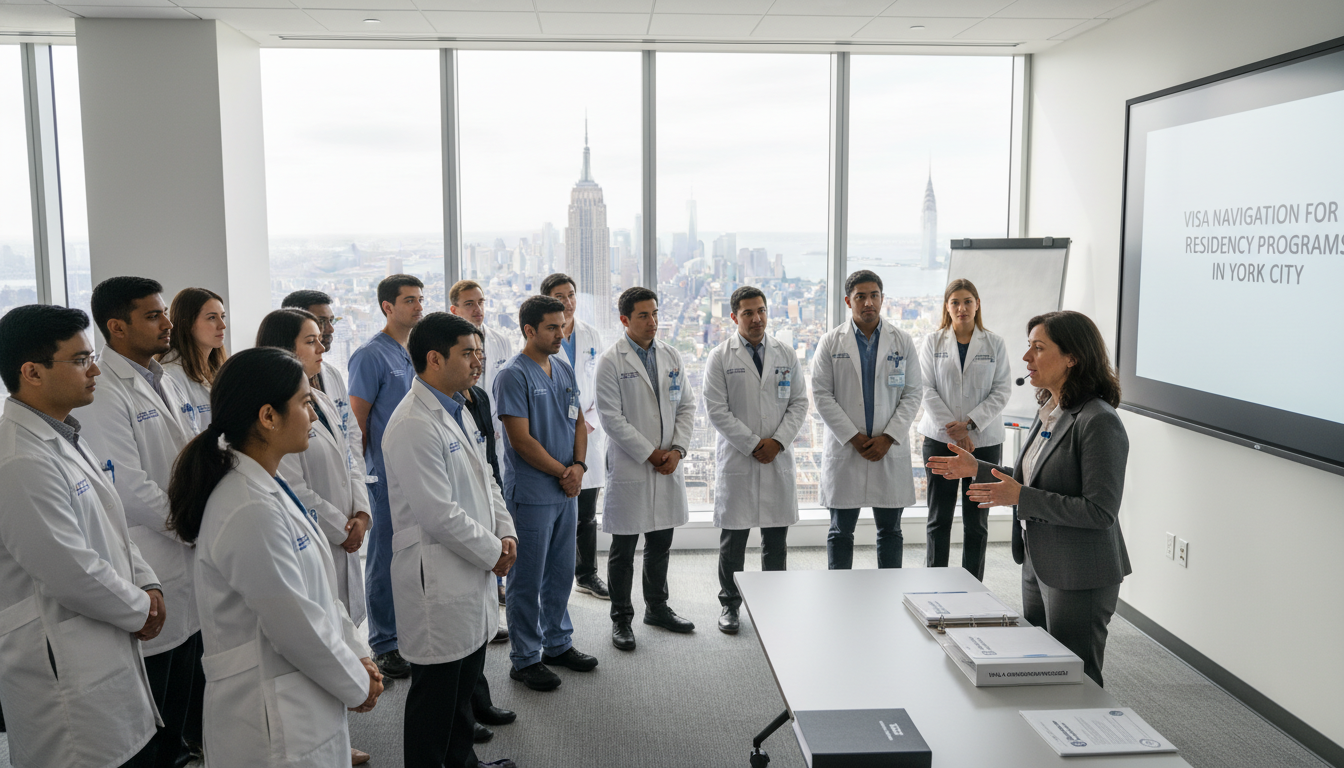
Long-Term Planning: Beyond Residency in New York City
Choosing between J-1 vs H-1B for your New York City residency has consequences beyond your PGY years. Think early about how your training visa fits into your overall immigration and career roadmap.
1. If You Train on a J-1
You will likely face the two-year home residency requirement unless you secure a waiver. Common paths:
- Conrad 30 waiver jobs (state-based programs offering 30 waivers per year)
- Typically in underserved or rural areas.
- New York State’s Conrad 30 program includes some roles in upstate NY; few, if any, are directly in central NYC.
- After completing a waiver job (usually 3 years full-time in a designated area), you may:
- Move into H-1B or other status.
- Begin or continue a green card process through employer sponsorship.
Pros of this path:
- You open many more opportunities to match in NYC, because most NYC residency programs accept J-1.
- You may gain exposure to diverse patient populations during waiver service.
Cons:
- You might need to leave New York City temporarily after training.
- Your exact location after residency (for the waiver job) is less under your control.
2. If You Train on an H-1B
You have more flexibility immediately after residency:
- You can move directly into an attending job in NYC or elsewhere on H-1B.
- You can begin green card sponsorship with less complication (no 212(e) barrier).
However, plan carefully:
- The 6-year H-1B maximum must cover:
- All H-1B years as a resident/fellow.
- Some or all years as an attending before green card approval.
- For long training paths (e.g., medicine + specialty + subspecialty), you may run out of H-1B time unless:
- You start your green card process early (PERM and I-140).
- You qualify for extensions beyond 6 years (e.g., approved I-140 and pending priority date).
NYC-specific consideration: Many attending positions in NYC are at academic and large healthcare systems that are H-1B cap-exempt, which can be helpful but does not remove the 6-year total time cap.
Practical Tips for IMGs Targeting NYC Residency and Visas
1. Start Visa Planning Early
- Think about residency visa implications at least 1–2 years before you apply.
- Align your USMLE preparation timeline with your intended visa route (especially Step 3 for H-1B).
2. Communicate Clearly With Programs
- Be honest about your visa needs.
- Ask questions before you rank, not after you match.
- Keep all communications polite and concise; program coordinators are key allies.
3. Consider Professional Legal Advice
- For complex situations (prior J-1 research stays, multiple visa statuses, dependents, or immigration violations), consult an experienced immigration attorney.
- Many NYC residents work with lawyers recommended by their hospital’s GME office.
4. Balance Ambition With Pragmatism
- NYC residency programs are highly competitive.
- Don’t limit yourself only to H-1B sponsorship programs if your application is borderline—being open to J-1 can significantly expand your options.
- At the same time, if long-term U.S. practice is your priority, include enough H-1B-capable programs in your list to realistically secure interviews.
5. Stay Up to Date
U.S. immigration policies can change. While core structures around J-1 and H-1B have been stable, you should:
- Check ECFMG, USCIS, and program websites each cycle.
- Confirm policies again directly with your matched program’s GME office.
FAQ: Visa Navigation for NYC Residency Programs
1. Do all NYC residency programs sponsor visas for IMGs?
No. New York City is relatively IMG-friendly, but not every program sponsors a residency visa. Most large teaching hospitals do sponsor J-1, and some sponsor H-1B as well. You must check each program’s current policy; do not assume sponsorship just because it’s a well-known NYC hospital.
2. Is it easier to get a J-1 or H-1B for residency in New York City?
For most IMGs, J-1 is easier to obtain for NYC residency programs:
- More programs support J-1.
- Requirements are less demanding (no mandatory Step 3 before Match).
- ECFMG coordinates the sponsorship, which programs are used to.
H-1B is available but limited; you need Step 3 and a program willing to invest time and money in the petition.
3. If I start residency on J-1, can I switch to H-1B later during residency in NYC?
In general, if you are subject to the J-1 two-year home residency requirement, you cannot easily change to H-1B or most immigrant statuses without first fulfilling or waiving that requirement. Some narrow exceptions and complex scenarios exist, but for most IMGs, once they begin clinical training on J-1, they must plan around the 212(e) requirement.
4. I am already in the U.S. on F-1 (or another status). Do I still need a residency visa?
Yes. Being on F-1, B-1/B-2, or another temporary visa does not automatically authorize paid clinical work as a resident. You will need to transition into J-1 or H-1B (or be a permanent resident/citizen) to start a residency program. Work with both your future NYC residency program’s GME office and, if needed, an immigration attorney to plan that transition.
Navigating IMG visa options for NYC residency programs takes advance planning, clear communication, and an understanding of how J-1 vs H-1B align with your long-term goals. With thoughtful preparation, you can successfully match into a New York City residency and set the foundation for the medical career—and life—you envision in the United States.