
Understanding the Visa Landscape for Caribbean IMGs
For a Caribbean medical school graduate aiming for residency in Alaska or Hawaii, visa strategy is just as important as exam scores and letters of recommendation. You may have strong clinical skills and a solid application, but if your residency visa plan is unclear or unrealistic, programs may hesitate to rank you.
In this article, we’ll focus on how a Caribbean IMG can navigate:
- The main residency visa types (J-1 vs H-1B)
- Specific considerations for Alaska residency and Hawaii residency programs
- Practical steps to position your application for visa sponsorship
- Timelines, documents, and common pitfalls
This is especially relevant if you are at an institution like SGU or another Caribbean medical school residency pathway that sends many graduates into U.S. programs, including in remote states like Alaska and Hawaii.
Core Visa Options: J-1 vs H-1B for Residency
For most Caribbean IMGs, the two realistic residency visa options are the J-1 exchange visitor visa and the H-1B temporary worker visa. Understanding J-1 vs H-1B at a granular level will shape your strategy.
The J-1 Visa for Residency
The J-1 is the most common visa category for IMGs in U.S. residency training.
Key features:
- Purpose: Graduate medical education or training
- Sponsor: Educational Commission for Foreign Medical Graduates (ECFMG)
- Duration: Up to 7 years for residency and fellowship (with yearly renewals)
- Funding: Must have guaranteed funding (salary/stipend) from the residency program or home government
Pros:
- Widely used and understood by residency programs
- Simpler and faster for programs than H-1B
- No prevailing wage requirement (unlike H-1B)
- Not subject to the regular H-1B lottery cap
Cons:
- Two-year home country physical presence requirement after training (your “country of last permanent residence” when you obtained J-1)
- More limited moonlighting compared to some H-1B positions
- Transition to independent practice can be more complex without a J-1 waiver
For many Caribbean IMGs, especially those graduating from large schools with established ECFMG processes (e.g., a typical SGU residency match pipeline), the J-1 is the path of least resistance for initial training.
The H-1B Visa for Residency
The H-1B is a temporary worker visa in a specialty occupation. For residency, it’s sometimes offered to highly competitive candidates or those who cannot or prefer not to use the J-1.
Key features:
- Purpose: Employment in a specialty occupation
- Sponsor: The residency program as your employer
- Duration: Typically 3 years, renewable up to 6 years total (extensions possible in some green card processes)
- Exams: You must have passed USMLE Step 3 before H-1B petition filing for residency
Pros:
- No J-1 two-year home return requirement
- Often easier transition to a work-based green card
- More flexibility in some types of moonlighting (varies by institution and state law)
- No federal J-1 waiver issue when you finish residency
Cons:
- Not all programs sponsor H-1B; many explicitly do J-1 only
- More complex and expensive for programs (legal fees, prevailing wage, etc.)
- Timing can be tight, especially if Step 3 results are delayed
- Some state licensing requirements add extra timing pressure
For Caribbean IMGs, especially first-time applicants and those targeting smaller or more remote programs (such as Alaska residency or many Hawaii residency programs), insisting on H-1B can significantly shrink your list of potential sponsors.
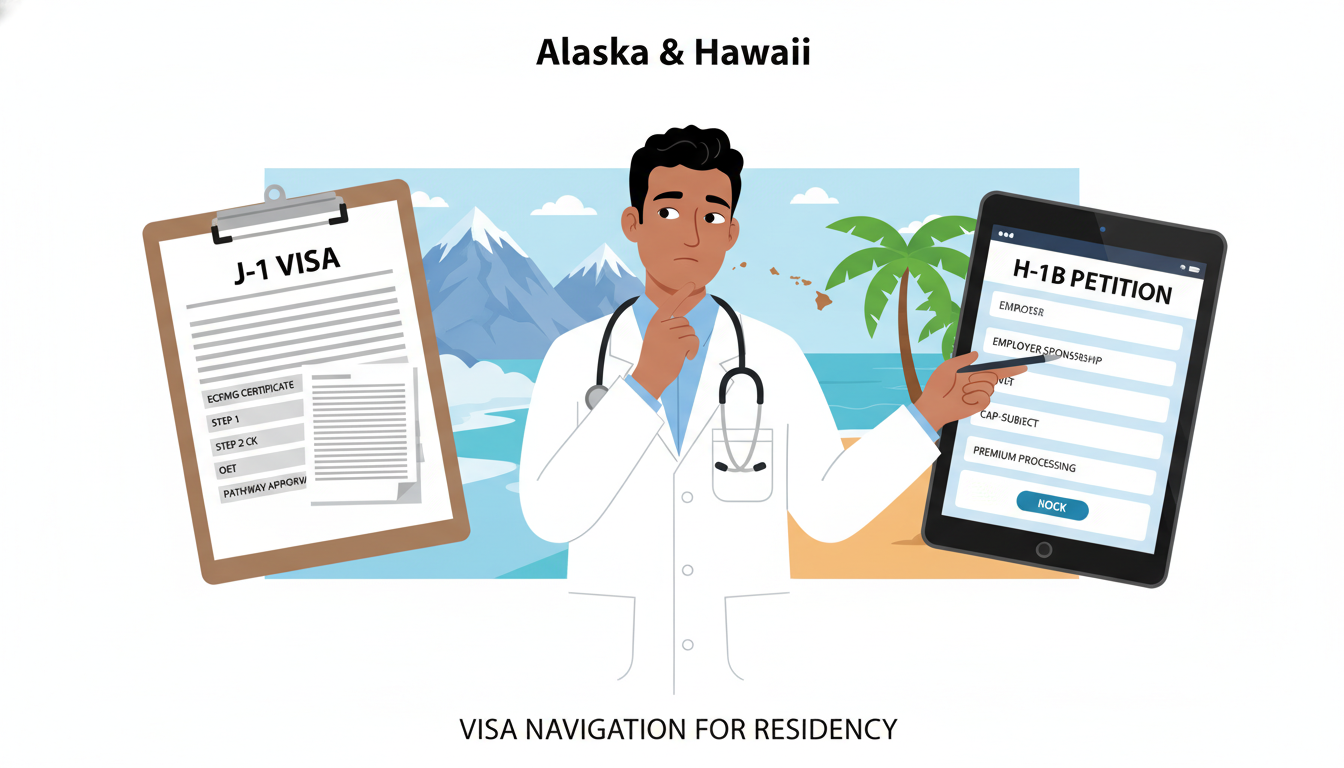
Special Considerations for Alaska Residency and Hawaii Residency Programs
Alaska and Hawaii are unique in geography, healthcare needs, and residency program structure. For a Caribbean IMG pursuing a Caribbean medical school residency pathway into these states, you need to understand the local context.
Program Landscape in Alaska & Hawaii
Alaska:
- Fewer total residency positions than most states
- Heavy focus on primary care, family medicine, and rural health
- Some programs are affiliated with larger institutions or consortia (e.g., WWAMI network linked to the University of Washington)
- Programs often emphasize service to underserved and rural/Native populations
Hawaii:
- More residency options than Alaska, but still limited compared with large mainland states
- Concentrated largely on Oahu, often around Honolulu
- Programs often affiliated with the University of Hawaii and major health systems
- Strong focus on primary care plus some subspecialties
For visa purposes, both Alaska and Hawaii may particularly value physicians willing to stay long-term in underserved regions, which can interact positively with future waiver and immigration options.
How Location Affects Visa Strategy
J-1 Waiver Opportunities:
The J-1 route becomes more attractive in Alaska and Hawaii because:
- Both states have many Health Professional Shortage Areas (HPSAs) or underserved regions.
- These underserved areas are potential sites for J-1 waiver jobs after residency, allowing you to avoid the two-year home return requirement by working in an underserved U.S. area for 3 years full-time.
States like Alaska and Hawaii are often eager to retain trained doctors, especially primary care physicians. That can create favorable conditions for your long-term immigration strategy.
H-1B Sponsorship Availability:
Many smaller or rural-focused residency programs:
- Prefer J-1 due to simpler administration
- Have limited experience or institutional support for H-1B
- May explicitly state “J-1 only” in their program descriptions
In Hawaii, some university-affiliated programs do sponsor H-1B, but the competition for those spots is usually intense. In Alaska, H-1B sponsorship is often less common in residency but more feasible later for attending positions, especially in shortage areas.
Actionable Advice:
- Check each Alaska and Hawaii residency program’s website for clear statements about visa sponsorship.
- Email program coordinators early if visa policy is unclear—specifically ask:
- “Do you sponsor J-1 visas for residency?”
- “Do you sponsor H-1B visas for residency?”
- Use ERAS filters and FREIDA to narrow to IMG-friendly programs that clearly sponsor your preferred residency visa type.
Step-by-Step Visa Planning for Caribbean IMGs
Step 1: Early Decision – J-1 vs H-1B Strategy
As a Caribbean IMG, decide your ideal visa path early, but stay flexible.
When J-1 is usually the better default:
- You are applying broadly, including smaller programs and remote regions.
- Your main target fields (e.g., Family Medicine, Internal Medicine) are common J-1 categories.
- You are okay with working in an underserved area after training to get a waiver.
- You don’t yet have Step 3 completed or anticipate difficulty timing Step 3 before match.
When to seriously pursue H-1B:
- You strongly wish to avoid the two-year home residency requirement.
- You can realistically complete and pass USMLE Step 3 well before match deadlines.
- You are a competitive applicant (strong scores, U.S. clinical experience, solid letters), targeting university or large teaching hospitals more likely to sponsor H-1B.
- You have researched and found specific Alaska or Hawaii residency programs with a history of H-1B sponsorship.
In Alaska and Hawaii, the reality is that J-1 is usually more accessible. Many Caribbean medical school residency matches into these states have occurred via the J-1 pathway, followed by a state or federal J-1 waiver job.
Step 2: Align Your ERAS Application with Visa Goals
On your ERAS Common Application Form, you will indicate your citizenship and whether you will require visa sponsorship.
Tips for Caribbean IMGs:
- Be accurate about your citizenship and country of permanent residence—it affects J-1 rules later.
- Use your personal statement or “Additional Information” sections to subtly demonstrate:
- Interest in working with underserved populations
- Long-term commitment to Alaska or Hawaii (e.g., prior travel, family ties, interest in rural or island medicine)
- Request letters of recommendation from U.S. physicians who can speak to your adaptability in varied settings (rural, resource-limited, culturally diverse), which fits many Alaska and Hawaii programs.
Step 3: Practical J-1 Pathway Checklist
If you are planning the J-1 route:
- Secure ECFMG Certification (or be on track before residency start).
- Gather documents needed for the J-1 application via ECFMG:
- Valid passport
- ECFMG certificate (or proof you will get it)
- Contract or official offer letter from the residency program
- Financial information (usually covered by residency salary)
- Once matched:
- Your program will generate training appointment documents.
- You will complete the online application through ECFMG.
- ECFMG issues Form DS-2019, which you then use for your visa interview.
- Attend U.S. consulate/embassy interview in your country of residence.
Caribbean-specific note: If you are from a Caribbean nation but have permanent residency in another country (e.g., Canada or the U.K.), your country of last permanent residence at the time you receive J-1 is crucial—it determines where the two-year home requirement applies.
Step 4: Practical H-1B Pathway Checklist
If you are targeting H-1B in Alaska or Hawaii:
- Take USMLE Step 3 early:
- Ideally by late summer or early fall of the application year.
- Make sure your Step 3 score report is available before programs decide on H-1B offers.
- Research and shortlist programs that:
- Explicitly state they sponsor H-1B.
- Are IMG-friendly and located in Alaska or Hawaii, or have strong links to those states.
- During interviews:
- Have a concise explanation for preferring H-1B.
- Clarify that you understand timing and documentation requirements.
- Once matched, if your program agrees to sponsor H-1B:
- They will file an H-1B petition on your behalf (often cap-exempt as an educational institution or affiliated nonprofit).
- You provide documents: diplomas, transcripts, ECFMG certificate, Step 3 pass, passport, etc.
- Attend visa interview if you are outside the U.S., or change of status if you’re within the U.S. in another valid nonimmigrant status.

Post-Residency Planning: J-1 Waivers and Long-Term Options
For many Caribbean IMGs, the ultimate question isn’t just, “How do I match?” but, “How do I stay and practice long-term in Alaska or Hawaii?”
J-1 Waiver Basics
If you train on a J-1 visa, you will normally be subject to a two-year home country residence requirement after finishing training. However, you can avoid this by obtaining a J-1 waiver, most commonly by:
- Working full-time for 3 years in a designated underserved area, often on an H-1B visa.
- Having a qualifying Interested Government Agency (IGA) or state health department sponsor your waiver request.
For Alaska and Hawaii, this can actually create a strong retention path:
- Both states have numerous underserved communities.
- They often struggle to recruit physicians, particularly in primary care and psychiatry.
- State health departments or designated agencies may actively support J-1 waiver applications.
Common waiver pathways:
- Conrad 30 program: Each state can recommend up to 30 J-1 waivers per year for physicians agreeing to work in underserved areas.
- Federal IGA programs: Certain federal agencies can sponsor waivers for service in specific facilities or populations.
How to Position Yourself for a Waiver in Alaska or Hawaii
- During residency, show clear interest in:
- Rural rotations
- Native/Indigenous health (in Alaska)
- Island and community health (in Hawaii)
- Underserved and safety-net clinics
- Network with faculty and program leadership who have connections with local clinics and health systems that hire J-1 waiver physicians.
- Start waiver planning in PGY-2 (or earlier):
- Attend any informational sessions about J-1 waiver and IMG visa options hosted by your GME office.
- Reach out to state health departments or recruiters in Alaska or Hawaii for information on waiver sites.
- Consider whether you may want to stay in the same state or are open to moving between Alaska and Hawaii or to another underserved state.
Long-Term Immigration Options
Regardless of starting with J-1 or H-1B, long-term paths can include:
- Employment-based green cards (EB-2 or EB-3):
- After waiver service (for J-1) or after a period of H-1B employment.
- Often sponsored by your employer in an underserved area.
- National Interest Waiver (NIW):
- For physicians working in designated shortage areas, your work can be considered in the U.S. national interest, easing some requirements.
- Family-based immigration, if applicable:
- If you marry a U.S. citizen or permanent resident.
- Academic or research-based pathways, for those who go into subspecialty fellowships and academic careers.
For Caribbean IMGs, especially those from small island countries, the combination of J-1 → J-1 waiver job in Alaska or Hawaii → green card can be a realistic and rewarding pathway.
Practical Tips and Common Pitfalls for Caribbean IMGs
Tips to Strengthen Your Application as a Caribbean IMG
Maximize U.S. clinical experience (USCE)
- Aim for at least 2–3 strong U.S. clinical rotations, ideally in internal medicine or family medicine if targeting Alaska/Hawaii.
- If possible, rotate in regions with similar characteristics (rural, underserved, or coastal communities).
Highlight cultural competence
- Both Alaska and Hawaii have diverse populations with distinct cultural backgrounds (Native Alaskan, Native Hawaiian, Pacific Islander, Asian, etc.).
- As a Caribbean IMG, emphasize your ability to connect with multicultural communities and adapt to new cultural settings.
Emphasize resilience and adaptability
- Remote locations, harsh weather (Alaska), and island logistics (Hawaii) demand flexibility.
- Use your personal statement to describe experiences that show your resilience—studying abroad at a Caribbean medical school itself is a strong example.
Leverage institutional support from your school
- Large Caribbean medical schools like SGU and others often have dedicated offices for immigration and match advising.
- Ask them about:
- Historical match patterns into Alaska residency and Hawaii residency programs
- Typical visa pathways (SGU residency match data often reveals a strong J-1 bias)
- Alumni who can mentor you through the process
Common Visa-Related Mistakes to Avoid
Ignoring program-specific visa policies
- Do not waste applications on programs that clearly state “U.S. citizens and permanent residents only” or “J-1 only” when you insist on H-1B.
Delaying Step 3 if you want H-1B
- If an H-1B is important to you, plan Step 3 strategically; late completion can close this option.
Unclear communication about visa needs
- Be honest and straightforward with programs about your visa situation.
- Provide documentation promptly when requested; delays can endanger your residency start date.
Assuming J-1 home requirement is unmanageable
- For many physicians, especially in Alaska and Hawaii, the J-1 waiver route is a realistic and rewarding path that leads to long-term practice in the U.S.
FAQs: Visa Navigation for Caribbean IMGs in Alaska & Hawaii
1. As a Caribbean IMG, is it realistic to match into Alaska or Hawaii on a J-1 visa?
Yes. Many Caribbean medical school residency matches into Alaska and Hawaii have been on J-1 visas. These states often welcome IMGs, particularly in primary care specialties. Your chances improve if you:
- Have solid USMLE scores and U.S. clinical experience
- Show genuine interest in underserved populations and long-term commitment
- Apply to IMG-friendly programs that clearly sponsor J-1 visas
2. Should I prioritize H-1B over J-1 if I want to practice long-term in Alaska or Hawaii?
Not necessarily. While H-1B avoids the two-year home requirement, it is harder to secure, especially in smaller or rural-focused programs. Many Alaska and Hawaii residency programs prefer J-1 because of administrative simplicity. The J-1 → waiver job → green card pathway is common and effective in these states. If you have strong credentials and target specific H-1B-sponsoring programs, H-1B can be an advantage—but it should be a strategic choice, not a rigid requirement.
3. How does my status as a Caribbean citizen affect the J-1 two-year home residency requirement?
The two-year requirement applies to your country of last permanent residence when you receive the J-1, which is often—but not always—your country of citizenship. For example:
- If you are a citizen of a Caribbean country and also a permanent resident of another country, the requirement might apply to that other country.
- You will need to confirm your situation with immigration counsel or ECFMG guidance.
In most cases, you can avoid this requirement by obtaining a J-1 waiver through service in an underserved area in the U.S.
4. What can I do during medical school to improve my chances of a visa-sponsored residency in Alaska or Hawaii?
- Plan early USMLE Steps and, if considering H-1B, an early Step 3.
- Secure strong U.S. clinical rotations and letters of recommendation.
- Seek rotations or volunteer experiences that show interest in rural, island, or underserved health.
- Research Alaska residency and Hawaii residency programs during your 3rd year and connect with alumni who matched there.
- Stay informed about IMG visa options and start thinking about the J-1 vs H-1B trade-offs well before ERAS season.
By combining a clear visa strategy with a strong, mission-driven application, a Caribbean IMG can navigate the residency visa landscape and build a meaningful medical career in Alaska, Hawaii, or both. Your path will involve careful planning, but the unique professional and personal rewards of practicing in these states can make the journey worthwhile.