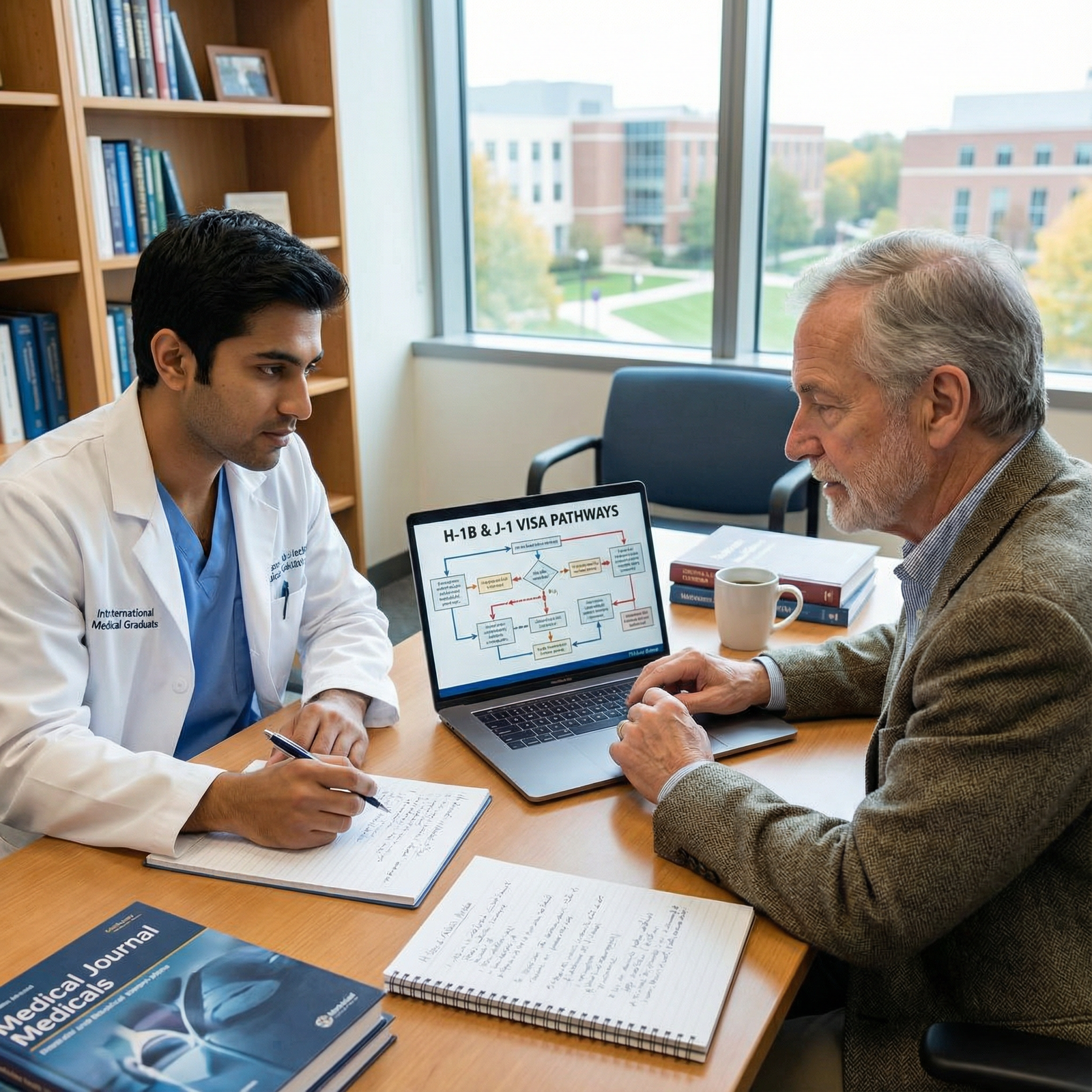
Understanding the Visa Landscape as a Caribbean IMG
For Caribbean international medical graduates (IMGs), especially those from schools like SGU, AUC, Ross, Saba and other offshore programs, matching into U.S. residency is only half the battle. Equally important is understanding how visas work—particularly in community hospital residency and community-based residency programs, where policies and support structures can differ significantly from large academic centers.
This guide walks you through:
- How visas intersect with residency for Caribbean IMGs
- Key differences between J-1 vs H-1B
- How community hospital programs typically approach Caribbean medical school residency applicants
- Strategies to improve your SGU residency match and similar outcomes from other Caribbean schools with visa needs
- Practical steps, timelines, and common pitfalls to avoid
Throughout, we’ll focus on the realities of community hospital programs, which are often IMG-friendly but can have more limited visa sponsorship resources.
Big Picture: How Visas Fit Into Your Residency Strategy
Before comparing visa types, you need a strategic overview of how immigration status interacts with your residency goals.
Step 1: Know Your Citizenship and School Status
Caribbean IMGs usually fall into one of these categories:
U.S. citizens/Permanent Residents trained in Caribbean schools
- No visa required for residency
- Treated like U.S. graduates for immigration purposes
- Visa issues mainly arise later for fellowship or if training abroad
Non-U.S. citizens trained in Caribbean schools
- Need a residency visa to train in the U.S.
- Must decide between J-1 vs H-1B (if both are options)
- Must plan ahead for long-term career and immigration pathways
This article is focused on group 2: non-U.S. citizen Caribbean IMGs applying to U.S. community-based residency programs.
Step 2: Understand the Match + Visa Timeline
A typical timeline:
June–September (Application Season)
- ERAS applications submitted
- Programs screen for visa needs
- Some community hospital residency programs automatically filter out applicants needing visas
- Others explicitly welcome IMGs and sponsor J-1 and/or H-1B
October–January (Interview Season)
- Programs may ask your visa preference (J-1 vs H-1B)
- You should be prepared with a clear, informed answer
- Some programs will only rank candidates they can sponsor
March (Match Day)
- If you match and require a visa, the GME office starts your visa process
- You must respond quickly to document requests
April–June
- Visa petitions and DS-2019 (for J-1) submitted
- Consular appointments (if outside the U.S.)
- Arrival planning
July 1
- Residency start date for most programs
For Caribbean IMGs, especially at schools with a strong SGU residency match or similar track record, your school’s dean’s office or career services may have dedicated visa advisors. Use them early.
J-1 vs H-1B: Core Differences Every Caribbean IMG Must Know
The central decision for many Caribbean IMGs is J-1 vs H-1B. Both can work; the best choice depends on your career goals, family situation, and willingness to work in underserved areas.
J-1 Visa for Residency: The Default Path for Many IMGs
The J-1 Exchange Visitor Visa (Alien Physician) is:
- Sponsored by the ECFMG, not directly by your hospital
- Common in both academic and community hospital residency programs
- Often the only option offered at smaller or resource-limited community hospitals
Key Features of J-1 for Residency
- Purpose: Graduate medical education (residency/fellowship)
- Duration: Typically up to 7 years total (enough for most residency + fellowship paths)
- 2-Year Home Residency Requirement:
- After training, you must return to your home country for a total of 2 years
- OR obtain a J-1 waiver (usually by working in an underserved area)
- Work Authorization:
- Strictly tied to your specific training program and site(s)
- Moonlighting often restricted or prohibited (varies by institution)
Advantages of J-1 for Caribbean IMGs
- Widely accepted:
- Many community-based residency programs are familiar with J-1
- ECFMG handles much of the paperwork and compliance
- Faster processing:
- Once your program sends required forms, DS-2019 issuance is usually straightforward
- Lower institutional burden:
- GME office does not need its own H-1B legal infrastructure
Disadvantages of J-1
- 2-year home-country requirement:
- Can delay permanent immigration plans unless you obtain a J-1 waiver
- Limited flexibility:
- No direct “dual intent” (immigrant) path
- Harsher restrictions on moonlighting and secondary employment
- Family planning considerations:
- J-2 dependents face similar restrictions and uncertainty
H-1B Visa for Residency: Fewer Programs, More Flexibility
The H-1B Temporary Worker Visa (specialty occupation) is less common in community hospitals but can be highly advantageous when available.
Key Features of H-1B for Residency
- Purpose: Employment in a specialty occupation (you are an employee, not an exchange visitor)
- Duration: Generally up to 6 years (3 + 3), with possible extensions if in green card processes
- No 2-year home requirement:
- No mandatory return to home country after residency
- Dual intent:
- You may pursue permanent residency (green card) during H-1B status
Advantages of H-1B for Caribbean IMGs
- Better for long-term immigration:
- No J-1 2-year requirement
- Connected more directly to future employment-based green card pathways
- More moonlighting flexibility:
- Some institutions allow H-1B residents to moonlight with proper approvals
- Attractive for competitive fellowships and employers:
- Especially in specialties where employers anticipate hiring you permanently
Disadvantages of H-1B
- Limited availability in community hospital residency programs:
- Requires more institutional legal infrastructure and cost
- Some programs categorically do not sponsor H-1B
- Stricter eligibility:
- Must have USMLE Steps completed (usually all 3, including Step 3) before filing
- Timing can be tight for Caribbean IMGs who take Step 3 late
- Cap Issues (less common in residency):
- Many hospitals are cap-exempt, but future employers may not be
How Community Hospital Programs Typically View J-1 vs H-1B
In practice:
Most community hospital residency programs:
- Sponsor J-1 only, if they sponsor at all
- Are comfortable with ECFMG/DS-2019 process
- Have limited budget for immigration lawyers, making J-1 simpler
Some larger or more established community hospitals:
- Sponsor both J-1 and H-1B
- Often have a track record with Caribbean IMGs and may list this clearly on their website
A minority of community hospitals:
- Sponsor no visas (U.S. citizens/green card holders only)
- Important to identify and filter out early to avoid wasted applications
For a Caribbean medical school residency applicant, especially from schools emphasizing community-based residency placements, understanding each program’s visa stance is crucial before you invest energy in that application.

Researching and Targeting Visa-Friendly Community Hospital Programs
For Caribbean IMGs, smart targeting can mean the difference between matching with a viable visa path or ending up unmatched despite being academically competitive.
Step 1: Use Public Information Wisely
When evaluating programs:
Program Websites
- Look under:
- “Eligibility & Requirements”
- “International Medical Graduates”
- “Visa Information”
- Keywords to look for:
- “We sponsor J-1 visas via ECFMG”
- “H-1B visa sponsorship considered”
- “Only applicants with U.S. citizenship or permanent residency are eligible”
- Be cautious if visa policies are not clearly stated; reach out by email.
- Look under:
FREIDA and Residency Explorer
- These tools may list whether programs accept IMGs and what visas they sponsor.
- Cross-check with the program site—policies can change year to year.
School-Specific Match Data (e.g., SGU, AUC, Ross)
- Many Caribbean schools publish residency match lists, including:
- Program names
- Locations
- Specialties
- Look for patterns: which community hospitals commonly take graduates from your school? They are likely more IMG- and visa-friendly.
- Many Caribbean schools publish residency match lists, including:
Step 2: Email Programs Proactively (But Professionally)
If a program’s website is unclear, a concise email can help:
- Send it to the program coordinator or program administrator, not the program director initially.
- Keep it short and direct; for example:
Dear [Name],
I am an international medical graduate from [School, e.g., SGU/Ross/etc.] and am very interested in your [Specialty] residency program.
Could you please confirm whether your program sponsors residency visas for IMGs, and if so, which type(s) (J-1 and/or H-1B)?
Thank you for your time and assistance.
Sincerely,
[Your Name, Credentials, AAMC ID]
This helps you avoid applying to programs that cannot support your residency visa needs.
Step 3: Use Your Caribbean School’s Network
Caribbean schools with strong SGU residency match or similar portfolios often have:
- Dedicated advisors for visa-related issues
- Alumni networks in community hospital residency programs
- Data on which programs consistently sponsor J-1 or H-1B
Ask for:
- Lists of visa-friendly community hospital programs
- Contact emails of alumni residents/fellows willing to share their experiences
- Sample timelines from past graduates who needed H-1B or J-1 waivers later
Practical Strategies to Strengthen Your Application as a Visa-Needing Caribbean IMG
Needing a visa can be perceived as an additional “hurdle” by some programs. Your job is to minimize real or perceived barriers while showcasing clear value.
Strengthen Your Overall Profile
Community-based residency programs, especially those in underserved or smaller areas, often value:
- Strong Step scores (or equivalent standardized exams)
- Solid clinical evaluations and LORs (especially from U.S. rotations)
- Commitment to primary care or underserved populations
- Reliability and strong communication skills
As a visa-needing Caribbean IMG, prioritize:
USMLE Performance
- Step 1: Pass is critical; a strong pass still helps, even if now pass/fail.
- Step 2 CK: High scores can offset bias against IMGs and provide objective comparison.
U.S. Clinical Experience (USCE)
- Core and elective rotations at community hospitals where IMGs have matched previously
- Sub-internships or audition rotations at target programs when possible
Letters of Recommendation
- At least two from U.S. academic or community attendings
- Ideally from sites similar to your target programs (community-based, high-IMG)
Be Transparent and Strategic About Visa Needs
In your application and interviews:
- Be honest about your citizenship and visa status.
- Clearly state your preferred visa (J-1 vs H-1B) only if asked:
- If the program only sponsors J-1: express full comfort with J-1.
- If both are offered: you may explain your preference and the reasons.
Example interview answer:
“I am an international graduate and will require a visa to train in the U.S. I understand your program sponsors J-1 visas, and I am fully prepared to train under J-1 sponsorship through ECFMG. My primary focus is high-quality training and contributing to your community.”
If a program asks about H-1B:
“I would be interested in H-1B sponsorship if feasible, primarily because I hope to continue practicing in the U.S. long-term and H-1B aligns with that path. That said, I respect your program’s visa policies and am comfortable with J-1 if that is your standard.”
Timing Considerations for H-1B
For H-1B eligibility during residency:
- You typically must have:
- Passed USMLE Step 3 before H-1B petition filing
- Completed ECFMG certification
This can be challenging for Caribbean IMGs who:
- Take Step 3 late in 4th year, or
- Are still waiting for scores during Match season
If you strongly want H-1B:
- Plan to take Step 3 early, ideally during late 4th year or very early PGY-1 (if your program will convert from J-1 to H-1B later, which some do).
- Confirm with target programs whether:
- They will sponsor H-1B for PGY-1, or
- They prefer to start residents on J-1 and possibly switch later.

Long-Term Planning: J-1 Waivers, Underserved Work, and Career Paths
For many non-U.S. Caribbean IMGs, the visa journey does not end at the conclusion of residency or fellowship. Long-term planning should begin early.
If You Train on a J-1: Understanding J-1 Waivers
If you complete residency/fellowship on a J-1 visa:
- You will face the 2-year home-country physical presence requirement, unless waived.
- The most common solution is a J-1 waiver job in a U.S. underserved area.
Typical J-1 Waiver Pathway:
- Complete residency (and fellowship, if applicable) on J-1.
- Secure a job offer in a qualifying underserved area (often primary care, psychiatry, hospitalist, etc.).
- Apply for a Conrad 30 waiver or other state/federal waiver programs.
- Work 3 years in that underserved job under H-1B status.
- After finishing the 3-year waiver commitment, you can:
- Stay with the employer and pursue permanent residency, or
- Move to other employers under H-1B or green card status.
For Caribbean IMGs interested in:
- Primary care (FM/IM)
- Psychiatry
- Pediatrics
- OB/GYN
- Hospitalist tracks
A J-1 + waiver path can be quite realistic, especially if you trained in a community-based residency that already serves underserved populations. Your experience there may help you secure a waiver job later.
If You Train on an H-1B: Direct Employment and Green Card Options
If your community hospital residency sponsors H-1B:
- You avoid the J-1 2-year home requirement.
- After residency:
- You can transition to another H-1B employer more easily.
- Employers may initiate green card sponsorship (often EB-2 or EB-3).
However:
- H-1B availability in residency is limited.
- Some states and employers still prefer J-1 waiver candidates for their guaranteed 3-year commitment.
Community Hospital Programs and Future Job Prospects
Training in a community hospital residency often positions you well for:
- Jobs in similar community settings, including:
- Rural hospitals
- Critical access facilities
- FQHCs (Federally Qualified Health Centers)
- Underserved urban clinics
These are precisely the settings that:
- Commonly sponsor J-1 waivers
- Are motivated to hire IMGs trained in similar environments
- May be more flexible and supportive with IMG visa options
If you anticipate a J-1 + waiver path:
- Choose residencies that:
- Provide strong training in bread-and-butter clinical work
- Serve Medicaid/uninsured populations
- Have a track record of graduates obtaining J-1 waiver positions
Action Plan: Concrete Steps for Caribbean IMGs Applying to Community Hospital Programs
To put all of this into a practical roadmap:
12–18 Months Before Application
- Clarify your status:
- Confirm you will need a residency visa (non-U.S. citizen, no green card).
- Research visa types:
- Learn basics of J-1 vs H-1B and think about long-term goals.
- Take USMLE exams on a strong timeline:
- Aim for competitive Step 2 CK.
- If targeting H-1B, plan Step 3 earlier if possible.
6–9 Months Before ERAS Opens
- Build your program list:
- Use your Caribbean school’s match lists (e.g., SGU residency match data) to identify community-based programs that have historically taken graduates like you.
- Check each program’s website for visa policies.
- Email unclear programs:
- Confirm whether they sponsor J-1 and/or H-1B.
During ERAS Application Season
- Clearly indicate IMG status and ECFMG certification (if available).
- Do not overemphasize “visa needs” in your personal statement; keep focus on:
- Fit with community medicine
- Cultural and linguistic skills
- Service to underserved populations
- Be prepared to discuss visa needs briefly and confidently during interviews.
Interview Season
- Ask tactful questions if visa policies are not explicit:
- “Could you share what types of visas your program has sponsored for prior IMG residents?”
- Take notes:
- Track which programs:
- Regularly sponsor J-1
- Are open to H-1B
- Are unclear or hesitant
- Track which programs:
After the Match
If you match into a community hospital residency:
- Respond immediately to GME office visa-related requests.
- For J-1:
- Complete all ECFMG and DS-2019 forms early.
- Schedule consulate appointments as soon as possible if outside the U.S.
- For H-1B:
- Provide Step 3 proof and other documents quickly.
- Keep in contact with your hospital’s immigration office or law firm contact.
Frequently Asked Questions (FAQ)
1. As a Caribbean IMG, is it realistic to get H-1B in a community hospital residency?
It is possible but less common. Many community hospitals sponsor only J-1 due to cost and administrative complexity. H-1B is more likely at larger community systems with established IMG pipelines. To increase your chances:
- Take and pass Step 3 early.
- Specifically target programs that explicitly state they sponsor H-1B.
- Use your school’s alumni network to identify where prior graduates obtained H-1B.
2. Will needing a visa significantly hurt my chances of matching into a community-based residency?
It can narrow your options but does not automatically prevent matching. Many community hospital programs:
- Are IMG-friendly
- Depend on IMGs to staff their services
- Have experience sponsoring J-1 (and sometimes H-1B)
Your competitiveness (scores, clinical performance, letters, and personal fit) still matters most. The key is targeting programs that explicitly sponsor visas and avoiding those that do not.
3. If I train on a J-1 visa, can I still stay in the U.S. long-term?
Yes, but usually via a J-1 waiver path. The common route:
- Finish residency (and possibly fellowship) on J-1.
- Obtain a J-1 waiver job in an underserved area (often under Conrad 30).
- Work 3 years at that site under H-1B.
- Transition to permanent residency (green card) and/or other jobs afterward.
Many Caribbean IMGs have successfully built long-term U.S. careers using this route, particularly in primary care and hospitalist medicine.
4. How do I know if a specific community hospital residency program sponsors visas?
Check:
- Program website – under “Eligibility” or “For IMGs.”
- FREIDA / Residency Explorer – visa information section.
- Email the program coordinator if unclear.
Ask directly whether they sponsor residency visas for IMGs and which types (J-1 vs H-1B). Do this before spending an application slot on programs that cannot accommodate your needs.
By understanding the nuances of J-1 vs H-1B, carefully targeting community hospital residency programs that align with your immigration needs, and planning your career with future waiver or employment pathways in mind, you can transform a complex visa landscape into a manageable and strategic part of your journey as a Caribbean IMG.