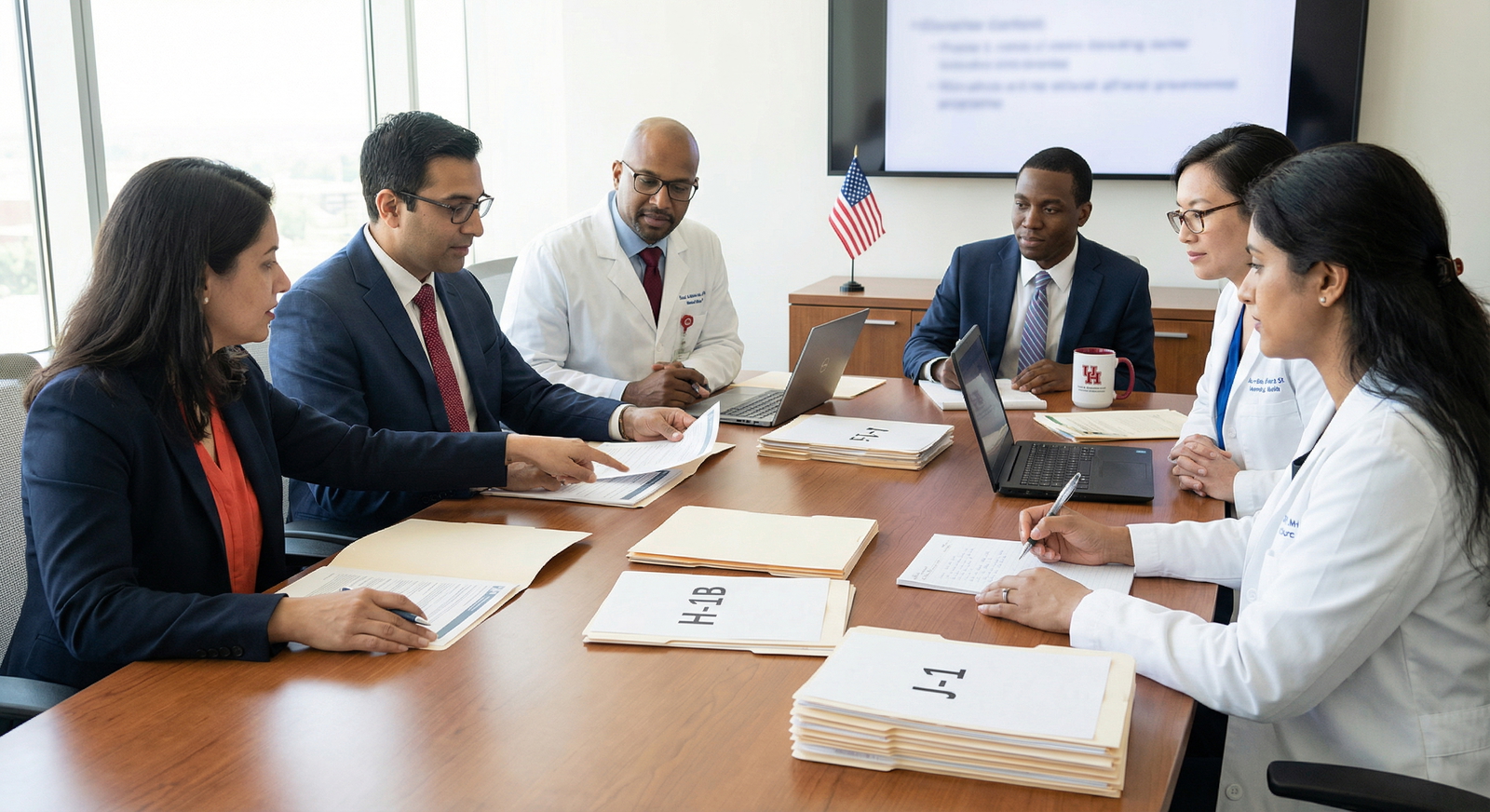
Understanding the Visa Landscape for Caribbean IMGs in HBCU-Affiliated Residencies
For a Caribbean international medical graduate (IMG), matching into a U.S. residency is only half the battle. The other half is visa navigation—especially if you are targeting HBCU-affiliated residency programs and safety-net hospitals that serve diverse communities. Whether you are applying from a Caribbean medical school, such as SGU, or another regional institution, understanding your IMG visa options, timelines, and how they connect to specific residency programs is crucial.
In this guide, we will focus on:
- The main visa pathways for residency (especially J-1 vs H-1B)
- How visa issues intersect with Caribbean medical school residency outcomes
- Specific considerations when applying to HBCU residency programs, including Meharry residency and similar institutions
- How to research and communicate about visas with programs
- Strategic planning for long-term training and career goals in the U.S.
Core Visa Options for Caribbean IMGs Entering Residency
For graduate medical education (GME) in the U.S., three pathways dominate:
- J-1 Exchange Visitor (ECFMG-sponsored)
- H-1B Temporary Worker (employed/sponsored by the hospital or institution)
- Alternative or “bridge” statuses (e.g., F-1 OPT, pending green card, other less common situations)
Most Caribbean IMGs enter residency on either a J-1 or H-1B. Each has advantages, trade-offs, and implications for your post-residency future.
J-1 Visa for Residency: The Default IMG Path
The J-1 Exchange Visitor visa for physicians is administered through ECFMG. It is the most common visa category used by IMGs in U.S. residency programs.
Key features of the J-1 for residency:
- Sponsor: ECFMG (not the hospital directly)
- Purpose: Graduate medical education—residency and fellowship
- Duration: Valid for the length of your training, usually up to 7 years total (residency + fellowship) with annual renewals
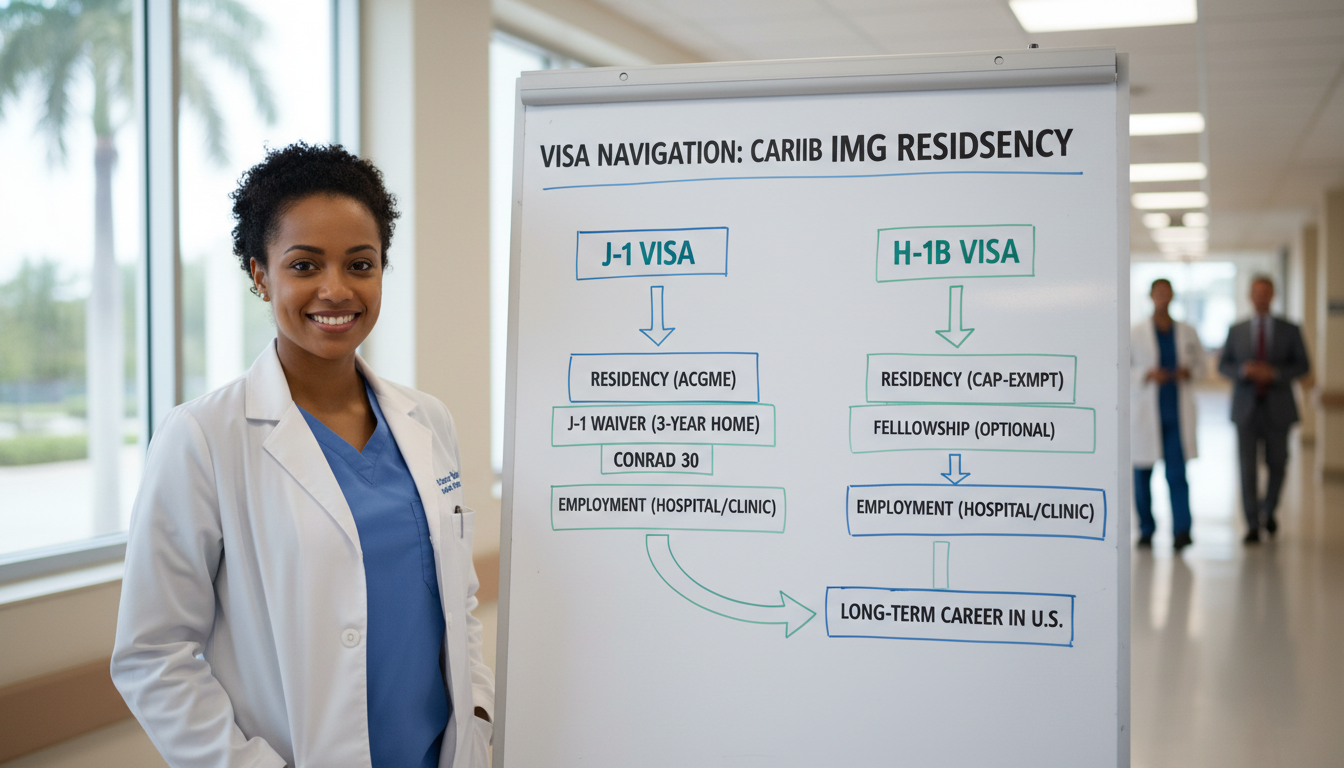
- Home-country physical presence requirement (2-year rule): After finishing training, most J-1 physicians must return to their home country for 2 years or obtain a J-1 waiver before eligible for H-1B or permanent residency (green card)
Pros for Caribbean IMGs:
- Widely accepted by programs; even hospitals with limited immigration infrastructure can sponsor J-1s because ECFMG handles most of the process.
- Often the only visa that smaller or resource-limited HBCU-affiliated programs or community hospitals may sponsor.
- Relatively straightforward and predictable, especially for training purposes.
Cons:
- The 2-year home residence requirement (212(e)) is a major constraint if you want to stay long-term in the U.S.
- J-1 physicians typically cannot moonlight (varies by institution and state, but much more limited than H-1B).
- Transition to fellowship or academic positions may be constrained unless programs understand J-1 visas well.
When J-1 is likely your primary option:
- Programs explicitly state “J-1 only” for IMG visa sponsorship.
- The institution is smaller, newer, or more resource-limited (common in some safety-net and HBCU-affiliated hospitals).
- You do not yet have U.S. immigration status (e.g., no green card, no U.S. citizenship, no H-4 EAD, etc.).
H-1B Visa for Residency: More Flexibility, More Barriers
The H-1B is a temporary worker visa used by some residency programs to sponsor IMGs as “specialty occupation” employees.
Key features of H-1B for residency:
- Sponsor: The hospital or institution (not ECFMG)
- Purpose: Employment as a resident physician
- Duration: Typically granted in increments up to a maximum of 6 years; can sometimes extend if a green card process is underway
- No 2-year home return requirement: Once you complete training, you can transition directly to other H-1B roles or green card sponsorship.
Pros for Caribbean IMGs:
- Greater long-term flexibility for staying in the U.S.
- Often allows moonlighting and supplemental employment (subject to institutional and licensing policies).
- More straightforward pathway to permanent residency compared to J-1 (no waiver needed).
Cons:
- Many programs, especially smaller or under-resourced programs (including some HBCU residency programs), do not sponsor H-1B due to legal costs, administrative burden, or institutional policy.
- Requirements can be stricter, e.g.:
- Must have passed USMLE Step 3 by the time of visa petition (not just by match rank list deadline)
- Licensure or training license requirements may be more complex
- H-1B petitions have filing fees and need experienced legal support—some institutions are unwilling to take this on.
When H-1B is realistically possible:
- Large academic health centers with established IMG support.
- Some SGU residency match partner institutions that historically sponsor H-1Bs.
- You already have Step 3 passed early and a strong application profile.
- The specific residency program declares “J-1 and H-1B sponsored” or “H-1B considered for exceptional candidates.”
J-1 vs H-1B: Strategic Comparison for Caribbean IMGs
Understanding J-1 vs H-1B is fundamental to your strategy:
| Factor | J-1 (ECFMG) | H-1B (Employer) |
|---|---|---|
| Sponsor | ECFMG | Hospital/Institution |
| Commonality for IMGs | Very common | Less common |
| Home-country 2-year requirement | Yes (usually) | No |
| Moonlighting | Often restricted | More flexible (institution-dependent) |
| Need USMLE Step 3 before Match | No (but required before J-1 extension) | Usually Yes before visa filing |
| Typical in smaller/HBCU-affiliated programs | Yes | Variable, often No |
| Long-term stay in US after training | Requires waiver or return home | Easier transition to jobs/green card |
For many Caribbean IMGs targeting HBCU-affiliated residencies, the practical answer is that J-1 is the default, and H-1B is an option only at specific, well-resourced institutions.
How Visa Issues Intersect with HBCU-Affiliated Residency Programs
Historically Black Colleges and Universities (HBCUs) and their affiliated hospitals have a unique mission: training physicians committed to serving underserved and minority communities. For Caribbean IMGs, these programs can be especially welcoming, but visa policies still vary considerably.
Common HBCU-Affiliated Training Environments
Examples of HBCU-affiliated institutions and environments (not exhaustive; always verify current accreditation and sponsor relationships):
- Meharry Medical College and associated training hospitals (e.g., Nashville General Hospital)
- Howard University Hospital
- HBCU-affiliated family medicine residency programs and community-based training sites in the South and Mid-Atlantic
- Safety-net, county, or historically minority-serving hospitals partnered with HBCU medical schools
These programs may have:
- Strong commitment to diversity, equity, and inclusion
- Focus on primary care, internal medicine, pediatrics, OB/GYN, psychiatry—fields where Caribbean IMGs frequently match
- Variable institutional resources and administrative capacity for visa sponsorship
Visa Sponsorship Reality in HBCU Residency Programs
While each program is unique, common patterns include:
J-1 Often Accepted; H-1B Less Common
Many HBCU-affiliated residency programs welcome IMGs on J-1 visas but do not routinely sponsor H-1Bs due to:- Cost of legal representation and filing
- Institutional policies
- Limited GME administrative capacity
Clarity in Program Descriptions Varies
Some programs clearly state their stance (e.g., “We sponsor J-1 visas only”), while others are vague or silent. Silence usually means:- They might not sponsor any visa, or
- They only sponsor J-1 and expect applicants to know that
Mission Alignment Can Offset Visa Hesitation
If your application demonstrates:- Commitment to underserved populations
- Cultural and linguistic alignment with their patient populations
- Prior clinical experience in safety-net settings
Programs may advocate internally to support your visa—even if they rarely sponsor IMGs.
Example: Meharry Residency and Visa Issues
A Meharry residency (for example, in internal medicine or family medicine at an affiliated hospital) typically values:
- Applicants with a history of serving marginalized communities
- Underrepresented backgrounds and commitment to HBCU values
- Strong academic preparation from Caribbean medical schools
From a visa perspective:
- J-1 sponsorship is more common and often more predictable.
- H-1B sponsorship may be limited or case-by-case and could depend on:
- Institutional budgets
- Existing policies established by GME leadership
- The perceived value and competitiveness of your application
If you are specifically targeting Meharry or similar HBCU programs:
- Plan as if you will need a J-1.
- If hoping for H-1B, communicate early (post-interview, pre-rank list) and be prepared with Step 3 passed, a CV, and evidence you understand the process.
Planning Your Application Strategy as a Caribbean IMG
Visa navigation is not separate from your residency application strategy—it is central to it, especially for a Caribbean medical school residency plan that includes HBCU-affiliated programs.
1. Research Program Visa Policies Early
Before applying, build a spreadsheet and categorize programs using publicly available data and direct communication.
Data sources:
- Program websites (GME or residency program pages)
- FREIDA (AMA residency database) if you have access
- NRMP and AAMC resources
- Alumni from your Caribbean medical school (especially SGU residency match outcomes)
- Forums or IMG communities (supplemental, always verify)
Key columns to track:
- Program name, specialty, and location
- Affiliation with HBCU or minority-serving mission
- Explicit visa policy (J-1 only, J-1 & H-1B, no IMG visas)
- Historical trends (e.g., SGU residency match data showing prior Caribbean IMGs in that program)
- Contact info for program coordinators
2. Reading Between the Lines of Visa Policies
Some programs are explicit; others require interpretation:
“We sponsor ECFMG J-1 visas”
→ Almost certainly no H-1B, but J-1 is feasible.“We do not sponsor visas”
→ Likely no J-1, no H-1B. Difficult for non-U.S. citizens or permanent residents.“U.S. citizenship or permanent residency required”
→ No visas at all; these are not viable as IMG visa options.No mention of visas
→ Contact the program coordinator: ask politely and directly.
Sample email template:
Dear [Coordinator’s Name],
I hope you are well. I am an international medical graduate from [Your Caribbean Medical School] and I am very interested in the [Specialty] residency program at [Institution]. Could you please clarify whether your program sponsors visas for international graduates, and if so, whether you sponsor J-1, H-1B, or both?
Thank you very much for your time.
Sincerely,
[Your Name]
3. Aligning Exam Timing With Visa Goals
For H-1B, many programs require USMLE Step 3 passed before filing the petition. Given the tight timeline from Match in March to residency start in July, consider:
- If H-1B is a realistic target, schedule Step 3 in late MS4 / early final year of your Caribbean medical school, with enough buffer to retake if needed.
- If you are comfortable with J-1, Step 3 timing is more flexible, though you will still need it for later licensing and any H-1B/fellowship considerations.
4. Targeting HBCU-Affiliated and Diversity-Focused Programs
As a Caribbean IMG, your background may align particularly well with HBCU-affiliated programs’ missions:
- Emphasize your experiences working with underserved populations in the Caribbean or U.S.
- Highlight bilingual skills or cultural competence relevant to the patient population.
- Showcase rotations or sub-internships at U.S. safety-net hospitals, including any HBCU partnerships.
In your personal statement and interviews, explicitly address:
- Why you are drawn to HBCU-affiliated training
- How your background as a Caribbean IMG contributes to their mission
- Your long-term commitment to serving similar communities—regardless of where you eventually practice.

Post-Residency: Waivers, Long-Term Status, and Career Planning
Visa navigation does not end when you match; it continues through residency, fellowship, and beyond. Understanding post-training options is essential, especially if you aim for a long-term career in the U.S.
If You Train on a J-1 Visa
You will typically face the two-year home-country physical presence requirement unless waived.
Main J-1 waiver paths:
Conrad 30 Program (State-Based)
- Each state can sponsor up to 30 J-1 physicians per year to work in underserved areas.
- Typically primary care, psychiatry, general internal medicine, pediatrics, sometimes hospitalist roles.
- Many states have strong demand, especially in rural or underserved urban communities.
- HBCU-affiliated or minority-serving hospitals sometimes hire J-1 waiver physicians for their service mission.
Federal Programs (e.g., VA, HHS, Delta Regional Authority)
- Certain federal agencies sponsor waivers for physicians in specific roles or shortage areas.
Hardship or Persecution Waivers
- Complex, require legal support, based on potential extreme hardship to a U.S. citizen/permanent resident spouse or child, or fear of persecution.
Practical implications for Caribbean IMGs:
- If you plan a long-term U.S. career, anticipate working in a medically underserved or rural area for 3 years after residency under a J-1 waiver.
- Your service mindset—as reflected in your decision to join an HBCU residency—can become a strength in waiver applications.
- Start exploring waiver options during residency, especially PGY-2 and PGY-3, not at the last minute.
If You Train on H-1B
You avoid the 2-year home return requirement but still need to plan:
- Many physicians on H-1B seek employers willing to sponsor green cards (permanent residency).
- Some safety-net and rural employers are experienced in this process and value IMGs.
- Timelines:
- Green card processes can take several years, especially for citizens of certain countries with backlog.
- You may need multiple H-1B extensions while your green card is pending, which is generally possible under U.S. law if certain milestones (I-140, I-485) are met.
Connection to HBCU and Underserved Care Careers
Whether on J-1 or H-1B, your career trajectory can remain aligned with underserved care:
- Many HBCU residency programs have networks in federally qualified health centers (FQHCs), community health centers, and rural clinics.
- These settings often:
- Qualify as underserved/shortage areas (helpful for J-1 waiver jobs)
- Are accustomed to hiring IMGs and supporting visa or green card processes
- As a Caribbean IMG familiar with resource-limited settings, you may be particularly attractive to such employers.
Practical Tips and Common Pitfalls in Visa Navigation
Practical Tips
Start Planning Visa Strategy During Clinical Rotations
- As early as your core rotations at your Caribbean medical school, think about where you might want to train and what visa each region/program typically offers.
Use SGU Residency Match and Other School Data Wisely
- If you’re at SGU or another large Caribbean institution, examine SGU residency match and similar reports:
- Which programs have taken Caribbean IMGs consistently?
- Which have a track record of sponsoring J-1 or occasional H-1B?
- If you’re at SGU or another large Caribbean institution, examine SGU residency match and similar reports:
Communicate Professionally About Visas
- Never sound demanding or entitled; your tone should be:
- Inquisitive
- Grateful for clarification
- Clear that you understand the administrative burden on the program.
- Never sound demanding or entitled; your tone should be:
Consult Qualified Immigration Counsel
- Residency program legal teams and ECFMG can explain processes, but they are not your personal attorneys.
- For complex questions—home-country requirement, previous U.S. status, family immigration plans—consult an experienced immigration lawyer.
Common Pitfalls
Assuming all programs treat visas the same
Policies can differ drastically, even within the same city or health system.Ignoring the impact of Step 3 timing
If aiming for H-1B, late Step 3 can kill your chances even if you match.Overfocusing on H-1B when your target programs only do J-1
Many HBCU-affiliated programs are J-1 only; insisting on H-1B can limit your match options.Not planning for the J-1 waiver early enough
Waiver positions are competitive and time-sensitive; waiting until late in PGY-3 is risky.Relying solely on social media or forums
Use them as a starting point, but always verify with official program and ECFMG sources.
FAQs: Visa Navigation for Caribbean IMGs in HBCU-Affiliated Residencies
1. Do most HBCU residency programs accept Caribbean IMGs on visas?
Many HBCU residency programs do accept Caribbean IMGs, but with varying visa policies. The most common pattern is:
- J-1 visas are accepted (ECFMG-sponsored)
- H-1B visas may be limited or unavailable
Always check program websites and contact coordinators for up-to-date information. Programs like Meharry and Howard often host IMGs, including graduates from Caribbean schools, but policies can change yearly.
2. Should I prioritize J-1 or H-1B when applying to HBCU-affiliated programs?
If your top programs are HBCU-affiliated or community-based, you should generally plan on J-1 being your primary option, because:
- Many of these programs sponsor only J-1.
- Their mission is service to underserved communities, which aligns well with J-1 waiver pathways later.
If you find a specific HBCU-affiliated or diversity-focused academic program that sponsors both J-1 and H-1B, and you have USMLE Step 3 completed, you can indicate an interest in H-1B while still being open to J-1.
3. How can I confirm if a Caribbean medical school residency program will sponsor my visa?
Use a three-step approach:
- Check official sources: Program website, FREIDA, institutional GME pages.
- Ask alumni from your Caribbean medical school who trained there, especially SGU residency match alumni networks if applicable.
- Email the program coordinator with a brief, polite question about visa sponsorship (J-1, H-1B, or neither).
Document their responses in a spreadsheet so you can refine your application list and ranking strategy.
4. If I match on a J-1 visa, how hard is it to stay in the U.S. after training?
Staying in the U.S. after J-1 training is feasible, but requires planning:
- You must either:
- Fulfill the 2-year home-country physical presence requirement, or
- Obtain a J-1 waiver, most commonly through:
- Conrad 30 state programs, or
- Federal shortage-area positions.
- This usually involves a 3-year service commitment in an underserved area.
- Caribbean IMGs from HBCU-affiliated residencies often succeed in this path because they are already aligned with underserved and minority-serving institutions.
Working backward from your long-term goals—fellowship, academic medicine, community practice—will help you choose residency programs and visa options that keep your pathway as open as possible.
By understanding the residency visa landscape, weighing J-1 vs H-1B, and strategically targeting HBCU residency programs that welcome Caribbean IMGs, you can navigate the path from Caribbean medical school to U.S. residency and beyond with clarity and confidence.