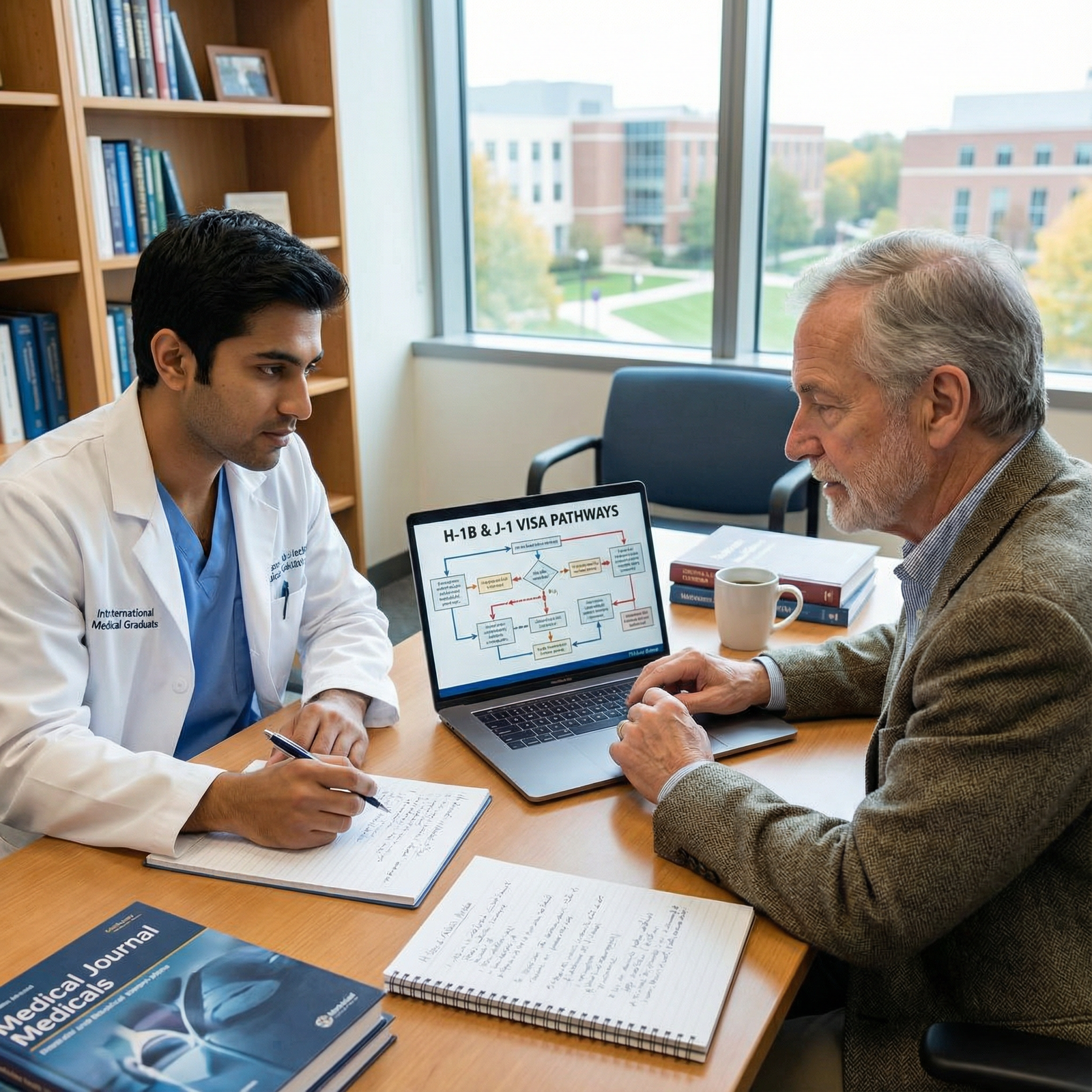
Understanding the Visa Landscape for DC/MD/VA Residency Programs
The DMV region (Washington DC, Maryland, and Virginia) is home to some of the most competitive and diverse training environments in the United States—academic powerhouses like Georgetown, GW, Howard, Johns Hopkins, University of Maryland, VCU, UVA, Inova Fairfax, and multiple community programs. For international medical graduates (IMGs), these DC residency programs and Maryland Virginia residency opportunities are attractive—but they also come with complex visa considerations.
In this region, you will encounter all the major visa pathways for residency: primarily J-1 and H-1B, with some limited use of other statuses (such as F-1 OPT, EAD-based categories, and pending green cards). Navigating these options correctly can determine not only where you match, but also how your career progresses after training.
This guide breaks down visa navigation for residency in DC/MD/VA, with a focus on:
- The main visa types and how they work for IMGs
- J-1 vs H-1B in the context of DMV programs
- State and regional patterns in DC, Maryland, and Virginia
- Practical strategies for choosing programs and planning your career
- Actionable steps and timelines for your residency visa
Core Visa Categories for IMGs in the DMV Region
1. J-1 Visa: The Default Pathway for Most IMGs
The J-1 Exchange Visitor Visa (ECFMG-sponsored) is the most common visa for residency and fellowship in the DMV region and nationwide.
Key features:
- Sponsored by ECFMG, not by the individual residency program
- Strictly for graduate medical education (GME) (residency/fellowship)
- Normally valid for the duration of training, up to 7 years total in most cases
- Requires return to home country for 2 years after training (the “two-year home residence requirement”) unless you obtain a waiver
Why DMV programs often favor J-1:
- Administrative burden on the program is lower (ECFMG handles main sponsorship)
- Predictable, well-understood process
- No U.S. Department of Labor prevailing wage or H-1B cap issues
- Faster to process in many cases
In DC, Maryland, and Virginia, most university and community programs will sponsor J-1 visas as their primary IMG visa option, and some will offer J-1 only.
Advantages of J-1 for IMGs:
- Widest acceptance: almost all programs in DMV accept J-1
- Simpler for the program: this can increase your chances of being reviewed fairly
- Multiple fellowships: you can often do more than one fellowship (within the 7-year limit)
- Clear, standardized requirements via ECFMG
Disadvantages:
- Two-year home-country physical presence requirement after training unless waived
- More limited ability to moonlight or do side clinical work (varies by institution and ECFMG rules)
- Post-residency job search typically tied to J-1 waiver jobs in underserved/shortage areas or academic roles that sponsor other visas/green cards
- Less flexibility if you want to remain in the DMV area immediately after training, unless you find a local waiver-qualifying job
2. H-1B Visa: The Alternative for Select Candidates and Programs
The H-1B Temporary Worker Visa in a Specialty Occupation is the main alternative to J-1 for residency and fellowship.
Key features:
- Program/employer-sponsored (not ECFMG-sponsored)
- Requires passage of USMLE Step 3 before visa processing (and typically before rank or contract finalization)
- Allows dual intent (you can pursue a green card while on H-1B)
- Initially granted up to 3 years, extendable, with a usual 6-year maximum, though academic settings may have extensions
How H-1B is used in DMV residency programs:
- Many academic centers in DC/MD/VA limit or restrict H-1B sponsorship for core residency programs due to cost, administration, and Step 3 requirements.
- H-1B is somewhat more commonly seen:
- In fellowships (especially subspecialties at major centers like Johns Hopkins, University of Maryland, VCU, UVA, Georgetown)
- For residents who are already on H-1B from prior work or training
- When a candidate brings compelling value (e.g., strong research profile) and the department is willing to support them
Advantages of H-1B for IMGs:
- No two-year home country return requirement
- More flexible pathway to transition to employer-sponsored green card
- Often more flexibility regarding moonlighting (subject to institutional policies and visa compliance)
- Can sometimes continue training or work in the same region (including DMV) without needing a J-1 waiver job
Disadvantages:
- Fewer DC residency programs and Maryland Virginia residency programs are willing to sponsor H-1B for residency
- Costly and administratively complex for the institution (attorneys, filing fees, compliance)
- Requires USMLE Step 3 early, often before ranking or offer
- Subject to H-1B rules, including prevailing wage and, in some cases, the federal H-1B cap (though many academic/affiliated hospitals are cap-exempt)
3. Other Statuses and Less Common Pathways
Beyond J-1 and H-1B, several other statuses might apply in specific cases. These are less about “residency visa options” you can choose from freely and more about leveraging the immigration status you already hold.
Common examples in the DMV region:
F-1 with OPT (Optional Practical Training)
- Rare for core residency; most programs will shift you to J-1 or H-1B.
- More relevant if you completed an advanced degree (MPH, MS, PhD) in the U.S. and are in a transitional situation.
Pending green card / Adjustment of Status (AOS)
- Some applicants are derivative beneficiaries through family or employment.
- Programs may employ you under an EAD (Employment Authorization Document), especially large academic institutions.
Other work-authorized categories (E-2, L-2, H-4 EAD, TPS/EAD, DACA):
- If you already have work authorization, some programs will hire you under that category rather than initiating new visa sponsorship. Policies vary by institution and HR/legal counsel.
Practical implication:
For most IMGs outside the U.S. or on non-work visas, the practical options boil down to J-1 vs H-1B. The other categories mainly apply if you or your family already secured a different immigration status.

J-1 vs H-1B: Strategic Considerations for DC/MD/VA
1. Program Preferences in the DMV Region
While every institution is different, several trends are common across DC, Maryland, and Virginia.
District of Columbia (DC):
- Large academic programs (e.g., Georgetown, GW, Howard) commonly sponsor J-1 visas for IMGs.
- H-1B may be possible but limited, often more common in fellowships than in core residencies.
- Some DC residency programs explicitly state “J-1 only” or “J-1 and U.S. citizens/green card holders only.”
Maryland:
- powerhouse academic centers like Johns Hopkins and University of Maryland attract many IMGs.
- Policies vary by department; some will sponsor H-1B in select cases (especially in fellowships or for very strong applicants with Step 3).
- Many community programs in Maryland rely primarily on J-1 sponsorship for IMGs.
Virginia:
- Major centers like VCU, UVA, Inova Fairfax, Carilion, Sentara and others host a range of residency programs.
- H-1B sponsorship may be slightly more common than in DC (especially at large health systems), but J-1 remains the dominant pathway.
- Community-based programs may have more rigid “J-1 only” policies because of resource constraints.
For your application strategy, always check each program’s official website and FREIDA listing for residency visa information, and clarify during interviews or via email when needed.
2. Timeline and Requirements: J-1 vs H-1B
J-1 Timeline Highlights:
- No Step 3 requirement
- Must pass Step 1 and Step 2 CK and be ECFMG certified
- Once you match, you’ll work with your program and ECFMG to submit J-1 sponsorship documents (Form DS-2019 issuance)
- Visa interview at the U.S. embassy/consulate in your country (if you’re abroad)
H-1B Timeline Highlights:
- Must pass USMLE Step 3 before H-1B petition filing (and often earlier, depending on program policies)
- Employer (residency program) must submit:
- Labor Condition Application (LCA) to Department of Labor
- H-1B petition (Form I-129 package) to USCIS
- Premium processing may be used to speed up approval, but costs more and still requires institutional agreement
- If outside the U.S., you’ll need to attend a visa interview once the H-1B is approved
Actionable advice:
- If you are strongly interested in H-1B, aim to:
- Complete Step 3 by early fall of the application cycle (before interviews)
- Explicitly mention your Step 3 status in your ERAS application/CV and personal statement
- Target programs in the DMV that explicitly state they consider or sponsor H-1B
3. Post-Residency Implications in the DMV
On a J-1 Visa:
You will normally need to either:
- Complete the 2-year home-country requirement,
or - Obtain a J-1 waiver that allows you to remain and work in the U.S.
Common waiver routes relevant to DC/MD/VA:
- Conrad 30 programs in Maryland and Virginia (note: DC is not a state and does not run a Conrad 30, but federal programs can play a role)
- Appalachian Regional Commission (ARC) or Delta Regional Authority (DRA) waivers (more relevant in parts of Virginia or nearby states)
- VA (Veterans Affairs) facilities, federal agencies, or academic medical centers with eligible positions in shortage areas
For many IMGs who train in the DMV, this means:
- Doing residency/fellowship in DC/MD/VA on J-1, then
- Moving to a waiver job—sometimes outside the DMV, though occasionally within Maryland or Virginia in underserved regions—before potentially returning to the DMV later in their career.
On an H-1B Visa:
You have more flexibility to:
- Transition directly into an attending job in the DMV (if you find an H-1B-sponsoring employer)
- Start employment-based green card processing during or soon after residency/fellowship
- Avoid the mandatory two-year home return or waiver constraints
However:
- The local job market in DC/MD/VA is competitive. Even on H-1B, you must secure an employer willing to sponsor your visa and potentially your green card.
- Academic centers and large health systems in this region often have established H-1B/green card processes, but positions are highly competitive.

Regional Nuances: DC, Maryland, and Virginia Compared
1. District of Columbia (DC)
Key characteristics:
- Predominantly academic and tertiary-care environments
- High proportion of J-1 positions for IMGs
- Limited geographic area, few “rural or underserved” regions directly within DC for J-1 waivers
- Many institutions are “cap-exempt” for H-1B (universities or university-affiliated hospitals), which is a positive for H-1B if they are willing to sponsor
What this means for you:
- For core residency, expect J-1 to be the main pathway
- If you secure an H-1B for a DC program, you will likely be in a strong academic environment—but you may still need to leave DC after training if you require a waiver or green card sponsorship elsewhere
- Long-term practice in DC after a J-1 pathway often involves:
- Completing a J-1 waiver job in Maryland/Virginia or another state
- Later returning to DC on H-1B or green card once the waiver obligation is met
2. Maryland
Key characteristics:
- Hosts globally recognized institutions like Johns Hopkins and the University of Maryland
- Significant urban, suburban, and rural areas; this is crucial for J-1 waiver opportunities
- Maryland has a Conrad 30 J-1 Waiver Program, often utilized by IMGs completing training in the region
Residency visa implications:
- Many Baltimore-area and suburban DC–adjacent hospitals welcome J-1 IMGs
- H-1B may be available in certain academic departments—especially for highly competitive candidates with Step 3
- For J-1 holders finishing residency/fellowship in Maryland:
- You may find waiver-eligible positions within the state, sometimes in smaller cities or rural communities
- This can be a pathway to remain relatively close to the DMV region while fulfilling your J-1 obligation
3. Virginia
Key characteristics:
- Large geographic area with urban centers (e.g., Northern Virginia, Richmond, Norfolk) and extensive rural/medically underserved regions
- Several academic centers (VCU, UVA), major health systems (Inova, Sentara, Carilion), and many community hospitals
- Virginia runs an active Conrad 30 J-1 Waiver Program, often with considerable need in rural and semi-rural areas
Residency visa implications:
- Virginia may offer the largest range of options within the DMV region for:
- J-1 residency positions
- J-1 waiver jobs after training
- H-1B sponsorship in certain hospitals/health systems
- For IMGs aiming to settle long-term in or near the DMV, a path some follow is:
- Do residency/fellowship in a Virginia program on J-1
- Obtain a Conrad 30 J-1 waiver job in a Virginia underserved community
- Later transition to more urban or academic settings in Virginia or nearby DC/Maryland once immigration obligations are resolved
Practical Strategies for IMGs Targeting DMV Residency Programs
1. Clarify Your Long-Term Goals Early
Ask yourself:
- Do you want to live long-term in the DMV region, or are you flexible nationwide?
- Are you open to doing a J-1 waiver job in a rural or underserved area, possibly outside DC?
- How quickly do you hope to pursue permanent residency (green card)?
If:
- Your top priority is staying in or near DMV long-term and you are open to underserved or non-urban areas → J-1 with planned Conrad 30 waiver in Maryland or Virginia can work.
- You want maximum flexibility and direct path to green card → Pursuing H-1B (residency or fellowship) and early employment-based sponsorship may be ideal, though harder to secure.
2. Choose Programs Based on Realistic Visa Options
When researching DC residency programs and Maryland Virginia residency options:
Filter by visa sponsorship:
- On FREIDA and program websites, check if they accept:
- J-1
- H-1B
- Both
- Some mention: “Can consider H-1B only for exceptional candidates with Step 3 passed.”
- On FREIDA and program websites, check if they accept:
Email programs when unclear:
Sample email language:
Dear [Program Coordinator/Director],
I am an international medical graduate applying to your [specialty] residency program. I am writing to clarify whether your program sponsors:
- J-1 visas, and/or
- H-1B visas (for applicants who have already passed USMLE Step 3).
I want to ensure that my immigration status aligns with your institutional policies before applying.
Sincerely,
[Your Name, AAMC ID]
Be realistic:
- If you do not have Step 3, focus on J-1–accepting programs.
- If you do have Step 3 and strong scores/experiences, selectively target DMV programs that consider H-1B while still applying broadly to J-1 programs.
3. Optimize Your Profile for Your Chosen Visa Route
If prioritizing J-1:
- Ensure ECFMG certification as early as possible.
- Keep documentation ready: diplomas, translations, police certificates, and financial support evidence if required.
- Familiarize yourself with ECFMG J-1 requirements and timelines so you can respond quickly after Match.
If prioritizing H-1B:
- Plan your Step 3 timing strategically:
- Aim to complete Step 3 by August–October of the application year.
- Book testing slots early; they fill fast, particularly for international locations.
- Emphasize in your ERAS and interviews:
- Step 3 passed
- Long-term commitment to the institution or area
- Research, leadership, or niche skills that provide extra value to the program
4. Use the DMV Region to Your Advantage
The DMV region is unique because:
- It has multiple states plus DC with differing J-1 waiver and workforce needs.
- Large academic centers often have cap-exempt H-1B potential.
- There is an ongoing need for physicians in both urban underserved and rural areas of Maryland and Virginia.
Strategies to leverage this:
- Consider residency in DC (J-1), then a J-1 waiver job in rural Virginia or underserved Maryland, then return to urban DMV later.
- Or residency in Virginia (potential J-1 or H-1B), followed by:
- H-1B employment and early green card sponsorship in a health system with established immigration support,
- or a Conrad 30 waiver plus long-term settlement in the region.
Action Plan and Timeline for IMGs Targeting the DMV
18–24 months before Match:
- Clarify your preferred residency visa path: J-1 vs H-1B
- Start/finish USMLE Steps 1, 2 CK; plan for Step 3 if H-1B is a priority
- Research DC, Maryland, and Virginia programs and make a list of:
- J-1–friendly institutions
- H-1B–friendly institutions (especially those that explicitly state it)
12–15 months before Match:
- Take Step 3 (if aiming for H-1B)
- Obtain ECFMG certification as early as possible
- Draft your personal statement and CV highlighting any ties to the DMV region (family, schooling, prior rotations) if applicable
ERAS Application Season:
- Clearly indicate exam status and visa needs in ERAS.
- During interviews, when appropriate, ask:
- “What visa categories do you typically sponsor for IMGs?”
- “Have you sponsored H-1B visas for residents or fellows in recent years?”
Post-Match (Spring to Summer before residency starts):
For J-1:
- Work with the GME office and ECFMG to assemble and submit documents quickly
- Monitor DS-2019 issuance and schedule your visa interview as soon as possible
For H-1B:
- Coordinate closely with your GME office and their immigration/legal team
- Provide required documents early (licenses, diplomas, Step 3 proof)
- Ask whether premium processing will be used and what timelines are expected
FAQs: Visa Navigation for Residency in the DMV Region (DC/MD/VA)
1. Do most DC/MD/VA residency programs prefer J-1 or H-1B visas?
Most DC residency programs and many in Maryland and Virginia primarily sponsor J-1 visas for IMGs, as J-1 is simpler and standardized through ECFMG. H-1B sponsorship is less common for core residency but may be available in select programs and is more frequently used for fellowships or applicants who already hold H-1B.
2. Can I get an H-1B visa for residency in the DMV region without Step 3?
No. For an H-1B residency visa, USMLE Step 3 is mandatory before the H-1B petition can be filed and is usually required even before ranking or issuing a contract. If you have not passed Step 3, J-1 is the realistic primary option in DC/MD/VA.
3. If I do residency on a J-1 visa in DC, can I stay in the DMV after training?
Yes, but with conditions. After J-1 training, you must either fulfill the two-year home-country requirement or obtain a J-1 waiver. In practice, IMGs often complete J-1 waiver jobs in Maryland or Virginia (via Conrad 30 or other waiver mechanisms), sometimes in underserved areas. After fulfilling the waiver and, often, obtaining a green card or new H-1B, many physicians later move back to DC or larger urban centers in the region.
4. How should I decide between J-1 vs H-1B for residency in DC/MD/VA?
Consider:
- Program availability: More programs offer J-1 than H-1B.
- Your exam status: If you don’t have Step 3, H-1B is generally not an option.
- Long-term plans: If you want maximal flexibility and an earlier green card path, H-1B is attractive but harder to secure. If you are open to a J-1 waiver job in Maryland/Virginia or elsewhere, J-1 is practical and widely available.
Whenever possible, discuss your situation with an immigration lawyer familiar with physician visas and the DMV region, and verify each program’s current policy directly, as institutional rules can change from year to year.
By understanding the IMG visa options, the J-1 vs H-1B trade-offs, and the unique opportunities within DC, Maryland, and Virginia, you can design a realistic and strategic path through residency and beyond in the DMV region.