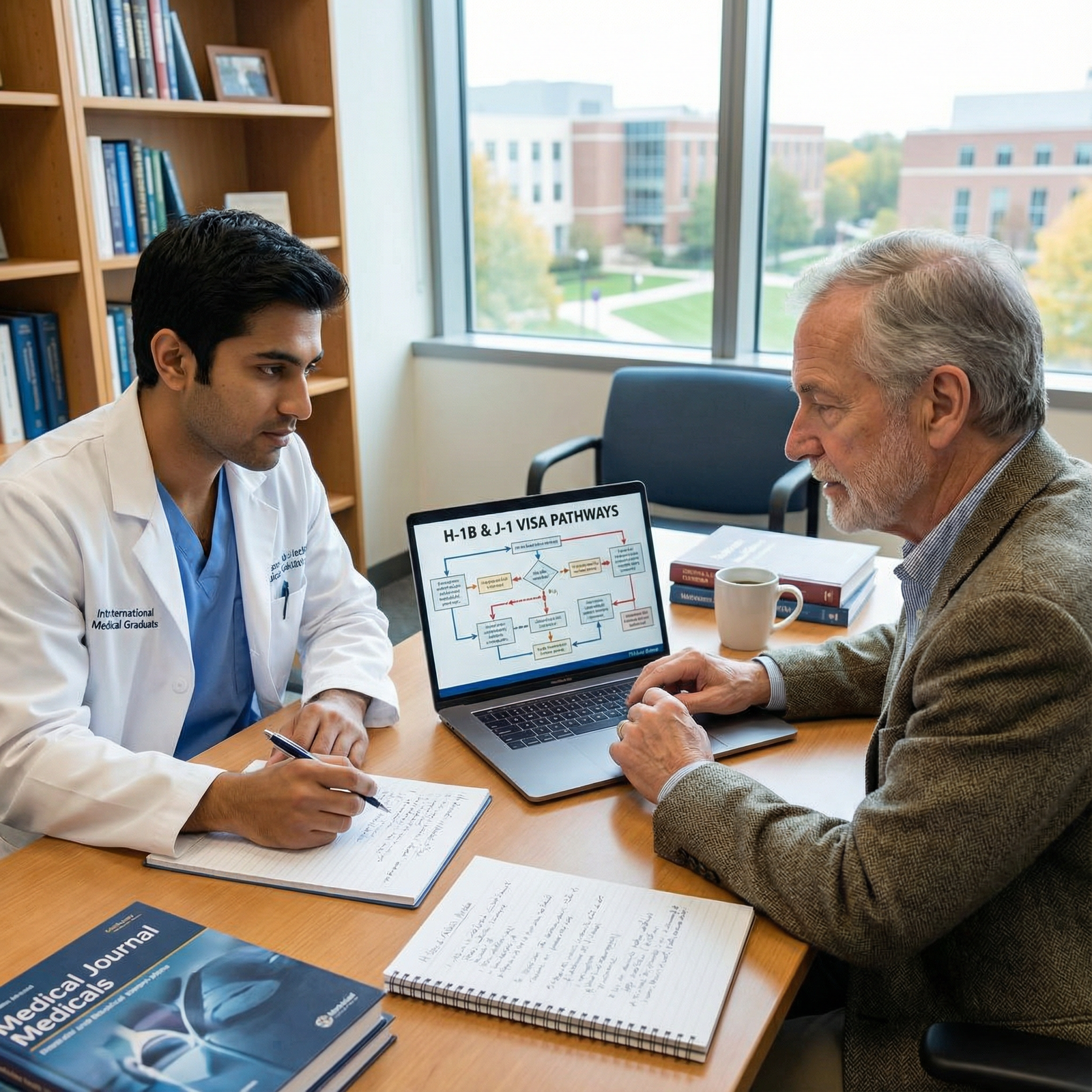
Dallas–Fort Worth (DFW) is one of the fastest‑growing hubs for graduate medical education in the United States. With large academic centers, community hospitals, and a rapidly expanding population, the region offers strong clinical training and a relatively IMG‑friendly environment. For international medical graduates, though, a major part of successfully entering Dallas residency programs is understanding visa navigation for residency—especially the practical implications of J‑1 vs H‑1B, institutional policies, and long‑term career planning.
This guide is designed specifically for IMGs aiming to match into Dallas–Fort Worth residency programs, with a focus on visa strategy, timelines, and common pitfalls to avoid.
Understanding the U.S. Visa Landscape for IMGs in DFW
Before comparing individual visa types, it helps to understand how U.S. immigration and graduate medical education intersect.
The Three Main Residency Visa Pathways
When U.S. hospitals sponsor international residents, they typically use one of three main visa categories:
- J‑1 Exchange Visitor (ECFMG-sponsored)
- H‑1B Temporary Worker (employer-sponsored)
- U.S. permanent resident or other non‑immigrant categories (less common as “training visas”)
For DFW medical training, the first two—J‑1 and H‑1B—are by far the most common. Each Dallas residency program can set its own visa policy, but it must also comply with federal law and institutional guidelines.
Region-Specific Context: Dallas–Fort Worth
DFW includes several major residency training institutions and systems, such as:
- Large academic centers (e.g., major university‑affiliated programs)
- County and safety‑net hospitals
- Community teaching hospitals
- VA medical centers
- Children’s hospitals and subspecialty centers
Many of these programs:
- Accept J‑1 visas as the default IMG pathway.
- Limit H‑1B sponsorship due to institutional policy, funding constraints, or administrative burden.
- May vary dramatically in their visa policies from one program to the next, even within the same health system.
If you are an IMG targeting Dallas residency programs, planning your residency visa strategy early—ideally 12–18 months before Match—is crucial.
J‑1 Visa for Residency in Dallas–Fort Worth
The J‑1 Exchange Visitor visa is the most widely used visa for IMGs in U.S. residency and fellowship programs, including in DFW.
Key Features of the J‑1 for Residency
- Sponsor: ECFMG (Educational Commission for Foreign Medical Graduates), not the individual hospital.
- Purpose: Graduate medical education (residency and fellowship training).
- Duration: Typically up to 7 years for training in total (residency + fellowship), with ECFMG approval.
- Dependents: Spouse and children can come on J‑2; spouse may apply for work authorization (EAD).
The 2-Year Home Residency Requirement (INA §212(e))
The most important element of J‑1 is the two‑year home country physical presence requirement. After completing your J‑1 training:
- You must either:
- Return to your home country for a total of 2 years,
or - Receive a waiver of the 2-year rule (e.g., through a Conrad 30 waiver, hardship, persecution, or other approved routes)
- Return to your home country for a total of 2 years,
- You cannot:
- Change directly from J‑1 to H‑1B within the U.S. (in most cases), or
- Apply for permanent residency (green card) until the requirement is satisfied or waived.
For IMGs planning to remain in the U.S. after training, the waiver process becomes a central concern, especially in high‑growth regions like DFW, where underserved areas and physician shortages may create waiver opportunities.
Why DFW Programs Frequently Prefer J‑1
Many Dallas residency programs default to J‑1 for IMGs because:
- ECFMG handles much of the immigration oversight and compliance.
- The process is standardized and familiar to GME offices.
- It avoids the complex numerical caps and employer documentation required for H‑1B.
- It is usually sufficient for residents who are still in training and not yet planning long‑term employment.
In practice, this means:
- In DFW, far more IMGs train on J‑1 than on H‑1B.
- Programs that only sponsor J‑1 are common, especially in primary care, internal medicine, pediatrics, and prelim/transitional year programs.
J‑1 Eligibility Basics for IMGs
To secure J‑1 status via ECFMG for residency in Dallas–Fort Worth, you will need:
- ECFMG certification (including USMLE exams as required).
- An official contract or offer letter from an ACGME‑accredited residency program.
- Proof of financial support (usually your residency contract salary).
- A valid passport from your home country.
- DS‑2019 issued by ECFMG, which you will present at your consular interview.
Advantages and Disadvantages of J‑1 in DFW
Advantages:
- Widely accepted by Dallas–Fort Worth programs.
- Straightforward for residency training; ECFMG manages many steps.
- Typically fewer delays once DS‑2019 is issued.
- J‑2 spouses can often obtain independent work authorization (EAD).
Disadvantages:
- Mandatory 2-year home residency requirement, unless waived.
- Less flexible for transitioning directly to non‑underserved jobs after training.
- Requires careful planning for post‑residency J‑1 waiver jobs (e.g., Conrad 30 or similar programs), which may or may not be in DFW.
- Gives you less negotiating leverage for certain high‑demand jobs compared to H‑1B holders.

H‑1B Visa for Residency in Dallas–Fort Worth
The H‑1B Temporary Worker (Specialty Occupation) visa is the other major pathway. For DFW medical training, H‑1B visas are less common but highly desirable for some IMGs due to their long‑term immigration benefits.
Key Features of the H‑1B for Residency
- Sponsor: The individual residency program/hospital (your employer), not ECFMG.
- Purpose: Work in a specialty occupation—residency and fellowship can qualify.
- Validity: Up to 6 years total, typically issued in increments of up to 3 years.
- Dependents: Spouse and children come on H‑4; spouse generally cannot work unless they qualify under specific separate rules (e.g., H‑4 EAD in limited cases).
Institutional Constraints in DFW
Not all Dallas residency programs sponsor H‑1B visas. Common institutional policies:
- Some programs do not sponsor H‑1B at all, accepting only J‑1.
- Others limit H‑1B to:
- Certain specialties (e.g., neurology, anesthesia, radiology) but not prelim year positions.
- Candidates who have already passed USMLE Step 3 at the time of ranking.
- A few institutions in DFW—often large academic centers—may have a structured process for H‑1B sponsorship but cap the number of positions.
You should verify the visa policy for each program individually on their website and, if unclear, by emailing the program coordinator early in the season.
H‑1B Eligibility for Residency Positions
To be competitive for H‑1B sponsorship in Dallas–Fort Worth:
- USMLE Step 3 is typically required before a petition can be filed.
- Many DFW programs expect Step 3 before ranking you for an H‑1B‑eligible spot.
- You must be eligible for state physician licensure (or training license) under Texas rules.
- Your program must be willing and able to absorb:
- USCIS filing fees,
- Attorney costs, and
- Administrative effort.
Advantages and Disadvantages of H‑1B in DFW
Advantages:
- No 2-year home residency requirement.
- More straightforward transition to:
- Permanent employment after residency in Texas or elsewhere.
- Green card pathways (e.g., EB‑2 or EB‑3) via employer sponsorship.
- Often perceived as giving more flexibility than J‑1, especially if you plan to remain in urban DFW rather than an underserved rural area.
Disadvantages:
- Fewer DFW medical training programs offer H‑1B sponsorship.
- Higher administrative and financial burden for the employer.
- Must secure Step 3 early, which is challenging for many IMGs.
- H‑4 spouses may have limited work options compared to J‑2 spouses.
Special Note: H‑1B Cap and Cap-Exempt Status
Academic medical centers and some teaching hospitals are cap-exempt for H‑1B, which means:
- They are not subject to the annual national H‑1B lottery cap.
- They can file H‑1B petitions year‑round.
Many major Dallas residency programs fall into this cap‑exempt category, which is a major advantage if they choose to sponsor H‑1B. This also allows some physicians to move between cap‑exempt and cap‑subject positions later, with strategic planning.
J‑1 vs H‑1B: Choosing the Right Path for Dallas–Fort Worth
The decision between J‑1 vs H‑1B for residency is not purely individual; it is constrained by what programs in DFW will actually sponsor. Still, understanding your own priorities helps you target programs and exams strategically.
Strategic Considerations
Long-Term Career Goals
If you plan to:
- Remain in the U.S.
- Work in an urban or suburban environment in Dallas–Fort Worth
- Eventually pursue a green card
Then H‑1B offers a more straightforward path, if available.
If you:
- Are open to serving in an underserved or rural area (possibly outside DFW) after training, or
- Are unsure where you want to practice
Then J‑1 + waiver may be perfectly workable.
Timing of Exams (Step 3)
- If you already have Step 3 before applying or early in the season:
- You can actively seek H‑1B‑sponsoring programs in DFW.
- If you do not have Step 3 yet:
- Focusing on J‑1‑friendly programs is more realistic.
- You may still complete Step 3 during residency on J‑1 for later transitions.
- If you already have Step 3 before applying or early in the season:
Family and Dependent Considerations
- Spouse wants or needs to work:
- J‑2 (J‑1 dependent) is often better because:
- J‑2 spouses can typically obtain an EAD.
- J‑2 (J‑1 dependent) is often better because:
- Spouse is fine not working or finds alternate visa/employment options:
- H‑4 may be acceptable.
- Spouse wants or needs to work:
Program Competitiveness
- Highly competitive specialties or prestigious institutions may:
- Reserve H‑1B sponsorship for top candidates.
- Prefer J‑1 for the majority of IMG trainees.
- Some DFW community programs may find J‑1 administratively simpler and therefore restrict H‑1B more strictly.
- Highly competitive specialties or prestigious institutions may:
Example Scenarios for DFW Applicants
Scenario 1: IMG targeting Internal Medicine in DFW, no Step 3 yet
- Most practical path: J‑1 visa
- Strategy:
- Apply widely to J‑1‑friendly internal medicine programs in Dallas–Fort Worth.
- Complete Step 3 during residency years 1–2.
- Near the end of residency, seek a Conrad 30 J‑1 waiver job—Texas has an active Conrad 30 program, though positions can be competitive.
Scenario 2: IMG with strong scores, Step 3 completed, and research interest, targeting academic neurology or radiology
- Options:
- Prioritize H‑1B‑sponsoring programs in the DFW academic medical systems.
- Contact programs early to confirm if they will sponsor H‑1B for your specialty.
- Benefit:
- H‑1B during residency and fellowship allows more flexibility for long‑term employment and green card processing in DFW.
Scenario 3: IMG with spouse needing to work in the U.S., open to leaving DFW later
- J‑1 could be preferable because:
- Spouse can apply for J‑2 work authorization.
- Plan:
- Match into a Dallas residency program on J‑1.
- Later, look for J‑1 waiver opportunities that still align with family needs (possibly rural or underserved areas in Texas or another state).
Practical Steps to Navigate Visa Issues for DFW Residency
To effectively manage IMG visa options when applying to Dallas–Fort Worth residency programs, you should follow a structured approach from pre‑application to post‑Match.
Step 1: Map Out Program Visa Policies Early
Before ERAS opens:
- Make a list of target programs in:
- Dallas, Fort Worth, Arlington, Plano, Irving, and other DFW cities.
- For each program, check:
- Website FAQ or “International Medical Graduates” section.
- Whether they:
- Accept IMGs.
- Offer J‑1 only, J‑1 and H‑1B, or no visa sponsorship.
- If unclear, send a polite email to the program coordinator:
- Mention you are an IMG.
- Ask specifically:
- “Do you sponsor J‑1 for categorical residents?”
- “Do you sponsor H‑1B? If so, do you require USMLE Step 3 at the time of ranking?”
Compile this data in a spreadsheet sorted by visa friendliness.
Step 2: Decide Your Primary Visa Goal
Based on your circumstances:
- If Step 3 is not done:
- Assume your primary route will be J‑1.
- If Step 3 is complete and scores are competitive:
- Explore H‑1B options heavily, particularly in larger academic DFW centers.
Keep in mind: It is completely acceptable to be open to both J‑1 and H‑1B and let individual programs decide, as long as your situation aligns with their requirements.
Step 3: Highlight Visa Readiness in Your Application
In your CV and sometimes in your ERAS application:
- Note your USMLE Step 3 status clearly if completed:
- This signals H‑1B readiness to DFW programs that sponsor it.
- If you already hold a different U.S. visa (e.g., F‑1 with OPT, or another non‑immigrant status), outline:
- Your current status and expiration.
- Whether you are eligible to change to J‑1 or H‑1B.
During interviews, be prepared to answer:
- “What visa will you need for training?”
- “Are you open to J‑1?” or “Would you require H‑1B?”
Your answers should be honest, but also show flexibility, unless you have clear and compelling reasons to avoid one route.
Step 4: Match Day and Post-Match Visa Processing
Once you match into a Dallas residency program:
If on J‑1:
- Your program sends an appointment letter to ECFMG.
- You complete ECFMG/DS‑2019 paperwork and pay the appropriate fees.
- Schedule a U.S. consulate appointment in your home country for the J‑1 stamp (if you’re abroad).
- Plan travel to arrive in DFW before orientation starts.
If on H‑1B:
- Your employer’s HR/GME office coordinates with an immigration attorney.
- You provide required documents (diplomas, ECFMG certificate, Step 3 report, passports).
- The attorney files the H‑1B petition with USCIS.
- If abroad, you attend a consular visa interview after petition approval.
Timing note for DFW:
Most programs aim to have your visa approved and in place well before July 1, but this requires your prompt response to document requests.
Step 5: Plan Ahead for Post-Residency Options
For J‑1 holders in DFW:
- Start discussing J‑1 waiver options in PGY‑2 or early PGY‑3:
- Explore Texas Conrad 30 or equivalent programs in other states.
- Look for employers in underserved areas who regularly sponsor J‑1 waivers.
- Understand that many waiver jobs:
- May not be in Dallas–Fort Worth.
- May require a multi‑year service commitment (commonly 3 years).
For H‑1B holders:
- Begin exploring:
- Fellowship programs (if staying in training).
- Employer‑sponsored green card pathways.
- Some DFW health systems may:
- Transition you from H‑1B residency status to H‑1B attending status.
- Sponsor your EB‑2 or EB‑3 petition while you work.
Common Mistakes IMGs Make with Visa Planning in DFW
Ignoring visa policies until after interviews
By then, it may be too late to adjust your rank list based on residency visa realities.Assuming all Dallas programs sponsor H‑1B if one does
Visa policies can differ even between departments within the same system.Delaying Step 3 if you truly want H‑1B
For competitive H‑1B‑sponsoring programs, Step 3 is nearly essential at ranking time.Not considering spouse and family needs early
Work authorization, schooling, and cost of living in the DFW area matter.Underestimating the impact of the J‑1 2-year rule
Failing to plan for J‑1 waiver jobs can create unnecessary stress near graduation.
FAQs: Visa Navigation for Residency in Dallas–Fort Worth
1. Do most Dallas–Fort Worth residency programs sponsor J‑1 or H‑1B?
Most DFW medical training programs that accept IMGs will sponsor J‑1 visas through ECFMG. A smaller subset also sponsors H‑1B for residency, often limited to certain specialties or candidates with USMLE Step 3 already completed. Always verify on each program’s website or by contacting the coordinator.
2. As an IMG, can I choose between J‑1 and H‑1B for any Dallas residency program I match into?
No. Your options depend on each program’s institutional policy. Some only permit J‑1, others offer both J‑1 and H‑1B, and a few may not sponsor any visas at all. You can express your preference, but the final decision must comply with the program’s policies and legal constraints.
3. Is it possible to switch from J‑1 to H‑1B after starting residency in DFW?
Switching from J‑1 to H‑1B within the U.S. is usually restricted by the 2-year home residency requirement. Most J‑1 physicians must either:
- Complete the 2-year home country requirement, or
- Obtain a J‑1 waiver (e.g., Conrad 30 or other approved categories)
before moving into H‑1B or permanent residency status. This typically occurs after residency, not during.
4. How can I find out which Dallas programs offer IMG visa options that match my needs?
Use a combination of strategies:
- Check program websites under “International Medical Graduates” or “Eligibility.”
- Review NRMP/ERAS program descriptions, where available.
- Email program coordinators with concise questions about J‑1 vs H‑1B policies.
- Network with current or former residents—especially other IMGs—in DFW via alumni groups or social media.
Creating a structured spreadsheet of Dallas residency programs, their visa policies, and your exam status is one of the most effective ways to stay organized and make informed decisions.
By understanding the nuances of J‑1 vs H‑1B, clarifying each Dallas–Fort Worth program’s policies, and aligning your exam timeline and family needs with your choice of visa, you can significantly reduce uncertainty and increase your chances of a successful match and stable long‑term career in the DFW area.