Radiology is one of the most competitive and rewarding specialties in the United States—and international medical graduates (IMGs) are an important part of the diagnostic radiology workforce. But even the strongest applicant can run into trouble if visa planning is neglected or misunderstood.
For IMGs, successful navigation of visa options is just as critical as a strong application or USMLE scores. This guide walks you step by step through visa navigation specifically for diagnostic radiology residency, from early planning through the diagnostic radiology match and beyond.
Understanding the Landscape: Radiology Residency and Visas
Diagnostic radiology sits at the intersection of high technology, anatomy, and clinical decision-making. Because of its competitiveness, radiology residency programs are often selective about the types of visas they sponsor and the institutional policies they follow. Understanding this context will help you plan realistically.
Why visas matter more in radiology than in some other fields
Radiology programs:
- Are often based at large academic centers or well-organized private-academic hybrids
- May have strict institutional policies on J-1 vs H-1B sponsorship
- Sometimes worry about long-term retention, fellowship training, and future employment restrictions related to J-1 waivers
This means that even if you are highly qualified, you must align your residency visa strategy with what programs are actually able and willing to sponsor.
Common visa categories for radiology residency
For graduate medical education (GME), three visa categories are most relevant:
- J-1 Exchange Visitor (ECFMG-sponsored)
- H-1B Temporary Worker (Cap-exempt, employer-sponsored)
- Less commonly: O-1 (extraordinary ability) or other statuses (e.g., green card, EAD under other status)
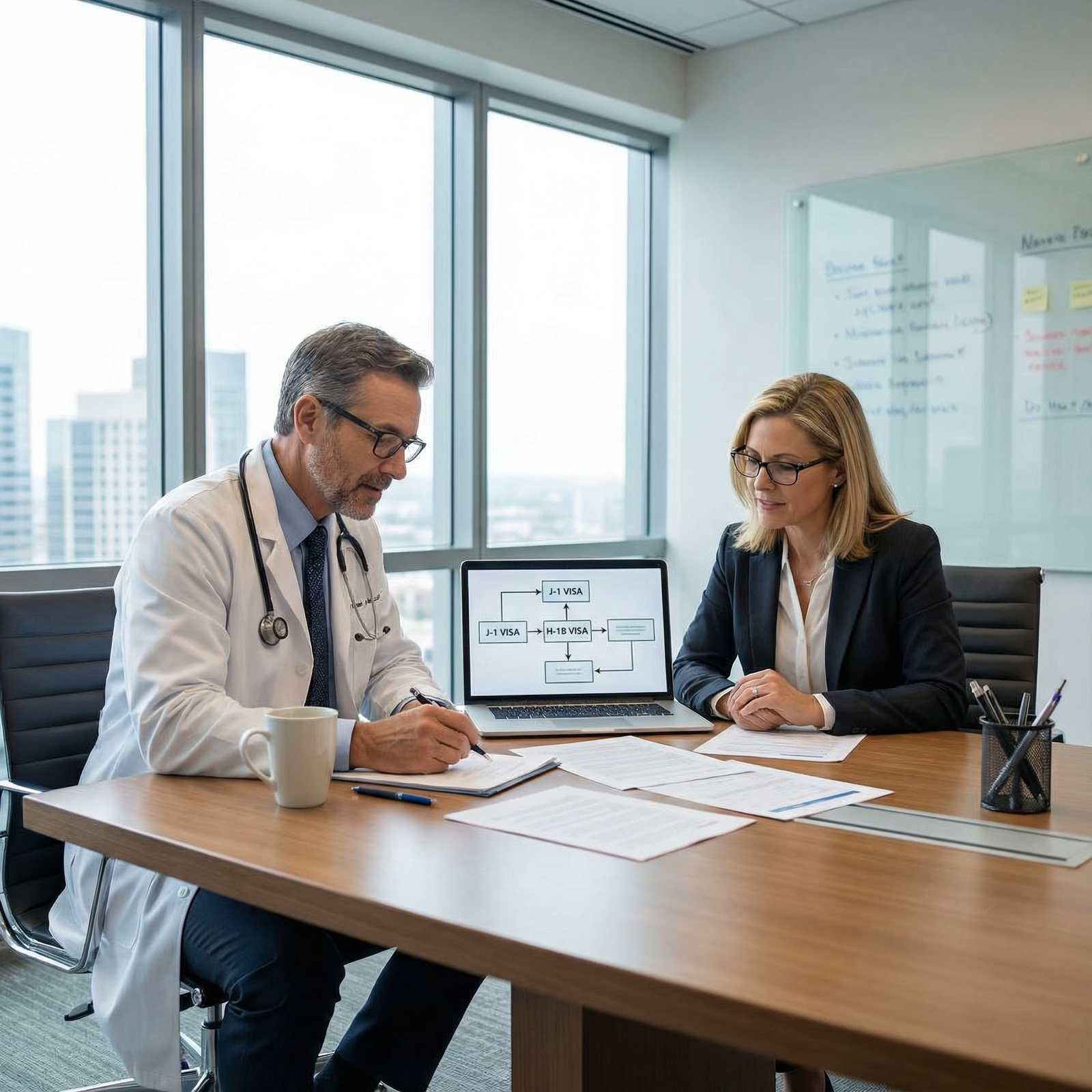
Most IMGs in diagnostic radiology residency will be on either a J-1 visa or an H-1B visa. Understanding the trade-offs is central to your planning.
J-1 vs H-1B for Diagnostic Radiology: Deep Dive and Practical Implications
J-1 (ECFMG-Sponsored) for Radiology Residency
The J-1 Exchange Visitor visa for physicians is coordinated through ECFMG. It is the most common visa type for IMGs in U.S. residency programs.
Key features:
- Purpose: Graduate medical education/training
- Sponsor: ECFMG (not the individual program)
- Maximum duration: Typically up to 7 years total for clinical training (sufficient for diagnostic radiology residency plus many fellowships)
- Two-year home-country physical presence requirement (212(e)): After completion of training, you must usually return to your home country for two years or obtain a J-1 waiver to remain in the U.S. in H-1B or immigrant status.
Pros for radiology residency:
- Widely accepted: Many radiology programs sponsor only J-1.
- Administrative burden on program is lower because ECFMG handles much of the visa process.
- Usually faster and more predictable than H-1B for residency timelines.
- Adequate duration for:
- 4 years of diagnostic radiology residency
- 1 year clinical internship (if applicable)
- 1-year subspecialty fellowship (e.g., neuroradiology, MSK, IR diagnostic year) within the 7-year limit.
Cons and limitations:
- The two-year home-country return requirement can complicate:
- U.S. fellowship training after residency
- Long-term U.S. employment plans
- Transition to permanent residency without a waiver
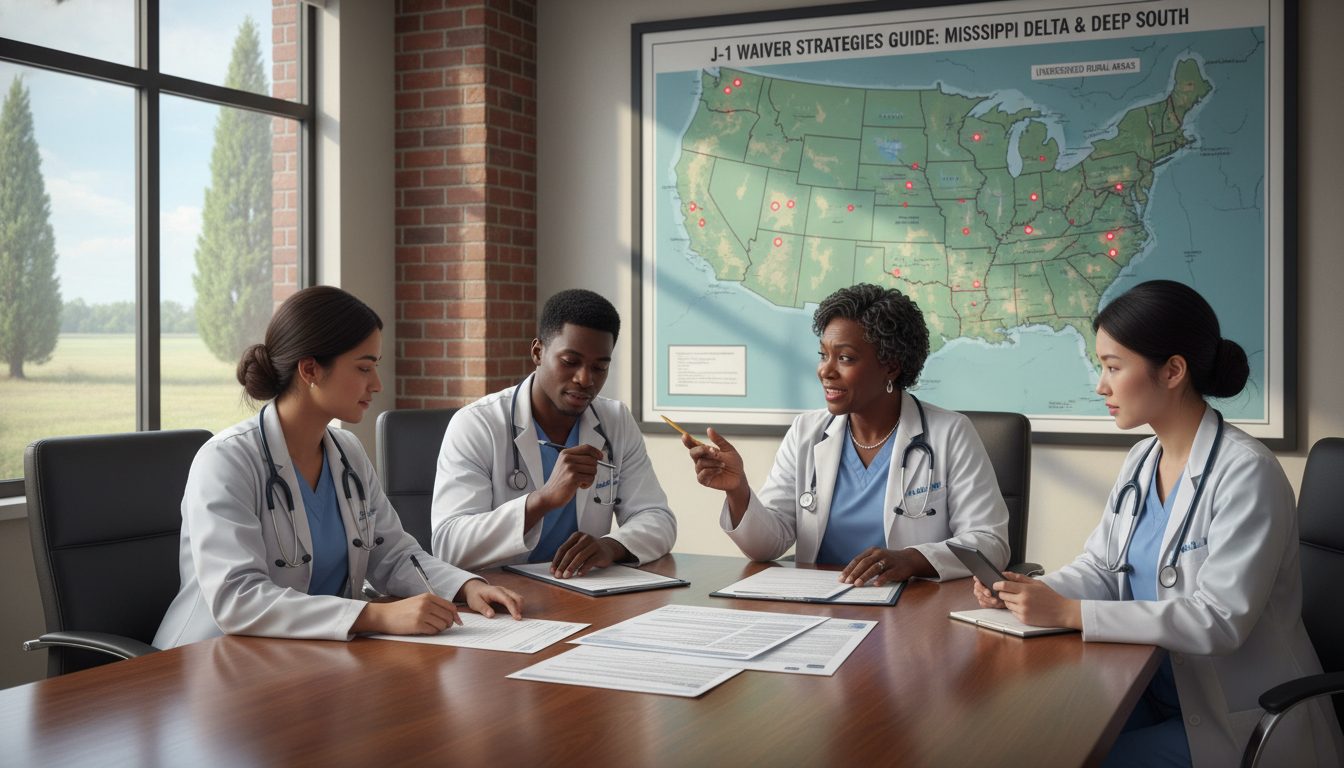
- Waiver options often tied to underserved or rural practice (e.g., Conrad 30), which may not match typical radiology practice preferences.
- Moonlighting may be restricted depending on ECFMG and program policies.
H-1B for Diagnostic Radiology Residency
The H-1B is a dual-intent temporary worker visa. In GME, it is typically cap-exempt when filed by a teaching hospital or affiliated nonprofit institution.
Key features:
- Sponsor: The residency program/hospital directly (not ECFMG)
- Dual-intent: You may pursue permanent residency while on H-1B.
- Maximum duration: 6 years total in H-1B status (can be extended in some green card-related situations).
Pros for radiology residency:
- No two-year home-country return requirement.
- Easier transition to:
- U.S.-based fellowships (if they also sponsor H-1B and you have time left)
- Long-term employment in the U.S.
- Applying for permanent residency (green card).
- Perceived by some employers as simpler for long-term hiring compared to J-1 waiver paths.
Cons and challenges:
- Not all radiology programs sponsor H-1B due to:
- Higher cost (legal fees, filing fees)
- More administrative complexity
- Institutional policy restrictions
- Strict eligibility criteria:
- USMLE Step 3 often required at time of H-1B petition filing (timing is critical).
- Some states require Step 3 for an independent license or certain training licenses; policies vary.
- Duration limitations:
- 1-year internship + 4-year diagnostic radiology residency + potential fellowship(s) can approach or exceed the 6-year cap.
- Time spent in H-1B before residency (e.g., research or another U.S. job) counts toward the 6-year maximum.
When is J-1 the “default” and when is H-1B realistic?
J-1 is usually the default if:
- You are applying broadly and want to maximize your chances in the diagnostic radiology match.
- You do not have Step 3 completed early.
- You are not yet sure about long-term U.S. plans.
- Most of your target programs explicitly say “J-1 only” or “J-1 preferred”.
H-1B is more realistic if:
- You have USMLE Step 3 completed before rank list deadlines (ideally before interview season).
- Your target programs or preferred institutions are known to sponsor H-1B for residents.
- You have a clear long-term plan to remain in the U.S. and perhaps pursue a green card.
- You are prepared for smaller pool of programs and potentially a more competitive application process.
Planning Visa Strategy Early in the Diagnostic Radiology Match
Visa navigation should start before you submit ERAS—ideally 12–18 months before your planned match.
Step 1: Clarify your long-term goals
Ask yourself:
- Do I want to practice long-term in the U.S., my home country, or keep both options open?
- Am I willing to work in a rural or underserved area after training to obtain a J-1 waiver (e.g., Conrad 30)?
- Do I plan to pursue one or more radiology fellowships (neuroradiology, IR, pediatric radiology, etc.) in the U.S.?
Examples:
- If you strongly want a long-term career in a major U.S. city, an H-1B strategy may better align with your future (if feasible).
- If you are open to returning home after training or flexible about J-1 waiver service locations, a J-1 may be perfectly acceptable.
Step 2: Map your timing for exams and documentation
Your visa options tie closely to your exam timeline:
For J-1:
- You must hold a valid ECFMG certification by the time your J-1 sponsorship is processed (after Match, before July 1 start).
- Step 3 is not mandatory for J-1 sponsorship.
For H-1B:
- Many programs require USMLE Step 3 passed before they can file the H-1B petition.
- Scheduling Step 3 can be challenging; available dates may be limited.
- You must account for:
- Score reporting time (3–4 weeks)
- Internal institutional processing
- USCIS processing (regular vs premium processing)
Actionable advice:
- If you are aiming for H-1B:
- Plan to take Step 3 no later than early winter of the year before residency start (ideally by December/January of Match year).
- Confirm with programs during interviews whether Step 3 must be passed before ranking, before contract issuance, or before H-1B filing.
Step 3: Build your program list around visa reality
When building your radiology residency application list:
Check each program’s website:
- Look for sections like “Eligibility and Visa Sponsorship”.
- Common phrasings:
- “We sponsor J-1 visas only.”
- “We sponsor J-1 and limited H-1B visas.”
- “We do not sponsor visas” (rare for large academic centers).
Track this information in a spreadsheet:
- Columns: Program, City/State, Visa Type Supported, Notes (e.g., “H-1B only for highly competitive applicants”, “H-1B requires Step 3 by Feb 1”).
Prioritize realistically:
- If you do not have Step 3, treat “H-1B possible” as “J-1 in practice” unless you can meet requirements in time.
- If you have Step 3 early with strong scores and a solid CV, you might target programs known to sponsor H-1B more aggressively.
Application, Interviews, and Ranking: Visa Talk in the Radiology Match
Addressing visa status in ERAS
In your ERAS application:
- Answer visa eligibility questions honestly.
- If you are already in the U.S. on another status (e.g., F-1 with OPT, J-2, H-4, TPS), indicate this accurately.
- In your personal statement or CV, you do not need to emphasize your visa needs, but be prepared to discuss them if asked.
Discussing visa options during interviews
During radiology residency interviews, visa questions are common for IMGs. Programs want clarity so they can plan ahead.
How to approach the conversation:
- Be informed: Know your preferences (J-1 vs H-1B) and constraints (Step 3 timing, current status).
- Be flexible where possible: Express openness if you are comfortable with both J-1 and H-1B.
- Ask targeted questions:
- “Which visa categories does your diagnostic radiology residency program currently sponsor?”
- “If H-1B is possible, what are your requirements for Step 3 timing?”
- “Has your institution sponsored H-1B for radiology residents in recent years?”
Example phrasing:
“I am an IMG currently on an F-1 visa and will have ECFMG certification by the time of residency. I am open to both J-1 and H-1B, though I am planning to take Step 3 by December to keep the H-1B option open. Could you share your program’s usual practice regarding visa sponsorship for diagnostic radiology residents?”
Ranking strategy and visa realities
When making your rank list:
- Respect your true preferences, but don’t ignore visa feasibility.
- If your top-choice program is “J-1 only” and you are willing to accept J-1, rank them as you wish.
- If long-term U.S. residence is critical to you, a lower-ranked program that offers H-1B may, for you personally, be worth ranking higher.
Scenario example:
- Program A: Top academic radiology program, J-1 only, in your dream city
- Program B: Very good radiology program, offers H-1B, strong record of sponsoring green cards
- You plan a long-term U.S. career.
In this case, some applicants might still rank A first for prestige and location, while others will prioritize B because of H-1B and long-term stability. There is no one-size-fits-all answer; align with your long-term goals and risk tolerance.
Post-Match to Residency Start: Turning the Offer into a Visa
Once you match into diagnostic radiology, visa logistics become time-sensitive.
For J-1: Working with ECFMG
If your matched program sponsors J-1:
Confirm with your program coordinator that they will support J-1 sponsorship.
Apply for ECFMG J-1 sponsorship:
- ECFMG will require:
- Form DS-2019 issuance request via your program
- Valid ECFMG certification
- Statement of Need from your home country’s Ministry of Health or equivalent
- Proof of funding (usually your residency contract)
- Other documentation listed on ECFMG’s website
- ECFMG will require:
Timeline:
- Start the process as soon as your program instructs you (often shortly after Match Day).
- Allow time for document collection, ECFMG review, and consular visa appointment.
Visa interview at U.S. embassy/consulate:
- Bring DS-2019, ECFMG documents, contract, and supporting financial and identity documents.
- Be ready to explain:
- The nature of residency as graduate medical education.
- Your plan to return home after training (remember J-1 is not dual-intent).
For H-1B: Institutional and USCIS Steps
If your program offers H-1B:
- Confirm eligibility:
- Step 3 passed (if required)
- State-specific licensing or training permit requirements
- Work with GME office and institutional immigration services:
- They will typically:
- File an LCA (Labor Condition Application) with the Department of Labor.
- Prepare the Form I-129 petition to USCIS.
- Decide on regular or premium processing (premium strongly preferred for tight timelines).
- They will typically:
- Timeline considerations:
- H-1B processing can take weeks to months.
- Delays can affect your ability to start on July 1 if not planned well.
- Consular interview (if outside the U.S.):
- Present H-1B petition approval (I-797 Notice of Approval).
- Show employment contract and supporting documents.
- Be familiar with your job duties and training plan.
Tip: Stay in close communication with your program coordinator. Respond promptly to document requests; delays on your side can easily push your start date.

Beyond Residency: Waivers, Fellowships, and Long-Term Strategy
Diagnostic radiology training typically spans:
- 1 clinical internship year (preliminary or transitional year)
- 4 years of diagnostic radiology residency (PGY-2 to PGY-5)
- Optional 1+ years of fellowship training
Visa navigation does not end on graduation day; planning ahead is especially important in radiology, where sub-specialization and academic careers are common.
J-1: Waivers and post-training options
If you complete radiology residency (and possibly fellowship) on a J-1, you will face the two-year home-country requirement unless you obtain a waiver.
Common J-1 waiver pathways include:
Conrad 30 Program (state-based):
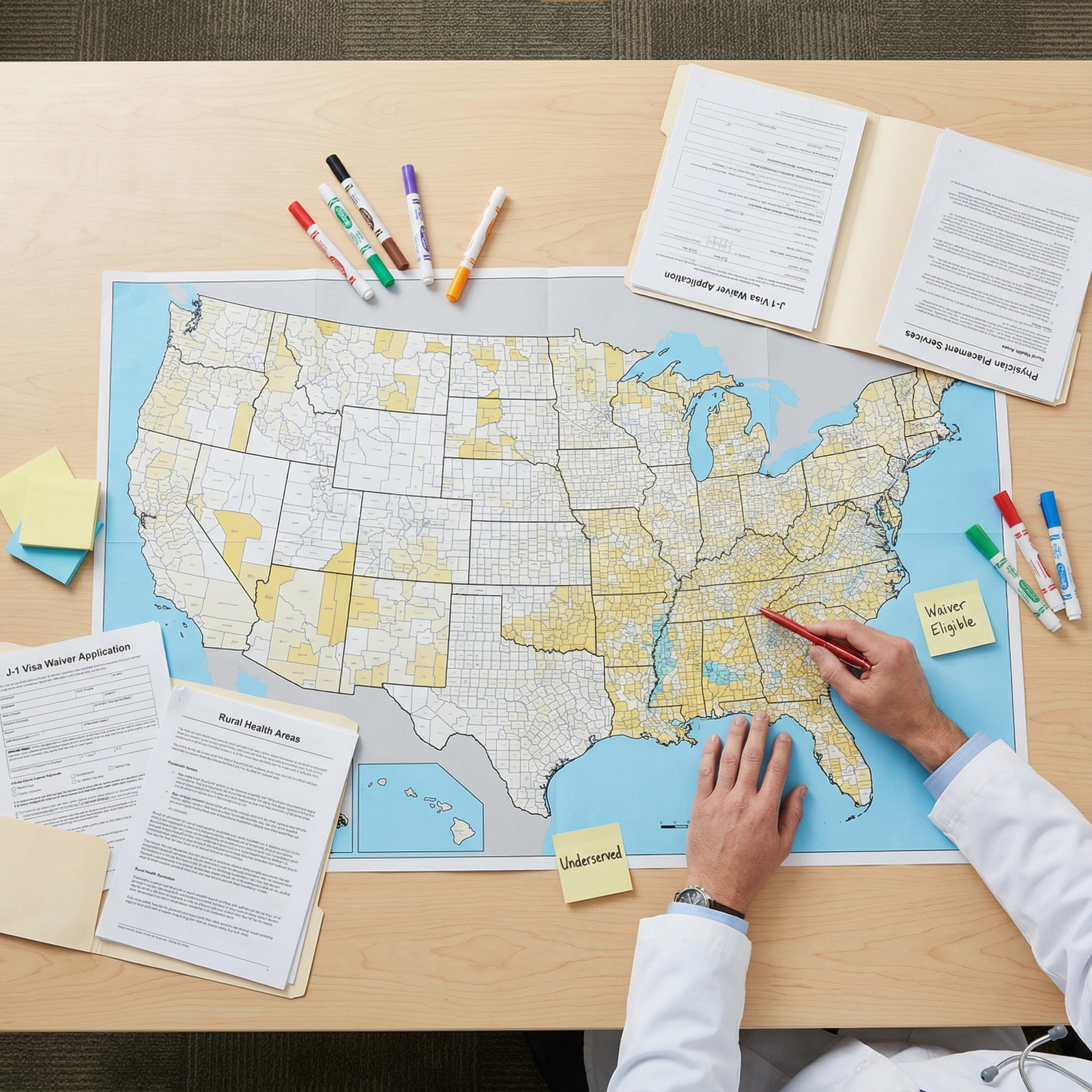
- Many states allocate up to 30 waivers annually for J-1 physicians willing to practice in underserved areas.
- Historically dominated by primary care, but radiology positions do exist in some states, especially where radiologists serve rural hospitals or critical access facilities.
- Often requires a 3-year commitment in an underserved or designated area.
Federal programs:
- VA (Veterans Affairs) facilities
- Certain federal agencies (e.g., Department of Health and Human Services)
- These can also apply to radiologists in specific roles.
Hardship or persecution-based waivers:
- Case-specific, often more complex; require legal guidance.
Impact on radiology careers:
- You may need to accept a job in a rural or underserved area after training, which might be different from a large academic center where you trained.
- For some, this is an acceptable trade-off; for others, it conflicts with career goals in subspecialized or urban practice.
H-1B: Transition to employment and green card
If you are in H-1B status:
- You can transition more straightforwardly from residency/fellowship to an attending job on H-1B (new employer must file a new petition).
- Many radiology groups and academic departments are familiar with H-1B hires.
Green card (permanent residency) strategies:
- Common pathways:
- EB-2 (with PERM labor certification)
- EB-2 NIW (National Interest Waiver) for some academics or those working in underserved areas
- EB-1 for those with extraordinary ability (more relevant in senior academic careers)
Timing considerations:
- The H-1B six-year cap can be extended if you are in the process of obtaining a green card (certain I-140 or PERM milestones).
- Starting the green card process early in your first or second attending job can provide more security.
Radiology fellowship and visa planning
Most diagnostic radiology graduates pursue at least one fellowship. Consider:
- Does the fellowship sponsor your current visa category?
- Will your total time in J-1 or H-1B be sufficient to cover fellowship plus future plans?
- Will accepting a J-1 for fellowship after a J-1 residency reset any waiver requirement? (Generally, the 2-year requirement accrues with all J-1 training, not per program.)
Practical example:
- You completed residency on J-1 (4 years).
- You want a neuroradiology fellowship at a major center (also J-1).
- After fellowship, you plan to seek a J-1 waiver job in an underserved region with a hospital needing neuroradiologists.
In this case, start identifying states and institutions with radiology J-1 waiver positions during fellowship, not after, so you don’t run out of time.
Common Pitfalls and How to Avoid Them
Neglecting Step 3 for H-1B aspirants
- Impact: You may lose H-1B eligibility at programs that otherwise would sponsor it.
- Prevention: Schedule Step 3 early and confirm institutional requirements.
Assuming all radiology programs treat visas the same
- Impact: You may waste applications on programs that do not sponsor your needed visa.
- Prevention: Verify each program’s policy individually and track it.
Ignoring the J-1 home-country requirement until the end of residency
- Impact: Limited time to secure a waiver or plan a return-home phase.
- Prevention: Start exploring J-1 waiver strategies during PGY-4 or fellowship.
Underestimating processing times and administrative steps
- Impact: Delays in visa issuance, late start, or inability to begin training.
- Prevention: Maintain close communication with your program and respond quickly to all requests.
Not seeking professional immigration advice when needed
- Impact: Missteps in status transitions or long-term planning.
- Prevention: For complex situations, consult a U.S. immigration attorney experienced in physician visas.
FAQs: Visa Navigation for Diagnostic Radiology Residency
1. Do most diagnostic radiology programs sponsor J-1 or H-1B?
Most U.S. diagnostic radiology residency programs sponsor J-1 visas because ECFMG manages much of the process and the structure is standardized. A subset—often larger academic or well-resourced institutions—also sponsor H-1B visas, but usually with stricter criteria (e.g., Step 3 completed, limited numbers per year). When building your application list, assume J-1 is more common unless program materials clearly state otherwise.
2. If I start residency on J-1, can I switch to H-1B later?
Sometimes, but not always. Switching from J-1 to H-1B without fulfilling the two-year home residency requirement or obtaining a waiver is generally not allowed if you are subject to 212(e). In practice, most physicians who start on J-1 complete all training on J-1 and then pursue a J-1 waiver job before transitioning to H-1B or permanent residency. There are limited exceptions (e.g., hardship or persecution waivers); these usually require legal counsel.
3. Is H-1B always better than J-1 for radiology residency?
Not necessarily. H-1B has advantages for long-term U.S. immigration and avoids the two-year home-country requirement, but:
- Fewer programs sponsor it.
- Requirements (like Step 3) and costs are higher.
- You are limited by the 6-year cap.
For many applicants, a J-1 is the most realistic and effective route to secure a high-quality radiology residency and fellowship. The “better” visa depends entirely on your goals, program options, and timeline.
4. How should I talk about visa needs without hurting my chances?
Be clear, concise, and informed, but avoid making visa demands. During interviews:
- Confirm what the program normally sponsors.
- Express openness if you can accept both J-1 and H-1B.
- Clarify your Step 3 plans if they are relevant.
Example: “I’m ECFMG-certified and eligible for J-1, and I’m also preparing for Step 3 so I can keep the H-1B option open. I’m flexible and would be glad to follow your institution’s usual visa pathway.”
Navigating visas for a radiology residency is complex, but manageable with early planning, honest self-assessment, and proactive communication. If you align your IMG visa options with your diagnostic radiology match strategy from the beginning, you’ll not only improve your chances of matching, but also set a solid foundation for fellowship and long-term practice in the setting you envision.