
Understanding the Visa Landscape for Internal Medicine Residency
For international medical graduates (IMGs), matching into an internal medicine residency is not just about scores, letters, and clinical experience—it’s also about securing the right visa. Visa planning can affect where you apply, how programs rank you, and ultimately whether you can start residency on time. Treat visa strategy as a core part of your IM match preparation, not an afterthought.
This guide breaks down the most important visa pathways—especially J‑1 and H‑1B—explains how they work specifically for internal medicine residency, and offers step-by-step strategies you can apply throughout the residency application cycle.
We’ll focus on:
- How residency visa sponsorship works in internal medicine
- Key differences between J‑1 vs H‑1B
- How visa type affects fellowship, moonlighting, and long-term career plans
- Practical timelines and checklists for the IM match
- Common mistakes IMGs make when navigating IMG visa options
Core Visa Options for Internal Medicine Residency
1. J‑1 Physician Visa (Educational Commission for Foreign Medical Graduates – ECFMG)
The J‑1 physician visa is the most common visa for IMGs entering internal medicine residency in the U.S.
Who sponsors it?
- The program does not sponsor the visa directly.
- ECFMG is the official J‑1 sponsor for all foreign physicians in accredited graduate medical education (GME) programs.
Basic eligibility for internal medicine residency:
- Valid ECFMG certification (including passing USMLE/COMLEX as required).
- Signed contract or official offer from an ACGME-accredited internal medicine residency program that participates in the IM match.
- Proof of adequate funding (your residency salary usually meets this requirement).
- Proof of home country ties and intent to return after training (as required by consular officers).
- Typically, proof of English language proficiency is via your medical exams and clinical training.
Key features of the J‑1 for IM residency:
- You are allowed to engage in graduate medical education only (residency and fellowship), under ECFMG sponsorship.
- You can change programs or specialties only with ECFMG approval.
- You are usually permitted to moonlight only if:
- It is approved by your GME office and ECFMG.
- It is educationally relevant and does not conflict with duty hours.
- Many programs prohibit moonlighting for J‑1 residents, especially in PGY‑1.
Major downside: the 2‑year home residency requirement (INA 212(e))
Most J‑1 physicians are subject to a two-year home-country physical presence requirement, meaning:
- After finishing training, you must return to your home country (or country of last permanent residence) for a total of 2 years before applying for:
- An H visa (e.g., H‑1B)
- An L visa
- A Green card (permanent residence)
- You can still:
- Travel to the U.S. on a B‑1/B‑2 tourist visa or F‑1 student visa (if approved by a consulate).
- Apply for jobs in your home country or other countries.
- The 2-year requirement can be waived through specific IMG visa options (e.g., Conrad 30 waiver), which we’ll discuss later.
From an internal medicine career perspective, this requirement greatly affects:
- Where you look for your first attending job after residency/fellowship.
- The type of fellowship program and location, if you remain on J‑1 during subspecialty training.
- Your family’s relocation planning and long-term settlement plans.
2. H‑1B Visa for Residency
The H‑1B is a temporary worker visa for “specialty occupations.” Some internal medicine residency programs are willing to sponsor H‑1B visas for IMGs, but many are not.
Key eligibility points for an internal medicine H‑1B:
- You must pass USMLE Step 3 (or COMLEX 3) before your H‑1B petition is filed.
- You must have a valid state medical license or at least an eligibility letter, depending on state requirements.
- The program must be willing and able to sponsor the H‑1B, including paying legal and filing fees.
Core characteristics for the IM match:
- H‑1B is typically employer-specific and position-specific (i.e., linked to your residency program).
- If you change residency programs, a new H‑1B petition is usually required.
- There is generally a 6-year total limit on H‑1B status, but:
- Time in J‑1 status does not count against it.
- Time spent outside the U.S. may be “recaptured.”
- Additional time extensions may be possible if you are in the green card process.
Advantages of H‑1B for internal medicine residents:
- No automatic 2-year home-country requirement.
- More flexibility in transitioning directly to an attending job after residency/fellowship, especially if your employer continues H‑1B sponsorship or files for a green card.
- Sometimes more comfortable for residents who have strong long-term U.S. settlement plans.
Disadvantages and challenges:
- Fewer internal medicine residency programs are willing to sponsor H‑1B due to:
- Extra cost and administrative burden.
- Step 3 and licensing requirements before residency start.
- You may need to limit your IM applications to programs that explicitly state they offer H‑1B sponsorship.
- If you need additional H‑1B years for fellowship plus attending work, timing and planning can become complex.
3. Other Less Common Pathways
A few less common visa paths sometimes intersect with internal medicine residency, but they are not primary routes for most IMGs.
- F‑1 Student Visa with OPT:
- Some IMGs do additional U.S. degrees (MPH, MS, PhD) before residency.
- Optional Practical Training (OPT) is usually not enough to cover the entire internal medicine residency.
- You will almost always need to transition to J‑1 or H‑1B for residency.
- O‑1 Visa (Extraordinary Ability):
- Rare in residency; more common for senior researchers or faculty with substantial academic achievements.
- Requires evidence of national/international recognition in your field.
- Green Card / Permanent Resident Status:
- If you are already a U.S. permanent resident, you usually do not need a specific “residency visa.”
- You apply to residency similarly to U.S. graduates, with no visa constraint, which is a major advantage in the IM match.
J‑1 vs H‑1B for Internal Medicine: Deep Dive Comparison
Understanding J‑1 vs H‑1B in the context of internal medicine residency is critical for planning not only the match but also your long-term career and fellowship path.
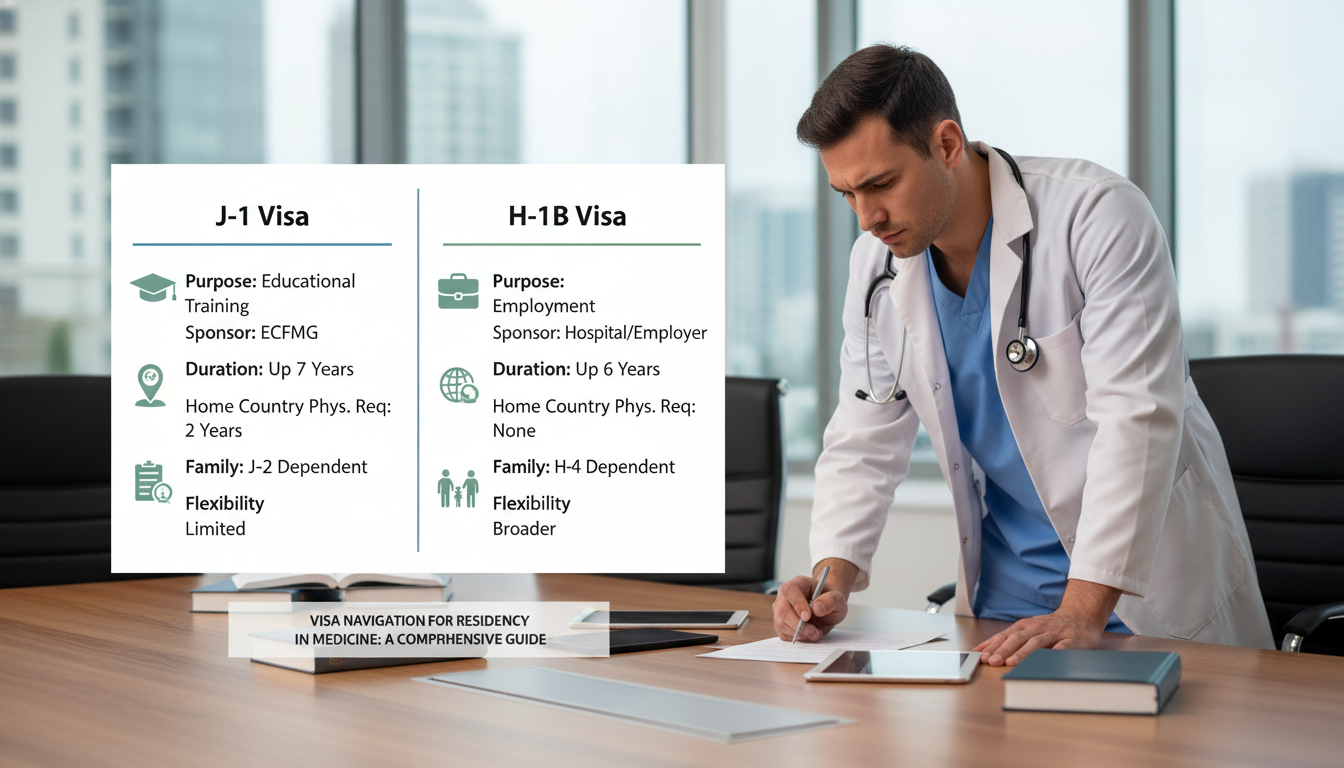
Program Perspective: Which Visa Do Internal Medicine Programs Prefer?
- Most IM programs sponsor J‑1 only.
- Simpler and standardized via ECFMG.
- No requirement to handle Step 3 timing or complex H‑1B paperwork.
- Many academic internal medicine residencies explicitly list “J‑1 only” on their websites.
- A subset of programs sponsor both J‑1 and H‑1B.
- More common in large academic centers or university-based IM programs with institutional immigration support.
- A small number of community-based IM programs might sponsor H‑1B only, but this is less usual.
Actionable advice:
- When researching programs, create a spreadsheet with these columns:
- Program name
- State
- Visa policy (J‑1 only / J‑1 + H‑1B / H‑1B only / No visa)
- Notes from website or email confirmation
- Reach out to program coordinators early (before ERAS submission) to clarify visa policies if not clearly stated online.
Training and Career Planning: Internal Medicine + Fellowship
Internal medicine is heavily subspecialty-focused. Many IM residents pursue fellowships in:
- Cardiology
- Gastroenterology
- Pulmonary/Critical Care
- Hematology/Oncology
- Nephrology
- Infectious Diseases
- Endocrinology, and others
Visa choice affects fellowship options as much as residency.
J‑1 Path: IM Residency + Fellowship
- You can usually obtain J‑1 extensions for ACGME-accredited fellowships after internal medicine residency.
- ECFMG remains your J‑1 sponsor throughout residency and fellowship.
- The 2-year home requirement accrues only once; it does not reset with each extension.
- After completing all training (residency + fellowship), you typically must:
- Return to your home country for two years, or
- Obtain a J‑1 waiver job (such as a Conrad 30 waiver in an underserved area).
This is workable for IMGs who:
- Are open to working in medically underserved areas initially.
- Are comfortable with location limitations early in their attending career.
- Have flexible family and long-term plans.
H‑1B Path: IM Residency + Fellowship
- You may need separate H‑1B sponsorship for fellowship, because:
- Your H‑1B is usually tied to your residency employer.
- Many fellowship programs do not sponsor H‑1B or may prefer J‑1 for fellows.
- Time on H‑1B is cumulative:
- 3 years of IM residency + 3 years of fellowship = 6 years (maximum basic H‑1B allowance).
- You may need careful planning to avoid running out of H‑1B time if fellowship is long.
- On completion, you can:
- Continue on H‑1B with an attending job (same or new employer) if extensions or new petitions are possible.
- Transition to green card processes without dealing with a J‑1 waiver or home residency requirement.
This path fits IMGs who:
- Strongly prefer avoiding the 2-year home requirement.
- Have targeted programs known to sponsor H‑1B for both internal medicine and their desired fellowship.
- Are prepared for more complex immigration strategy and possibly higher legal costs.
Flexibility, Family, and Lifestyle Considerations
Family (spouse and children):
- J‑1 dependents are on J‑2; they may apply for work authorization (EAD) but approvals can be slow.
- H‑1B dependents are on H‑4; historically, they had limited work options, but some H‑4 EAD options exist (usually when the primary is in the green card process).
Location flexibility after training:
- J‑1 waiver jobs are often in rural or underserved urban areas.
- H‑1B or green card holders have broader geographic flexibility for their first attending job.
Lifestyle and moonlighting:
- H‑1B may provide more straightforward moonlighting or additional pay arrangements, depending on institutional policy and visa terms.
- J‑1 moonlighting is often heavily restricted and must be educationally justified.
Step-by-Step Visa Strategy Through the IM Match Timeline

1. 18–24 Months Before Match: Clarify Your Long-Term Goals
Before you decide firmly between J‑1 vs H‑1B, consider:
- Do you intend to settle long-term in the U.S.?
- Are you open to working in underserved areas after training?
- Do you plan for an academic vs purely clinical career?
- Are you planning to pursue a competitive IM fellowship (e.g., cardiology, GI)?
If your goal is long-term U.S. practice but you’re flexible on early-career location, J‑1 may be entirely reasonable. If you prioritize maximum flexibility and minimal restrictions after training, you may strive for H‑1B—but that will significantly constrain your program list.
2. 12–15 Months Before ERAS: Research Programs and Visa Policies
As you compile your internal medicine residency application list:
- Use:
- Program websites
- FREIDA
- NRMP and ACGME resources
- Check for statements like:
- “We sponsor J‑1 visas only.”
- “We sponsor J‑1 and H‑1B visas.”
- “We do not sponsor visas.”
If the website is unclear:
- Email the program coordinator with a short, professional message:
- Introduce yourself briefly.
- State that you are an IMG and ask:
- “Does your program sponsor J‑1 physician visas?”
- “Does your program sponsor H‑1B visas for internal medicine residents?”
Document the responses in your spreadsheet.
3. 9–12 Months Before Match: Align Exam and Licensing with Visa Requirements
If you are targeting H‑1B:
- Plan to pass USMLE Step 3 well before:
- ERAS application, ideally, or
- At the latest, the date programs typically file H‑1B petitions (often early in the calendar year you start residency).
- Check state medical board requirements for a limited or training license:
- Some states require Step 3 for licensure.
- You may need to coordinate Step 3 timing with these rules.
If you are comfortable with J‑1 only:
- Focus on obtaining ECFMG certification and strong IM application metrics (scores, LORs, U.S. clinical experience).
- You do not need Step 3 before starting residency in most states (but it’s still advantageous for fellowship and future H‑1B options).
4. During Interview Season: Discussing Visa with Programs
Programs will often ask about your visa needs and Step 3 status during interviews or on pre-interview questionnaires.
How to handle:
- Be honest and clear about:
- Whether you need sponsorship.
- Whether you prefer J‑1 vs H‑1B (if asked).
- Your Step 3 status and timeline.
- Avoid making visa your only topic; show that your primary interest is in internal medicine training quality, curriculum, mentorship, and career development.
Some programs will indicate:
- “We can sponsor H‑1B, but only if:”
- You have Step 3 passed by a certain date.
- You meet specific state licensing requirements.
Document these conditions in your notes and follow up if needed.
5. Post-Match: From Match Day to Residency Start
Once you match into an internal medicine residency program:
If J‑1:
- Your program will send instructions to start the ECFMG J‑1 sponsorship process, including:
- Uploading your signed contract.
- Providing required personal and financial documents.
- You will receive a DS‑2019 from ECFMG.
- You then:
- Schedule a visa interview at a U.S. consulate.
- Bring all required documents (DS‑2019, ECFMG certification, proof of funding, etc.).
- Aim to complete this process as early as possible to avoid delays in starting residency.
If H‑1B:
- Your program (or its immigration lawyer) will gather:
- Proof of your medical degree, ECFMG certificate.
- Step 3 score report.
- State license or eligibility evidence.
- They file the H‑1B petition with USCIS.
- Once approved, depending on where you are:
- You may change status in the U.S.
- Or attend a consular interview abroad to obtain the H‑1B visa stamp.
Always keep copies of all immigration documents and maintain clear communication with the program’s GME and HR offices.
J‑1 Home Residency Waivers and Early Career Planning for IM
Because internal medicine often leads to long training paths (residency + fellowship), many IMGs on J‑1 eventually face the home residency requirement. Planning early can reduce stress.
Common J‑1 Waiver Routes for Internal Medicine
- Conrad 30 Program (State 30 Waivers)
- Each U.S. state can recommend up to 30 J‑1 waiver positions per year.
- Most positions are for primary care and hospital-based internal medicine in underserved areas.
- Requirements vary by state but typically include:
- A job offer in a Health Professional Shortage Area (HPSA) or Medically Underserved Area/Population (MUA/P).
- A contract to work full-time for 3 years.
- Agreement to start the job within a specified timeline after waiver approval.
- Widely used by IMGs finishing internal medicine residency or fellowship on J‑1.
- Federal Programs (e.g., VA, ARC, HHS)
- Some federal agencies can sponsor J‑1 waivers for physicians in certain specialties and locations (for example, veterans’ hospitals, rural regions).
- These positions are fewer but often highly structured.
- Hardship or Persecution-Based Waivers
- Based on extreme hardship to a U.S. citizen or LPR spouse/child, or risk of persecution if returning home.
- Complex legal standard; requires strong documentation and legal representation.
- Less common, but important for trainees from certain countries or personal circumstances.
Practical Tips for Future J‑1 Waiver Success
- During residency and fellowship:
- Cultivate clinical excellence and strong references—these help you secure a competitive waiver job.
- Gain exposure to underserved/inner-city or rural rotations; they can lead to job offers later.
- Start looking for J‑1 waiver jobs 12–18 months before training completion.
- Understand that your first attending job might be in a small town or underserved urban area, but:
- It can offer high procedural volume, leadership opportunities, and strong early-career autonomy.
- After completing the 3-year waiver obligation, your geographic options expand dramatically.
Common Pitfalls IMGs Face with Residency Visa Navigation
- Waiting too long to think about visas
- Not checking visa policies early can lead to:
- Applying heavily to programs that don’t sponsor your preferred visa.
- Last-minute panic about Step 3 or licensing deadlines.
- Over-restricting program list to H‑1B only
- If you insist on H‑1B exclusively, you may:
- Shrink your application pool dramatically.
- Hurt your chances of matching into internal medicine at all.
- For many IMGs, a J‑1 is preferable to no residency match.
- Ignoring the impact on fellowship
- If you choose H‑1B for IM residency but then target a fellowship that does not sponsor H‑1B, you may be forced onto J‑1 later anyway, reintroducing the 2‑year rule.
- Always check fellowship visa practices for the subspecialties and institutions you aspire to.
- Poor documentation and timing
- Missing deadlines for:
- DS‑2019 issuance.
- Visa interviews.
- H‑1B filing windows.
- Not keeping copies of prior visas, I‑94 records, exam scores, or ECFMG documents.
- Not consulting professionals when needed
- Immigration law changes and individual circumstances vary widely.
- For complex cases (prior U.S. visas, status violations, 212(e) issues), it’s wise to consult an immigration attorney familiar with physicians and GME.
Frequently Asked Questions (FAQ)
1. Is it easier to match into internal medicine residency on J‑1 or H‑1B?
In practice, it is easier to match on J‑1, because:
- Many more internal medicine programs sponsor J‑1 than H‑1B.
- J‑1 has standardized procedures via ECFMG, which programs are very familiar with.
- H‑1B requires Step 3 and more administrative effort, so many IM programs avoid it.
If your primary goal is to maximize your IM match chances, being open to J‑1 generally helps.
2. Do I need USMLE Step 3 to start internal medicine residency?
For most programs:
- No, you don’t need Step 3 to start residency if you are on J‑1.
- Yes, you usually need Step 3 if you want an H‑1B for residency:
- The H‑1B petition often requires proof of passing Step 3.
- Some state licensing boards also require Step 3 for a training license.
Passing Step 3 early can increase your flexibility even if you ultimately choose J‑1, especially for future fellowship or job options.
3. Can I switch from J‑1 to H‑1B during or after internal medicine residency?
During residency:
- Switching from J‑1 to H‑1B is generally difficult because:
- You are often subject to the 2-year home residency requirement (212(e)).
- Unless you obtain a waiver first, you cannot usually change to H‑1B from within the U.S.
- After residency (or fellowship), you might:
- Obtain a J‑1 waiver job and then use H‑1B for that position.
- Or complete your 2-year return home period and later return on H‑1B.
Each case is unique, and legal advice is essential if you are considering this transition.
4. How should I decide between J‑1 vs H‑1B for internal medicine residency?
Consider:
- Match probability:
- J‑1: larger pool of programs; higher odds of matching.
- H‑1B: smaller pool; may limit your IM match options.
- Long-term goals:
- J‑1: requires waiver or home return; common path for those open to underserved work and structured waiver routes.
- H‑1B: more direct path to staying long-term, but more complex administration and planning.
- Fellowship plans:
- Some fellowships prefer or only support J‑1.
- If your dream fellowship does not support H‑1B, a J‑1 from the start may be smoother.
Many IMGs adopt a pragmatic approach: apply widely to J‑1 programs, and also target a select number of H‑1B-sponsoring internal medicine residencies. Then decide based on where you match and the full package of training quality, career prospects, and personal priorities.
Visa navigation is a central part of your journey to an internal medicine residency in the U.S. By understanding the main IMG visa options, planning early around J‑1 vs H‑1B, and integrating visa strategy into your IM match preparation, you can reduce uncertainty and focus more of your energy on what matters most: becoming an excellent internist.