

Navigating visa options during residency applications is one of the most important—and often most confusing—parts of the journey for international medical graduates (IMGs). The visa you hold can affect where you match, what work you are allowed to do, whether your spouse can work, your long‑term immigration options, and your obligations after training.
This guide walks you step‑by‑step through residency visa basics, J‑1 vs H‑1B comparisons, strategy for choosing and planning, and practical tips for making your application as strong and smooth as possible.
Understanding the Big Picture: How Visas Fit Into Residency
Before diving into specific IMG visa options, it helps to understand the overall framework:
1. Residency and immigration are separate (but intertwined) processes
- ERAS / NRMP / SOAP decide where you match.
- U.S. immigration law and hospital policies decide how you’re allowed to train there.
- A program may love your application but still not rank you if:
- They do not sponsor the visa type you need, or
- Your timeline or documentation for that visa is uncertain.
2. The three most common statuses for residents
- J‑1 Exchange Visitor (ECFMG-sponsored)
- The most widely used residency visa for IMGs.
- Sponsored by ECFMG, not by each individual hospital for the core residency purpose.
- H‑1B Temporary Worker (specialty occupation)
- Employment-based; directly sponsored by the residency program.
- Often preferred for those aiming for long‑term U.S. practice and potential green card.
- Permanent resident or U.S. citizen (no visa needed)
- If you already have a green card or citizenship, you don’t need a residency visa, but you may still need to document your work authorization.
Other categories (e.g., F‑1 with OPT, O‑1) occasionally appear but are far less common for standard residency training.
3. Timing: When does visa planning start?
Visa planning should begin before you submit ERAS:
- At least 12–18 months before July 1 start date:
- Understand J‑1 vs H‑1B.
- Decide which you will mainly pursue.
- At least 9–12 months before start date:
- Take/complete USMLE Steps required for H‑1B (including Step 3 in most cases).
- Gather documents needed for ECFMG and consular processing.
Early planning helps you target programs that fit your visa profile and reduces last‑minute obstacles after Match Day.
Core IMG Visa Options for Residency
In the residency context, “IMG visa options” usually narrow down to J‑1 and H‑1B. Additional statuses exist, but these two dominate.
J‑1 Exchange Visitor Physician Visa
The J‑1 for physicians is overseen by ECFMG, which acts as the J‑1 sponsor for clinical training programs.
Key features
- Purpose: Graduate medical education (residency/fellowship).
- Duration: Up to 7 years total for all GME (residency + fellowship), sometimes extendable in limited circumstances.
- Two-year home residency requirement (212(e)):
- Most J‑1 clinical physicians must return to their home country for an aggregate of 2 years after training or obtain a waiver before being eligible for:
- H‑1B status
- Permanent residency (green card)
- This requirement is critical for long‑term planning.
- Most J‑1 clinical physicians must return to their home country for an aggregate of 2 years after training or obtain a waiver before being eligible for:
Eligibility basics
To obtain J‑1 physician sponsorship via ECFMG, you generally need:
- ECFMG certification (including required USMLE steps and primary source verification).
- A valid contract or offer letter from an ACGME-accredited residency/fellowship.
- Sufficient English proficiency (usually evidenced through ECFMG certification process).
- Proof of financial support (usually the residency salary plus any personal funds if required).
- Evidence of home country ties (relevant later during visa interview).
ECFMG issues a Form DS‑2019, which you use to apply for a J‑1 visa stamp at a U.S. consulate (unless you are already in the U.S. in another status and eligible for change of status).
Advantages of J‑1 for residency
- Widely accepted: Many programs are “J‑1 only” because ECFMG takes on some of the administrative burden.
- No USMLE Step 3 requirement for entry.
- Relative predictability: ECFMG and institutions are very familiar with the process; timelines are well‑established.
- Often faster to arrange if you match late or have delays in Step 3.
Disadvantages and limitations
- Two‑year home residency requirement:
- You usually cannot move directly from J‑1 to H‑1B or green card without:
- Completing 2 years in your home country, or
- Obtaining a J‑1 waiver (e.g., Conrad 30, government agency waiver, hardship/persecution waivers).
- You usually cannot move directly from J‑1 to H‑1B or green card without:
- Work limitations:
- You may only work for the program/locations listed on your DS‑2019 and approved by your sponsor.
- Moonlighting is heavily restricted and often not allowed under ECFMG rules.
- Spouse and dependents (J‑2):
- J‑2 spouses can usually apply for work authorization (EAD), but processing time can be several months.
- Dependents’ status is tied to your J‑1 status.
H‑1B Temporary Worker Visa for Residency
The H‑1B is an employment-based visa used by some residency and fellowship programs for IMGs.
Key features
- Purpose: Employment in a specialty occupation (physician in training is recognized as such).
- Duration: Up to 6 years total in most cases (time during residency and later employment counts against this cap), with potential extensions beyond 6 years under certain green card processes.
- Employer-specific: Each hospital/employer must file its own H‑1B petition; the visa is job- and location-specific.
Eligibility basics
For most residency H‑1B sponsorships, you must have:
- USMLE Step 3 passed before the H‑1B filing (many programs require Step 3 score before ranking you).
- A valid state medical license or training license compatible with H‑1B requirements in that state.
- A contract or offer letter for a physician-in-training position.
- Credentials equivalent to a U.S. M.D. or D.O. degree (usually met through ECFMG process).
Notably, many residency H‑1B positions are cap-exempt because they are at non-profit hospitals affiliated with universities. This avoids the annual lottery that affects private-sector employers.
Advantages of H‑1B for residents
- No two-year home residency requirement like J‑1.
- Often more straightforward to:
- Transition into H‑1B attending positions later.
- Begin green card processes during or immediately after residency.
- Spouse status (H‑4):
- H‑4 spouses typically do not have unrestricted work authorization, but:
- They may obtain EAD in certain scenarios (e.g., if the H‑1B holder has an approved I‑140 immigrant petition under specific conditions).
- H‑4 spouses typically do not have unrestricted work authorization, but:
- Potential for limited moonlighting if allowed by state law, hospital policy, and H‑1B petition terms (requires careful legal review).
Disadvantages and limitations
- Step 3 requirement is a major barrier:
- You need to fit Step 3 into your schedule early enough to have results by interview season or rank list deadlines for H‑1B programs.
- Fewer programs sponsor H‑1B:
- Some institutions have strict “J‑1 only” policies due to cost, complexity, or institutional preference.
- Higher administrative and legal costs:
- Programs may be hesitant due to added legal fees and paperwork.
- Time counted against total H‑1B limit:
- Years spent in residency on H‑1B reduce the 6-year total available for later H‑1B employment before you need a green card or special extension.
J‑1 vs H‑1B: Strategic Comparison for IMGs
The “J‑1 vs H‑1B” decision is one of the most frequent and consequential choices for IMG residency applicants.
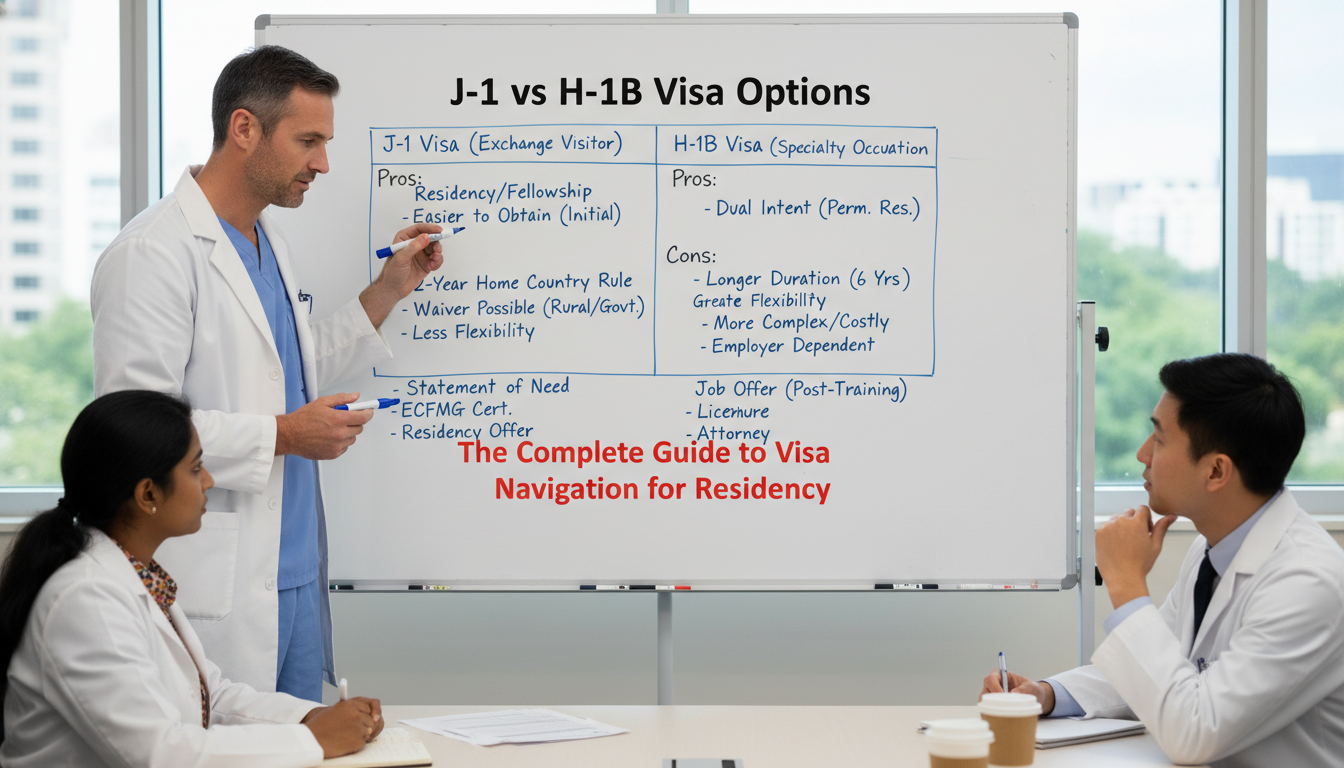
Key decision factors
- Your long-term career plans
- If your goal is long-term practice in the U.S.:
- H‑1B is often preferred because it avoids the two-year home requirement and can transition more smoothly to green card pathways.
- On J‑1, you typically must secure a J‑1 waiver job, often in an underserved area, before transitioning to H‑1B or permanent residence.
- If you are open to returning home or working abroad for a few years:
- J‑1 may be more acceptable and gives you broader residency options.
- Your competitiveness and timeline for Step 3
- If you can realistically complete USMLE Step 3 by early interview season (or at least before rank lists are finalized):
- You can actively pursue H‑1B‑sponsoring programs.
- If Step 3 timing is tight:
- J‑1 is more forgiving because Step 3 is not required to start residency.
- Some strong applicants intentionally focus on J‑1–sponsoring programs to avoid Step 3 pressure during application year.
- Specialty choice
- Some competitive specialties (e.g., dermatology, plastic surgery) may have fewer H‑1B options, and many top academic programs are J‑1 only.
- Primary care and hospital-based fields (IM, FM, pediatrics, psychiatry, neurology) often have more J‑1 waiver opportunities later, which can make the J‑1 route manageable for long‑term U.S. plans.
- Certain subspecialty fellowships may be more or less willing to support H‑1B, depending on institutional policy.
- Family considerations
- J‑2 spouses (on J‑1 derivative status) can typically apply for open work authorization.
- H‑4 spouses generally cannot work unless specific immigration milestones are met.
- School options for children are similar in both statuses, but renewal/transition timelines might affect stability.
Practical comparison table (conceptual)
Residency visa sponsorship availability:
- J‑1: Very common
- H‑1B: Less common, institution-dependent
Step 3 requirement to start residency:
- J‑1: Not required
- H‑1B: Typically required
Home-country 2-year requirement:
- J‑1: Usually yes (unless waived)
- H‑1B: No
Ease of transitioning to U.S. attending job:
- J‑1: Requires waiver or home-country return
- H‑1B: Direct transition possible
Spouse work authorization:
- J‑2: Can usually obtain EAD
- H‑4: Limited; mostly not until certain green card steps
Sample applicant scenarios
Applicant A: Strong internal medicine candidate, early Step 3
- Has passed Step 3 before ERAS.
- Wants to live long‑term in the U.S. and eventually work in a metropolitan academic center.
- Strategy:
- Apply broadly but especially target H‑1B‑friendly IM programs.
- Still rank strong J‑1 programs as a backup (not all H‑1B programs will match).
Applicant B: Pediatrics candidate, no Step 3 yet, late application year
- Good scores but limited time to prepare for Step 3 before interview season.
- Comfortable working in underserved or rural areas after residency.
- Strategy:
- Focus on J‑1 residency visa programs to maximize match chances.
- Later, pursue a Conrad 30 or other J‑1 waiver pediatric position in an underserved region.
Applicant C: Surgical subspecialty aspirant with green card prospects
- Spouse is a U.S. permanent resident and may petition for them.
- Specialty is highly competitive, and many top programs are J‑1 only.
- Strategy:
- Apply broadly without restricting to H‑1B; maximize match probability.
- Accept J‑1 if needed, with the plan to obtain J‑1 waiver later or consider home residence requirement if family situation allows.
How Visa Policies Affect Your Residency Application Strategy
Understanding program policies early helps you build a realistic and efficient application list.
Researching program visa policies
Use multiple sources:
- Program websites:
- Many explicitly state: “We sponsor J‑1 only” or “We sponsor J‑1 and H‑1B” or “We only consider applicants with U.S. citizenship/permanent residency.”
- FREIDA / ACGME / AMA databases:
- Often include fields about residency visa sponsorship, but sometimes outdated.
- Program coordinator emails:
- If unclear, a concise email is appropriate:
- Ask specifically: “Do you sponsor J‑1 visas, H‑1B visas, or both for categorical residents?”
- If unclear, a concise email is appropriate:
Keep a tracking spreadsheet with columns:
- Program name
- Specialty and track
- J‑1 policy
- H‑1B policy and notes
- Step 3 required for ranking? (Y/N)
- Any additional comments (e.g., prefers prior U.S. experience)
Tailoring your program list
Based on your situation:
- If you rely on J‑1:
- Filter out programs that “Do not sponsor visas” or “H‑1B only.”
- Emphasize programs historically known to match IMGs with J‑1.
- If aiming for H‑1B:
- Confirm H‑1B sponsorship before investing energy in applications.
- Prioritize programs in states where licensing/training license requirements align with H‑1B rules.
- If unsure:
- Apply to a mix of J‑1‑friendly and H‑1B‑friendly programs.
- Continue working on Step 3 so that you remain eligible for H‑1B if the opportunity arises.
Communicating about visas in your application
- Personal statement:
- Usually not the place for detailed residency visa discussions.
- An exception is when your long‑term service goals (e.g., working in underserved areas) align with typical J‑1 waiver pathways; you can mention this qualitatively, not technically.
- ERAS Application:
- Accurately state your current citizenship, visa status, and if you will need sponsorship.
- Interviews:
- Be honest and concise:
- “I will require visa sponsorship; I am eligible for J‑1 and, if required, can pursue H‑1B as I have completed Step 3.”
- Or:
- “I will require J‑1 sponsorship; I do not yet have Step 3 but plan to complete it later in residency.”
- Be honest and concise:
Never misrepresent your eligibility. Inconsistencies can damage trust and potentially risk both match and visa.
Practical Steps and Timelines: From Match to Visa in Hand
Once you match, visa logistics move quickly. Having a roadmap helps you stay organized and calm.
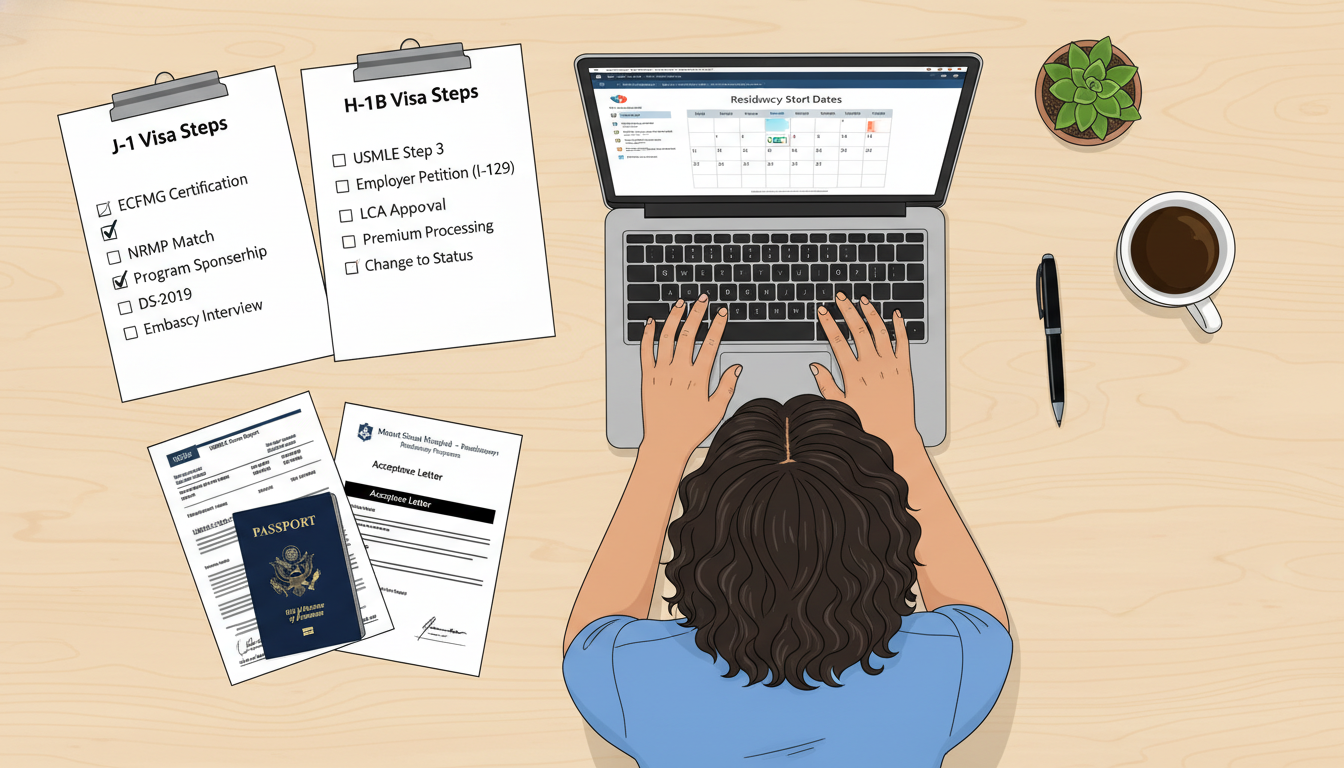
General post-Match timeline (J‑1 route)
- Match Day – Late March
- Program sends you welcome information and instructions for ECFMG J‑1 sponsorship.
- March–April
- Submit online J‑1 sponsorship application to ECFMG via OASIS/EVNet or equivalent portal.
- Upload documents: contract, passport, financial forms, etc.
- April–May
- ECFMG reviews your application, may request additional documents.
- Once approved, ECFMG issues Form DS‑2019.
- May–June
- Schedule U.S. consulate appointment (if outside the U.S.).
- Prepare for visa interview (documents, financial support, ties to home country).
- Receive J‑1 visa stamp if approved.
- Late June–July 1
- Travel to the U.S. and report to program for orientation.
- Maintain compliance with ECFMG and program rules throughout residency.
General post-Match timeline (H‑1B route)
- Immediately after Match Day
- Confirm with program they will sponsor H‑1B and you meet all requirements (especially Step 3 and licensure).
- March–April
- Program’s legal team collects:
- Your Step 3 score report
- Medical school and ECFMG certificates
- Licensing or training permit documentation
- Passport, CV, and other personal data
- Program files Labor Condition Application (LCA) with the Department of Labor.
- Program’s legal team collects:
- April–May
- After LCA approval, program files the H‑1B petition (Form I‑129) with USCIS.
- You may use premium processing (often paid by program or shared cost) to expedite decision.
- May–June
- If petition is approved:
- If outside U.S.: schedule H‑1B visa interview at a U.S. consulate.
- If inside U.S. in valid status: your status may change automatically on the approved start date.
- If petition is approved:
- Late June–July 1
- Enter the U.S. with H‑1B stamp (if applicable) and start residency.
Common pitfalls and how to avoid them
- Delaying document collection:
- Start gathering transcripts, diplomas, translations, and passport renewals months before Match Day.
- Expiring passports:
- Ensure your passport is valid for at least 6–12 months beyond your intended stay.
- Underestimating consular delays:
- In some countries, visa interview backlogs or administrative processing can significantly delay start dates—book early and stay informed.
- Ignoring institutional deadlines:
- Many GME offices set internal deadlines for receiving documents (e.g., by May 1). Missing them can jeopardize your start date.
Long-Term Planning: After Residency and Beyond
Residency is temporary; your visa decisions now shape your future options.
If you train on a J‑1
Most J‑1 physicians must address the two‑year home residency requirement before moving on to long‑term U.S. practice or immigration.
Common strategies:
Conrad 30 Waiver Programs (state-based)
- Each U.S. state can sponsor up to 30 J‑1 waiver positions per year (often primary care and some shortage specialties).
- Typically requires 3 years of full-time service in a designated underserved area on H‑1B.
- After completing the service obligation, you are free to pursue other H‑1B or green card options.
Federal agency waivers
- Agencies like the VA, HHS, or DoD can sponsor waivers for certain positions (e.g., research, public health needs).
- Especially relevant for certain subspecialties or academic roles.
Hardship or persecution waivers
- Based on demonstrating that you or your U.S.-citizen/LPR spouse/child would face exceptional hardship or persecution if you returned.
- More complex and case-specific; usually requires legal counsel.
If none of these are pursued, you may:
- Return to your home country for 2 years cumulative, fulfilling the requirement, then later apply for H‑1B or immigrant visas.
If you train on H‑1B
Your path is usually more direct:
- Continue on H‑1B for fellowship or attending roles (with each employer filing their own petition).
- Start or continue green card processes (e.g., EB‑2 or EB‑3 with labor certification, or EB‑1 in some academic/extraordinary ability pathways).
- Be mindful of the 6-year cap if you do not have an approved I‑140 or certain pending green card steps.
Working with an immigration attorney
While residency programs and ECFMG provide guidance for training visas, your personal long-term immigration strategy (especially green card and waiver planning) is best discussed with a qualified immigration attorney experienced in physician cases.
Consider a consultation if:
- You have complex prior visa history (e.g., multiple J‑1s, prior denials, overstays).
- You’re planning a Conrad 30 waiver or federal agency waiver.
- You want to map out the fastest route from residency to permanent residency given your specialty and personal situation.
FAQs: Residency Visa Navigation for IMGs
1. Can I switch from J‑1 to H‑1B during residency?
In most cases, no, not without first dealing with the two‑year home residency requirement. If you start residency on J‑1, you are generally subject to 212(e). To obtain H‑1B later (for fellowship or attending work), you must either:
- Complete 2 years in your home country, or
- Obtain a J‑1 waiver (e.g., Conrad 30) that removes the requirement.
There are a few narrow exceptions (e.g., if you were incorrectly classified), but they are rare and require legal review.
2. Is it better for my chances of matching to choose J‑1 over H‑1B?
Residency match probability is driven mostly by your overall application strength, but practically:
- Many more programs are willing to sponsor J‑1 only.
- Fewer programs sponsor H‑1B due to cost and complexity.
So, if you insist on H‑1B only, you are limiting the number of programs that can rank you. However, strong applicants may still secure H‑1B positions. A mixed strategy—aiming for H‑1B but remaining open to J‑1—often balances match chances and long‑term goals.
3. Do I need to pass USMLE Step 3 for a J‑1 residency visa?
No. Step 3 is not required to obtain ECFMG J‑1 sponsorship for residency training. Many J‑1 residents take Step 3 during PGY‑1 or PGY‑2. In contrast, most H‑1B‑sponsoring programs require Step 3 before filing the H‑1B petition and may require it even earlier (before ranking).
4. My spouse wants to work during my residency. Which visa is better for us?
From a spouse employment standpoint:
- J‑2 (dependent of J‑1):
- Can usually apply for an EAD (work permit) and work for any employer once approved.
- H‑4 (dependent of H‑1B):
- Generally cannot work, unless specific conditions are met (e.g., you have an approved I‑140 and are waiting for green card processing).
However, you should weigh this against long‑term factors (like the J‑1 two‑year home requirement and waiver options) before making a final decision.
Visa navigation for residency is complex, but with early planning, accurate information, and open communication with programs, you can align your residency visa choice with both your immediate match goals and your long‑term career plans in the U.S.


