Understanding the Landscape: Visas, IMGs, and HBCU-Affiliated Residencies
For a non-US citizen IMG, the dream of training in the United States is inseparable from one core challenge: securing the right residency visa. When your target is HBCU residency programs—such as Meharry residency training programs or other HBCU-affiliated institutions—the process brings unique opportunities and considerations.
Historically Black Colleges and Universities (HBCUs) and their affiliated teaching hospitals play a special role in US medical education and healthcare equity. They often serve diverse, underserved communities and may be particularly welcoming to international physicians committed to health equity and primary care. However, they must still work within federal immigration rules and institutional policies that shape what IMG visa options they can offer.
This guide is designed for the non-US citizen IMG / foreign national medical graduate specifically aiming at HBCU-affiliated residency programs. It will walk you through:
- The main residency visa categories (J-1 vs H-1B and others)
- How visa policies typically work at HBCU programs (with examples like Meharry)
- How to research and choose programs based on visa sponsorship
- Practical timelines, documentation tips, and interview strategies
- Common pitfalls and how to avoid them
Core Visa Pathways for IMGs: J-1 vs H-1B and Beyond
Most non-US citizen IMGs in US residency train under either the J-1 or H-1B visa. Understanding J-1 vs H-1B fully is essential before you target specific HBCU residency programs.
1. The J-1 Physician Visa (ECFMG-Sponsored)
The J-1 Exchange Visitor (physician) visa is the dominant pathway for IMGs entering residency.
Key features
- Sponsor: ECFMG (Educational Commission for Foreign Medical Graduates) is the official J-1 sponsor for physicians in GME.
- Primary use: Residency and fellowship (accredited training programs).
- Duration: Up to 7 years in total for clinical training (with exceptions in special circumstances).
- Requirement: You must be sponsored by ECFMG and accepted into an ACGME-accredited program.
Advantages for a non-US citizen IMG
- Widely available: Many HBCU residency programs sponsor J-1 but not H-1B.
- Lower cost and administrative burden for the institution compared to H-1B, which means more programs are willing to sponsor J-1.
- Straightforward eligibility once you meet ECFMG certification and program acceptance criteria.
Key obligations and restrictions
Two-year home-country physical presence requirement (the “212(e)” rule)
After finishing J-1 clinical training, most IMGs:- Must return to their home country for 2 years, or
- Obtain a J-1 waiver (e.g., Conrad 30, federal or state waiver programs) before changing to certain other US visa statuses (like H-1B) or applying for permanent residence.
Employment restrictions
- You may only work in your approved training program (and sometimes at affiliated sites with written authorization).
- No moonlighting unless explicitly allowed by ECFMG and the program, and any additional clinical work must be pre-approved.
When J-1 is usually the best fit
- You’re open to eventually returning to your home country or are comfortable pursuing a J-1 waiver job in an underserved area after residency.
- The HBCU or Meharry residency program you like only sponsors J-1.
- You don’t yet have a long-term, immediate plan to obtain US permanent residency.
2. The H-1B Visa for Residency
The H-1B is a temporary specialty occupation work visa that can also be used for residency and fellowship.
Key features
- Sponsor: The residency program / employing hospital petitions for H-1B.
- Dual intent: Allows you to have immigrant intent (you can pursue a green card while on H-1B).
- Duration: Typically up to 6 years total, but can be extended for those pursuing permanent residency.
Advantages for a foreign national medical graduate
- No home-country return requirement like J-1’s two-year rule.
- More direct transition from training to other US employment or green card processes.
- Potentially more flexibility in subsequent job choices if you transition to “cap-exempt” or “cap-subject” H-1B positions.
Challenges and requirements
- Higher institutional burden: Legal fees, filing costs, and administrative work are significantly higher for H-1B.
- Program policies differ: Many residency programs—especially those with tight budgets, including some HBCU residency programs—do not sponsor H-1B for residents or only do so in limited circumstances.
- USMLE Step 3 requirement
- Most institutions require that H-1B applicants pass USMLE Step 3 before the visa petition is filed (often before Match rank lists or shortly thereafter, depending on the program).
- Prevailing wage rules
- The hospital must pay a wage that meets or exceeds the Department of Labor’s prevailing wage for that position.
When H-1B may be suitable
- You already passed USMLE Step 3 early.
- You plan a long-term career in the US, aiming for permanent residency.
- The HBCU-affiliated program explicitly offers H-1B sponsorship and has experience handling it.
- You want to avoid the J-1 two-year home-rule and potential waiver complications.
3. Other Less Common Options
Occasionally, non-US citizen IMGs may enter residency on:
- O-1 visa (Extraordinary Ability): Rare, usually for exceptional researchers or physicians with a strong academic portfolio. Requires extensive evidence.
- TN visa (for Canadian and Mexican citizens): Sometimes used for physicians in certain roles but less common specifically for residents.
- EAD (Employment Authorization Document):
- For those with pending asylum, TPS, DACA, or other humanitarian statuses.
- For spouses of certain visa holders or certain pending green card applicants.
These are highly case-specific and should be navigated with an immigration attorney. For most IMGs targeting HBCU residency programs, the realistic pathways remain J-1 or H-1B.
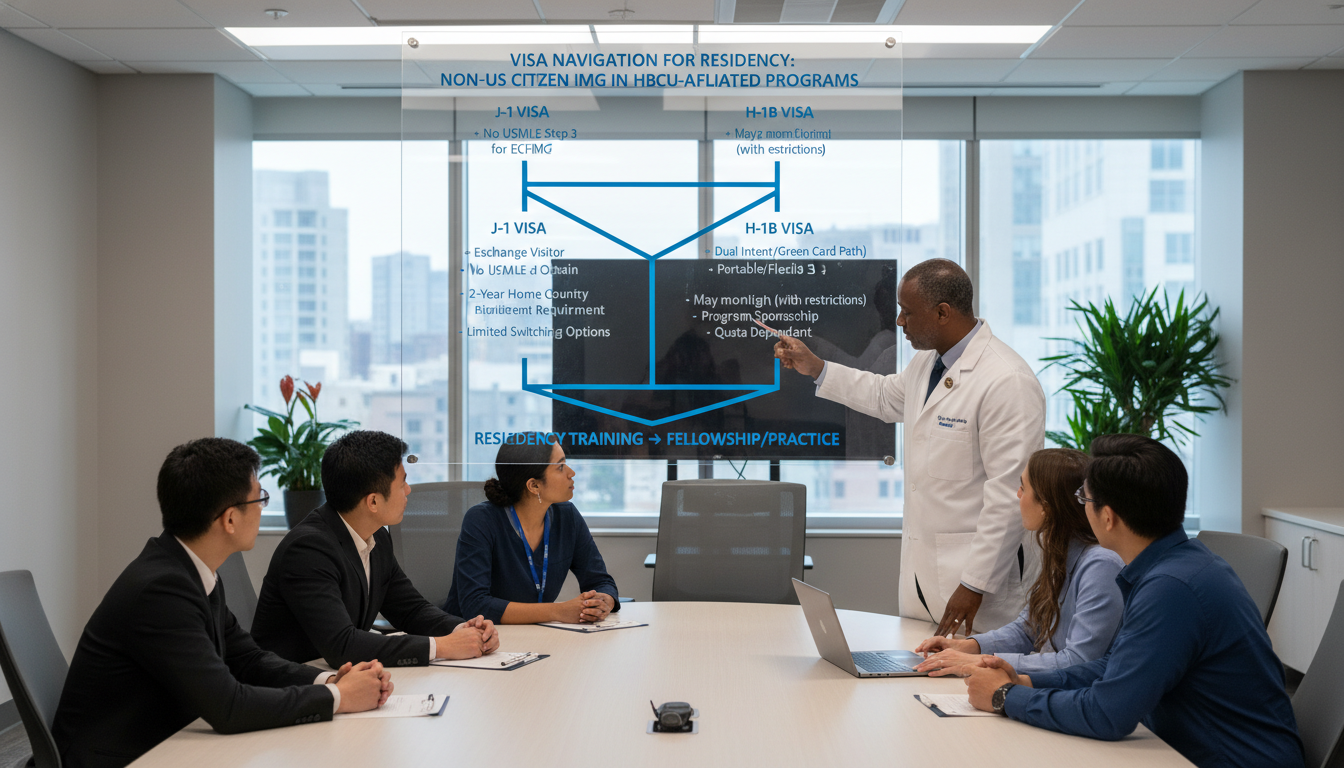
How Visa Sponsorship Works at HBCU-Affiliated Programs
HBCU-affiliated residency programs are diverse in size, funding, and institutional culture. However, some themes are common across the space—whether you’re looking at Meharry residency programs, Howard University Hospital, Morehouse School of Medicine affiliates, or other HBCU residency programs.
1. Why HBCU Programs May Be Particularly IMG-Friendly
Many HBCU institutions:
- Serve medically underserved, low-income, and predominantly minority communities.
- Have a mission-driven focus on health equity, primary care, and service.
- Value diversity of background and experience, including international perspectives.
For a non-US citizen IMG, this often translates into:
- Openness to candidates from a wide range of medical schools and countries.
- Appreciation for applicants who speak multiple languages and understand diverse cultures.
- A mission-aligned fit for those who want to serve under-resourced populations globally and in the US.
However, “IMG-friendly” does not automatically mean “H-1B-friendly.” Visa sponsorship remains constrained by:
- Institutional funding and legal resources
- Graduate medical education (GME) office policies
- Hospital administration risk tolerance for more complex visa types
As a result, many HBCU-affiliated residency programs are primarily J-1 sponsors, with limited or no H-1B sponsorship.
2. Typical Visa Policies in HBCU-Affiliated GME Programs
While policies vary, a typical HBCU residency program might have one of the following structures:
J-1 Only
- Program states: “We sponsor J-1 visas only through ECFMG; H-1B visas are not sponsored.”
- Most common scenario given cost and administrative simplicity.
- Non-US citizen IMGs must be prepared to enter on J-1 if matched.
J-1 Preferred, H-1B Case-by-Case
- Program states: “We sponsor J-1 and may consider H-1B for exceptional candidates who already have USMLE Step 3.”
- H-1B often not guaranteed, even if technically “possible.”
- Selection for H-1B may depend on candidate’s qualifications and timing.
J-1 or H-1B Equally Supported (Less Common at HBCU Sites)
- Larger academic systems or university hospitals might support both J-1 and H-1B more routinely.
- More likely at well-resourced academic centers or where the GME office has a dedicated immigration team.
Programs may differ within the same HBCU system. For example, one department (e.g., Internal Medicine) may occasionally use H-1B, while another (e.g., Pediatrics) uses only J-1.
3. Meharry Residency and Similar Programs: What to Expect
As a foreign national medical graduate targeting Meharry residency or other HBCU sites, you should:
- Expect J-1 sponsorship to be the default option.
- Check the GME office website and each residency’s specific page for explicit visa statements.
- Pay close attention to:
- “We sponsor J-1 only” vs “J-1 and H-1B”
- Requirements for H-1B (USMLE Step 3, previous US training, timing)
Actionable approach
- Make a spreadsheet of target HBCU residency programs:
- Column A: Program name & specialty
- Column B: HBCU or affiliated institution (e.g., Meharry/Howard/Morehouse)
- Column C: IMG friendliness (past match lists, % IMGs)
- Column D: Stated visa policy (J-1 only, J-1 + H-1B, unclear)
- Column E: Notes from emails/calls with program coordinators
- Update this regularly as you receive responses or attend information sessions.
Strategic Planning: Choosing Between J-1 and H-1B for HBCU Programs
You do not always get to “choose” your visa freely, because your residency visa options are tightly linked to what a program is willing to sponsor. However, you can strategically plan based on your goals and the programs you target.
1. Clarify Your Long-Term Career Goals
Ask yourself:
- Do I want to live and work long-term in the US, or am I open to returning home after training?
- Am I committed to serving underserved communities, including rural or inner-city US areas, which often host J-1 waiver jobs?
- Do I anticipate pursuing a green card during or soon after residency?
If your goal is long-term US practice:
- H-1B becomes attractive because:
- No 2-year home requirement.
- Simpler transition to permanent residency.
- However, if your preferred HBCU programs do not sponsor H-1B, you must be pragmatic:
- A J-1 plus a well-planned J-1 waiver job in an underserved area can still ultimately lead to permanent residency.
If you are open to returning home after residency:
- J-1 is often perfectly aligned:
- You train at a mission-driven HBCU program.
- You return with advanced skills to improve care in your home country.
- The 2-year requirement is less of a “burden” and more of a planned step.
2. Assessing Your Competitiveness for H-1B
For H-1B in residency, you should ideally have:
- USMLE Step 1, Step 2 CK, and Step 3 completed with strong scores.
- Solid clinical experience in the US (USCE), e.g., electives, observerships, or externships.
- A profile that makes the added cost and effort worthwhile for the program (research, leadership, unique skills, strong letters).
If you’re a non-US citizen IMG applying to HBCU residency programs and want H-1B:
- Plan to take Step 3 early—ideally before rank lists are due.
- Highlight your long-term commitment to the program’s mission, and how a stable, long-term stay (facilitated by H-1B) benefits the institution and its patient population.
- Remember: H-1B is still not guaranteed even if you meet all criteria.
3. Balancing Visa Strategy with Program Fit
Avoid narrowing your focus solely to visa type. For a fulfilling career and a successful Match, also consider:
- Clinical training quality and case volume
- Fellowship opportunities after residency
- The program’s culture and support for IMGs
- Alignment with your desire to serve underserved communities
For many foreign national medical graduates, an excellent HBCU-based J-1 training experience plus a carefully chosen waiver job can be more beneficial long-term than a poorly supported H-1B residency at a less suitable institution.

Practical Steps and Timeline: From Application to Visa Approval
To navigate residency visas effectively, you must align your USMLE, ECFMG, ERAS, and visa steps. Below is a practical roadmap tailored for non-US citizen IMG applicants to HBCU-affiliated residencies.
1. 18–24 Months Before Residency Start Date
- Complete USMLE Step 1 and Step 2 CK
- Aim for competitive scores, especially if seeking H-1B support.
- Work toward ECFMG certification
- Ensure your medical school credentials are verified.
- Pass OET or any current English proficiency requirement (if applicable when you apply).
- Gain US clinical experience (USCE)
- Target observerships or electives in safety-net or academic hospitals—ideally those connected to HBCU systems if possible.
Visa-focused tasks
- Research IMG visa options thoroughly.
- Start mapping HBCU residency programs that sponsor J-1 or H-1B.
- Note any programs that require Step 3 for H-1B.
2. 12–15 Months Before Residency Start Date (ERAS Application Season)
- Finalize your ERAS application
- Strong personal statement emphasizing:
- Commitment to underserved communities
- Health disparities and social determinants of health
- Why HBCU-affiliated training fits your mission
- Strong personal statement emphasizing:
- Select programs strategically
- Include a mix of:
- J-1-only HBCU programs (higher availability)
- J-1 + H-1B HBCU or other academic programs
- Use your spreadsheet to keep track of each program’s visa policy.
- Include a mix of:
Visa-focused tasks
- For H-1B interests, schedule USMLE Step 3 as early as feasible.
- Email program coordinators:
- Politely inquire about current visa sponsorship policies for non-US citizen IMG applicants, especially if the website is unclear:
- “Do you sponsor J-1 only, or also H-1B for residency?”
- “Are there additional requirements for H-1B (e.g., Step 3 by a specific date)?”
- Politely inquire about current visa sponsorship policies for non-US citizen IMG applicants, especially if the website is unclear:
Document and save all replies.
3. Interview Season (Approx. October–January)
During interviews with HBCU programs:
- Be precise and informed about visas
- If you’re open to J-1: State that clearly.
- If you prefer H-1B: Explain why and confirm if the program can accommodate it.
- Sample wording
- “As a non-US citizen IMG, I am currently exploring both J-1 and H-1B pathways. Can you clarify what visa sponsorship your program typically offers and whether there are any additional requirements I should be aware of?”
Be careful not to sound demanding. Present your question as part of your planning process, and emphasize that your primary focus is on training quality and mission fit.
If you have Step 3:
- Mention it during the interview.
- Politely ask if H-1B is a realistic option for you at their institution.
4. Ranking and Post-Match Period
When creating your rank list:
- Consider both program quality and visa feasibility.
- Ask yourself:
- “If I match at Program X (J-1 only), am I prepared to handle the 2-year home rule or pursue a J-1 waiver job?”
- “If Program Y offers H-1B, how strong is my candidacy there compared to alternatives?”
After Match Day:
- You’ll receive instructions from your GME office regarding visa processing.
- For J-1:
- Complete the ECFMG online application and documentation.
- Secure and upload required supporting documents (contracts, statements of need).
- For H-1B:
- Work with your program’s HR and legal counsel.
- Provide all required documents (medical degree, ECFMG cert, USMLE scores, passport bio page, etc.).
- Monitor petition filing and approval timing (I-129 and possibly premium processing).
5. Visa Interview at the US Embassy/Consulate
When attending your visa interview:
- Carry all required documents (DS-2019 for J-1 or I-797 approval notice for H-1B, program letters, financial documents, etc.).
- Be prepared to discuss:
- Your training plan.
- Your commitment to complying with visa rules.
- For J-1: Your understanding of the exchange nature of the program and the expectation to return or seek a lawful waiver route.
Plan travel dates with enough buffer before your residency start date (usually July 1) to account for any delays.
Common Pitfalls and How to Avoid Them
Pitfall 1: Assuming Every Program Sponsors H-1B
Many non-US citizen IMGs mistakenly assume they can pick any program and later demand H-1B. In reality:
- Many HBCU and non-HBCU programs are J-1 only.
- Pushing for H-1B where it is not policy can damage your relationship with the program.
Solution: Clarify visa sponsorship before ranking, and be flexible where necessary.
Pitfall 2: Delaying USMLE Step 3 If You Want H-1B
Without Step 3, your chances for H-1B are very low.
Solution:
If H-1B is important to you:
- Prioritize Step 3 as early as feasible (before or during interview season).
- Communicate your progress clearly to programs.
Pitfall 3: Ignoring the J-1 Two-Year Home Requirement
Some J-1 physicians underestimate the implications of 212(e). It can affect:
- Future eligibility for H-1B or L visas.
- Family planning and career moves.
Solution:
- Understand J-1 waiver options early:
- Conrad 30, VA, federal agencies, or state health departments.
- Align your career goals with likely waiver positions (often rural or underserved settings), which may actually match well with your HBCU-inspired mission.
Pitfall 4: Poor Communication with GME and Program Offices
Delays and misunderstandings in visa processing often stem from incomplete communication or missing documents.
Solution:
- Respond promptly to document requests.
- Keep scanned copies of all critical documents (passport, diplomas, USMLE scores, ECFMG certificate).
- Stay organized and maintain a personal folder of all visa-related emails and approvals.
FAQs: Visa Navigation for Non-US Citizen IMGs in HBCU-Affiliated Programs
1. As a non-US citizen IMG, is it harder to match into HBCU residency programs because of visa issues?
Not necessarily. Many HBCU programs are IMG-friendly and familiar with J-1 sponsorship. However, if you require H-1B specifically, the options may be more limited, as many HBCU programs default to J-1 due to cost and administrative simplicity. Your competitiveness will depend on your overall application strength and how well your personal mission aligns with the program’s focus on underserved communities.
2. If I match into a Meharry residency on a J-1 visa, can I later change to H-1B during residency?
Usually, you will remain on the same visa type for the duration of residency. Changing from J-1 to H-1B mid-training is legally complex and often not supported by institutional policy. If you know you strongly prefer H-1B, discuss this before you rank programs and clarify policies directly with the GME office.
3. How can I find out if a specific HBCU residency program sponsors H-1B for IMGs?
Check the program’s official website and GME pages first. Look under “Eligibility,” “How to Apply,” or “International Applicants.” If the information is not clear, email the program coordinator with a short, professional inquiry. Keep the question direct and respectful: ask whether they sponsor J-1 only or also H-1B for foreign national medical graduates, and whether Step 3 is required.
4. Will being on a J-1 visa limit my chances for fellowship after an HBCU residency?
You can pursue fellowship on J-1 in the same way you pursue residency, as long as you remain within ECFMG-sponsored training limits (commonly up to 7 years total). Many J-1 physicians complete fellowship in the US successfully. The main issue is the post-training two-year home requirement or waiver need, not the fellowship itself. Plan early, especially if your specialty has competitive fellowships, and coordinate with your HBCU program’s leadership and ECFMG.
By understanding your IMG visa options, the J-1 vs H-1B tradeoffs, and the specific culture and policies of HBCU residency programs like Meharry and others, you can build a realistic, mission-aligned pathway into US training. Thoughtful preparation, early communication, and a clear sense of your long-term goals will be your strongest tools in navigating residency visa requirements as a non-US citizen IMG.