
Understanding the Visa Landscape as a Non-US Citizen IMG in Medicine-Psychiatry
For a non-US citizen IMG interested in a med psych residency (combined Internal Medicine–Psychiatry), visa navigation is as critical as exam scores and letters of recommendation. Many foreign national medical graduates underestimate how much visa planning can shape their programs list, timeline, and ultimately their chances of matching.
This article breaks down what you need to know—specifically tailored to applicants targeting medicine psychiatry combined programs—so you can align your residency goals with realistic IMG visa options and a strong application strategy.
We’ll cover:
- The basic visa types relevant to residency training
- How J-1 vs H‑1B choices affect your long-term career
- Program selection strategies for Medicine-Psychiatry applicants
- Practical timelines, documentation, and common pitfalls
- FAQs non-US citizen IMGs commonly ask about residency visas
Core Visa Options for Residency: What Non-US Citizen IMGs Need to Know
Most non-US citizen IMGs in GME (graduate medical education) train on one of three immigration pathways:
- J-1 Exchange Visitor Visa (ECFMG-sponsored)
- H‑1B Temporary Worker Visa (institution-sponsored)
- Other paths (green card, EAD, etc.) – less common at the start of residency
Because med psych residency is a five-year combined program, understanding how each visa type interacts with longer training is crucial.
1. J-1 Visa for Residency: The Default for Many IMGs
The J-1 physician visa is sponsored by ECFMG and is, in practice, the most widely used route for foreign national medical graduates entering US residency.
Key features:
- Sponsor: ECFMG (not the residency program itself)
- Purpose: Graduate medical education or training
- Duration: Typically issued/renewed annually, for the length of an approved training program
- Eligibility basics:
- Valid ECFMG certification
- A finalized offer/contract from an accredited residency program
- Passing USMLE Step 1 and Step 2 CK (and OET in some contexts)
- Proof of country-of-last-legal-permanent-residence (for the 2-year rule)
Pros of the J-1 for a Medicine-Psychiatry applicant:
- Most IMG-friendly programs accept J-1s; many only sponsor J‑1 and do not sponsor H‑1B.
- Standardized ECFMG process; programs are familiar and comfortable with it.
- Easier onboarding for hospitals since immigration sponsorship is centralized through ECFMG.
- Usually does not require USMLE Step 3 prior to starting residency.
Cons and constraints:
- Two-Year Home Country Physical Presence Requirement:
After training, most J-1 physicians must return to their home country or country of last residence for two years before being eligible for certain other US visas or green cards, unless they obtain a J-1 waiver. - Limited ability to moonlight in many settings (varies by program and ECFMG rules).
- J-1 is strictly for training; transitioning to non-training roles requires a change of status or a waiver.
For a med psych residency, this means you could complete five years of combined training on a J-1, then face the two-year requirement—or actively plan for a J-1 waiver via underserved-area service (e.g., Conrad 30) or other mechanisms.
2. H‑1B Visa for Residency: Attractive but Harder to Secure
The H‑1B is a temporary worker visa category that some residency programs can use to employ residents directly.
Key features:
- Sponsor: The residency institution (hospital/university), not ECFMG
- Purpose: Employment in a specialty occupation (physician fits this definition)
- Duration: Typically up to 6 years total (often issued in 3-year increments)
- Eligibility basics:
- ECFMG certification
- USMLE Step 3 passed before H‑1B petition filing (timing is critical)
- Program willing and able to sponsor H‑1B and pay associated fees
- License or appropriate training permit as required by state
Pros of H‑1B for Medicine-Psychiatry:
- No automatic two-year home country requirement as with J-1.
- Easier long-term path for those who want to:
- Transition directly into US practice after residency/fellowship
- Apply for employment-based green cards without a waiver.
- More flexible for post-training options; some employers are more familiar with H‑1B than J‑1 waivers.
Cons and common barriers:
- Not all programs sponsor H‑1B – many explicitly limit sponsorship to J‑1 only.
- Requires USMLE Step 3 results early, typically by the time of ranking or contract issuance.
- Higher administrative and legal burden on the program: government filing fees, lawyer costs, and complex paperwork.
- The H‑1B “clock” (maximum 6 years) can be an issue if you intend to do long fellowships after a five-year med psych residency.
For a five-year medicine psychiatry combined program, if you start on H‑1B, you may use 5 of the 6 allowable years during residency alone. If you then want a fellowship (e.g., addiction psychiatry, consult-liaison, geriatrics, or cardiology), you may have only 1 year left unless you have already secured a green card or exceptions.
3. Alternative Paths: Green Cards, EADs, and Other Statuses
While less common at the time of residency start, some non-US citizen IMGs enter with:
- Green cards (permanent residents)
- EADs (Employment Authorization Documents) through other statuses (e.g., asylum, pending adjustment of status, certain dependent statuses)
- Dependent visas (e.g., J‑2, H‑4) with work authorization
These paths can simplify residency from the program’s viewpoint, but they are highly individual and often tied to personal/family circumstances. If you have such a status, you may not need J‑1 or H‑1B at all for residency, but you still must confirm with each program’s GME office.
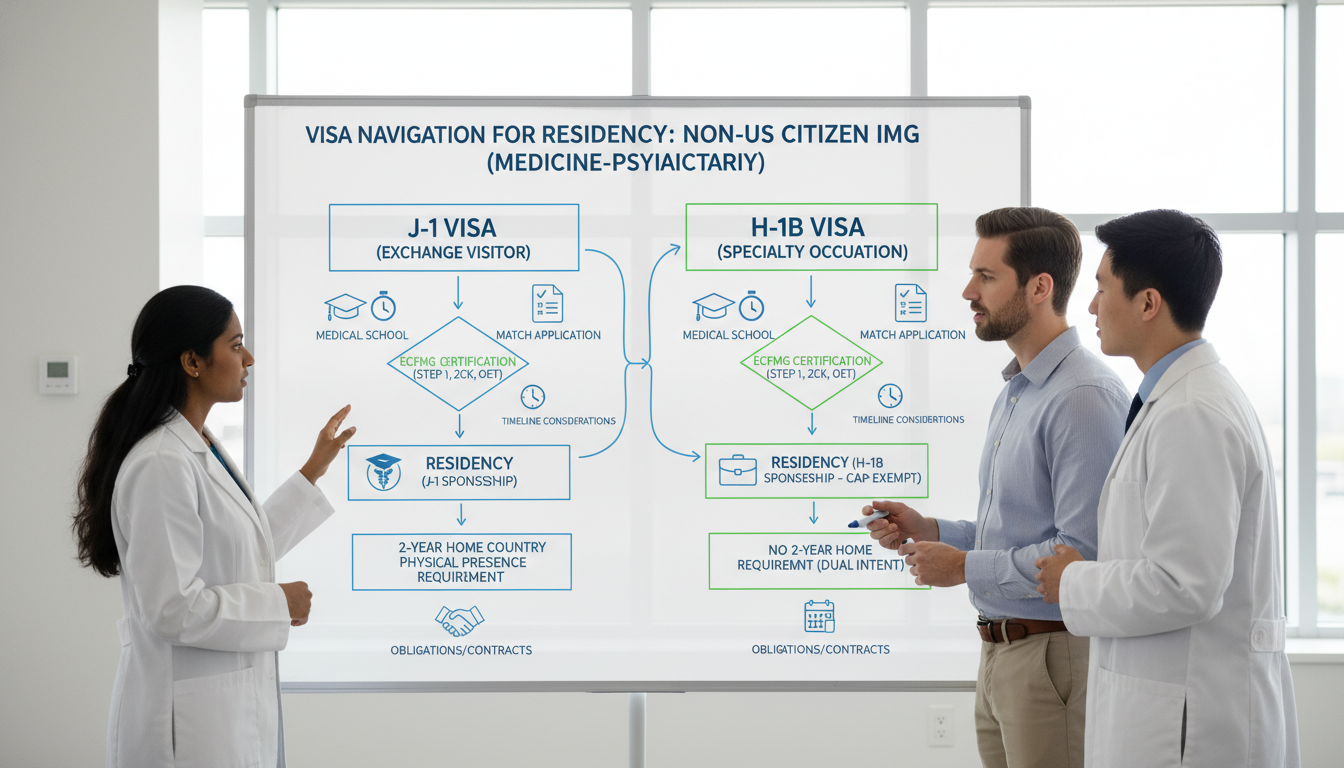
J-1 vs H‑1B: How to Decide as a Med Psych Residency Applicant
The debate around J-1 vs H‑1B is often emotional—many IMGs feel that H‑1B is always better. In reality, the best choice depends on your goals, timeline, and flexibility.
Key Questions to Ask Yourself
How certain am I that I want a long-term career in the US?
- If you are 100% committed to staying, H‑1B can be attractive because it avoids the J-1 waiver process.
- If you are open to practicing outside the US or in your home country, the J‑1 obligation may not be a major drawback.
Can I realistically pass USMLE Step 3 early enough?
- To use H‑1B for residency start in July, you need:
- Step 3 scheduled and passed ideally by January–March of the Match year (or earlier).
- If you are still working through Step 2 CK, trying to add Step 3 just for H‑1B can stretch you too thin and harm overall match competitiveness.
- To use H‑1B for residency start in July, you need:
Which visa types do my target Medicine-Psychiatry programs support?
- Many med psych residency programs are university-based and J‑1-heavy.
- A subset offers H‑1B, but often with stricter policies (e.g., “H‑1B considered only if Step 3 is completed before ranking”).
- Some programs may be open to H‑1B on paper but rarely sponsor it in practice.
Do I plan additional fellowships after med psych?
- Five years of medicine psychiatry combined training on H‑1B leaves limited H‑1B time for additional fellowships unless you transition to permanent residence.
- On J‑1, length of training is generally not the main issue; the post-training 2-year rule is.
Common Scenarios for Non-US Citizen IMGs
Scenario 1: Highly competitive IMG, strong scores, early Step 3, wants to stay in US long-term
- Strategy: Target programs that sponsor H‑1B, take Step 3 early, and list J‑1-sponsoring programs as backup.
- Risk: Narrowing your programs list too much around visa preferences can hurt your overall chances.
Scenario 2: Strong candidate but late with exams, prioritizing match success over visa type
- Strategy: Apply broadly, primarily on J‑1, keeping H‑1B as a bonus if a program offers it and you can fit Step 3 in time.
- This is the most common and often the most realistic path.
Scenario 3: Applicant with pre-existing US immigration status (e.g., green card, EAD)
- Strategy: Leverage your flexibility; programs will see fewer administrative barriers. Focus all energy on building a standout med psych application rather than visa logistics.
Medicine-Psychiatry Combined Programs: Visa-Specific Considerations
Med psych residency is a unique track with its own structure and visa implications.
1. Program Structure and Duration
- Length: 5 years (usually 60 months)
- Training: Integrated curriculum covering both Internal Medicine and Psychiatry; graduates are eligible for board certification in both specialties.
From a visa standpoint, the longer training length means:
- On J‑1, ECFMG typically renews sponsorship annually for the full duration of an approved program, assuming good standing and compliance.
- On H‑1B, five years of training consumes nearly the entire 6-year limit. If you anticipate needing an H‑1B for fellowship or early practice, you must plan for timely green card strategies.
2. Program Policies Differ Even Within the Same Institution
Many academic centers host multiple residency programs under one GME structure. A given institution might:
- Sponsor J‑1 for all programs
- Offer H‑1B for some (e.g., Internal Medicine, Neurology) but not for combined tracks like medicine psychiatry
- Impose stricter H‑1B criteria for IMGs vs US graduates
For a non-US citizen IMG, it’s crucial not to assume that if the Internal Medicine program sponsors H‑1B, the Medicine-Psychiatry combined track does as well. Always verify per program.
3. How Being a Foreign National Medical Graduate Affects Competitiveness
The combined med psych pathway is relatively small, with limited positions nationally. As a foreign national medical graduate:
- You may face:
- Fewer total programs willing to sponsor your preferred visa (especially H‑1B).
- Additional scrutiny around continuity of training (e.g., no gaps that complicate visa renewals).
- You gain advantages if you:
- Demonstrate clear, cohesive interest in integrated care (research, electives, psychiatry exposure, internal medicine strength).
- Show resilience and adaptability, which align with the psychosocial demands of med psych.
Programs want residents who will complete the full five years. Visa stability—having a realistic, feasible plan—is part of that reassurance.

Strategy and Timeline: How to Plan Your Visa Path Around the Match
Application Year Timeline (Typical Cycle)
Below is an approximate timeline for a non-US citizen IMG planning to apply to Medicine-Psychiatry:
18–24 months before Match (early preparation):
- Complete or plan for:
- USMLE Step 1 and Step 2 CK
- OET (if applicable)
- Begin exploring:
- Long-term career goals (US vs global practice)
- Basic understanding of J‑1 vs H‑1B and how they relate to med psych.
12–15 months before Match (pre-ERAS season):
- Research programs and their IMG visa options:
- Use FREIDA, program websites, and email GME offices if the website is unclear.
- Make a spreadsheet including:
- J‑1 sponsorship? (Yes/No)
- H‑1B sponsorship? (Yes/No/In special cases)
- Step 3 required for H‑1B? (Typically Yes)
- Any visa-related notes from coordinators.
- Decide if you will attempt Step 3 before Match:
- If yes, schedule it with enough time to receive scores before rank list deadlines for H‑1B-friendly programs.
September–February (application and interview season):
- Submit ERAS, specifying:
- Your citizenship and any current US status.
- Willingness to accept J‑1, H‑1B, or both (as appropriate).
- During interviews:
- Ask targeted but professional questions about visas, such as:
- “Can you share how your program typically sponsors visas for non-US citizen IMGs?”
- “Do you currently sponsor J‑1 only, or also H‑1B for Medicine-Psychiatry?”
- “Are there any additional requirements if a candidate is interested in H‑1B?”
- Ask targeted but professional questions about visas, such as:
February–March (ranking and pre-Match decisions):
- Reconcile:
- Your program preferences
- Your visa priorities
- The realism of Step 3 timing (for H‑1B).
- Rank programs primarily based on training quality and fit, with visa considerations as a secondary filter, unless you have very specific immigration goals.
Post-Match (March–June):
- Once matched:
- If J‑1: Work with ECFMG and your program to complete:
- DS-2019 request forms
- Proof of funding, ECFMG status, and home country ties
- If H‑1B: Coordinate with the program’s immigration/legal office:
- Provide diplomas, USMLE scores (including Step 3), CV, passport data
- Support the preparation of the H‑1B petition (I-129, LCA, etc.)
- If J‑1: Work with ECFMG and your program to complete:
- Schedule visa interviews (if outside the US) as soon as documentation is ready.
Practical Tips for Non-US Citizen IMGs Targeting Medicine-Psychiatry
1. Don’t Let Visa Concerns Shrink Your Application List Too Much
While it’s important to understand J‑1 vs H‑1B, your first priority is to match in a program that will train you well. For most non-US citizen IMGs:
- Applying broadly to J‑1-friendly programs is essential.
- Treat H‑1B as an advantage, not a requirement—unless you have very specific plans and the profile to realistically achieve them.
2. Communicate Clearly and Early About Your Status
On your ERAS and with programs:
- Be transparent about:
- Your citizenship
- Any current US status (F‑1, B‑1/B‑2, J‑2, H‑4, TPS, etc.)
- Whether you will need full sponsorship as a foreign national medical graduate.
- If you are already in the US and changing status (e.g., F‑1 to J‑1), understand that this can take time. Start early and stay in close communication with your program.
3. Understand the J‑1 Two-Year Home Country Requirement and Waivers
If you train on a J‑1:
- After residency (and any fellowship), you generally must either:
- Return to your home country for 2 years cumulatively,
- Or obtain a J‑1 waiver (e.g., via:
- Conrad 30 program (state-sponsored underserved-area jobs)
- Federal programs such as VA or HHS waivers
- Persecution or hardship waivers in special circumstances).
For a med psych grad, underserved-area jobs can align well with your training, especially in regions with high mental health and primary care needs. Planning ahead for this path can help you transition smoothly into practice.
4. Budget for Costs and Logistics
Visa processes involve time and money:
- J‑1:
- ECFMG administrative fees
- SEVIS fees
- Visa interview/issuance fees
- H‑1B:
- Most government filing fees are paid by the employer, but you may incur some incidental costs (translations, courier fees, etc.).
Start collecting and organizing required documents early:
- Medical school diploma and transcripts
- Translations (if not in English)
- Previous visas and I‑20/DS‑2019 forms if applicable
- Updated CV, exam score reports, and ECFMG certificate
5. Leverage Your Medicine-Psychiatry Interest as a Strength
When you are a non-US citizen IMG, your application may be scrutinized more closely. Use your distinctive interest in integrated medicine-psychiatry care to stand out:
- Highlight:
- Rotations that combined medical and psychiatric care
- Research or quality-improvement projects on comorbid medical and mental illness
- Experience in emergency psychiatry, consult-liaison, or primary care mental health integration.
- Explain how your background and international perspective equip you to serve complex, underserved populations—this resonates with both med psych programs and with the public health missions behind J‑1 waiver programs later.
FAQs: Visa Navigation for Non-US Citizen IMGs in Medicine-Psychiatry
1. As a non-US citizen IMG, is it realistic to match into a Medicine-Psychiatry combined program on an H‑1B visa?
It is possible but less common. Many med psych residency programs rely primarily on J‑1 sponsorship. A subset will consider H‑1B if you have USMLE Step 3 completed early and a strong overall application. Your best strategy is to:
- Identify which specific med psych programs have historically sponsored H‑1B.
- Apply to them and to a broader group of J‑1-friendly programs.
- Treat H‑1B as a desirable bonus, not the only acceptable outcome, unless your immigration constraints are absolute.
2. If I train on a J‑1 visa in a medicine psychiatry combined program, can I still pursue a fellowship in the US afterward?
Yes, you can extend J‑1 status for eligible fellowships, as long as they are ACGME-accredited and approved by ECFMG. The J‑1 two-year home country requirement typically arises after you complete all your training (residency and fellowship). You can then:
- Pursue a J‑1 waiver (e.g., Conrad 30) after all training is complete,
- Or return to your home country for two years,
- Or explore other specialized waiver pathways if eligible.
Plan carefully, because combined residency + fellowship can mean many years of J‑1 status before you reach the waiver decision point.
3. Do all programs that accept non-US citizen IMGs support both J‑1 and H‑1B visas?
No. Visa policies are highly program-specific. Common patterns:
- Many academic programs: J‑1 only for IMGs.
- Some university or large hospital systems: J‑1 as default, H‑1B selectively (often for highly qualified candidates or US grads).
- A small number of programs, including a few community-based ones, may be more H‑1B-friendly.
Always verify on each program’s website or by contacting the program coordinator. Do not rely solely on secondhand lists or old forum posts; policies can change yearly.
4. I’m currently on an F‑1 visa in the US. How does that affect my residency visa options as a foreign national medical graduate?
As an F‑1 holder (e.g., from a US or Caribbean school with US clinical rotations), you will typically transition from F‑1 to either J‑1 or H‑1B for residency:
- If going to J‑1:
- ECFMG coordinates the DS‑2019 issuance.
- You may need to travel for a visa interview depending on your situation.
- If going to H‑1B:
- Your residency program’s legal office files a petition for change of status or consular processing.
Your F‑1 background doesn’t inherently disadvantage you; what matters is your exam performance, ECFMG certification, and the program’s visa policies. However, start early with your program’s GME office so timing aligns and you avoid gaps in status.
Navigating the residency visa landscape as a non-US citizen IMG in Medicine-Psychiatry is complex, but with early planning, realistic expectations, and a balanced J‑1 vs H‑1B strategy, you can align your immigration pathway with your long-term career goals. Focus first on building the strongest possible med psych application—then use the information in this guide to choose programs and visa options that support your path forward.