Understanding the Visa Landscape as a Non-US Citizen IMG in the Research Triangle
If you are a non-US citizen IMG (international medical graduate) targeting North Carolina residency programs—especially in the Research Triangle (Duke, UNC, WakeMed, and affiliated hospitals)—your visa strategy is as important as your USMLE scores and letters of recommendation.
The Research Triangle (Raleigh–Durham–Chapel Hill) is rich with academic institutions and teaching hospitals, but each system has its own policies on a residency visa, especially regarding J‑1 vs H‑1B. As a foreign national medical graduate, you must understand:
- Which visas are realistic for residency
- How Duke residency and other local programs typically handle visas
- How your long-term goals (fellowship, practice in the US, or eventual return home) shape the best IMG visa options for you
This guide focuses on residency visa navigation specifically for non-US citizen IMGs applying in the Research Triangle area.
Core Visa Options for Residency: J‑1 vs H‑1B
The two main visas for GME (residency and fellowship) are:
- J‑1 Alien Physician (Exchange Visitor) – Sponsored by ECFMG
- H‑1B (Temporary Worker in Specialty Occupation) – Sponsored by the residency program/employer
Some IMGs also ask about O‑1 (extraordinary ability) or green cards, but for residency entry, J‑1 and H‑1B dominate.
J‑1 Alien Physician Visa: The Default Path for Most IMGs
For many non-US citizen IMGs, the J‑1 visa is the most accessible route into US residency.
Key points about the J‑1 (ECFMG-sponsored)
- Who sponsors it?
- ECFMG (Educational Commission for Foreign Medical Graduates), not the residency program directly.
- Program requirements
- ACGME-accredited program (or equivalent)
- Valid ECFMG certification (for IMGs)
- Contract or official offer letter from your residency program
- Duration
- Initial: up to 7 years total for clinical training (residency + fellowship), with some limited extensions in specific cases.
- Spouse/children
- J‑2 status; spouses can usually apply for work authorization (EAD), children can attend school.
The 2-year home residency requirement (INA 212(e))
This is the biggest issue for long-term planning:
- After completing J‑1 training, you are required to return to your home country for at least 2 years
- “Home country” = the country of your last permanent residence at the time of getting your J‑1, not necessarily citizenship.
- You generally cannot
- Change to H‑1B or L‑1 within the US
- Obtain a green card (permanent residency)
- Get certain other nonimmigrant visas
until you either: - Fulfill the 2-year physical presence requirement, or
- Obtain a J‑1 waiver.
Waiver options (at the end of training)
Most non-US citizen IMGs who train on J‑1 ultimately pursue a waiver instead of leaving for two years. Common waiver pathways include:
- Conrad 30 (State 30) Waiver Programs
- Each state can sponsor up to 30 J‑1 physicians per year.
- Typically requires a 3-year full-time service commitment in a federally-designated underserved or high-need area on an H‑1B visa.
- North Carolina participates; many positions are in rural or underserved communities, less often in major academic centers like Duke or UNC.
- Federal agency waivers
- e.g., VA, HHS, or other federal agencies for specific public interest roles.
- Fear of persecution waivers
- Based on risk of persecution if you return to your home country.
Advantages of J‑1 for a non-US citizen IMG
- Widely accepted: Many university and community programs in the Research Triangle sponsor only J‑1 due to simplicity.
- Lower administrative burden on the program compared to H‑1B.
- Often more predictable timing for ECFMG/DS-2019 vs H‑1B cap issues (for non-cap-exempt institutions).
Disadvantages
- The 2-year home residency requirement and need for J‑1 waiver afterward can complicate your career.
- Limited total duration for training (residency + fellowship cumulative).
- Less flexibility to switch employers/type of work during or immediately after training.
For a non-US citizen IMG targeting Duke residency or other Research Triangle programs, assume J‑1 will be the default unless you have a compelling case and a program that explicitly supports H‑1B.
H‑1B Visa: More Freedom Later, Harder to Get at the Start
The H‑1B is often seen as the “gold standard” by foreign national medical graduates seeking long-term US careers, but it comes with challenges.
Key characteristics of the H‑1B for residency
- Employer-sponsored:
- The residency program must file and pay for the petition.
- They must demonstrate you qualify for a “specialty occupation” (physician training does qualify).
- Eligibility
- Typically requires passing USMLE Step 3 before H‑1B filing.
- Must meet state licensure requirements (often an educational or training license).
- Duration
- Up to 6 years total, including all H‑1B employment (not just residency).
- Can be extended beyond 6 years if green card process is well advanced.
Cap-exempt vs cap-subject H‑1B
Residency programs at non-profit universities or affiliated teaching hospitals (like Duke, UNC, and many Research Triangle academic centers) are usually cap-exempt:
- They can file H‑1B petitions year-round.
- No lottery for these positions.
- However, if you later move to a private practice or non-academic employer, you might then face cap-subject H‑1B restrictions.
Advantages of H‑1B for the non-US citizen IMG
- No 2-year home residency requirement.
- Easier transition to:
- Fellowships (some use H‑1B; some still prefer J‑1)
- Private practice positions
- Green card sponsorship.
- Some physicians prefer avoiding J‑1 waiver programs and the practice restrictions they may come with.
Disadvantages
- Many residency programs avoid H‑1B due to:
- Cost and legal complexity
- Timing around Step 3 and match timelines
- Concerns about limited 6-year clock (especially for long training paths like neurosurgery or combined programs).
- If your program is willing to sponsor, you must ensure Step 3 and licensure requirements are completed early enough (often before rank list deadlines).
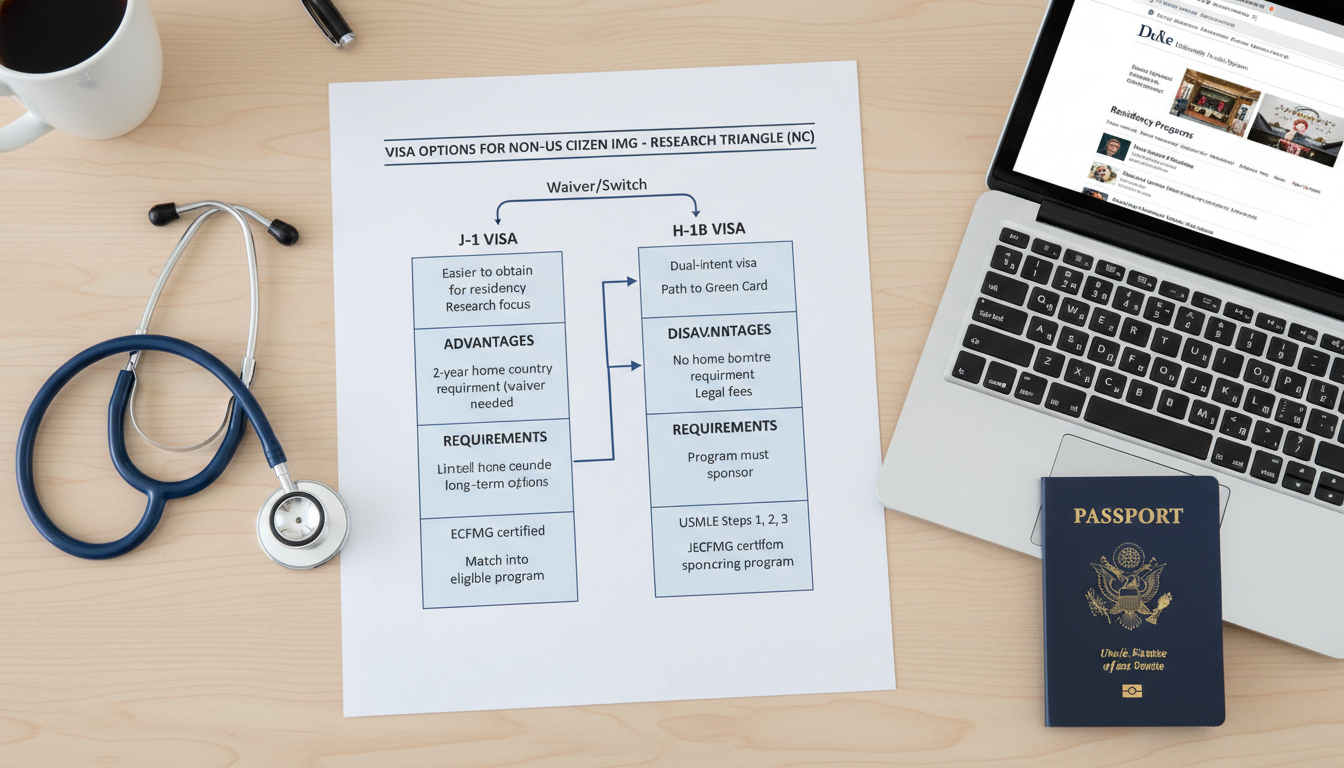
J‑1 vs H‑1B: Practical Comparison for IMGs
| Factor | J‑1 Alien Physician | H‑1B Temporary Worker |
|---|---|---|
| Who sponsors? | ECFMG + Program | Residency program/employer |
| Common in Research Triangle? | Very common | Variable, program-dependent |
| USMLE Step 3 required? | Not required for visa | Usually required before filing |
| 2-year home residency requirement? | Yes (unless waived) | No |
| Total typical duration | Up to 7 years for training | Up to 6 years (all H‑1B jobs combined) |
| Transition to post-training jobs | Need J‑1 waiver or 2-year return | Can transition more flexibly |
| Program administrative burden | Lower | Higher |
For a non-US citizen IMG focusing on North Carolina residency, especially in the Research Triangle, the main question is not “Which visa is better in theory?” but rather “Which visa will this specific program sponsor for me, given my credentials and timeline?”
Visa Policies in the Research Triangle: Duke, UNC, and Local Programs
While individual policies can change yearly, certain patterns recur across Research Triangle residency programs. Always verify the latest information directly on each program’s website or by email, but these general principles will help you plan.
Academic Powerhouses: Duke and UNC
Duke University Hospital / Duke residency programs
- Duke is a major academic institution with a long history of hosting IMGs.
- Policy trends (subject to change):
- Many Duke residency and fellowship programs are J‑1–friendly through ECFMG sponsorship.
- Some may consider H‑1B for exceptional candidates or specific specialties, particularly where long-term academic careers are anticipated.
- Duke’s GME office typically publishes a system-wide visa policy. Look for phrases like:
- “We sponsor J‑1 visas through ECFMG”
- “H‑1B sponsorship is considered on a case-by-case basis” or “not supported for residency.”
University of North Carolina (UNC) / UNC Hospitals
- Another large academic center, also popular among foreign national medical graduates.
- Historically, many UNC programs have leaned heavily towards J‑1 visas.
- H‑1B may be available (especially in fellowships or for faculty) but is often more limited at the residency level.
In both cases—Duke residency or UNC programs—assume J‑1 is the baseline and H‑1B is the exception, not the rule.
Other Research Triangle Programs
Beyond Duke and UNC, the Triangle includes:
- WakeMed Health & Hospitals affiliates
- UNC/Rex, Duke Regional, and other community or university-affiliated programs
- Veteran’s Affairs Medical Centers (Durham VA), often aligned with academic sponsors
- Smaller or community-based programs in Raleigh, Chapel Hill, and surrounding areas
Visa policies here vary widely:
- Some community programs might only accept US citizens or permanent residents due to institutional policy or perceived administrative burden.
- Some support J‑1 only (very common).
- A smaller fraction will explicitly state J‑1 and H‑1B are both possible, often specifying requirements such as:
- Step 3 passed by a given date
- Strong academic record
- Willingness to commit to long training sequences (e.g., 5-year general surgery).
Research Triangle–Specific Considerations
As a non-US citizen IMG targeting North Carolina residency in this region, be strategic:
Make a program-specific visa matrix early (before ERAS submission)
- Columns: Program | City | Visa types accepted | H‑1B conditions | % IMG residents (if known).
- Use program websites, FREIDA, and direct emails to fill this out.
Prioritize research-friendly, IMG-welcoming institutions
- Research Triangle programs often care heavily about your academic potential and potential for scholarly output.
- Strong research track record can make an H‑1B request more compelling in programs that allow it.
Be realistic about competitiveness
- If you require H‑1B only, your application pool may shrink significantly.
- If you are willing to take J‑1, your viable options in the Triangle and beyond increase.
Building Your Application Around Your Visa Strategy
Your visa plans shouldn’t be an afterthought. They should shape how you prepare your residency application as a non-US citizen IMG.
Step 1: Decide Your Flexibility on J‑1 vs H‑1B
Ask yourself:
- Are you absolutely unwilling to accept a J‑1 due to the home residency requirement and waiver obligations?
- Or are you open to J‑1, with a plan to pursue a Conrad 30 or similar waiver in North Carolina or elsewhere?
If you are open to J‑1:
- Focus on maximizing your overall competitiveness for Research Triangle programs:
- Strong USMLE scores
- US clinical experience (USCE), ideally at academic centers
- Solid letters from US faculty
- Research aligned with the strengths of Duke, UNC, or other local programs.
If you strongly prefer H‑1B:
- Prioritize passing USMLE Step 3 early, ideally before application season (or by interview/rank-list deadlines at the latest).
- Specifically target programs that:
- Explicitly state “H‑1B sponsorship available”
- Have a track record of sponsoring H‑1B IMGs.
- Be prepared to explain your rationale succinctly if asked (e.g., long-term academic career in US, avoidance of J‑1 waiver obligations).
Step 2: Communicating with Programs About Visa Issues
When to ask about visas:
- Before applying:
- Check official websites and FREIDA; many state “J‑1 only,” “J‑1 and H‑1B,” or “no visas.”
- If unclear:
- A polite pre-application email to the program coordinator is reasonable, especially if H‑1B is crucial to you.
Sample concise inquiry:
Dear [Coordinator Name],
I am a non-US citizen IMG planning to apply to your Internal Medicine residency program this cycle. Could you please clarify whether your program sponsors J‑1 only, or also considers H‑1B visas for residents?
Thank you very much for your time.
Sincerely,
[Your Name], MD
During interviews:
- If the program has already disclosed their policy (e.g., “We only sponsor J‑1”), do not push for H‑1B. It can appear tone-deaf.
- If they consider both, you can briefly discuss your preferences and Step 3 status—without making it sound like a condition for ranking them.
Step 3: Aligning Your Timeline with Visa Requirements
For J‑1 applicants (ECFMG-sponsored)
- Ensure ECFMG certification is completed as early as possible.
- Make sure your passport is valid for the duration of training.
- Respond promptly to any documentation requests for DS-2019 issuance after you match.
For H‑1B–hopeful applicants
- Plan Step 3 aggressively:
- Aim to complete Step 3 by late summer/early fall before the Match if possible.
- This allows program directors to know you meet H‑1B prerequisites when building rank lists.
- Know your state training license rules for North Carolina:
- Some NC boards may require particular documentation timelines.
- Your GME office often assists, but you must be prompt and organized.

Long-Term Planning: After Residency in the Research Triangle
Your choice of residency visa affects what happens after you finish training in North Carolina.
If You Train on a J‑1
End of training, you face three main paths:
Return to your home country for 2 years
- Fulfills the 212(e) requirement.
- You can then pursue H‑1B or green card options if you later want to come back.
Secure a J‑1 waiver job (most common)
- Typically a 3-year H‑1B position in an underserved or high-need area.
- These jobs are often:
- Outside major academic hubs like the Research Triangle
- In rural or smaller city practices
- After completing the 3 years, you have more freedom to transition to other jobs or start a green card process.
Other waiver routes
- Federal agency waivers or persecution-based waivers (less common but possible).
If your dream is to stay in academic medicine at institutions like Duke or UNC, the J‑1 waiver path can be trickier because:
- Many academic positions are not in designated underserved areas.
- You might need to do your 3-year waiver service elsewhere, then return to an academic center afterward.
If You Train on an H‑1B
With an H‑1B, once residency (and possibly fellowship) ends:
- You can look for H‑1B–sponsoring jobs in:
- Academic centers (some are cap-exempt)
- Private practices (often cap-subject if for-profit).
- You may transition directly into an employer-sponsored green card process if they are willing.
Keep track of your H‑1B year count:
- Residency H‑1B years + any fellowship H‑1B + post-training H‑1B must stay within the 6-year limit (absent green card–related extensions).
For non-US citizen IMGs starting in the Research Triangle, a common path might be:
- H‑1B for residency at Duke or UNC (if available) →
- H‑1B for fellowship (possibly at same or another academic center) →
- Transition to faculty position with concurrent green card process.
Practical Tips and Common Pitfalls for Non-US Citizen IMGs
Tips
Start visa planning 12–18 months before Match day
- This gives you time to align Step 3, documentation, and your target program list.
Create a “Visa-Friendliness” tier list of programs
- Tier 1: J‑1 and H‑1B, historically IMG-friendly
- Tier 2: J‑1 only but strongly IMG-supportive
- Tier 3: Unclear or limited visa support
- Tier 4: No visa sponsorship (avoid).
Document everything
- Save emails confirming program visa policies.
- Keep scanned, organized copies of passports, ECFMG certificate, USMLE transcripts, prior visas, and DS-2019s or I-797 approvals.
Build a support network in the Research Triangle
- Current residents/fellows at Duke, UNC, WakeMed, etc., especially non-US citizen IMGs, can provide real-time insights into visa handling and institutional culture.
Pitfalls to Avoid
- Assuming all big universities sponsor H‑1B for residency – Many do not, or do so only rarely.
- Waiting too late for Step 3 if you want H‑1B; missing the timing can collapse that option.
- Ignoring the J‑1 home residency requirement until the end of training; it should factor into your long-term career and family plans from the start.
- Relying solely on hearsay – Policies change; always confirm with official sources.
Frequently Asked Questions (FAQ)
1. As a non-US citizen IMG, is it realistic to get H‑1B for Duke residency?
It is possible but not guaranteed. Duke residency programs commonly sponsor J‑1 visas via ECFMG. Some specialties or specific situations may allow H‑1B, especially for highly qualified candidates who already have Step 3. You should:
- Check Duke’s GME website for official policy
- Review each program’s web page
- Contact the program coordinator if the policy is unclear
Plan as if J‑1 is the baseline and consider H‑1B a potential bonus if your profile and timing align.
2. If I do residency at UNC on a J‑1, can I stay in North Carolina afterward?
Yes, but not automatically. You must address the 2-year home residency requirement:
- Either return to your home country for 2 years,
- Or obtain a J‑1 waiver (e.g., Conrad 30 NC waiver program or a federal waiver).
Many physicians complete a 3-year waiver position in rural or underserved parts of North Carolina on an H‑1B, then transition to other NC jobs, including potentially in the Research Triangle.
3. Do programs in the Research Triangle prefer US citizens over non-US citizen IMGs because of visas?
Programs must comply with all anti-discrimination laws, but visa sponsorship does add complexity, and some institutions limit or avoid it. As a result:
- Some programs openly state “we cannot sponsor visas,” effectively restricting applicants to US citizens/green card holders.
- Others actively welcome non-US citizen IMGs and sponsor J‑1 (and sometimes H‑1B).
Your best strategy is to identify and target programs that clearly support IMGs and sponsor your needed residency visa. Many Research Triangle programs have successful IMGs in their current or recent classes.
4. I’m a foreign national medical graduate with no US clinical experience yet. Should I first get USCE or focus on visa planning?
You need both, but US clinical experience (USCE) should usually come first:
- Without strong USCE and letters, you may not be competitive enough for Research Triangle or other desirable programs—regardless of visa.
- While planning and learning about J‑1 vs H‑1B is important, you can refine your visa strategy once your exam scores and USCE trajectory are clear.
Aim to build a solid profile (USMLE scores, USCE, ECFMG certification), then apply that profile strategically to visa-compatible programs in North Carolina and nationwide.
By understanding the J‑1 vs H‑1B landscape, program-specific policies in the Research Triangle, and how residency visa choices shape your post-training options, you can approach the Match as a non-US citizen IMG with a clear, realistic strategy. Combine strong credentials with early visa planning, and North Carolina residency—at Duke, UNC, or other regional programs—can become a well-navigated step toward your long-term career in American medicine.