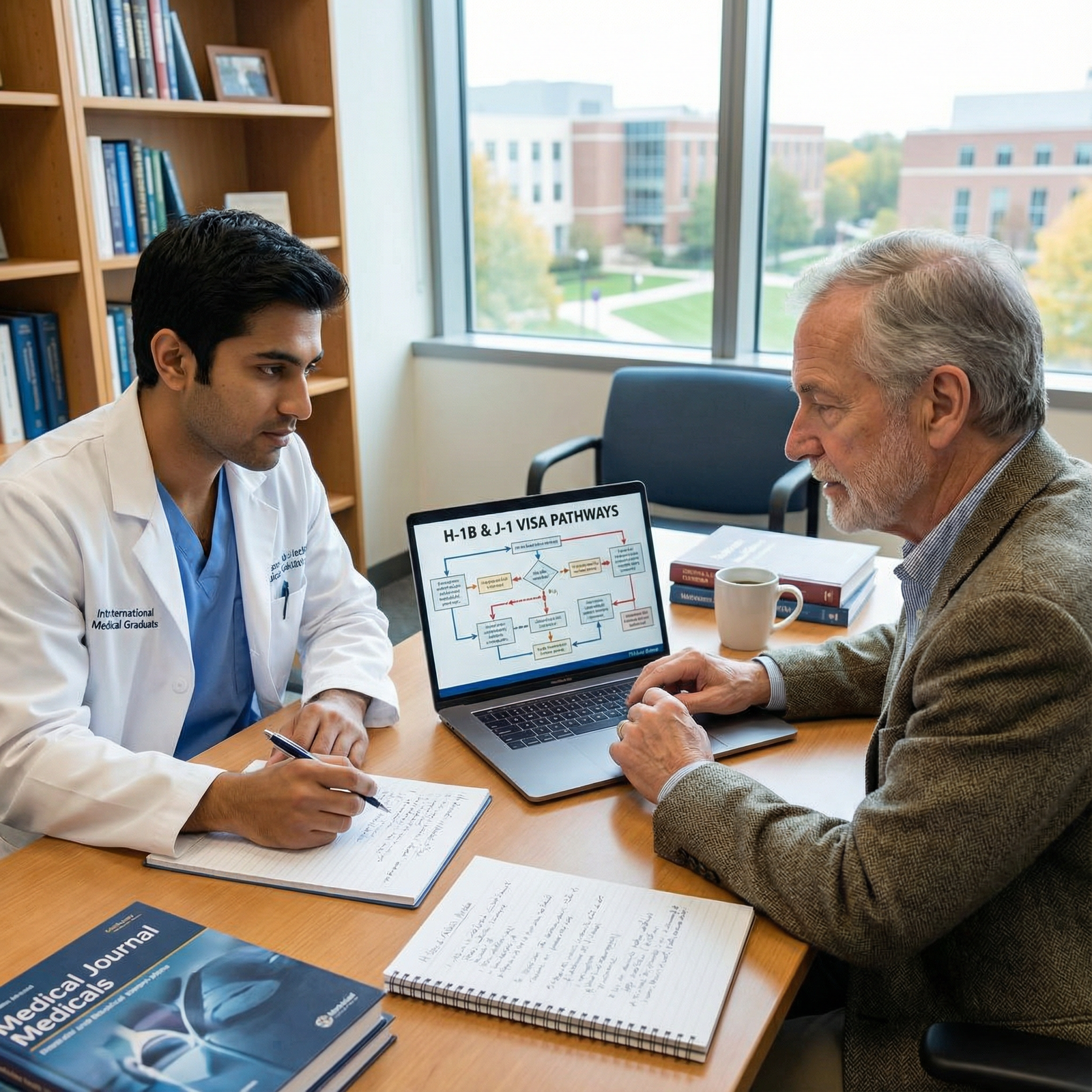
Understanding the Visa Landscape for Non‑US Citizen IMGs in the Rural Midwest
For a non-US citizen IMG and foreign national medical graduate, visa planning is just as important as exam scores and personal statements—especially if you’re targeting a rural Midwest residency in states like Iowa, Nebraska, Kansas, or the Dakotas. Many excellent community and university-affiliated programs in these areas are IMG‑friendly, but their visa policies, institutional resources, and long‑term immigration strategies can differ significantly.
This article focuses on visa navigation for residency in the rural Midwest, with practical guidance tailored to non-US citizen IMGs considering or targeting Iowa and Nebraska residency programs and similar regions. You’ll learn how to interpret program policies, choose between J‑1 vs H‑1B, time your applications, and strategically position yourself for both residency and long‑term career goals in the United States.
Core Visa Pathways: J‑1 vs H‑1B for Residency Training
Most non-US citizen IMG residents in the USA train on one of two visa types:
- J‑1 Exchange Visitor (ECFMG-sponsored)
- H‑1B Temporary Worker (Specialty Occupation)
Understanding the differences is critical before you build your list of target programs in the rural Midwest.
The J‑1 Clinical Visa (ECFMG-Sponsored)
For the vast majority of non-US citizen IMG residents, the J‑1 is the primary visa route.
Key features of the J‑1 for residency:
- Sponsor: ECFMG (not the hospital or university directly).
- Purpose: Graduate medical education (residency/fellowship).
- Duration: Normally up to 7 years total for GME (with some exceptions).
- Employment: Only at the approved training site(s) listed in your DS‑2019.
- Eligibility requirements:
- Valid ECFMG certification.
- USMLE exams appropriate to your level (generally Step 1 and Step 2 CK passed).
- A contract or official offer from an ACGME-accredited residency/fellowship.
- Proof of adequate funding and health insurance.
- Dependents: J‑2 visas for spouse and children (may apply for work permission after arrival).
2‑year home residency requirement (212(e)):
Almost all IMGs on J‑1 clinical visas are subject to the two-year home-country physical presence requirement, meaning:
- After completing your J‑1 training, you must either:
- Return to your home country for 2 cumulative years, or
- Obtain a waiver of this requirement.
- Without fulfilling or waiving it, you generally cannot:
- Change to H‑1B or L‑1 status in the US.
- Obtain an immigrant visa (green card).
- Adjust status to permanent resident.
This is where the rural Midwest becomes highly relevant: many underserved areas in Iowa, Nebraska, and surrounding states actively recruit J‑1 waiver physicians. Your decision to train in the Midwest can position you well for later J‑1 waiver jobs in the same region.
The H‑1B Clinical Visa for Residency
The H‑1B is an employment-based visa category for “specialty occupations” requiring at least a bachelor’s degree—medicine clearly qualifies. However, for residency training, H‑1B is more restrictive and more complex to obtain.
Key features of the H‑1B for residency:
- Sponsor: The hospital or university (not ECFMG).
- Purpose: Employment as a resident physician (still considered a “specialty occupation”).
- Duration: Up to 6 years total (in 3-year increments), with some extensions possible when green card processes are underway.
- Exams: USMLE Step 1, Step 2 CK, and Step 3 usually must be completed before H‑1B petition filing for residency.
- Prevailing wage requirement: Employer must pay at or above the prevailing wage for that position.
- No inherent 2‑year home requirement: Unlike J‑1, H‑1B does not automatically impose a 2‑year return obligation.
Cap-exempt vs. cap-subject H‑1B:
Residency positions at teaching hospitals affiliated with universities are generally H‑1B cap‑exempt, meaning:
- They can sponsor H‑1B at any time of year.
- They are not limited by the annual national H‑1B lottery.
Many rural Midwest residency programs are community-based but affiliated with a university. Those institutions may still be cap-exempt or have arrangements to file cap-exempt H‑1B. However, some purely community hospitals in smaller towns may have less experience with H‑1B petitions and may prefer J‑1.
J‑1 vs H‑1B: Strategic Comparison for a Rural Midwest Career
Deciding between J‑1 vs H‑1B should not be based on hearsay or myths. It requires aligning visa strategy with your long-term career and immigration goals—especially if you hope to build a life in Midwestern states like Iowa or Nebraska.
When the J‑1 Often Makes Sense
The J‑1 is the most common route for a non-US citizen IMG and foreign national medical graduate for residency, and it often aligns well with a rural Midwest career path.
Advantages of J‑1:
- Widely accepted: Many rural Midwest residency programs clearly state they sponsor or accept J‑1.
- Simpler for institutions: ECFMG manages much of the administrative burden. Programs used to recruiting IMGs often prefer J‑1 for logistical reasons.
- Flexibility for multi-step training: The 7-year total ECFMG limit typically allows for:
- A 3-year residency (e.g., Internal Medicine, Family Medicine, Pediatrics)
- Plus 3–4 years of fellowship (e.g., Cardiology, Nephrology) within the same J‑1 framework.
How J‑1 interacts with rural Midwest opportunities:
Rural Midwest states often suffer from primary care and specialty shortages, especially in smaller towns and agricultural regions. Many of these areas qualify as medically underserved or health professional shortage areas (HPSAs)—precisely where J‑1 waiver jobs are concentrated.
This means:
- Completing residency (even in a mid-sized city like Des Moines, Omaha, or Sioux City) can set you up for:
- A J‑1 waiver job in a smaller surrounding community.
- A path to a green card while serving a region in real need of physicians.
When the H‑1B May Be Preferable
The H‑1B may be a better fit if:
- You definitely want to avoid the 2‑year home requirement and do not want to rely on waiver jobs, or
- You anticipate an early, aggressive green card strategy (e.g., employer sponsorship right after residency, or EB‑1/NIW filings), or
- You have strong Step scores, strong CV, and Step 3 completed early, making H‑1B sponsorship feasible.
Advantages of H‑1B:
- No automatic 2‑year home-country obligation.
- Potentially smoother transition to:
- Fellowship on H‑1B (if the fellowship program is willing to sponsor).
- Direct employment with green card sponsorship, especially in rural or underserved areas that can support an EB-2 NIW (National Interest Waiver).
Challenges of H‑1B in the rural Midwest context:
- Not all Iowa or Nebraska residency programs sponsor H‑1B. Some smaller or community-based programs may lack legal infrastructure or budget for H‑1B petitions.
- Step 3 timing: Many IMGs find it challenging to complete Step 3 before Match deadlines, especially if they are still abroad.
- Prevailing wage: Some rural programs with modest budgets may find H‑1B salary and legal requirements harder to meet.
Typical Midwest pattern:
- Large academic centers in Iowa City, Omaha, or bigger regional hubs:
- More likely to consider H‑1B, especially in highly competitive specialties.
- Smaller community programs in rural areas:
- More likely to accept only J‑1 due to simplicity and cost.

Practical Steps: How to Plan Your Visa Strategy Before and During the Match
A smart visa plan starts before ERAS opens. For a foreign national medical graduate targeting a rural Midwest residency, visa navigation should be integrated into every stage: research, application, interview, and ranking.
Step 1: Clarify Your Long-Term Goals
Before choosing J‑1 vs H‑1B targets, ask:
- Do I want to stay in the US long term?
- Am I open to working in a rural or underserved community after residency (for J‑1 waiver purposes)?
- Am I on track to complete USMLE Step 3 before the Match (for potential H‑1B)?
- Do I have family or personal reasons that make a 2‑year home-country return impossible or undesirable?
If you are open to rural practice after residency—for example, in a town in Nebraska, Iowa, or Kansas—the J‑1 route plus a rural J‑1 waiver job can be a powerful, realistic path to a green card and permanent residence.
If you have strong reasons to avoid any home-country requirement and possibly less flexibility for rural practice later, you may want to focus more on H‑1B‑friendly programs, even if that slightly narrows your options.
Step 2: Research Program Visa Policies (Iowa, Nebraska, and Beyond)
When building your list of programs—especially in the rural Midwest—dig for visa-specific details:
Program websites:
- Look for pages for “International Medical Graduates,” “Eligibility,” or “Visa Information.”
- Note wording patterns:
- “We sponsor J‑1 visas only”
- “We sponsor J‑1 and a limited number of H‑1B visas”
- “We do not sponsor visas” (sometimes they only accept green card holders or US citizens)
Reach out by email:
- Introduce yourself briefly as a non-US citizen IMG.
- Ask specifically:
- “Do you sponsor non-US citizen IMG visas?”
- “Which visa types do you support: J‑1, H‑1B, or both?”
- “Do you have specific requirements (e.g., Step 3 for H‑1B)?”
- Be concise and professional; program coordinators appreciate clear, focused questions.
Track your findings in a spreadsheet:
- Columns: Program, City/State, Region (rural vs urban), Visa types (J‑1/H‑1B), Step 3 requirement, Notes.
- Mark rural Midwest residency programs in specific states (Iowa, Nebraska, Kansas, the Dakotas) and flag those that have historically been IMG-friendly.
Step 3: Time Your Exams with Visa Strategy in Mind
For J‑1:
- You mainly need:
- ECFMG certification (which requires Step 1 and Step 2 CK; OET if applicable).
- Timing priority:
- Certification before Match rank list deadlines.
- Paperwork for ECFMG J‑1 sponsorship after you receive a Match.
For H‑1B:
- Most teaching hospitals require:
- USMLE Step 3 passed before H‑1B petition filing.
- Action plan:
- If you intend to seek H‑1B programs, aim to complete Step 3 by the fall before Match, or at the latest by early winter (depending on program policies).
- Communicate clearly in your application if your Step 3 exam date is scheduled.
Step 4: Use the Interview to Clarify Visa Nuances
During interviews, especially at Iowa or Nebraska residency programs and other rural Midwest sites, you can inquire politely about visa policies. Possible questions:
- “Does your program sponsor both J‑1 and H‑1B visas for non-US citizen IMG residents?”
- “For applicants on J‑1, do your graduates commonly find J‑1 waiver positions in this region after residency?”
- “For H‑1B sponsorship, do you require Step 3 to be passed by a particular date?”
- “Do you have institutional immigration support or legal counsel for visa issues?”
This shows that you are serious, informed, and thinking ahead—qualities program directors often value.
Step 5: Rank Lists and Contingency Planning
When finalizing your rank list:
If you are open to J‑1 and rural practice later:
- Rank programs primarily by training quality and fit, not just visa type.
- Make sure at least several of your top choices clearly support J‑1.
If you strongly prefer H‑1B:
- Include multiple H‑1B-sponsoring programs to mitigate risk.
- Still include some J‑1 programs as a backup, unless you have a compelling reason to avoid J‑1 entirely.
Remember: ending up on J‑1 does not end your chances of staying in the US long term—it simply means your strategy will likely run through a J‑1 waiver job, often in a rural or underserved area.

After Residency: J‑1 Waivers, H‑1B, and Green Card Pathways in the Rural Midwest
Your visa navigation doesn’t stop when residency ends. The rural Midwest can actually be one of the most favorable regions for turning your training into a long‑term US career.
J‑1 Waiver Options in the Rural Midwest
If you complete residency on a J‑1 visa, you will typically need a J‑1 waiver to stay in the US and work without returning home for 2 years. The waiver usually works through:
- A three-year employment commitment in an underserved or high‑need area.
- The employer filing for a waiver recommendation, often through:
- Conrad 30 programs (state-level programs), or
- Federal programs like VA, Appalachian/River programs, or other shortage-driven waivers.
Why rural Midwest is attractive for J‑1 waivers:
- States like Iowa and Nebraska sometimes have unfilled Conrad 30 slots, especially in primary care and psychiatry.
- Smaller towns and critical-access hospitals may actively seek J‑1 waiver physicians and will often:
- Sponsor your change of status to H‑1B for the waiver job.
- Support green card applications (often via EB‑2 or NIW) once you’ve started work.
Common pattern for a J‑1 IMG in the rural Midwest:
- Residency on J‑1 (e.g., Family Medicine in Iowa).
- J‑1 waiver job in a small town in Nebraska or Iowa:
- Hospital files for J‑1 waiver and H‑1B.
- Work there 3 years under the waiver.
- Employer initiates green card process—often EB‑2 with NIW due to service in an underserved area.
- Transition to permanent residence while continuing practice in the region.
If you are open to living in a smaller community for a few years and practicing broad-spectrum medicine, this path is highly practical.
H‑1B Post-Residency and Green Card
If you finish residency on H‑1B:
- You usually continue on H‑1B with your post-residency employer:
- Could be a hospital in an urban center.
- Could also be a rural Midwest facility that sponsors H‑1B directly.
Advantages:
- No J‑1 home requirement to waive.
- You can move directly into positions that support:
- EB‑2 PERM (employment-based green card with labor certification).
- EB‑1 or NIW strategies for highly accomplished physicians or those serving national interest areas.
In the rural Midwest context:
- Many underserved rural employers are willing to sponsor:
- H‑1B for immediate practice.
- EB‑2 NIW if your service aligns with public health needs (primary care, psychiatry, some specialties).
Special Considerations for Family and Dependents
As a non-US citizen IMG, your spouse and children will be on dependent status (J‑2 or H‑4). Consider:
- J‑2 dependents:
- Can apply for EAD (Employment Authorization Document) and may work in the US.
- Children can attend school.
- H‑4 dependents:
- Children can attend school.
- Spouses may have limited work authorization options unless the H‑1B principal is far along in the green card process (varies by current US rules).
When evaluating long-term placements in the rural Midwest, think not only about your own role but also schools, community life, and job options for your partner if applicable.
Common Pitfalls and How to Avoid Them
Many non-US citizen IMGs and foreign national medical graduates face similar problems in visa navigation. Awareness can help you avoid costly mistakes.
Pitfall 1: Ignoring Visa Information Until After Interviews
Waiting too long to check visa policies can leave you with:
- A rank list heavy with programs that do not sponsor your preferred visa, or
- Surprises when a program tells you after Match that they cannot support your visa type.
Solution:
Start investigating visa types as you build your application list, not at the end of the cycle.
Pitfall 2: Over-focusing on H‑1B Without Meeting Requirements
Some IMGs fixate on H‑1B without:
- Passing Step 3 in time.
- Ensuring enough H‑1B‑friendly programs in their specialty and region.
This can significantly restrict your Match chances, especially in more competitive specialties.
Solution:
If you aim for H‑1B, plan your Step 3 timeline carefully and balance your application list with both H‑1B and J‑1 programs.
Pitfall 3: Misunderstanding the 2‑Year Home Requirement
Some candidates:
- Believe they must return home after J‑1, unaware of waiver options.
- Confuse the requirement with being “banned” from the US, which is not accurate.
Solution:
Understand that the 2‑year requirement can be waived through J‑1 waiver jobs, which are plentiful in rural Midwest regions. Learn about Conrad 30 and other waiver pathways early.
Pitfall 4: Underestimating the Value of the Rural Midwest
Some IMGs focus exclusively on big coastal cities, ignoring the Midwest due to misconceptions about lifestyle, training quality, or immigration options.
In reality:
- Many Iowa and Nebraska residency programs provide:
- Strong hands-on training.
- High procedural volume and autonomy.
- A clear path to J‑1 waivers or H‑1B jobs after graduation.
- Cost of living is often much lower, and communities are eager to welcome physicians and their families.
Solution:
Give serious consideration to rural Midwest residency and post-residency opportunities as part of a deliberate IMG visa options strategy.
FAQs: Visa Navigation for Non‑US Citizen IMGs in the Rural Midwest
1. Is it easier to get a residency visa (J‑1 or H‑1B) in Iowa or Nebraska compared to big cities?
Not necessarily “easier,” but many Iowa and Nebraska residency programs are more accustomed to IMGs and more willing to sponsor J‑1 visas. H‑1B sponsorship varies by institution. The key advantage of the rural Midwest is often post-residency—plentiful J‑1 waiver and H‑1B employment opportunities in underserved communities, which can make your long-term immigration journey smoother.
2. As a non-US citizen IMG, should I prioritize J‑1 or H‑1B when applying to rural Midwest residency programs?
It depends on your goals. If you are open to a rural or underserved practice after residency and want the widest range of residency programs, J‑1 is usually the more flexible and realistic option. If you are strongly opposed to the 2‑year home-country requirement and can complete Step 3 early, you can prioritize H‑1B-sponsoring programs—but still keep some J‑1 options as backup.
3. Can I switch from J‑1 to H‑1B during residency?
Usually, you cannot switch directly from a J‑1 clinical visa to H‑1B status inside the US because of the 2‑year home residency requirement (212(e)). To move into H‑1B after J‑1, you typically must:
- Either fulfill the 2-year physical presence in your home country, or
- Obtain a J‑1 waiver, usually by committing to a waiver job after completion of training.
4. How early should I start planning my visa strategy as a foreign national medical graduate interested in a rural Midwest residency?
Ideally, start 12–18 months before the Match you aim for. That timeline allows you to:
- Complete USMLE exams (including Step 3 if aiming for H‑1B).
- Research visa policies for programs (especially in Iowa, Nebraska, and neighboring states).
- Reach out to programs with targeted questions.
- Build a balanced list of J‑1 and/or H‑1B programs that fits both your career and immigration goals.
By understanding the strengths and limitations of J‑1 vs H‑1B, and by embracing the unique opportunities that rural Midwest residency programs offer, you can design a visa and career strategy that leads not only to a successful Match, but also to a sustainable, fulfilling life and medical practice in the United States.