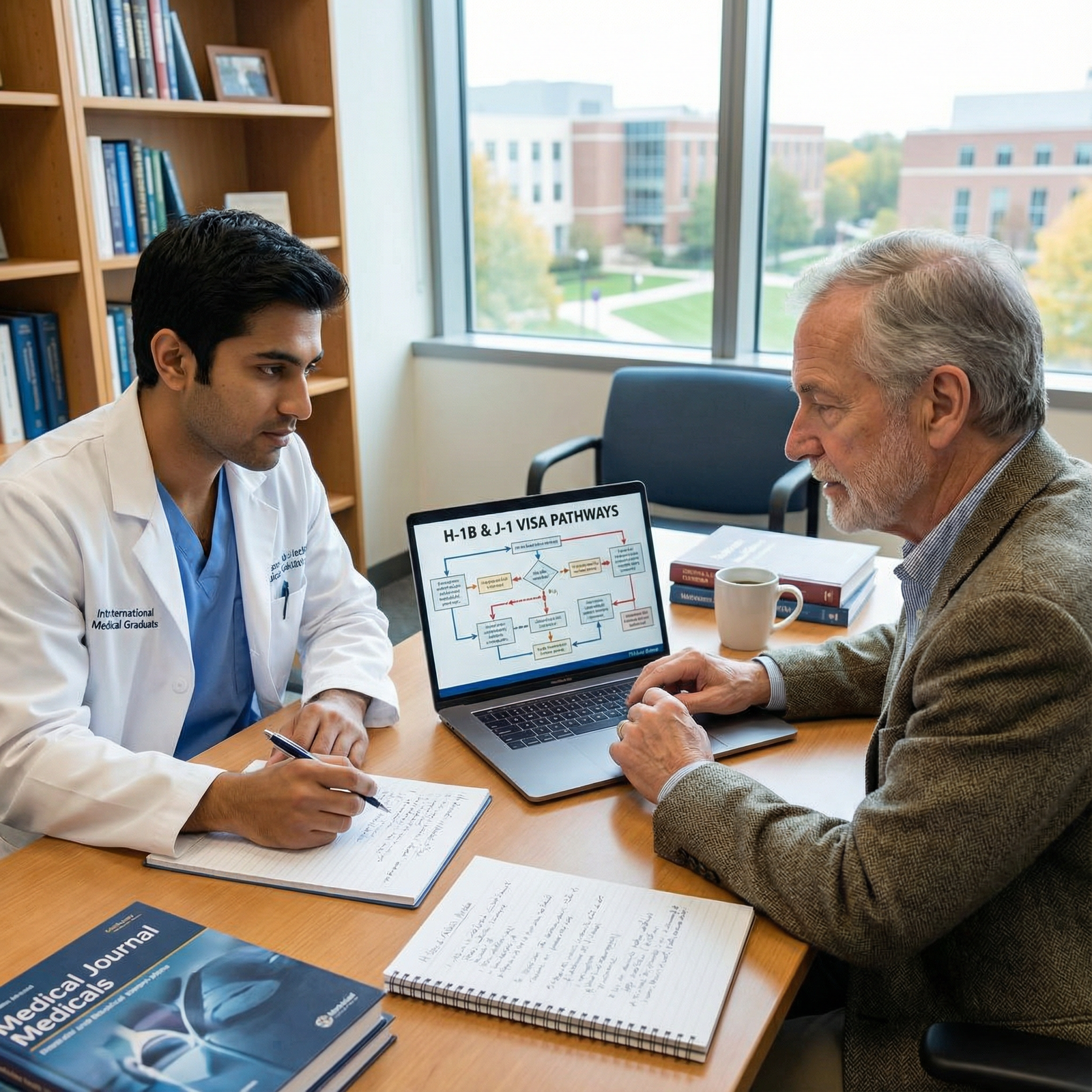
Understanding the Visa Landscape for PM&R Residency
For international medical graduates (IMGs), the path to a PM&R residency in the United States always runs through one core challenge: visa navigation. The physiatry match is competitive, and your visa strategy is not a side issue—it is a central component of your application, timeline planning, and long‑term career goals.
This guide focuses on visa navigation for residency specifically in Physical Medicine & Rehabilitation (PM&R), with a particular emphasis on:
- How PM&R residency programs view different visa types
- J-1 vs H-1B for residency and fellowship
- Common IMG visa options and their implications
- Practical steps to position yourself competitively as an IMG
- Long-term planning for practice in the U.S. after training
While this article is comprehensive, immigration rules change. Always cross‑check with official sources (ECFMG, ACGME, NRMP, U.S. Department of State, and USCIS) and, when needed, a qualified immigration attorney.
Overview of Visa Options for PM&R Residency Applicants
Before looking at program‑specific details, you need a clear understanding of the main residency visa categories:
- J-1 (Exchange Visitor – Physician Category)
- H-1B (Temporary Worker – Specialty Occupation)
- Other less common paths (green card holders, EAD via other statuses, etc.)
J-1 Visa: The Most Common Path for IMGs in PM&R
For most IMGs entering PM&R, the J-1 visa sponsored by ECFMG is the default route.
Key features of the J-1 physician visa:
- Sponsored and monitored by ECFMG, not the residency program directly
- Used for residency and fellowship training
- Generally limited to 7 years total for GME (residency + fellowship)
- Requires full ECFMG certification before sponsorship
- Imposes a 2-year home-country physical presence requirement after training
- You must return to your home country for 2 years OR
- Obtain a J-1 waiver (e.g., Conrad 30, academic waiver, government agency waiver)
Why J-1 is common in PM&R:
- Easier for programs to administer: ECFMG handles much of the paperwork.
- Many academic PM&R departments are accustomed to J‑1 residents and fellows.
- Widely accepted and understood across graduate medical education.
Implications for your PM&R career path:
- You may complete:
- 3–4 years of PM&R residency (categorical or advanced)
- Plus 1–2 years of fellowship (e.g., Pain, SCI, TBI, Sports, Neuromuscular, Pediatric Rehab)
- You must plan ahead for a J-1 waiver job if you want to stay in the U.S. to practice.
- This often involves working in an underserved area or at a qualifying institution.
H-1B Visa: Less Common, More Complex, Sometimes Strategically Valuable
The H-1B visa is a temporary work visa used for “specialty occupations,” including physicians. In the context of PM&R residency:
Key features of H-1B for residency:
- Sponsored directly by the residency program (not ECFMG).
- Requires:
- USMLE Step 3 passed before the H-1B petition is filed (many programs require it before ranking you).
- A valid state medical training license or eligibility to obtain one.
- Typically limited to 6 years, including all H-1B time (residency + fellowship + later employment).
- No automatic 2-year home-country requirement (unlike J-1).
- Can sometimes provide a smoother path to long‑term U.S. practice and green card sponsorship.
Why H-1B is less common in PM&R residency:
- More administrative work and legal cost for the program.
- Some state medical boards have additional requirements.
- Programs worry about Step 3 timing and training license logistics.
- Many academic PM&R programs have institutional policies favoring J-1 only.
When H-1B may be advantageous:
- You have a long-term plan to live and work in the U.S. without the obligation of a J‑1 waiver.
- You have already passed Step 3 early and meet state licensing requirements before match.
- You are targeting PM&R programs that explicitly accept or prefer H‑1B.
Other Visa/Status Categories
Though the focus is J‑1 vs H‑1B, other IMG visa options exist:
- Permanent resident (green card): No visa issue; you apply to PM&R residency as a domestic candidate.
- U.S. citizen (including naturalized citizens): No visa concerns.
- EAD (Employment Authorization Document) via:
- Pending asylum, refugee status, pending I‑485, TPS, DACA, etc.
- Some PM&R programs may accept EAD holders, but policies vary.
- Other nonimmigrant statuses (e.g., F‑1 with OPT, J‑2, H‑4):
- Sometimes transition to J‑1 or H‑1B for residency.
- Must coordinate timing of status changes carefully.
These alternative scenarios are specialized; if you fall into one of them, consult with both an immigration attorney and targeted PM&R programs.
J‑1 vs H‑1B in Detail: Strategic Considerations for Physiatry
Both J‑1 and H‑1B can get you into a PM&R residency, but they shape your long‑term options differently.
J-1 Visa: Pros, Cons, and PM&R-Specific Examples
Advantages of J-1 for PM&R residency:
- Broad acceptance: Many PM&R programs, especially university-affiliated, are “J‑1 only.”
- Predictable process: ECFMG guides both you and the program through the steps.
- Flexibility with fellowships: Easier to extend J‑1 within the 7-year limit for fellowships.
Disadvantages and challenges:
- 2-year home-country requirement after training unless you secure a waiver.
- J-1 waiver jobs in PM&R may be:
- Geographically limited (e.g., rural areas, underserved regions).
- Focused on general outpatient rehab or pain medicine rather than niche subspecialties.
- Some academic or private practice groups may strongly prefer candidates without waiver obligations.
PM&R-specific example (J-1 track):
- You match into a categorical PM&R residency on a J‑1.
- You complete 4 years of training (1 transitional year + 3 PM&R years).
- You then pursue a 1-year Sports Medicine fellowship and a 1-year Pain Medicine fellowship, both on J‑1 visas.
- Total J‑1 time: 6 years (within the 7-year cap).
- After fellowship, you must:
- Return to your home country for 2 years, or
- Obtain a J‑1 waiver position, perhaps in an underserved community pain clinic or rehabilitation hospital.
H‑1B Visa: Pros, Cons, and PM&R-Specific Examples
Advantages of H-1B for PM&R residency:
- No 2-year home-country requirement.
- Potentially smoother progression from residency → fellowship → attending position.
- Easier to proceed toward permanent residency (green card) with employer sponsorship.
- Attractive to some employers (no J-1 waiver complexity).
Disadvantages and challenges:
- Early Step 3 requirement: You usually need Step 3 passed before the rank list deadline (often by December–January).
- Not all PM&R programs are willing or able to sponsor H‑1B due to:
- Institutional policy
- Costs and administrative overhead
- The 6-year H‑1B limit can become a constraint if:
- You do a long residency+fellowship path and delay green card processing.
PM&R-specific example (H‑1B track):
- You pass Step 3 early (e.g., during or just after an observership/elective in the U.S.).
- You target a set of PM&R programs that explicitly state “H-1B sponsorship available.”
- You match into a 3-year advanced PM&R residency (PGY2–PGY4) after a separate prelim year.
- Total residency H‑1B time: 4 years.
- You then complete a 1-year SCI fellowship on H‑1B (same or new institution). Total: 5 years.
- Your employer begins green card sponsorship during fellowship, allowing you to continue on extended H‑1B status if needed.
Choosing Between J‑1 and H‑1B: Practical Decision Points
When planning your visa strategy for the physiatry match, ask:
- Do I realistically have time to pass Step 3 before residency applications/Rank Order List?
- If no, J‑1 is likely your main viable option.
- Do my target PM&R programs sponsor H‑1B?
- Many smaller community-based or “J‑1 only” institutions will not.
- What are my long-term goals?
- If you strongly intend to live and practice in the U.S. long term, H‑1B is attractive, but J‑1 with a waiver can still work.
- Am I prepared to be geographically flexible for a J‑1 waiver job?
- If yes, J‑1 may not be a major barrier.
- Does my home country’s health system require me to return anyway?
- If so, the J‑1 2-year rule might align with your existing obligations.
How PM&R Programs View Visa Sponsorship
Physical Medicine & Rehabilitation programs vary widely in how they handle residency visa issues. Understanding this landscape can help you target your applications strategically.
Common PM&R Program Policies on Visas
You will commonly see PM&R residency websites list one of the following:
“We accept only J‑1 visas sponsored by ECFMG”
- Most straightforward for the institution.
- You must be eligible for ECFMG J‑1 sponsorship.
“We sponsor J‑1 and H‑1B visas”
- More IMG-friendly and flexible.
- Often larger academic centers or systems with experience in international recruitment.
“We do not sponsor any visas”
- Typically limited to U.S. citizens, permanent residents, or those with independent work authorization (e.g., EAD).
No explicit mention of visas
- Requires you to email the coordinator or program director for clarification.
- Policies may be institution-wide rather than program-specific.
How Visa Type Affects Your Competitiveness
Residency visa type can subtly influence how programs view your application:
J‑1 applicants
- Usually considered “standard” international applicants.
- Programs may already have established processes and current J‑1 residents.
- Programs with “J‑1 only” policies will naturally prefer or restrict to J‑1.
H‑1B applicants
- Strongly preferred by some programs, especially those wanting long-term recruits.
- May be seen as more “serious” about the U.S. system if Step 3 is complete early.
- However, programs that are J‑1 only will not consider them for H‑1B at all; some may be reluctant due to costs.
Applicants with Green Card or U.S. Citizenship
- Usually have a logistical advantage; no sponsorship needed.
- Program resources can be focused on training rather than visa paperwork.
PM&R-Specific Nuances
PM&R as a specialty has particular patterns that interact with visa options:
Academic PM&R departments (often at large teaching hospitals):
- Frequently accept J‑1 visas.
- Many also have infrastructure to handle H‑1B sponsorship, especially if the hospital is a cap‑exempt institution (which avoids the standard H‑1B lottery issues).
Community-based PM&R programs:
- Some are very IMG-friendly with J‑1 sponsorship.
- Others may have strict institutional restrictions and sponsor no visas.
Fellowship implications:
- Top pain, sports, or SCI fellowships may have their own visa preferences (often J‑1 but some allow H‑1B).
- Planning your PM&R residency visa choice with fellowship pathways in mind is prudent.
Step-by-Step Visa Navigation Strategy for PM&R Applicants
To make visa navigation more concrete, here’s a structured approach you can follow while preparing for the physiatry match.
Step 1: Clarify Your Status and Long-Term Goals
Ask yourself:
- What is my current status (in or outside the U.S.)?
- Am I eligible for ECFMG certification within the application timeline?
- Do I intend to practice long-term in the U.S., or return home after training?
- Am I able to complete USMLE Step 3 early (before the rank order list deadline)?
Your honest answers will guide whether J‑1, H‑1B, or another path is realistic.
Step 2: Learn the Requirements for Each Visa Type
For J‑1 (ECFMG):
- ECFMG certification (USMLE Steps 1 and 2 CK + credential verification).
- A confirmed residency position in an ACGME-accredited program.
- Documentary evidence (sponsorship forms, DS-2019 issuance, etc.).
- Maintain adequate health insurance and comply with ECFMG regulations.
For H‑1B (Residency):
- USMLE Step 3 passed.
- State medical board trainee license eligibility (varies by state).
- A PM&R program willing to:
- Pay filing fees and possibly attorney fees.
- File on time for a cap-exempt H‑1B (most teaching hospitals are cap-exempt).
- Evidence of your medical degree and ECFMG certification.
Create a timeline backward from your intended July 1 residency start date to ensure each step is achievable.
Step 3: Research PM&R Programs’ Visa Policies Early
Before you invest time and money applying broadly, narrow your target list based on visa sponsorship:
- Use FREIDA, program websites, and ERAS program descriptions.
- Note which programs:
- Sponsor J‑1 only
- Accept J‑1 and H‑1B
- Don’t sponsor any visas
- Make a spreadsheet that includes:
- Program name
- City/state
- Visa policy (J‑1, H‑1B, both, none, unclear)
- Step requirements (Scores, cutoffs, Step 3 expectations)
- IMG-friendliness (based on current residents/faculty)
For visa questions not clearly stated, send a short, professional email to the program coordinator:
Subject: Visa Sponsorship Inquiry – PM&R Residency Applicant
Dear [Coordinator Name],
I am an international medical graduate planning to apply to your PM&R residency program this cycle. Could you please confirm which visa types (e.g., J‑1, H‑1B) your program is able to sponsor for incoming residents?
Thank you for your time and assistance.
Sincerely,
[Your Name], MD
Step 4: Align Your Application Strategy with Your Visa Reality
Once you understand your options:
If J‑1 is your primary path:
- Apply broadly to J‑1‑friendly PM&R programs.
- Make sure your ECFMG certification is on track.
- Highlight your adaptability and interest in underserved care (valuable if you later seek a J‑1 waiver).
If you are eligible for H‑1B (with Step 3):
- Include H‑1B-sponsoring PM&R programs in your priority list.
- But still apply to some J‑1 programs to maintain options.
- Prepare to discuss your early Step 3 and long-term goals professionally on interviews.
If you have independent work authorization (Green Card, EAD):
- Clearly indicate your status in ERAS.
- This often makes you more attractive to programs concerned about visa costs or caps.
Step 5: Communicate Clearly During Interviews
During PM&R residency interviews, visa questions may arise:
- Be transparent and concise.
- Demonstrate you understand the basics of your own visa path.
- Emphasize your focus on training quality and fit rather than only immigration issues.
Example talking points:
- “I am eligible for ECFMG-sponsored J‑1 and prepared to comply with all requirements.”
- “I have passed Step 3 and would be happy to pursue an H‑1B if that aligns with your institution’s policies.”
- “My long-term goal is to practice in rehabilitation medicine with a focus on [subspecialty], and I’m open to working in underserved areas to fulfill any waiver obligations if necessary.”
Programs appreciate applicants who show both professional maturity and realistic expectations.
Step 6: Plan Early for Post-Residency Options
While you should focus on matching into PM&R first, it is wise to understand your post‑residency pathways:
J‑1 Graduates
- Explore Conrad 30 and other waiver programs (VA, academic, state agencies).
- Network during residency with potential employers in underserved or waiver-eligible areas.
- Understand timing: waiver job contracts often need to be signed 1–2 years before completion of training.
H‑1B Graduates
- Discuss green card sponsorship with potential employers early.
- Understand PERM and I‑140 timelines so your H‑1B status can extend beyond 6 years if necessary.
Both groups
- Use PM&R conferences (AAPM&R, AAP, AAPM, etc.) to network with programs and practices familiar with IMG visa options.
- Seek mentors—especially senior physiatrists who previously navigated J‑1 or H‑1B themselves.
Special Considerations for IMGs Aiming for PM&R
Balancing Visa Strategy with Overall Application Strength
Your visa type is important, but it cannot compensate for a weak application. To be competitive in PM&R:
- Strengthen your US clinical experience (observerships, electives, externships in rehab or neurology).
- Gather strong letters of recommendation from PM&R faculty in the U.S. when possible.
- Show genuine understanding of physiatry—rehab team dynamics, functional goals, exposure to inpatient rehab units, EMGs, spasticity management, etc.
- Highlight any rehabilitation-related research, volunteer work, or sports/neuromuscular interests.
Programs are more willing to handle visa complexity for candidates who are clearly excellent fits for PM&R.
Timing Challenges for Non-U.S.-Based IMGs
If you are still outside the U.S.:
- Plan exam timelines (Step 1, Step 2 CK, and potentially Step 3) early.
- Consider whether traveling for U.S. rotations is feasible; these can significantly strengthen your profile.
- Factor in visa appointment wait times at U.S. consulates for your eventual J‑1 or H‑1B stamping.
Red Flags and Common Mistakes
- Assuming all PM&R programs sponsor visas: Many do not.
- Waiting too long to pass Step 3 if you are aiming for H‑1B.
- Not understanding the 2-year home residency requirement attached to J‑1.
- Over‑relying on one program type (e.g., only big academic centers) without backup options.
- Failing to update your status or exam completion promptly in ERAS.
FAQs: Visa Navigation for PM&R Residency
1. Is it easier to match into PM&R residency on a J‑1 or H‑1B visa?
For most IMGs, J‑1 is easier because more PM&R programs accept J‑1 than H‑1B, and you do not need Step 3 before applying. H‑1B can be advantageous but limits you to programs willing to sponsor it and requires more preparation (especially early Step 3).
2. Can I switch from J‑1 to H‑1B during PM&R residency or fellowship?
Sometimes, but it is complex and not guaranteed. Moving from J‑1 to H‑1B may require addressing the J‑1 2-year home residency requirement (usually via a waiver). Many residents stay on J‑1 for the duration of training and only switch to H‑1B (or other status) for their first attending job after obtaining a J‑1 waiver.
3. Do PM&R fellowships (e.g., Pain Medicine, Sports, SCI) accept J‑1 or H‑1B?
Yes, but policies vary widely by program and subspecialty. Many fellowships accept J‑1, some accept both J‑1 and H‑1B, and a few may restrict to certain visa types. When you start PM&R residency, begin tracking fellowship programs’ visa policies early so you can plan accordingly.
4. As an IMG with a visa, am I at a disadvantage in the physiatry match compared to U.S. graduates?
You face additional hurdles (visa sponsorship, exam timing, and often fewer U.S. clinical experiences), but many IMGs successfully match PM&R every year on J‑1 and H‑1B visas. Strengthening your application (USCE, letters, research, clear PM&R motivation) and targeting visa-friendly programs strategically can significantly narrow this gap.
Navigating residency visa options as an IMG is challenging, but with early planning, accurate information, and a focused PM&R strategy, you can align your immigration path with a successful physiatry career in the United States.