
Understanding the Visa Landscape for Radiation Oncology Residency
Radiation oncology is one of the most competitive and academically rigorous specialties in the United States. For international medical graduates (IMGs), the challenge is two-fold: succeeding in the rad onc match and simultaneously navigating complex residency visa rules.
Visa issues in radiation oncology residency can be more sensitive than in many other fields because:
- Programs are small (often 3–4 residents per year), so each resident slot is strategically important.
- Training is long (typically 4 years after internship), which makes programs wary of visa interruptions.
- Many residents pursue research years or fellowships, requiring careful long-term planning of status.
This guide focuses on the two main visa options for graduate medical education (GME) in the U.S.:
- J-1 exchange visitor visa
- H-1B temporary worker visa
and how they specifically affect radiation oncology residency applicants, especially IMGs.
Core Visa Types for Radiation Oncology Residency
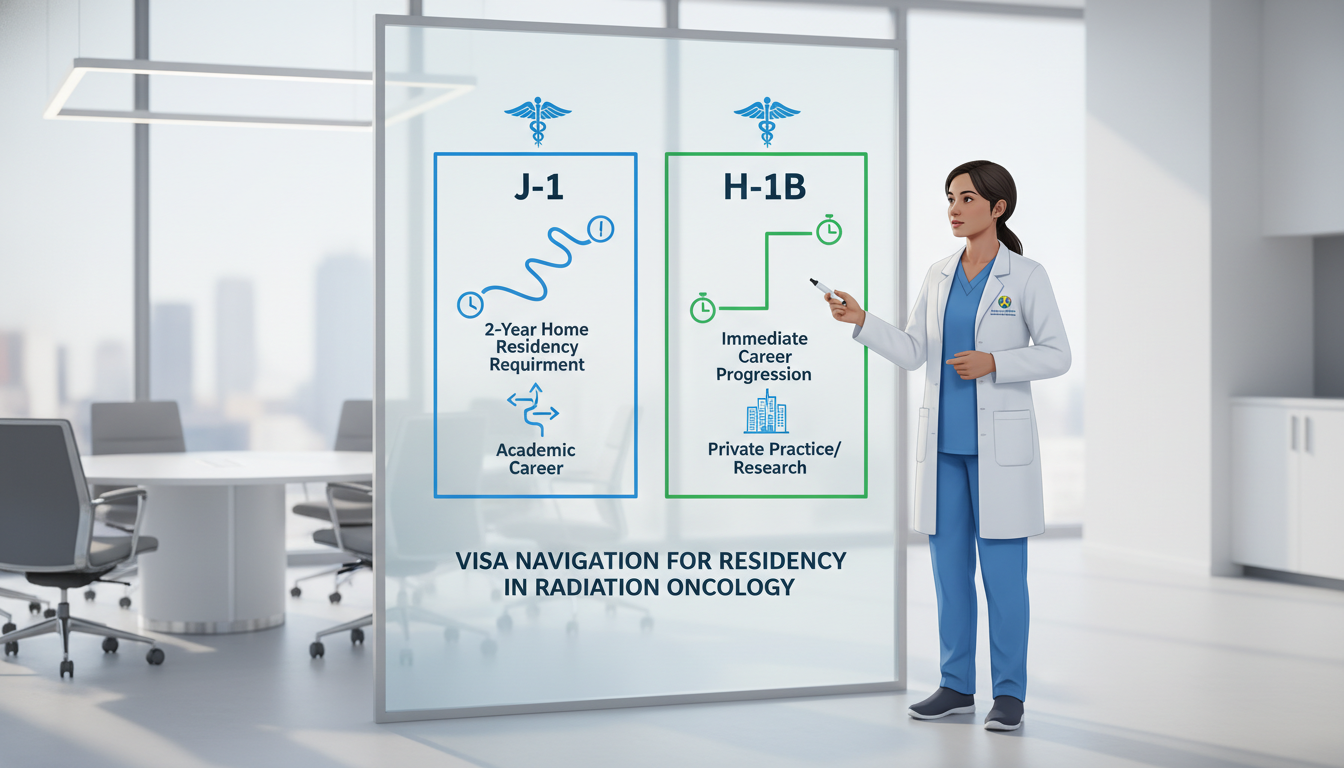
1. The J-1 Visa for Physicians
The J-1 is the most common visa pathway for IMGs in U.S. residency programs. It is sponsored by the Educational Commission for Foreign Medical Graduates (ECFMG), not by individual hospitals.
Key features of the J-1 for rad onc residents:
- Category: J-1 “Alien Physician” sponsored by ECFMG
- Duration: Up to 7 years total of clinical training (sufficient for internship + 4-year rad onc, and often still enough for one-year fellowship)
- Employment: Only in ACGME-accredited programs and positions approved in your training plan
- Program flexibility: Changes in training site or program require ECFMG approval
Two-year home-residency requirement
The biggest practical issue with the J-1 is the two-year home-country physical presence requirement (INA 212(e)):
- After finishing all J-1–sponsored training, you must either:
- Return to your home country (or country of last permanent residence) for a cumulative two years; or
- Obtain a J-1 waiver (e.g., Conrad 30, VA, research waiver, or hardship/persecution-based waiver)
Until you satisfy or waive this requirement, you generally cannot:
- Change status to H-1B or L-1 in the U.S.
- Obtain an H-1B, L-1, or immigrant visa (green card) at a consulate
For a radiation oncologist, this has practical implications:
- It may delay or complicate pursuing permanent employment in the U.S. after residency/fellowship.
- Waiver jobs typically must be in underserved areas, which may not align perfectly with where academic radiation oncology centers are located.
- If your long-term goal is an academic rad onc career in the U.S., you must plan your waiver strategy early.
Advantages of the J-1 for rad onc applicants
- Widely accepted: Many radiation oncology residency programs that sponsor IMGs are “J-1 only.”
- Centralized sponsorship: Handled through ECFMG, simplifying some administrative aspects for the program.
- Sufficient training time: The 7-year limit usually accommodates:
- 1 year preliminary/transitional internship
- 4 years diagnostic radiation oncology residency
- Plus possible 1–2 years fellowship or research if carefully planned.
Disadvantages of the J-1
- The two-year home requirement complicates long-term U.S. career planning.
- You’re more limited in moonlighting or non-standard training activities compared to H-1B.
- Less direct route to permanent residency; any green card process typically happens after waiver or after you’ve fulfilled the two-year requirement abroad.
2. The H-1B Visa for Residency
The H-1B is a temporary worker visa for “specialty occupations.” In GME, some programs choose to sponsor residents and fellows on H-1B instead of J-1.
Radiation oncology residency programs sponsoring H-1B are a minority but can be found, especially in:
- Larger academic medical centers
- Institutions with strong IMG recruitment histories
- Programs that want to support long-term academic or research careers in the U.S.
Key H-1B features for rad onc residents
- Duration: Up to 6 years total (including all previous H-1B time in other roles)
- Requires passing USMLE Step 3 before H-1B filing (crucial for timing your application)
- Employer-specific: Your hospital GME office is the H-1B petitioner
- No two-year home residency requirement
Because radiation oncology residency is 4 years (PGY-2 to PGY-5), and many IMGs need a 1-year internship before that, the total minimum is 5 years of training after graduation. With the 6-year H-1B limit, this is tight but usually workable if managed well.
Advantages of H-1B for IMG radiation oncologists
- No two-year home return rule: This makes it much simpler to:
- Transition into attending positions on H-1B
- Start green card processes during or immediately after training
- More flexible for long-term U.S. careers, especially in academic radiation oncology
- Some residents feel more secure about independent work and future job options
Disadvantages and challenges of H-1B
- Not all programs sponsor H-1B; many are J-1 only.
- Requires USMLE Step 3 early (often by December of the year before residency starts).
- Legal costs and paperwork are higher; some institutions are reluctant to commit resources.
- The 6-year time cap can be limiting if:
- You’ve already used H-1B years in other roles; or
- You plan extra research years, multiple fellowships, or interruptions.
3. Comparing J-1 vs H-1B for Radiation Oncology (High-Level)
Program perspective
- Many rad onc programs prefer J-1 because:
- It’s administratively simpler.
- ECFMG manages compliance.
- Waiver programs may encourage graduates to serve in underserved communities.
- Some programs support both J-1 vs H-1B options to broaden their applicant pool and help with long-term recruitment.
Applicant perspective
Choose J-1 if:
- The majority of programs you love are J-1 only.
- You’re open to going home or taking a waiver job after residency/fellowship.
- You want a simpler path to enter U.S. training without aggressive early Step 3 timing.
Choose H-1B (where available) if:
- Your long-term goal is a U.S.-based radiation oncology career with minimal geographic restriction.
- You’re comfortable planning ahead (Step 3, immigration timelines).
- You may want to start a green card process earlier or transition smoothly to attending roles.
How Visa Status Shapes Your Rad Onc Match Strategy
1. Researching Program Visa Policies
For the rad onc match, understanding each program’s visa stance is non-negotiable. Program policies vary widely:
- J-1 only (very common)
- J-1 and H-1B (less common but important for long-term planners)
- No visa sponsorship (U.S. citizen/green card only)
- Case-by-case (flexible but uncertain)
Where to find this information
- Program websites – Often under “For Applicants,” “International Applicants,” or “Eligibility.”
- FREIDA / AAMC / ERAS – Many programs list whether they sponsor visas and which types.
- Direct program emails – Short, professional queries can clarify ambiguous policies.
Example email:
Subject: Visa Sponsorship Policy for Radiation Oncology Residency Applicants
Dear Dr. [Program Director Last Name] / Residency Coordinator,
I am an international medical graduate applying to radiation oncology residency in the upcoming match. Could you please clarify whether your program sponsors visas, and if so, which types (J-1, H-1B, or both)?
Thank you for your time and assistance.
Sincerely,
[Your Name, Degree, Medical School, Expected Graduation Year]
Keep notes in a spreadsheet: program name, city, visa type (J-1 only/H-1B allowed/none), and any nuances mentioned.
2. Aligning Your Application Strategy with Visa Realities
For IMGs, visa compatibility should be a key filter when building your program list.
- If you’re open to J-1, your universe of possible programs is much larger.
- If you are aiming specifically for H-1B, especially in radiation oncology, you must:
- Identify H-1B-friendly programs early.
- Be realistic: smaller list + highly competitive field = higher risk of not matching.
- Consider applying broadly in geography and institution type.
Sample decisions by applicant profile
IMG focused on any U.S. rad onc training:
- Prioritize programs that take IMGs (historically) regardless of visa type.
- Be comfortable with J-1.
- Long-term career planning might include J-1 waiver strategies or possible return home.
IMG with strong desire for permanent U.S. academic career:
- Include as many H-1B-sponsoring rad onc programs as possible.
- Also apply to J-1 programs but prioritize H-1B in your rank list if comparable in quality and fit.
- Think early about institutions that also hire H-1B attendings and sponsor green cards.
3. Timing Issues: USMLE, ECFMG, and Match Deadlines
Visa navigation is about timing as much as choices.
For J-1:
- Must be ECFMG certified before J-1 sponsorship is finalized.
- Need:
- Passing USMLE Step 1 and Step 2 CK
- Primary source verification of your medical diploma
- J-1 paperwork typically follows your Match result and GME office instructions.
For H-1B:
- Must have USMLE Step 3 passed before H-1B petition is filed.
- Many institutions want Step 3 done by December–January of the Match year to allow:
- H-1B petition preparation
- Potential RFEs (Requests for Evidence) and delays
- This often means:
- Taking Step 3 either during your internship (for advanced positions)
- Or during a research/preliminary year, and well in advance if you’re not already in the U.S.
Rad Onc–specific scenario
Because radiation oncology is an advanced specialty (PGY-2 start):
- You typically apply during your final year of medical school or your internship.
- Your internship might be:
- In the U.S. (preliminary medicine/surgery or transitional year)
- Abroad (less common for U.S. rad onc entry)
For applicants seeking H-1B for the rad onc years:
- If you are doing your internship on a J-1 or other status, your H-1B for PGY-2 must still meet the Step 3 requirement.
- Coordinate Step 3 timing with your anticipated H-1B petition filing (often March–May before July 1 PGY-2 start).
IMG Visa Options and Practical Scenarios in Radiation Oncology
1. Common Pathways for IMGs Entering Rad Onc
Scenario A: IMG on J-1 for both internship and rad onc
- Year 1: Preliminary/transitional year on J-1 (ECFMG physician category).
- Years 2–5: Radiation oncology residency on J-1.
- After: Fellowship (if within 7-year limit) also on J-1.
Outcome:
- You accumulate J-1 clinical training time (typically 5–6 years).
- You then must address the two-year home residency requirement or arrange a waiver job.
Scenario B: IMG on J-1 for internship, converting to H-1B for rad onc
This is not straightforward because of the J-1 two-year rule. In most cases:
- If your J-1 is subject to 212(e), you cannot switch directly to H-1B without:
- Completing 2 years in your home country; or
- Getting a J-1 waiver.
Thus, many applicants avoid starting with J-1 if they know they want H-1B later, although this may reduce initial options.
Scenario C: IMG on H-1B from the beginning
- Year 1: Preliminary year on H-1B (some programs sponsor this, some do not).
- Years 2–5: Radiation oncology residency at H-1B–friendly program.
- Potentially start green card process late in residency or early as faculty.
Outcome:
- No “return home” requirement.
- Better continuity for long-term U.S. academic or private practice plans.
However:
- Requires early Step 3.
- Dependent on finding H-1B-supportive programs for both internship and rad onc.
2. Visa Considerations for Research and Gap Years
Radiation oncology is research-intensive. IMGs commonly take:
- Research fellowships
- Postdoctoral positions
- MPH/PhD or other graduate degrees in U.S. institutions
These may involve:
- F-1 (student visa)
- J-1 (research scholar category)
- H-1B in research roles
How this interacts with residency visas:
- Time spent in H-1B research roles counts toward the 6-year H-1B limit, possibly leaving less time for residency.
- Time in research J-1 may also trigger a two-year home residency requirement, separate from J-1 clinical. You must understand which category you’re in and whether 212(e) applies.
- If you’ve had multiple J-1 stays with 212(e), these requirements typically merge into a single 2-year total, not stacked. But the specific rules are nuanced; expert legal advice is essential.
Planning tip for rad onc aspirants:
- If you are early in your career and know you’ll need many years in the U.S. (research + residency + possible fellowship):
- Map out the total visa timeline with a qualified immigration attorney.
- Be cautious about using up H-1B years too early in non-training roles.
- Understand if a research J-1 will create a future barrier to H-1B.
Long-Term Career Planning: Post-Residency Visa Paths for Rad Onc
1. J-1 Waiver Options for Radiation Oncologists
After completing J-1–sponsored residency/fellowship, you have three main paths:
- Return home for 2 years (fulfilling the requirement)
- Obtain a J-1 waiver
- Change career plans geographically (e.g., non-U.S. practice)
Common J-1 waiver options:
- Conrad 30 waivers (state-based) – Mostly for primary care and some specialties; radiation oncology positions may be available but are less common and depend heavily on state needs.
- VA waivers – Working at a Veterans Affairs facility in underserved areas; occasionally relevant for radiation oncology, but positions are limited.
- Federal agency waivers – NIH or other federal bodies may sponsor waivers for certain research roles.
- Hardship or persecution waivers – Based on personal or family circumstances.
For a new radiation oncologist just finishing residency:
- Waiver jobs may be in rural or underserved regions where oncology services are needed.
- Academic positions in major cancer centers might be less compatible with waiver requirements, but exceptions exist.
2. Green Card Strategies for H-1B Rad Onc Graduates
If you train on H-1B, you avoid the J-1 home requirement and can often:
- Transition to an attending job on H-1B.
- Start an employment-based green card process (EB-2 or EB-1 categories, depending on your credentials).
Radiation oncologists, especially with research portfolios, may qualify relatively quickly for:
- EB-1A (extraordinary ability) or
- EB-1B (outstanding researcher/professor)
- EB-2 NIW (National Interest Waiver)
This is particularly achievable if you:
- Have strong research productivity during residency/fellowship (publications, national presentations).
- Work at an academic cancer center supportive of permanent sponsorship.
- Build a national reputation in a focused area of radiation oncology (e.g., stereotactic radiation, proton therapy, global oncology).

Practical Tips and Actionable Advice for Visa Navigation
1. Start Planning Early (Years Before the Match)
During medical school or early research years:
- Clarify your end-goal: Long-term U.S. practice vs training only vs undecided.
- Learn the basics of J-1 vs H-1B implications.
- Track which radiation oncology institutions are historically IMG- and visa-friendly.
Build a simple “visa and career planning file”:
- Summary of your current status and any prior J-1/H-1B history.
- Targets for Step 3 timing (if H-1B is desired).
- Short notes from any attorney consultations.
2. Make Visa Questions Part of Program Due Diligence
When considering where to apply or ranking programs, look for:
- Clear statements like “We sponsor J-1 visas only.”
- Evidence that the program:
- Has current or recent IMGs
- Has successfully navigated complex visa scenarios
- During interviews (if appropriate and late in the conversation), ask:
- “Do you currently have residents on visas?”
- “Do you anticipate any changes to your visa sponsorship policies in the next few years?”
Keep the tone professional and focused on continuity of training, not just immigration benefits.
3. Coordinate with Legal and Institutional Resources
Immigration for physicians is complex and dynamic. Always:
- Use official resources:
- ECFMG website for J-1 policies
- AAMC & NRMP guidance for residents
- Institutional graduate medical education (GME) office updates
- Consult a qualified immigration attorney for:
- Multiple prior visa histories
- Long-term green card planning
- J-1 waiver strategy discussions
4. Maintain Excellent Documentation
Throughout medical school, research years, and residency applications:
- Keep:
- Copies of all I-20, DS-2019, I-797, and visa stamps
- Records of entry/exit dates, I-94 forms
- Up-to-date CV and evidence of research/teaching/service
These are crucial for:
- Accurate H-1B time calculations
- Green card applications
- Proving eligibility for certain waivers or categories
5. Match Your Visa Strategy to Your Risk Tolerance
Radiation oncology is a high-stakes, low-seats specialty. Visa rigidity can increase your risk of not matching.
- If your top priority is simply matching in U.S. rad onc:
- Maximize your program list without visa constraints (i.e., accept J-1).
- If your top priority is long-term U.S. retention and academic trajectory:
- Emphasize H-1B programs, but have a realistic plan B (including geography or even alternative specialties if necessary).
FAQs: Visa Navigation for Radiation Oncology Residency
1. Is it realistic to aim for H-1B as an IMG in radiation oncology?
Yes, but it’s challenging. The rad onc match is highly competitive, and only a subset of programs sponsor H-1B. To keep this realistic, you should:
- Pass USMLE Step 3 early enough.
- Identify and apply broadly to H-1B-friendly programs.
- Maintain an open mind about J-1 programs as part of your rank list if matching in rad onc is your primary goal.
2. Will being on a J-1 hurt my chances of an academic career in radiation oncology in the U.S.?
Not necessarily. Many academic radiation oncologists trained on J-1 visas. The challenge is mainly transitioning after residency/fellowship—you’ll likely need:
- A J-1 waiver job, which might be outside major academic hubs; or
- To spend 2 years in your home country and then return.
Some physicians successfully build hybrid careers, starting with waiver positions and then moving into academic roles later, or pursuing academic work in their home country.
3. Can I switch from J-1 to H-1B during or after residency?
If your J-1 is subject to the two-year home-country requirement (which is typical for J-1 physicians), you generally cannot change to H-1B until:
- You have completed 2 years physically in your home country; or
- You have obtained a J-1 waiver.
Thus, planning a direct switch from J-1 to H-1B during residency is generally not feasible without securing a waiver early (which is unusual for residents). This is why your initial choice of visa path is so important.
4. Are there special IMG visa options unique to radiation oncology?
No special visa category exists specifically for radiation oncology. However:
- Some federal or academic employers may value the public health impact of radiation oncology for National Interest Waiver (NIW) or EB-1/EB-2 green card petitions.
- Certain underserved regions may prioritize oncology specialists, potentially making J-1 waiver jobs more available, though this is highly state- and institution-dependent.
This guide provides a structured overview of IMG visa options and strategies for radiation oncology residency. Immigration law changes frequently, and individual backgrounds vary, so always verify details through official sources and consult an experienced immigration attorney before making high-stakes decisions about your training and career.