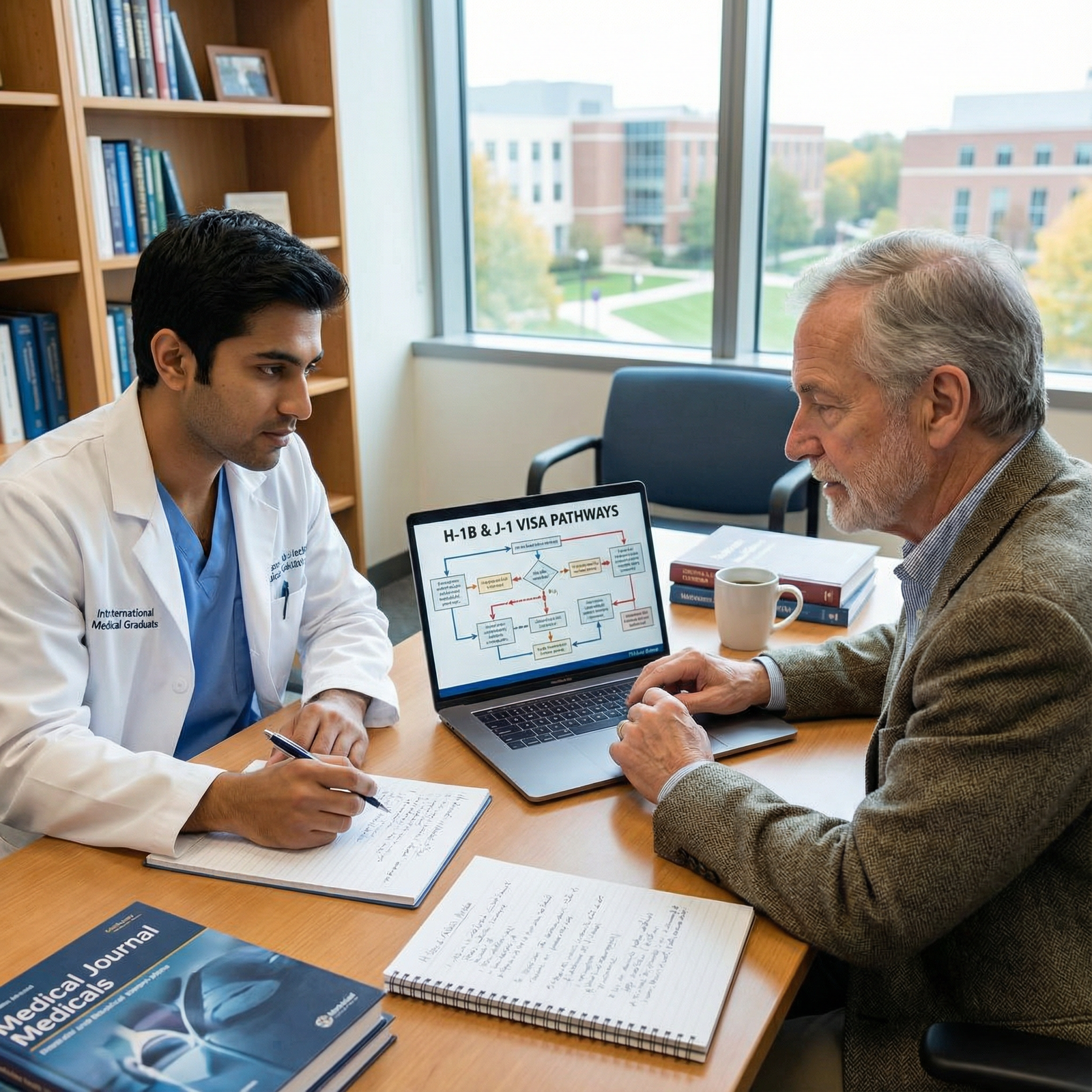
Understanding Visa Navigation for Residency in North Carolina’s Research Triangle
The Research Triangle in North Carolina—anchored by Duke, UNC, and NC State—is one of the most competitive and academically rich regions in the United States for graduate medical education. For international medical graduates (IMGs), it is also a region with well-established structures for sponsoring residency visas and supporting international trainees.
When you think about “North Carolina residency” from an immigration perspective, you’re really asking: What visa options will allow me to train, live, and (potentially) continue working in the Research Triangle? This article walks you through the key visa categories (especially J-1 vs H-1B), how large academic centers such as Duke residency programs typically handle sponsorship, and what practical steps you should take as an IMG targeting programs in the Triangle.
We’ll focus on:
- How residency visa sponsorship works in general
- Specific realities for the Research Triangle (NC): Duke, UNC, and affiliated hospitals
- The pros and cons of IMG visa options (J‑1, H‑1B, and others)
- How to align your visa planning with your specialty, long-term goals, and match strategy
Overview of Residency Visa Sponsorship in the Research Triangle
Residency programs cannot simply “decide” to sponsor any visa they want; they must operate within federal immigration law, institutional policies, and, for J‑1 visas, Educational Commission for Foreign Medical Graduates (ECFMG) regulations. The Research Triangle’s major institutions have long experience with IMGs and mature processes in place.
Key Institutions in the Triangle
When you hear “Research Triangle,” you’re primarily looking at:
- Duke University Health System (Duke University Hospital and affiliated sites)
- UNC Health / University of North Carolina at Chapel Hill
- WakeMed, UNC Rex, Duke Regional, Durham VA, and other affiliated training sites
Each residency program in these systems can have slightly different visa policies, even within the same university. For example, among Duke residency programs:
- Internal medicine may routinely sponsor both J‑1 and H‑1B
- A smaller subspecialty fellowship might accept only J‑1
- Some programs may have historically preferred J‑1 due to simpler processing
You must check each program’s website and contact the program coordinator if visa information is unclear.
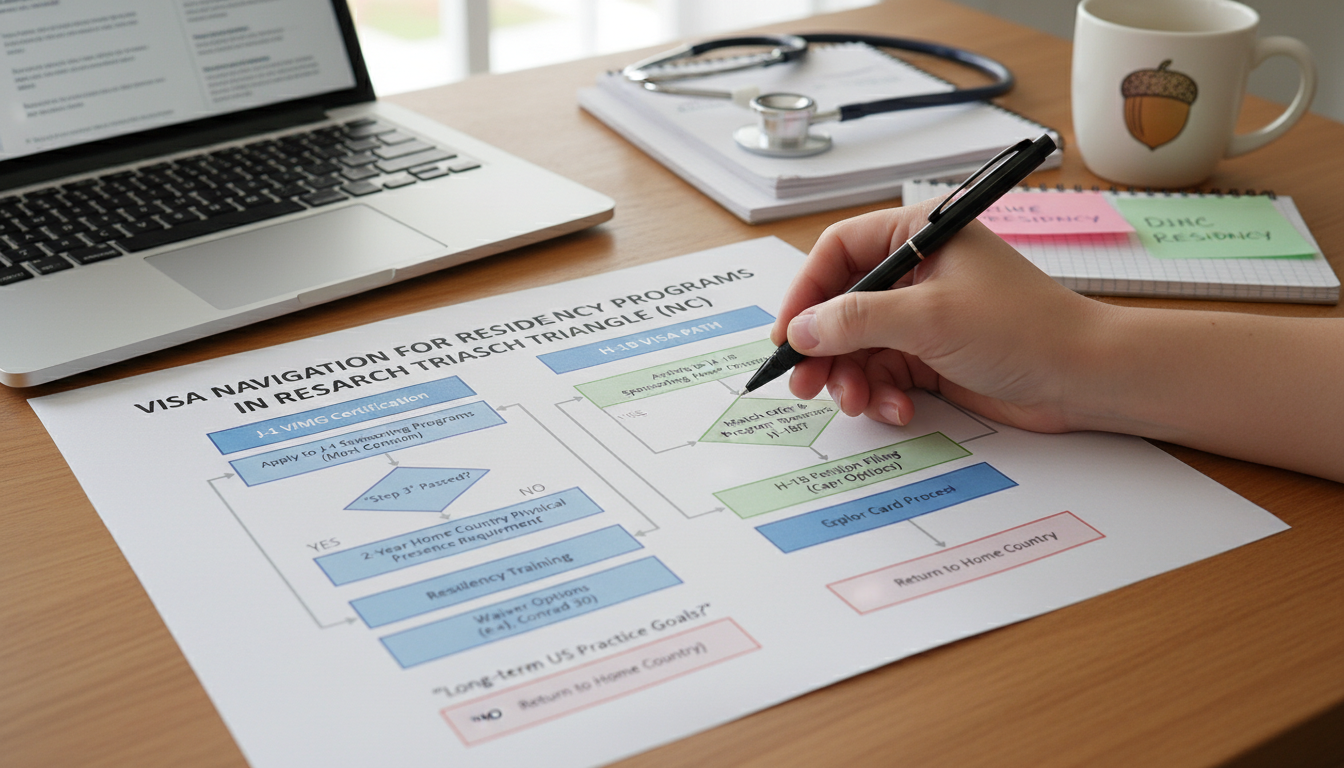
Common Visa Pathways for IMGs in the Triangle
For clinical residents and fellows, the realistic options are:
- J‑1 Physician (ECFMG-sponsored) – by far the most common
- H‑1B (Temporary Worker in Specialty Occupation) – selectively offered for residency/fellowship at some Triangle institutions
- Other statuses (F‑1 OPT, O‑1, etc.) – rare in residency entry, but sometimes relevant for transitions or research years
Family-based or employment-based permanent residency (“green cards”) usually come after or alongside training, rather than as the initial path into residency.
J‑1 vs H‑1B for Residency: What IMGs Need to Know
Understanding J‑1 vs H‑1B is central to any discussion of IMG visa options in the Triangle. Your long-term goals—academic career, community practice in North Carolina, subspecialty training—should influence which visa best aligns with your trajectory, when you have a choice.
The J‑1 Physician Visa (Most Common for Residency)
Who sponsors it?
For residency, J‑1 physicians are sponsored by ECFMG, not by the individual hospital (though the institution supports the process).
Key features:
- Purpose: Graduate medical education (residency/fellowship) in accredited programs
- Eligibility:
- ECFMG certification
- USMLE Step requirements met (per ECFMG and program)
- Valid training position in an ACGME-accredited program (e.g., Duke, UNC)
- Duration: Typically valid one year at a time, renewable up to 7 years in total for clinical training (exceptions are possible but limited)
- Two-year home residence requirement (212(e)):
- After training, most J‑1 physicians must return to their home country for two years before being eligible for certain US immigration benefits (e.g., H‑1B or permanent residency), unless they obtain a waiver
This 2-year rule is the single biggest strategic consideration of the J‑1 pathway.
Why Triangle Programs Like the J‑1
Programs in the Research Triangle widely use J‑1 sponsorship because:
- The process is standardized through ECFMG
- It’s administratively lighter for programs compared with H‑1B
- It’s aligned with ACGME/ECFMG oversight and widely accepted in academic centers
Many Duke residency and UNC residency programs explicitly state that they sponsor or accept applicants on J‑1 visas.
Advantages of J‑1 for IMGs
- Broad acceptance: More programs in NC (and nationwide) are comfortable with J‑1 than H‑1B for training
- Predictability: ECFMG processes are well established
- Shorter lead time: Often easier to arrange within tight Match timelines
- Easier transitions between accredited programs (e.g., internal medicine residency at Duke to fellowship elsewhere on J‑1)
Challenges of J‑1 for Long-Term Plans
- Two-year home residence requirement can delay:
- Transition to H‑1B employment after training
- Green card sponsorship
- You may need a J‑1 waiver job afterward (e.g., underserved/physician shortage areas) before settling in your desired location
- Less flexibility if you want to immediately practice in the US after training in an unrestricted way
In North Carolina, many physicians complete residency/fellowship on J‑1, then take J‑1 waiver positions in underserved areas (sometimes still near major centers) before moving to more competitive urban practices.
The H‑1B Visa for Residency
The H‑1B is a work visa for “specialty occupations” that some residency programs—including certain Duke residency and UNC programs—may sponsor for highly qualified IMGs.
Key features:
- Employer-sponsored: The hospital/university files and maintains the petition
- Qualification:
- You must have passed USMLE Step 3 before the H‑1B is filed (a critical timeline issue)
- Have an unrestricted medical license or appropriate training license (requirements vary by state; North Carolina has defined criteria for training permits)
- Duration: Initially up to 3 years, renewable up to a maximum of 6 years in most cases (time in certain statuses abroad may “reset” this)
- No automatic 2‑year home rule as with J‑1 (though 212(e) can apply from prior J‑1 uses in some cases)
Why Some IMGs Prefer H‑1B
- No routine 2‑year home residence requirement
- Generally easier to transition directly to employment or a green card after residency/fellowship
- Can allow a smoother path into academic or subspecialty positions in the US, including in North Carolina, without the detour of a J‑1 waiver job
For example, an IMG completing an internal medicine residency at a Duke-affiliated program on H‑1B may move straight into a hospitalist job in the Triangle or into an H‑1B fellowship without home-country return.
Limitations and Challenges of H‑1B in the Triangle
- Not all programs sponsor H‑1B: Many will say “J‑1 only” or “J‑1 preferred.”
- Step 3 timing:
- You must pass USMLE Step 3 early enough (often by January–March of Match year) for an H‑1B to be feasible for a July 1 start.
- Triangle programs are strict about this; missing the deadline can force a switch to J‑1 or even jeopardize your ability to start.
- Costs and administrative burden:
- Legal fees and filing costs are higher
- Institutions may impose selection thresholds (e.g., only exceptional candidates, or only for certain specialties)
Because of these challenges, some Research Triangle programs reserve H‑1B sponsorship for:
- Candidates with strong research or academic potential
- Subspecialty fellows who are already in their institutional ecosystem
- Programmatic needs in critical specialties (e.g., some departments may be more flexible than others)
J‑1 vs H‑1B: Strategic Comparison for Research Triangle IMGs
Key strategic points when targeting North Carolina residency positions:
Match likelihood
- More programs in the Triangle accept J‑1; you’ll limit your options severely if you apply only to H‑1B-supporting programs.
- Many IMGs leverage J‑1 to enter the system, then decide on waiver strategies later.
Long-term career in the US
- If your priority is a straight line to US permanent practice (especially in academic roles), H‑1B is attractive.
- If you are open to J‑1 waiver jobs (often in underserved areas, possibly outside the Triangle) then a J‑1 can still support a stable long-term US career.
Specialty choice and fellowship ambitions
- Competitive specialties and elite academic fellowships (cardiology, GI, heme/onc, etc.) in places like Duke and UNC may be equally accessible from either visa, but some employers may find H‑1B transitions administratively simpler.
- However, a strong academic record and network matter far more than the specific training visa.
In practice, many IMGs who match into Duke residency or UNC programs in the Triangle are on J‑1. A smaller subset navigates the extra hurdles to secure H‑1B, particularly if they plan long-term US practice and can manage early Step 3 completion.
Other Relevant Visa and Status Scenarios
While J‑1 and H‑1B dominate discussions of IMG visa options for residency, you may encounter or consider other statuses as stepping stones or side paths, especially in a region with heavy research emphasis like the Research Triangle.
F‑1 Students and the OPT Bridge
Some IMGs in the Triangle complete:
- Master’s degrees (e.g., MPH, MS in Clinical Research)
- PhD programs in biomedical sciences
on F‑1 student visas, often at Duke, UNC, or NC State, then transition to residency.
Optional Practical Training (OPT) may occasionally be used:
- For research positions while applying for residency
- To maintain status while awaiting the Match
But for clinical residency training itself, F‑1/OPT is generally not a primary pathway. You will typically need to convert into a J‑1 or H‑1B before starting an ACGME residency.
O‑1 Visa (Extraordinary Ability)
Rarely, highly accomplished physician-scientists in the Triangle may hold O‑1 status:
- Usually for research or faculty roles, not initial residency
- Can sometimes be relevant later in academic careers at Duke or UNC
For pure residency applicants, O‑1 is unusual and not a realistic first-line plan.
Permanent Residents and Other Special Categories
If you already hold:
- US permanent residency (green card)
- Asylum or refugee status
- Other work-authorized statuses (e.g., EAD through pending green card)
your situation is different. You apply as an IMG without needing residency visa sponsorship. In that case, the “North Carolina residency” issue becomes one of:
- Meeting state licensing/training permit requirements
- Competing effectively in the Match
But if you’re reading this for J‑1 vs H‑1B comparisons, you’re likely not in this group yet.
Practical Steps: How to Plan Your Visa Strategy for Triangle Programs
To successfully navigate visas for residency in the Research Triangle, you need both early planning and targeted communication with programs.
1. Clarify Your Long-Term Goals Up Front
Ask yourself:
- Do I want to settle long-term in the US, ideally in an academic or subspecialty role?
- Am I open to doing a J‑1 waiver job in a rural or underserved area after training?
- Is my dream to work specifically in North Carolina, or am I geographically flexible?
If you strongly want a direct path to permanent US practice with minimal detours, and you can realistically handle the extra requirements, you may prioritize programs that offer H‑1B. However, you should not underestimate the competitiveness of programs and the limited number of H‑1B slots.
2. Research Each Program’s Sponsorship Policy
For each program in the Triangle you’re considering:
- Check their website under “International Medical Graduates” or “Eligibility & Visa Sponsorship.”
- Look for explicit phrases like:
- “We sponsor J‑1 visas only”
- “We sponsor J‑1 and H‑1B visas”
- “We accept J‑1 visa holders; H‑1B considered on a case-by-case basis”
- If unclear, email the program coordinator with a short, specific query:
“I’m an IMG planning to apply this cycle. Could you please confirm whether your program sponsors J‑1, H‑1B, or both for residency trainees?”
For Duke residency programs, policy variations among departments are common. UNC and other area hospitals may also differ by specialty.
3. Time Your USMLE Step 3 Strategically
If H‑1B is important to you:
- Plan to take and pass Step 3 early—ideally by late fall or early winter of the application year.
- Confirm with programs and their GME office what latest acceptable Step 3 completion date is for H‑1B filing.
If you apply for positions that only sponsor J‑1, Step 3 timing is less critical for visa purposes (though still useful for your overall profile and for future state licensing).
4. Prepare Documentation Early
Typical documents programs and their GME/HR offices will need for residency visa processing:
- Passport, CV, medical school diploma, transcripts
- ECFMG certificate
- USMLE score reports
- For J‑1: Application materials as per ECFMG requirements (Form DS‑2019, etc.)
- For H‑1B:
- Step 3 score report
- Proof of medical degree equivalency
- State training license or eligibility evidence
- Any prior US immigration history (I‑94, previous visas, etc.)
In the Research Triangle, major academic centers have central GME offices that coordinate this. But delays in obtaining documents can still impact your start date. Start collecting and scanning documents early.
5. Coordinate with Your Matched Program Immediately After the Match
Once you match (e.g., into a Duke residency program, UNC, or another Triangle institution):
- Respond promptly to their onboarding communications
- Clarify your current immigration status and desired visa category
- Ask precise questions if needed, such as:
- “Given my Step 3 completion and your policy, am I eligible for H‑1B sponsorship, or should I plan for a J‑1 through ECFMG?”
This region has experienced visa and GME offices, but they still operate on firm timelines. Late responses from you can force a simpler visa option (often J‑1) even when H‑1B might have been feasible.

Special Considerations for the Research Triangle (NC)
The Triangle’s mix of world-class universities, robust health systems, and a growing population shapes the visa environment for IMGs.
Academic Intensity and Research Opportunities
Duke and UNC are internationally recognized for their research output. As an IMG:
- Being on J‑1 does not limit your ability to engage in research or scholarly activities during residency.
- Being on H‑1B may offer slightly smoother pathways to research-intensive faculty roles later, especially if pursuing O‑1 or green card pathways directly from an H‑1B base.
If your long-term plan is a physician-scientist career in the Triangle, you should:
- Build a strong research profile regardless of visa
- Network early with mentors in your field
- Discuss career and visa trajectories with your program director and institutional international services office
Post-Training Practice in North Carolina
If your goal is to remain in North Carolina after training:
J‑1 route:
- You may need to obtain a J‑1 waiver position.
- Many J‑1 waiver opportunities in NC are in rural or underserved areas, sometimes several hours from the Triangle.
- After fulfilling your 3-year waiver obligation (common requirement), you may then move more freely, including to Triangle-based roles.
H‑1B route:
- You can potentially transition directly into a hospital or clinic in the Triangle, assuming an employer sponsors you.
- You may move toward permanent residency with employer sponsorship without the 2-year home rule complication.
Because the Triangle is an attractive location, competition for permanent roles—especially those that require visa sponsorship—is stiff. Building a strong clinical reputation, network, and scholarly portfolio during residency/fellowship matters as much as the visa category you hold.
Actionable Tips for IMGs Targeting the Triangle
Cast a wide net, then refine.
Apply to multiple North Carolina residency programs (both J‑1 and H‑1B sponsors). After interviews, refine preferences based on both training quality and visa realities.Don’t let visa preference completely override program quality.
Training at a strong Duke residency or UNC program on J‑1 may be more beneficial long-term than a lower-quality program elsewhere that offers H‑1B.Be transparent—but strategic—about visa needs.
You can safely indicate that you are flexible (e.g., “willing to train on J‑1 or H‑1B”), as this increases your attractiveness to programs. Reserve visa preference discussions for post-interview or post-match communications when appropriate.Use institutional resources once matched.
Duke, UNC, and other Triangle institutions have:- GME offices
- International student/scholar offices
- Immigration attorneys or contracted law firms
Use them actively to clarify timelines, document requirements, and long-term planning.
Stay updated on immigration policy changes.
Visa rules and interpretations can change, including J‑1 waiver options and H‑1B processing. Follow:- ECFMG announcements
- Institutional immigration office updates
- Reliable professional societies and immigration law resources
FAQs: Visa Navigation for Residency in the Research Triangle (NC)
1. Do Duke residency programs sponsor H‑1B, or only J‑1?
It varies by department and by year. Some Duke residency and fellowship programs sponsor both J‑1 and H‑1B; others prefer J‑1 only due to administrative burden and timing. You should:
- Check each program’s official website for current policy
- Email the program coordinator with a brief inquiry
- Understand that even in H‑1B-sponsoring departments, Step 3 timing and candidate competitiveness influence whether an H‑1B will be offered
2. Is it harder for IMGs to match into North Carolina residency programs because of visa issues?
Visa needs add complexity, but they are not a disqualifier. Programs in the Triangle are accustomed to IMGs and residency visa sponsorship. What matters most is:
- Clinical and academic performance
- USMLE scores
- Strong letters of recommendation and personal statement
- Clear communication about your ability to meet visa requirements (e.g., J‑1 eligibility, Step 3 timing for H‑1B)
Visa concerns may narrow options slightly, but many IMGs successfully match into North Carolina residency positions every year.
3. If I start residency on J‑1, can I later switch to H‑1B during fellowship or after residency in the Triangle?
Possibly, but it is not automatic. Key factors:
- If you are subject to the two-year home residence requirement (212(e)) from J‑1, you typically must:
- Fulfill it (spend 2 years physically in your home country), or
- Obtain a J‑1 waiver
before changing status to H‑1B or permanent residency in the US.
Some physicians complete J‑1 residency/fellowship, obtain a waiver through underserved work (often outside the Triangle), then later transition to H‑1B or permanent residency. Switching directly from J‑1 residency to H‑1B fellowship may be possible only if you are not subject to 212(e), or if you’ve already cleared that requirement.
4. Which visa is “better” for residency in the Research Triangle: J‑1 or H‑1B?
Neither is universally “better”; they serve different needs:
- J‑1 is usually easier to obtain for residency, widely accepted, and supported by ECFMG, making it the most common choice.
- H‑1B can be better for long-term US practice plans because it avoids the standard 2-year home rule and can lead more directly to employment and green card sponsorship.
For many IMGs targeting the Triangle, the optimal approach is:
- Prioritize training quality (program reputation, case mix, mentorship)
- Be flexible on visa category (especially if you lack early Step 3)
- Incorporate visa strategy into your post-residency planning, not just into program selection
By understanding the nuances of J‑1 vs H‑1B, how Duke residency and other Triangle programs handle sponsorship, and how your long-term ambitions align with each pathway, you can make informed choices and confidently move toward a successful training and career journey in North Carolina’s Research Triangle.