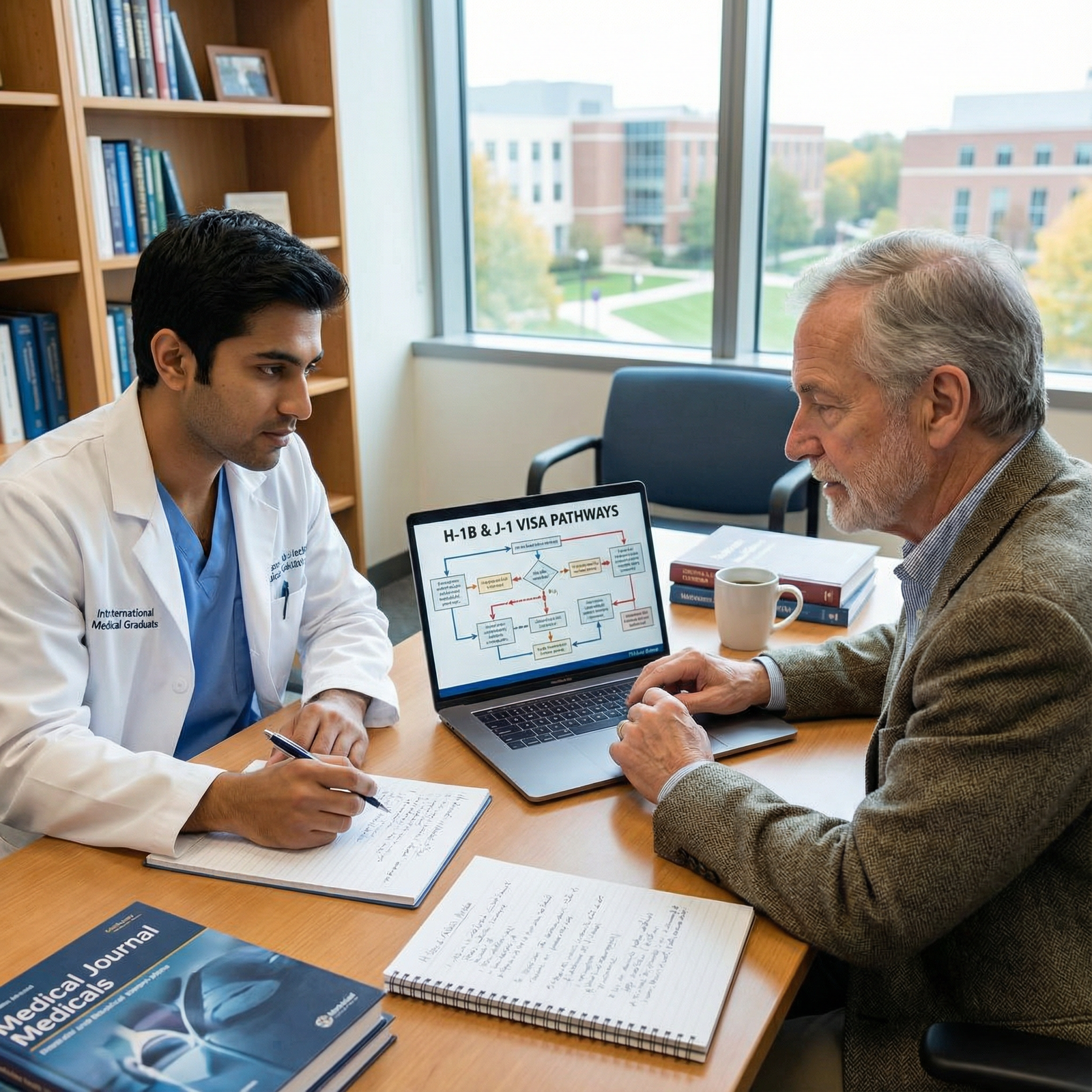
San Francisco Bay Area residency training is highly competitive and uniquely complex for international medical graduates (IMGs), especially when it comes to visas. Between world-renowned academic centers (UCSF, Stanford, Kaiser, Sutter, county systems) and high cost of living, understanding how to navigate a residency visa is critical to planning your career.
This guide walks you step-by-step through visa navigation for residency programs in the San Francisco Bay Area, with a focus on J-1 vs H-1B, practical application strategies, and common pitfalls for IMGs.
Understanding the Bay Area Residency Landscape for IMGs
The San Francisco Bay Area includes multiple major training hubs:
- San Francisco: UCSF, Zuckerberg San Francisco General, Kaiser San Francisco, California Pacific Medical Center (CPMC)
- East Bay (Oakland/Berkeley): UCSF Benioff Children’s – Oakland, Highland Hospital (Alameda Health System), Kaiser Oakland, Sutter Health affiliates
- South Bay / Peninsula: Stanford, Santa Clara Valley Medical Center, Kaiser Santa Clara, Palo Alto VA, community hospitals
- North Bay: Kaiser Santa Rosa, Sutter Santa Rosa, smaller community programs
For IMGs, there are three big realities in this region:
- High competition: Programs receive many applications; US grads often fill most positions.
- Visa-picky programs: Some will sponsor only J-1, some only H-1B (rare), some both, and some none.
- Complex institutional policies: Large universities and healthcare systems often have strict, centralized visa policies.
Because of that, visa strategy must be part of your application strategy, not an afterthought.
Key questions to clarify early:
- Do you need a visa, or are you a US citizen/green card holder?
- Are you currently in the US (F-1, F-1 OPT, other status) or abroad?
- Are you aiming for J-1 vs H-1B for residency?
- Do your exam scores, attempts, and graduation year realistically align with Bay Area competitiveness?
Core Visa Pathways: J-1 vs H-1B for Bay Area Residency
For clinical residency and fellowship, almost all IMGs in the Bay Area will be on either a J-1 exchange visitor visa or an H-1B temporary worker visa.
The J-1 Visa for Residency
The J-1 physician visa is sponsored nationally by the ECFMG (Educational Commission for Foreign Medical Graduates), not by individual programs directly, although programs must agree to support it.
Key features of J-1:
- Purpose: Graduate medical education (residency or fellowship)
- Duration: Up to 7 years total (with some limited extension pathways)
- Work authorization: Only in the approved training program(s)
- Two-year home residency requirement:
- After training, you must return to your home country for 2 years, unless you get a J-1 waiver or change status under a qualifying exemption.
- Dependents (J-2): Spouse/children can accompany you; spouse can apply for EAD (work authorization)
Pros of J-1 in the Bay Area
- More widely accepted: Many San Francisco residency and Bay Area residency programs accept J-1 because it’s standardized and managed through ECFMG.
- Simpler for programs: Institutions are often more comfortable since J-1 processes are routine and don’t involve complex prevailing wage or cap issues.
- More positions available for J-1 vs H-1B: If you are flexible with J-1, your list of possible Bay Area programs is much larger.
Cons of J-1
- Two-year home residency requirement (212(e)):
- This can delay or complicate long-term US career plans.
- You may need a J-1 waiver job later, which has its own competition and location constraints.
- Limited flexibility: You are tied to training; moonlighting and extra work are restricted and must be explicitly approved.
The H-1B Visa for Residency
The H-1B visa is a temporary worker visa, classified for “specialty occupations.” For residency, the employer (hospital/university) petitions for you.
Key features of H-1B for residency:
- Purpose: Employment in a specialty occupation—here, graduate medical education.
- Duration: Up to 6 years total (can be extended in some green-card pathways).
- Requirements:
- USMLE Step 3 usually required at time of petition (some institutions insist on it before ranking).
- State medical license or eligibility (e.g., PTAL is no longer needed in California, but you must meet California Medical Board standards).
- Cap-exempt: Most academic and nonprofit hospital employers in the Bay Area are cap-exempt, meaning they can file H-1B any time of the year and you are not subject to the national lottery.
- Dependents (H-4): Spouse/children can accompany you; spouse may obtain work authorization only in limited scenarios (e.g., if you progress far enough in a green card process).
Pros of H-1B in the Bay Area
- No two-year home residency requirement.
- Easier path to long-term US employment:
- You can transition from residency to a hospitalist or specialist job on H-1B directly.
- Green card process is often more straightforward starting from H-1B.
- Attractive to some employers: For long-term recruitment, some Bay Area health systems prefer candidates already on H-1B.
Cons of H-1B
- Not all programs sponsor it: Many San Francisco residency programs sponsor only J-1 due to complexity and cost.
- Higher bar to qualify: Step 3 requirement, licensing details, and institutional policies can be hurdles.
- Time-limited: The 6-year maximum can be tight if you plan long residency + fellowship in highly specialized fields.
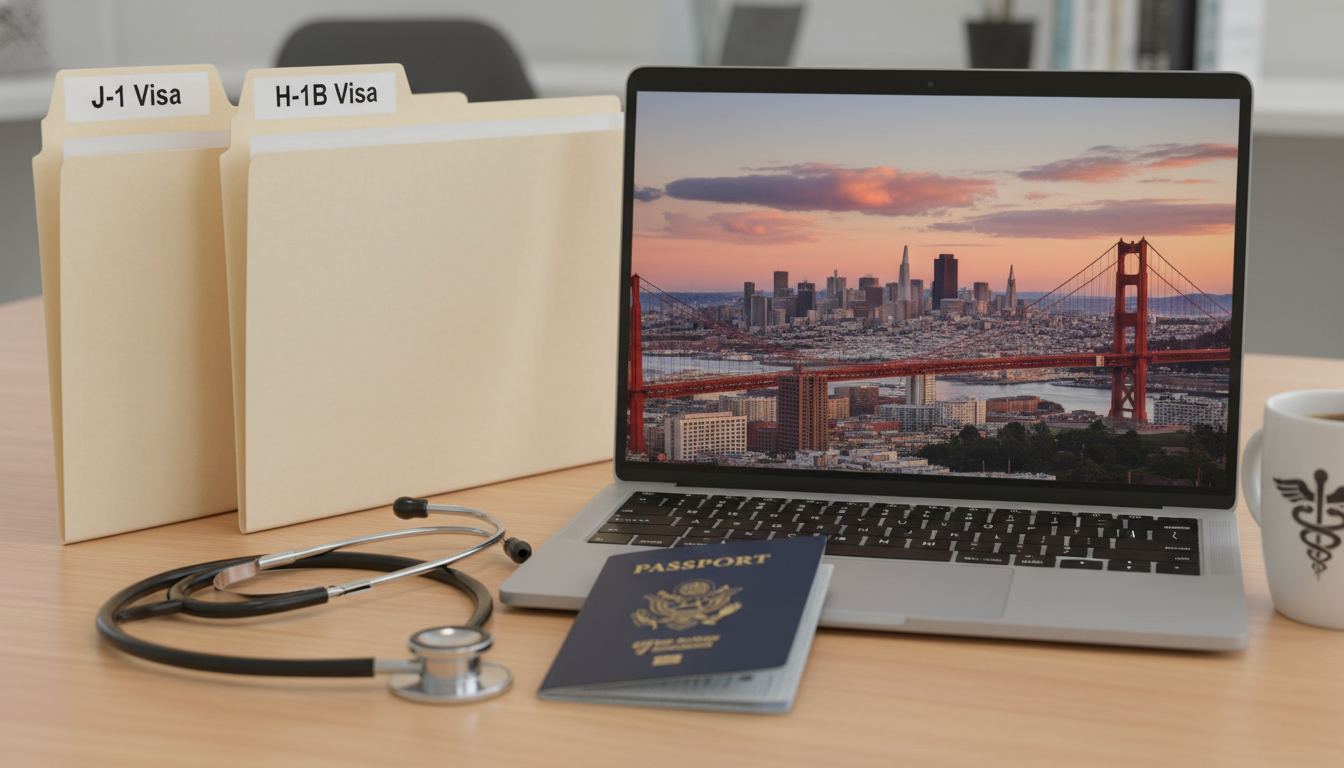
Choosing Between J-1 vs H-1B in the Bay Area: Strategic Considerations
Choosing a residency visa is a career decision, not just a paperwork preference. For San Francisco residency and Bay Area residency programs, think through:
1. Your Long-Term Career Plans
Ask yourself:
- Do I want to settle in the US long-term, or am I open to returning home?
- Is my specialty choice compatible with J-1 waiver jobs (often in underserved or rural locations)?
- Am I planning a long training path (residency + multiple fellowships)?
Better fit for J-1 might be:
- You are open to working in an underserved area after training to obtain a waiver.
- Your home country career options are appealing if you eventually return.
- Your specialty is in demand in waiver-eligible regions (e.g., primary care, psychiatry, some hospitalist positions).
Better fit for H-1B might be:
- You are committed to long-term practice in the US.
- You want the option to stay in metropolitan areas (including potentially the Bay Area) long-term.
- Your planned training length fits well into the 6-year H-1B window, or you anticipate starting green card early.
2. Competitiveness and Feasibility
Bay Area programs are among the most competitive in the country. This reality affects your flexibility:
- If your application is very strong (high scores, strong US clinical experience, research at US institutions, no exam failures), you may have more leverage requesting H-1B.
- If your portfolio is moderate, insisting on H-1B may significantly shrink your list of interview offers.
Practical advice:
- Be flexible: If your main goal is “Bay Area residency,” J-1 usually gives you far more options than H-1B.
- Consider a hybrid plan:
- Prioritize programs that explicitly support both J-1 vs H-1B, but be willing to accept J-1 if needed.
- Later, use a J-1 waiver job and/or a change to H-1B after waiver completion.
3. Program-Specific Policies in the Bay Area
Different institutions have different patterns (always verify by checking their websites and emailing coordinators):
- Often J-1 only: Some large academic centers and county hospitals (policies can change; always confirm).
- J-1 + selective H-1B: Some university-affiliated programs may sponsor H-1B for exceptional candidates who have Step 3 completed early.
- Community programs: Some are willing to be flexible; others may avoid visa sponsorship entirely due to limited administrative support.
Action step: Create a spreadsheet of Bay Area programs and note:
- Do they sponsor J-1?
- Do they sponsor H-1B?
- Any conditions (Step 3 by ranking, USCE requirements, graduation cutoffs)?
- Any statement on their website regarding IMGs or visas?
Then align your application list with your realistic visa pathway.
Key Steps in Visa Navigation During the Residency Application Cycle
Visa planning starts well before Match season. Here’s how to navigate the process step by step as an IMG targeting San Francisco residency or broader Bay Area residency programs.
Step 1: Clarify Your Current and Future Immigration Status
Common scenarios:
- You are abroad with no US status.
- You will enter on J-1 or H-1B when residency starts.
- You are an F-1 student in the US (e.g., MPH, research master’s).
- You might have OPT or STEM OPT; consider whether you can bridge time before residency starts.
- You will still need to change to J-1 or H-1B for residency itself.
- You are already on J-1 research, H-4, or other status.
- Consult an immigration attorney or institutional advisor early; prior J-1 categories can trigger the two-year rule too.
Document your status, I-20/DS-2019 history, and whether you are already subject to 212(e) (two-year home residency requirement), as this can affect future changes.
Step 2: Decide Your Primary Visa Strategy (J-1 vs H-1B)
Before you submit ERAS:
- Decide if you are:
- J-1 only
- H-1B only
- Open to both (recommended for many applicants)
Your choice will determine:
- Which programs you apply to
- How you answer visa-related supplemental questions
- How you discuss your plans in interviews
If you decide to pursue H-1B, plan to:
- Take USMLE Step 3 as early as feasible.
- Have your results available by the time programs are setting their rank lists (typically January–February).
Step 3: Research Bay Area Programs’ Visa Policies
For each San Francisco residency or Bay Area residency program:
- Visit the program’s website → “Prospective Residents,” “International Applicants,” or “Visa Information.”
- Note:
- J-1 acceptance
- H-1B sponsorship
- Historical patterns (check forums, but verify with official sources)
- If unclear, email the program coordinator with a concise question, for example:
“Dear [Coordinator],
I am an international medical graduate applying for [Specialty] Residency. Could you please confirm whether your program sponsors J-1 visas, H-1B visas, or both for incoming residents?
Thank you for your time and assistance.
Sincerely, [Name], MD”
Use this information to create tiers of applications:
- Tier 1: Programs that sponsor both J-1 and H-1B (if relevant to you).
- Tier 2: Programs that sponsor J-1 only but are strong training opportunities.
- Tier 3: More “reach” programs or those with limited/unclear visa policies.
Step 4: Apply and Address Visa Topics in Interviews
In most interviews, visa discussion is normal and expected for IMGs.
When to bring up visa issues:
- If the program’s policy is clear from their website, you don’t need to initiate a long discussion unless you have specific circumstances.
- If you are considering H-1B, you can mention:
- You have completed or will complete Step 3.
- You are aware of their policies and are flexible if they can only offer J-1.
How to phrase it professionally:
“I am currently on [status] and will require visa sponsorship for residency. I understand your program sponsors [J-1/H-1B]. I’ve completed Step 3 and would be very happy to join under whichever visa category best aligns with your institutional policy.”
Avoid sounding demanding or inflexible, especially in very competitive Bay Area programs.
Step 5: Post-Match Visa Processing
Once you match:
J-1:
- Work with ECFMG and your program’s GME office to prepare the DS-2019.
- Prepare required documentation (degree, ECFMG certificate, Statement of Need, etc.).
- Schedule your visa interview at a US consulate if you are outside the US.
H-1B:
- The program’s legal or HR team will initiate the petition.
- You’ll provide documents (diplomas, licenses, Step 3 score report).
- Once approved, if abroad, you’ll attend a consular interview; if inside the US, you may change status without leaving (if eligible).
For both, keep copies of all I-94s, DS-2019s, I-797 approvals, and correspondence. Bay Area institutions are rigorous about documentation.

Life After Residency: J-1 Waivers, H-1B Transitions, and Staying in the Bay Area
Most IMGs considering a San Francisco residency or other Bay Area residency are also thinking long-term: “Can I stay in the Bay Area after training?”
If You Train on J-1
You will likely need to address the two-year home residency requirement. Options typically include:
J-1 Waiver through Service in Underserved Areas
- Federal and state waiver programs (e.g., Conrad 30) allow waiver of the 2-year rule in exchange for 3 years of service in specific sites.
- Many waiver jobs are not in the Bay Area; they are often in rural or underserved urban locations elsewhere in California or other states.
- Some limited waiver-eligible positions may be within broader Northern California, but competition is high.
Other Waiver Categories
- Hardship waivers (if your US-citizen or permanent resident spouse/child would face exceptional hardship).
- Persecution-based waivers (if returning to your home country poses specific dangers).
After obtaining a J-1 waiver, you typically work on H-1B at the waiver site. Later, you might transition to other positions (possibly back to the Bay Area), usually continuing on H-1B or via green card sponsorship.
If You Train on H-1B
If your residency was entirely on H-1B and you were never on J-1, you are not subject to the J-1 two-year rule. Your considerations instead include:
- Remaining within the 6-year H-1B maximum.
- Planning early for green card sponsorship if you want to continue in the Bay Area.
- Progressing through training and then seeking post-residency jobs in academic centers, community hospitals, or private groups.
In high-demand specialties or hospitalist roles, Bay Area employers may prefer candidates already on H-1B (no need for a J-1 waiver). However, they may still be cautious because of costs and processing timelines.
Practical Example: Two Different Paths
Example 1: Internal Medicine IMG on J-1
- Completes internal medicine residency at a San Francisco program on J-1.
- Obtains a Conrad 30 waiver position in a Central Valley underserved hospital on H-1B for 3 years.
- After fulfilling the waiver, secures a hospitalist job in the East Bay on H-1B, later moves to a green card.
- Eventually returns to the Bay Area in an attending role after about 7–10 years in the US.
Example 2: Neurology IMG on H-1B
- Secures H-1B sponsorship at a Bay Area academic neurology residency (Step 3 done early).
- Completes 4 years of neurology + 1–2 years of fellowship within the H-1B 6-year time frame.
- Starts a green card process during fellowship via employer sponsorship.
- Continues as attending faculty in San Francisco on H-1B extensions based on green card progress, then transitions to permanent residency.
Both paths can end with a stable career in the Bay Area; the routes and timing just differ.
Common Pitfalls and Practical Tips for IMGs Targeting the Bay Area
1. Over-focusing on H-1B Too Early
Many IMGs hear “H-1B is better” and restrict their applications solely to H-1B programs. In a hyper-competitive region like the Bay Area, this can severely limit your chances of matching at all.
Tip: Unless you have strong reasons, consider being open to J-1, especially for your first training position.
2. Ignoring the Cost of Living Factor
San Francisco and the broader Bay Area have some of the highest living costs in the US. For IMGs:
- J-1 or H-1B salary is the same as for US graduates; there is no “visa bonus.”
- Visas do not allow unrestricted moonlighting, especially early in training.
- Dependents may face limited work authorization depending on visa type (J-2 vs H-4).
Tip: Factor in finances: shared housing, commuting from less expensive areas (e.g., East Bay to SF), and careful budgeting.
3. Missing Step 3 Timing for H-1B
If you want H-1B:
- Many Bay Area programs will not file H-1B petitions unless Step 3 is passed by a defined deadline.
- Some programs will not even rank you as an H-1B candidate without Step 3.
Tip: If H-1B is important to you, schedule Step 3 as early as your exam schedule realistically allows, ideally before interview season or early in it.
4. Not Keeping Thorough Documentation
US immigration and institutional GME offices are detail-oriented. Lost documents or missing records can delay or jeopardize visa processing.
Tip: Maintain:
- Digital and physical copies of:
- Passport pages, previous visas, I-94s
- ECFMG certificate
- Degree and transcripts
- USMLE score reports
- All DS-2019 or I-797 documents
- Organized folders labeled by category and year.
5. Not Consulting an Expert When Needed
While program coordinators and GME offices are helpful, they cannot give individualized legal advice.
Tip: If your situation is complex (prior J-1, multiple status changes, dependents, or past immigration issues), consider consulting an immigration attorney familiar with physician immigration and Bay Area institutions.
FAQs: Visa Navigation for Residency in the San Francisco Bay Area
1. Do most San Francisco residency programs sponsor J-1 or H-1B?
In the Bay Area, J-1 is more widely supported across academic and community programs. Some large academic centers will consider H-1B for strong candidates who have completed USMLE Step 3. Policies vary widely by specialty and institution and can change over time, so always verify directly with each program.
2. Is it realistic to match into a Bay Area residency as an IMG needing a visa?
Yes, it is possible, but highly competitive. You improve your chances by:
- Having strong scores (preferably with no exam failures)
- Demonstrating US clinical experience and letters from US faculty
- Being flexible with visa type, especially open to J-1
- Applying broadly across the Bay Area and beyond, not only to one city or one famous program
3. If I start residency on a J-1 visa, can I later switch to H-1B to avoid the two-year requirement?
Generally, no. Once you are subject to the J-1 physician two-year home residency requirement, you cannot change to H-1B or permanent resident status in the US unless you:
- Fulfill the 2-year home-country physical presence requirement, or
- Obtain a J-1 waiver (most commonly via government service, hardship, or persecution grounds)
Switching from J-1 to H-1B is usually only possible after waiver approval (or after fulfilling the 2-year stay).
4. Should I delay applying for Bay Area residency until I have Step 3 to improve my H-1B chances?
It depends on your overall competitiveness and timeline. Having Step 3 can help if you are specifically aiming for H-1B, but:
- Waiting a full year just for Step 3 may not be necessary if you are open to J-1.
- You can also apply while planning to take Step 3 early in the cycle; if results are available by the time rank lists are made, some programs may consider H-1B.
If Bay Area residency is your top goal, discuss timelines carefully with mentors and consider both visa flexibility and your application strength.
By approaching visa planning as a strategic component of your Bay Area residency application—rather than a last-minute administrative task—you’ll be better positioned to match into a program that fits both your training goals and your long-term immigration plans.