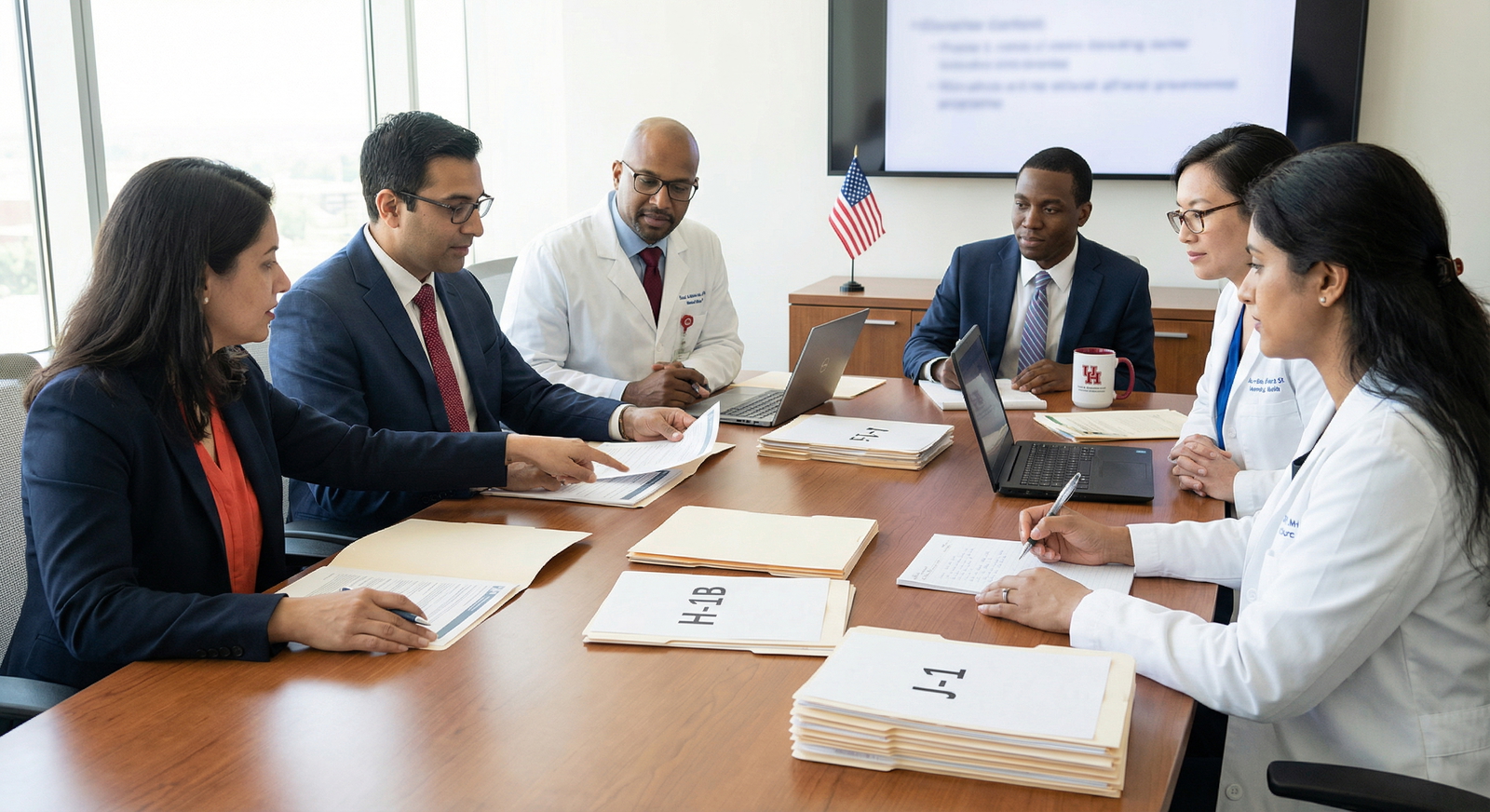
State university residency programs are among the most popular—and competitive—destinations for international medical graduates (IMGs). They offer strong clinical training, large patient populations, and relatively accessible tuition and fee structures. Yet for IMGs, none of that matters if the visa pathway is unclear or unworkable.
This guide explains how to navigate visa options step by step if you are aiming for a state university residency or public medical school residency in the United States, with a focus on residency visa pathways, IMG visa options, and the key comparison of J-1 vs H-1B.
Understanding the Visa Landscape for State University Residencies
Before you can optimize your application strategy, you need a clear picture of the visa categories relevant to residency training at public institutions.
The Three Main Visa Categories for IMGs
For residency and fellowship, IMGs primarily use:
- J-1 Exchange Visitor (ECFMG-sponsored)
- H-1B Temporary Worker (specialty occupation)
- Immigrant or dual-intent statuses (e.g., Green Card, pending I-485, some EAD-based statuses)
Some candidates apply while in other statuses (F-1, O-1, etc.), but the residency sponsorship almost always ends up as J-1 or H-1B.
Why this matters more in state university programs
State universities and public medical schools differ from private hospitals in several ways that affect visa sponsorship:
- They may be subject to state employment rules and budget constraints, making H-1B sponsorship more complex.
- Some are tied to public university HR systems, which may have strict policies on job classifications and prevailing wage.
- Teaching hospitals affiliated with state universities often train large numbers of IMGs, leading many to default to J-1 sponsorship because it is standardized and funded largely outside hospital payroll.
Action step: Before you build your application list, confirm each program’s stated visa policy on:
- Their website (FAQ, “International Medical Graduates” section)
- FREIDA (AMA)
- Program’s ERAS page
If unclear, email the program coordinator directly.
J-1 Visa for Residency: The Most Common Pathway
For most IMGs in state university residency programs, the J-1 is the default option. It is sponsored by ECFMG, not the individual hospital, which makes it attractive to public programs with limited immigration resources.
Core Features of the J-1 for Residency
- Sponsor: ECFMG (Educational Commission for Foreign Medical Graduates)
- Purpose: Graduate medical education (residency/fellowship)
- Duration: Up to 7 years total for clinical training (with some nuances)
- Dependents: J-2 spouse and children can accompany you and may apply for work authorization (EAD)
Key requirements:
- Valid ECFMG certification
- A signed training contract (offer letter) from an ACGME-accredited program
- Proof of financial support (salary is usually sufficient)
- Home country residence and intent to return, at least on paper
Advantages of J-1 for State University Programs
Standardized process:
ECFMG handles the DS-2019 and most immigration paperwork, easing the burden on state university HR and GME offices.Predictable timelines:
ECFMG issues DS-2019s on a well-defined schedule, which programs are familiar with.Broad acceptance:
Many public medical school residency programs accept only J-1 due to administrative simplicity, budget, or institutional policy.Less institutional legal cost:
No need to pay prevailing wage determinations and attorney fees commonly associated with H-1B.
Disadvantages: The Two-Year Home Residency Requirement
The main drawback of the J-1 is the INA 212(e) two-year home country physical presence requirement. Upon completing your J-1 training:
- You must return to your home country (or country of last permanent residence) for a total of two years, OR
- Obtain a J-1 waiver before changing to H-1B or obtaining permanent residency in the U.S.
Without fulfilling or waiving this requirement, you cannot:
- Apply for an H-1B (or certain other statuses)
- Apply for an immigrant visa or adjust status to a green card holder
Typical J-1 Waiver Options After Residency
Common waiver routes for physicians:
Conrad 30 Waiver (State Health Department Programs)
- Each U.S. state can sponsor up to 30 J-1 physicians per year
- Must agree to work for 3 years in a designated underserved area (HPSA/MUA)
- Usually requires H-1B employment after completion of training
Federal agency waivers (e.g., VA, HHS, ARC)
- Similar concept but sponsored by federal agencies
Persecution or hardship waivers
- If returning home creates risk of persecution or exceptional hardship to a U.S. citizen or permanent resident spouse/child
Practical implication:
If you choose J-1 for residency, start learning about Conrad 30 and other waiver programs during PGY-2 or early PGY-3 so you can time your job search appropriately.
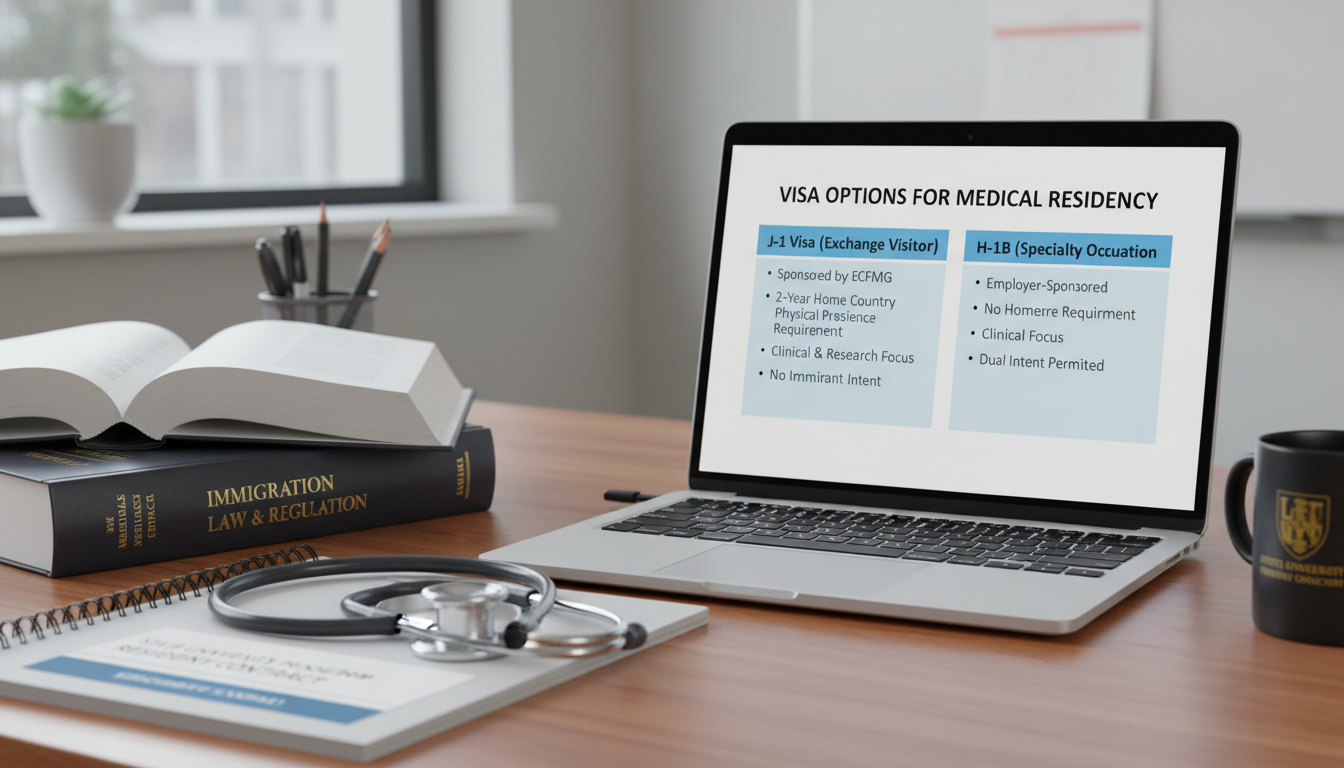
H-1B Visa for Residency: When and How It Works
While the J-1 is the more common residency visa at state institutions, some public medical school residency programs sponsor H-1B for eligible IMGs, especially in more competitive fields or for candidates with strong research or U.S. credentials.
Key Features of H-1B for Residents
- Sponsor: The residency program/hospital (not ECFMG)
- Purpose: Employment in a “specialty occupation” (physician)
- Duration: Up to 6 years total (sometimes extended if green card is in process)
- Dual intent: You may pursue permanent residency while on H-1B
- Depends: H-4 status; spouse may apply for work authorization only in certain green-card-related situations
H-1B for residents is almost always in the “cap-exempt” category because:
- The employer (state university or affiliated teaching hospital) is often a nonprofit, public, or academic institution tied to higher education.
- Cap-exempt H-1B positions can be started any time of year, avoiding the regular April lottery.
Advantages of H-1B for Residency
No two-year home residency requirement:
You can transition to another H-1B, O-1, or green card route without needing a J-1 waiver.Dual-intent flexibility:
You can pursue a green card during or immediately after training if an employer sponsors you.Simplified post-residency transitions:
Easier to move into fellowship or attending roles that also use H-1B, especially at academic or large private systems.
Major Limitations and Challenges in State University Programs
Institutional policies:
Many state universities have a blanket policy: “We sponsor J-1 only for residents.”
This may be driven by HR rules, attorney cost, or perceived liability.USMLE and licensing requirements:
- Most programs require:
- USMLE Step 1 & 2 CK passed
- Step 3 passed before H-1B filing (and often before ranking)
- Step 3 can be hard to schedule in time if you are still outside the U.S. or in late stages of med school.
- Most programs require:
Prevailing wage and salary mismatch:
- H-1B requires the employer to pay at least the prevailing wage for that role in that region.
- In some states, typical resident salaries may be lower than the determined prevailing wage; this can make H-1B legally difficult or impossible unless salary is adjusted.
Legal costs and processing time:
- H-1B petitions involve attorney fees and sometimes premium processing fees.
- Public institutions with tight budgets may avoid this.
Typical Profile of a Successful H-1B Resident at a State University
- USMLE Step 1, 2 CK, and Step 3 all passed
- Strong U.S. clinical experience (e.g., sub-internships, observerships)
- Applying to departments with explicit H-1B support (often internal medicine, neurology, anesthesia, pathology)
- Possibly a U.S. permanent address, or already in the U.S. on a different status (e.g., F-1 OPT, J-1 research)
Action step:
If you are strongly interested in H-1B rather than J-1:
- Prioritize early Step 3 completion, ideally by the time ERAS opens.
- Build a school list that includes state university residency programs explicitly stating “H-1B sponsorship considered” or “J-1 and H-1B” on their websites.
- Email program coordinators early in the application season to confirm:
- Whether they sponsor H-1B for first-year residents
- Any extra criteria (Step 3 requirement, years since graduation limits, etc.)
J-1 vs H-1B: Strategic Decision-Making for IMGs
Choosing between J-1 vs H-1B is not just about the visa; it is about your long-term career, personal life, and willingness to accept service commitments.
Side-by-Side Comparison
| Feature | J-1 (ECFMG) | H-1B (Cap-Exempt, Academic) |
|---|---|---|
| Sponsor | ECFMG | State university / teaching hospital |
| Typical availability | Very widely accepted | Limited; program-specific |
| Two-year home requirement | Yes, unless waived | No |
| Dual intent | No (officially) | Yes |
| Waiver/service obligation | Often 3 years underserved (Conrad 30) | Not visa-mandated |
| Step 3 required by match | Usually not | Often yes |
| Institutional cost burden | Lower for program | Higher (legal + processing) |
| Flexibility after training | Constrained without waiver | Higher mobility |
When J-1 Might Be Better for You
- You are applying broadly and want to maximize the number of programs that can rank you.
- You cannot reasonably complete Step 3 before ranking or match.
- You are open to working in an underserved community after residency (e.g., rural primary care, community psychiatry).
- Your priority is securing any residency position, especially in competitive or IMG-heavy specialties and locations.
When H-1B Might Be Better for You
- You strongly prefer to avoid the J-1 waiver process.
- You have a clear pathway to academic or subspecialty work in the U.S. and potential green card sponsorship soon after training.
- You are in a specialty where Conrad 30 positions are scarce (e.g., some surgical subspecialties, dermatology).
- You have excellent USMLE scores, U.S. clinical experience, and can complete Step 3 early.
Hybrid Strategies
Many IMGs apply for both possibilities and adjust once offers emerge:
- Apply broadly, including programs that are J-1 only and those that allow H-1B.
- If you get interviews at H-1B-friendly programs, be prepared to discuss:
- Your Step 3 timeline
- Your long-term U.S. career goals
- If matched into a J-1-only program, start planning early for a J-1 waiver and potential underserved work.

Practical Steps to Navigate Visa Issues in State University Programs
Moving from theory to practice, here’s how to incorporate visa planning into your residency application strategy.
1. Research Each Program’s Visa Policies Early
For each program on your list:
Check:
- Program website → “International Medical Graduates,” “Visas,” or “FAQ” sections.
- FREIDA listing → Filter by visa type (J-1, H-1B, or both).
- ERAS program descriptions.
Track in a spreadsheet:
- Accepts J-1?
- Accepts H-1B?
- Step 3 required?
- Any IMG-specific notes?
If the information is unclear:
Email the coordinator with a concise message such as:
Dear [Coordinator Name],
I am an international medical graduate planning to apply to your [Specialty] residency program. Could you please confirm which visa types your program sponsors for incoming residents (J-1, H-1B, or both)?
Additionally, if H-1B is an option, do you require USMLE Step 3 to be completed before ranking applicants?
Thank you for your guidance,
[Your Name]
2. Plan Your Exams With Visa in Mind
If H-1B is your goal, schedule USMLE Step 3 as early as possible:
- Ideal: Score available by the time rank lists are finalized (February).
- Many state university programs will not initiate H-1B sponsorship without a passed Step 3.
If you are open to J-1, Step 3 is still valuable (e.g., for fellowship, waiver jobs), but not usually required for initial residency.
3. Clarify Your Current Immigration Status
Your starting point influences your options:
If you are abroad (most IMGs):
- You will apply for either a J-1 visa with ECFMG DS-2019 or H-1B consular processing.
If you are already in the U.S. (F-1, J-1 research, H-4, etc.):
- You may have the option of change of status vs consular processing.
- Discuss with the program’s GME office and, if possible, an immigration attorney.
4. Communicate Clearly With Programs After Match
Once you match into a state university residency:
You will receive documents from:
- The residency program (offer letter/training contract)
- ECFMG (for J-1) or HR/attorney (for H-1B)
Respond promptly with:
- Copies of your passport
- Prior visa documents (I-20s, DS-2019s, I-94 records)
- ECFMG certificate (for J-1)
- USMLE scores (including Step 3 if applicable)
Delays in submitting documents can lead to late visa appointments and threaten your ability to start on time.
5. Build a Long-Term Plan Early in Residency
Your IMG visa options during and after residency should be part of a multi-year plan, not an afterthought in PGY-3.
If on J-1:
- By mid–PGY-2:
- Start reading about Conrad 30 and other waiver programs in states where you might want to practice.
- Talk to senior residents/fellows who recently obtained waivers.
- By early PGY-3:
- Begin contacting potential employers in underserved areas who have prior experience with J-1 waivers and H-1B transfers.
If on H-1B:
- During PGY-2–3:
- Learn about employment-based green card categories (EB-2, NIW, employer-sponsored I-140).
- Discuss possibilities with academic mentors or hospital HR if you aim for a faculty or hospitalist position.
Common Pitfalls and How to Avoid Them
Despite careful planning, many IMGs face preventable visa problems. Being aware of them can save you time and stress.
1. Assuming All State Universities Have the Same Policy
Reality:
Two public medical school residency programs in the same state can have completely different visa policies—one may offer H-1B freely, another J-1 only.
Avoid this by:
- Program-by-program verification rather than relying on state-level assumptions or online forums.
2. Delaying Step 3 When You Want H-1B
If you say you are targeting H-1B but sit Step 3 in late March of your match year, many state university programs will not be able to file your petition in time.
Solution:
- Plan Step 3 no later than early winter of the application year if H-1B is crucial to your strategy.
3. Not Accounting for the Two-Year Home Requirement
Some J-1 residents only realize in PGY-3 that they cannot simply switch to H-1B or apply for a green card at graduation.
Solution:
- Understand the 212(e) rule before you accept a J-1-based position.
- Treat J-1 waiver research as part of your core career planning.
4. Over-relying on Informal Advice
Visa rules are nuanced and can change. Different states and institutions interpret regulations differently.
Best practice:
- Use:
- Official sources (ECFMG, USCIS, state health departments).
- Your program’s GME office or institutional immigration counsel.
- If needed, a qualified immigration attorney with physician experience.
Frequently Asked Questions (FAQ)
1. Do most state university residency programs sponsor J-1 or H-1B?
Most state university residency and public medical school residency programs predominantly sponsor J-1 visas for IMGs. J-1 is easier administratively because ECFMG handles sponsorship. Some programs also sponsor H-1B—often in internal medicine, psychiatry, neurology, or pathology—but this is less common and highly program-specific.
2. Is it possible to change from J-1 to H-1B at the same institution for fellowship?
Yes, but only if you first obtain a J-1 waiver (e.g., Conrad 30 or federal waiver) or complete your two-year home country residence requirement. Without either, you cannot change from J-1 to H-1B status in the U.S. Programs may be willing to sponsor H-1B after a waiver, especially for fellows or junior faculty.
3. Can I apply for state university residency programs if I don’t yet have Step 3?
Yes. Many programs—especially those that are J-1 only—do not require Step 3 for interview or ranking. However, if you are specifically targeting H-1B sponsorship, you should plan to complete Step 3 early because many H-1B-sponsoring programs require it before they will file the petition.
4. Which visa is better for long-term U.S. practice: J-1 or H-1B?
Neither is universally “better”; it depends on your circumstances and goals:
- J-1 is more widely available and often easier to obtain for residency at public institutions, but it imposes a two-year home residency requirement or waiver, typically leading to a three-year service commitment in an underserved area.
- H-1B avoids the home residency requirement and allows dual intent, which is helpful if you plan to seek permanent residency soon after training, but fewer state university programs offer it and it often requires early completion of Step 3.
Ideally, you should consider both your likelihood of matching and your post-residency career plan in choosing between them.
Navigating the residency visa process as an IMG in state university programs requires early planning, precise information, and honest self-assessment. By understanding the trade-offs between J-1 vs H-1B, researching each program’s policies, and integrating visa strategy into your exam and career timeline, you can significantly improve your chances of both matching successfully and building a sustainable career in the United States.