
Understanding the Visa Landscape for Non‑US Citizen IMGs
For a non-US citizen IMG, visa navigation is not just paperwork—it is a core strategic element of your residency application. Your visa type influences where you can apply, how programs rank you, your ability to moonlight, and your long‑term career options in the United States.
Most foreign national medical graduates pursue residency on one of three main pathways:
- J-1 physician visa (Educational and Cultural Exchange)
- H‑1B temporary worker visa (Specialty Occupation)
- Other statuses (e.g., green card, EAD, dependent visas like H‑4, F‑1 OPT, etc.)
Before diving into strategy, clarify your own situation:
- Are you a non-US citizen IMG currently outside the US?
- Are you on an F‑1 student visa in the US (e.g., doing a master’s, MPH, or research)?
- Are you on a dependent visa (H‑4, L‑2, etc.) through a spouse or parent?
- Do you already have permanent residency (green card) or an EAD (e.g., asylum, TPS, pending adjustment of status)?
Your answers shape which residency visa options are realistic and how aggressive your strategy can be.
Key principles to keep in mind:
- Visa issues can make or break your match even if your academic profile is strong.
- You must understand what programs sponsor which visa types before you build your program list.
- J‑1 vs H‑1B is not about “good vs bad”; it is about trade‑offs in competition, flexibility, and long‑term plans.
J‑1 vs H‑1B: Core Differences, Pros, and Cons
Most non-US citizen IMGs will face the decision between J‑1 and H‑1B, or will at least wonder which one they should aim for. Understanding this comparison is central to your residency visa strategy.
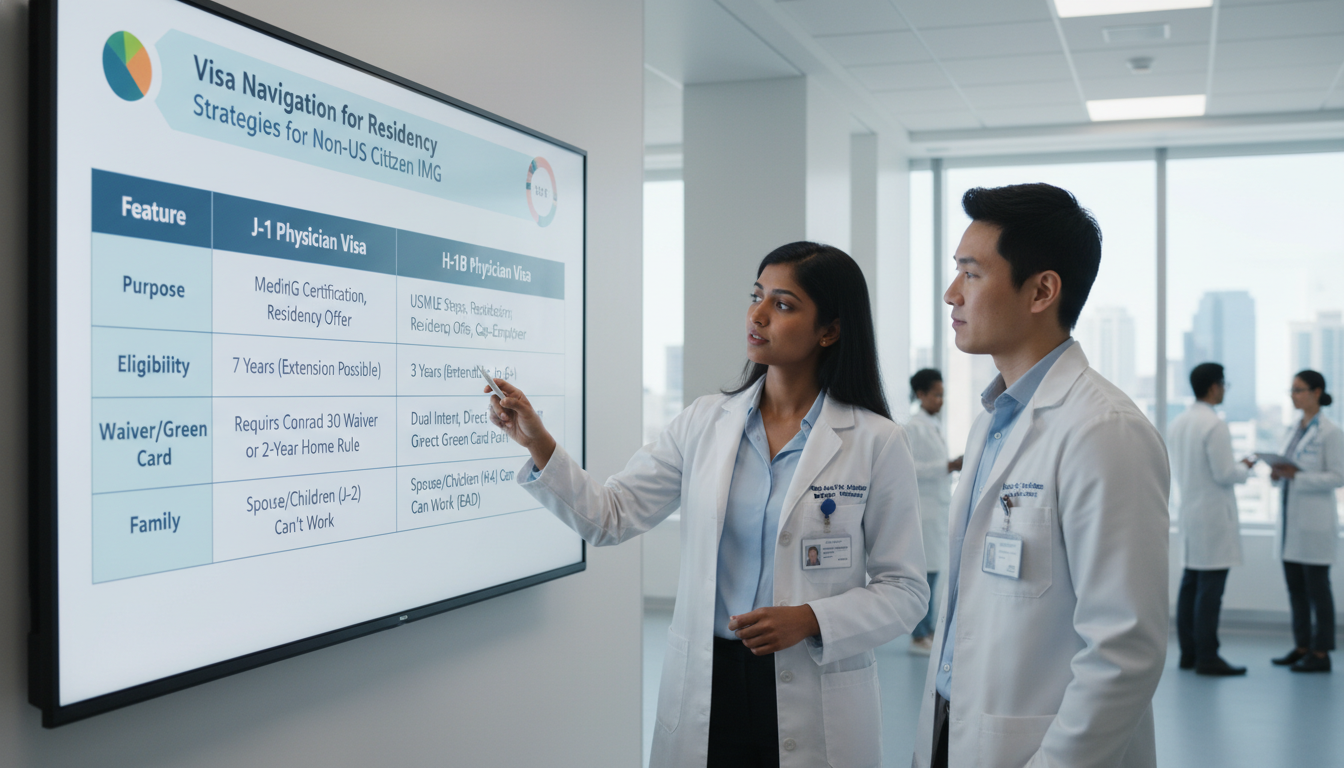
The J‑1 Physician Visa: Overview
The J‑1 visa for physicians is administered through the Educational Commission for Foreign Medical Graduates (ECFMG) as the sponsorship body. It is specifically designed for graduate medical education (GME: residency and fellowship).
Key features:
- Sponsored by ECFMG, not directly by the residency program (though the program must accept J‑1s).
- Duration: Covers the length of your residency (and eligible fellowships), generally renewable annually.
- Two-year home residence requirement: After completing training, you are usually required to return to your home country (or country of last permanent residence) for two years before being eligible for:
- H‑1B or L‑1 visas
- Permanent residency (green card) through most routes
Unless you obtain a J‑1 waiver.
- No path to permanent residency through J‑1 itself (but you can later transition to H‑1B or another status once the requirement is fulfilled or waived).
Advantages of J‑1:
More widely accepted
- A large proportion of residency programs that sponsor any visa will sponsor J‑1.
- Many community and academic programs explicitly state “J‑1 visa only.”
Simpler for programs
- Visa processing is centralized through ECFMG.
- Less legal/administrative burden for the hospital, making them more open to J‑1 than H‑1B.
More realistic for many specialties
- Competitive specialties that do sponsor IMGs (e.g., Internal Medicine, Pediatrics, Family Medicine, Psychiatry) often prefer J‑1.
- For applicants with moderate scores or significant application risk factors, targeting J‑1‑friendly programs can increase match chances.
Disadvantages of J‑1:
Two‑year home country physical presence requirement
- You must either:
- Return home for 2 years cumulatively, or
- Obtain a J‑1 waiver (e.g., Conrad 30 or other federal waivers) to stay and work in the US after training.
- This requirement can delay your transition to long‑term US practice or permanent residency.
- You must either:
Restrictions during training
- Moonlighting often more restricted than on H‑1B, depending on state and employer policy.
- You are primarily a trainee, not a “worker,” under US immigration law.
Waiver process can be competitive and geographically limiting
- Conrad 30 waivers generally require working in underserved areas, often rural or semi‑rural.
- State caps (30 per year) make some states highly competitive.
The H‑1B Visa for Residency: Overview
The H‑1B is a work visa for “specialty occupations” that requires at least a bachelor’s degree, and in the case of physicians, a medical degree plus exams and licensing steps.
Key features:
- Sponsored directly by the employing institution (the residency program/hospital).
- Duration: Up to 6 years total (including time used in prior positions), often granted in 3‑year increments.
- No default “home return” requirement like the J‑1.
- Dual intent: You can pursue a green card while on H‑1B.
Advantages of H‑1B:
No two‑year home requirement
- You can finish residency and directly move into fellowship or attending positions on H‑1B, and pursue permanent residency.
- More straightforward for long‑term US career planning.
Worker status
- Easier to:
- Moonlight (if allowed by program and licensing)
- Transition between institutions within H‑1B rules
- Often preferred if you want continuous career progression in the US.
- Easier to:
Alignment with green card pathways
- Many physicians later transition from H‑1B to permanent residency through employer sponsorship or national interest waiver (NIW) options.
Disadvantages of H‑1B:
Fewer programs sponsor it
- Many residencies do not sponsor H‑1B due to:
- Cost
- Legal complexity
- Institutional policy limits
- This drastically shrinks your applicable program list.
- Many residencies do not sponsor H‑1B due to:
Stricter eligibility requirements
- Typically required:
- USMLE Step 3 passed before H‑1B petition filing (some programs require before ranking).
- ECFMG certification at the time of visa processing.
- Some states or institutions may have additional licensing or timeline constraints.
- Typically required:
Time limit
- The 6‑year maximum (minus any previous H‑1B time) must cover residency + fellowship, or you’ll need a plan to transition to another status or green card.
J‑1 vs H‑1B: Which Should You Aim For?
The answer depends on your profile, competitiveness, and long-term goals:
J‑1 is often better if:
- You have average or below-average scores, attempts, or gaps, and want the broadest possible program pool.
- You are flexible to:
- Work in underserved areas post-residency to get a J‑1 waiver.
- Potentially return to your home country for 2 years if waiver options are limited.
- Your near‑term priority is “match somewhere solid first; plan long‑term later.”
H‑1B is often better if:
- You are a highly competitive foreign national medical graduate:
- Strong USMLE performance
- Recent graduation
- US clinical experience and strong letters
- You have a strong reason to:
- Avoid the two‑year home requirement (e.g., family plans, career trajectory).
- Stay continuously in the US and pursue permanent residency.
- You are targeting specialties or institutions with a track record of H‑1B sponsorship.
Strategically, many non-US citizen IMGs apply broadly to J‑1‑friendly programs, while selectively adding a smaller number of programs known to sponsor H‑1B, especially if they already have Step 3.
Step‑by‑Step Visa Strategy Across the Residency Timeline
Visa navigation must be integrated into your entire residency application timeline, not treated as an afterthought.
1. Pre‑Application Phase (12–24 Months Before Applying)
Focus: Understanding options, documentation, and prerequisites.
Actions:
Clarify your immigration status
- Are you abroad, on F‑1, H‑4, etc.? Different statuses allow different transitional paths.
- Example: An IMG on F‑1 doing a research fellowship may have OPT time they can use before residency—but this rarely replaces the need for J‑1 or H‑1B for GME.
Decide your primary visa target
- If aiming for H‑1B, plan to:
- Take USMLE Step 3 as early as realistically possible.
- Gather documentation required for state licensing (since Step 3 usually requires certain credentials).
- If targeting J‑1, understand ECFMG’s requirements and timeline.
- If aiming for H‑1B, plan to:
Research visa policies by program
- Use:
- Program websites
- FREIDA database
- Program coordinator emails (polite, concise inquiries)
- Build a spreadsheet with columns:
- Accepts IMG? Y/N
- Visa types: J‑1 / H‑1B / None
- Notes: Step 3 requirement, special conditions, last confirmed year of sponsorship.
- Use:
Practical example:
- You discover that out of 150 Internal Medicine programs you’re interested in:
- 90 sponsor J‑1 only
- 20 sponsor J‑1 and H‑1B
- 40 do not sponsor any visa
- If you require H‑1B, your effective list shrinks from 110 (visa‑sponsoring) to only 20 programs. This drastically changes your application strategy.
2. Application Season (ERAS Submission to Interviews)
Focus: Aligning your profile with program visa expectations.
Actions:
Tailor your program list to visa realities
- If you are a non-US citizen IMG without Step 3, heavily prioritize:
- Programs stating “J‑1 accepted” or “J‑1 only.”
- If you already have Step 3 and a strong profile:
- Include programs that offer H‑1B—but still apply to J‑1 programs to maintain match flexibility.
- If you are a non-US citizen IMG without Step 3, heavily prioritize:
Communicate status clearly in your application
- In your CV or ERAS section, include:
- Citizenship
- Current visa status (if in US)
- Whether you’ve passed Step 3 (crucial for H‑1B)
- This prevents confusion and potential interview denials due to vague immigration information.
- In your CV or ERAS section, include:
Prepare to discuss visas in interviews
- Programs may ask:
- “Are you able to work under J‑1 sponsorship?”
- “Do you require H‑1B? Have you passed Step 3?”
- Be ready with concise answers that show:
- You understand the basics of J‑1 vs H‑1B.
- You are flexible where possible.
- You are aware of the obligations (e.g., J‑1 two‑year rule).
- Programs may ask:
Example interview answer (J‑1‑flexible applicant):
“I am a non-US citizen IMG and will require visa sponsorship. I am fully prepared to train on a J‑1 visa and understand the two‑year home country requirement and waiver pathways. I am also taking Step 3 this winter, which may allow H‑1B in some institutions, but I am comfortable with either option depending on your program’s policy.”
3. Ranking and Match Phase
Focus: Realistic ranking strategy with visa in mind.
Actions:
Confirm visa policies of programs that interviewed you
- Email coordinators (if unclear) before creating your rank list:
- “Does your program sponsor J‑1 and/or H‑1B visas for incoming residents?”
- Some programs may have changed policies recently.
- Email coordinators (if unclear) before creating your rank list:
Prioritize match probability vs visa preference Consider three hypothetical programs:
- Program A: Strong academic center, H‑1B possible, highly competitive.
- Program B: Mid‑tier community program, J‑1 only, historically IMG‑friendly.
- Program C: Smaller program, J‑1 only, highly IMG‑friendly.
If your primary goal is simply to match:
- You might rank B and C relatively high, even if they are J‑1 only. If you are extremely competitive and strongly prefer H‑1B:
- You might still rank A highest, but only if you understand the risk of not matching at all.
Be honest about your risk tolerance
- Avoid constructing a rank list that:
- Overemphasizes a small number of H‑1B programs
- Underestimates more accessible J‑1 programs
- A failed match means no visa, no training, and possibly derailed plans.
- Avoid constructing a rank list that:
4. Post‑Match: Visa Processing Logistics
Focus: Moving from match result to actual visa issuance.
J‑1 Pathway (ECFMG-Sponsored):
- After match, your program generates training contract and supporting documents.
- You apply through ECFMG’s OASIS/EVNet system for J‑1 sponsorship.
- ECFMG issues Form DS‑2019 once all documents are in order.
- You schedule a visa interview at a US consulate (if outside the US).
- You enter the US and start residency under J‑1 status.
Key tips:
- Start document gathering early (passport, diplomas, ECFMG certificate).
- Monitor ECFMG and consular delays—especially crucial if you are from a country subject to additional security clearances.
H‑1B Pathway:
- Program’s legal department files an H‑1B petition (Form I‑129) with USCIS.
- Step 3, ECFMG certification, and state licensing prerequisites must be met.
- Once approved, you either:
- Change status within the US (if already in valid status), or
- Go to a US consulate abroad to get an H‑1B visa stamp.
Key tips:
- Communicate early with GME office about Step 3 timing and deadlines.
- Be prepared for processing delays; premium processing may be used by some institutions.
Long‑Term Planning: Life After Residency on J‑1 or H‑1B
Visa strategy does not end when you match. For a foreign national medical graduate, the post‑residency phase is where the differences between J‑1 and H‑1B matter the most.
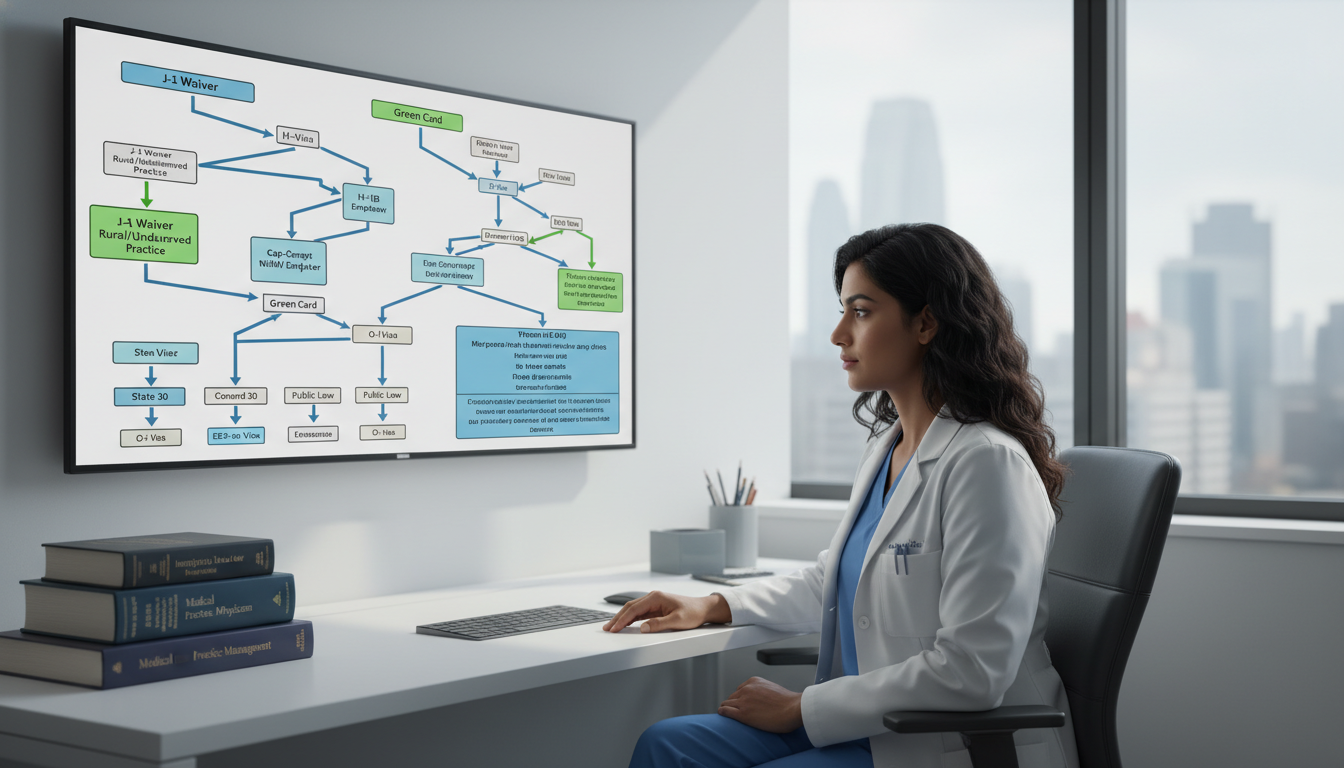
If You Trained on a J‑1 Visa
You face the two‑year home residence requirement, unless you secure a waiver. Your main options are:
Return home for two years
- Work or live in your home country (or last country of permanent residence) for a cumulative 2 years.
- After that, you can apply for:
- H‑1B
- Green card
- This is more common if:
- Waiver jobs are unattractive to you.
- You have strong career prospects back home.
Conrad 30 Waiver (State‑Based)
- Each US state can sponsor up to 30 J‑1 waiver positions per year, usually in underserved or rural areas.
- Common specialties: Primary Care (FM, IM, Pediatrics), Psychiatry, OB/Gyn, and some sub‑specialties depending on state.
- Process:
- You secure a job offer in a qualifying underserved area.
- The employer and you apply for a waiver through that state’s health department.
- If approved, you transition from J‑1 to H‑1B and must work there (usually for 3 years).
Federal Waivers
- Options include:
- Veterans Affairs (VA)
- Appalachian Regional Commission (ARC)
- Delta Regional Authority (DRA)
- Department of Health and Human Services (HHS) for certain specialties
- Requirements and numbers vary and may be more competitive or specialty‑restricted.
- Options include:
Strategic advice if you plan to train on J‑1:
- Research underserved jobs early—don’t wait until your last year of residency.
- Understand that initial attending positions may be geographically limited, but you can often relocate after fulfilling your 3‑year waiver service.
- Many physicians eventually transition to green card status via:
- Employer‑sponsored PERM
- National Interest Waiver (NIW), especially if they continue working in shortage areas.
If You Trained on an H‑1B Visa
Your main considerations are:
Time left on H‑1B clock
- Total authorized H‑1B time for most people is 6 years.
- Example:
- 3 years residency + 3 years fellowship = 6 years total.
- If you already used H‑1B time before residency (e.g., research job), you might have less.
Transition to attending roles
- You can move directly into:
- Hospital employment
- Private practices
- Academic positions
As long as they are willing to sponsor H‑1B and can file a new petition (or transfer).
- You can move directly into:
Green card strategies
- Many physicians transition from H‑1B to permanent residency through:
- Employer‑sponsored green cards (PERM, EB‑2)
- Physician National Interest Waiver (NIW) for service in underserved areas
- Because H‑1B allows dual intent, this process is usually smoother than coming from J‑1 without a waiver.
- Many physicians transition from H‑1B to permanent residency through:
Strategic advice if you plan to train on H‑1B:
- Keep a running count of how many H‑1B years you’ve used.
- Discuss long‑term sponsorship with potential employers early in contract negotiations.
- Consider whether an NIW (serving in medically underserved areas) could accelerate green card timelines.
Special Situations and Alternative Statuses
Not every non-US citizen IMG fits cleanly into the J‑1 vs H‑1B dichotomy. You should understand several common alternative scenarios.
1. IMGs with US Permanent Residency (Green Card) or Citizenship
If you are a non-US citizen by birth but now a US permanent resident or naturalized citizen, you:
- Do not need a residency visa
- Will be treated as a US graduate for visa purposes, though you remain an IMG academically
- Should communicate clearly in ERAS that you do not require sponsorship
This dramatically broadens your program options.
2. IMGs on Dependent Visas (H‑4, L‑2, etc.)
If you are in the US as a dependent (e.g., spouse of H‑1B worker):
- Some residency programs still prefer to sponsor J‑1 or H‑1B for clear employment status.
- In some cases, if you have work authorization via an EAD (e.g., H‑4 EAD, L‑2 automatic work authorization):
- Programs may hire you without separate visa sponsorship, though this varies by institution policy.
- You must:
- Clarify with each GME office how they handle such cases.
- Ensure that your EAD validity will cover the residency period, or be renewable.
3. IMGs on F‑1 (Student) Visa in the US
If you’re doing a master’s or research degree on an F‑1 visa:
- Optional Practical Training (OPT) is typically not sufficient for full residency (duration is too short).
- Programs still generally sponsor you under J‑1 or H‑1B for the full residency.
- However:
- You might use F‑1 OPT for short pre‑residency research, building your CV.
- You will later change status to J‑1/H‑1B once matched.
Practical Action Plan for Non‑US Citizen IMGs
To bring this together, here is a practical, step‑by‑step plan you can adapt.
12–24 Months Before Application
- Confirm your citizenship and current visa status.
- Learn the basics of J‑1 vs H‑1B and how they affect:
- Match chances
- Post‑residency obligations
- Long‑term US plans
- If you might pursue H‑1B:
- Schedule and prepare for USMLE Step 3.
- Start a program spreadsheet noting:
- Whether they sponsor IMGs
- Visa types (J‑1, H‑1B)
- Any special conditions
6–12 Months Before Application
- Finalize a primary visa target:
- J‑1, H‑1B, or flexible for both
- Contact programs with unclear visa information:
- Ask concise, respectful questions about IMG visa options.
- Strengthen your overall application with:
- US clinical experience (if possible)
- Strong letters of recommendation
- Research or quality improvement projects
Application Season
- Apply broadly enough considering your visa constraints:
- J‑1‑only applicants: maximize number of J‑1‑friendly programs.
- H‑1B‑hopefuls: selectively include H‑1B programs but avoid making your list too narrow.
- Clearly indicate:
- Your need for sponsorship
- Your Step 3 status (if completed or scheduled)
Interview and Ranking Phase
- Prepare to discuss:
- Your understanding of J‑1 vs H‑1B
- Your flexibility and long‑term goals
- Before ranking:
- Verify visa sponsorship policies of interviewed programs.
- Construct a rank list that balances:
- Career aspirations (H‑1B preference, academic centers)
- Match probability (J‑1‑friendly, IMG‑friendly programs)
After Match
- Respond promptly to any information requests from your GME office.
- For J‑1:
- Complete ECFMG sponsorship steps early.
- Prepare for consular interview if needed.
- For H‑1B:
- Coordinate with legal office on paperwork, Step 3 proofs, and timelines.
FAQs: Visa Navigation for Non‑US Citizen IMGs
1. Is it possible to start residency on a J‑1 visa and later switch to H‑1B during training?
Generally, no. For most programs, your visa type is chosen at the start of residency and maintained throughout the program. Transitioning from J‑1 to H‑1B during residency is rare and complicated, because:
- J‑1 physician status is specifically tied to your GME program and ECFMG sponsorship.
- H‑1B requires a different legal framework, wage requirements, and institutional policy changes.
Most transitions from J‑1 to H‑1B happen after training, when you obtain a waiver job, not mid‑residency.
2. Do I need USMLE Step 3 to get a J‑1 visa for residency?
No. Step 3 is not required for J‑1 physician sponsorship through ECFMG for residency training. You only need:
- ECFMG certification
- An approved training contract
- Valid passport and other standard documentation
However, Step 3 is commonly required for H‑1B sponsorship. Some programs also prefer residents to complete Step 3 during training for promotion or fellowship applications, but it is not a J‑1 requirement.
3. Which visa type makes it easier to eventually get a green card?
From a purely immigration perspective, H‑1B is more straightforward for transitioning to a green card because:
- It is a “dual‑intent” visa—permitting you to pursue permanent residency while in H‑1B status.
- There is no two‑year home residence requirement.
For J‑1 physicians, you must either complete the 2‑year home return requirement or obtain a J‑1 waiver before most employment‑based green card processes can proceed. That said, many J‑1 physicians successfully get waivers and then obtain green cards while working in underserved areas.
4. If a program’s website doesn’t mention visas, should I assume they don’t sponsor IMGs?
No. Program websites are often outdated or incomplete. Instead:
- Look up the program on FREIDA and similar databases.
- Email the program coordinator with a brief, specific question such as:
“I am a non-US citizen IMG who will require visa sponsorship. Could you please let me know whether your program sponsors J‑1 and/or H‑1B visas for incoming residents?” - Check the current residents list—if you see clear IMGs, the program likely sponsors at least J‑1.
Never rely solely on website silence; always verify directly.
By understanding the landscape of residency visa options, especially the implications of J‑1 vs H‑1B, you can align your application strategy with both your match goals and your long‑term career vision. For a non-US citizen IMG, informed visa planning is as essential as strong scores and strong letters—and it can be the difference between a stalled dream and a sustainable medical career in the United States.