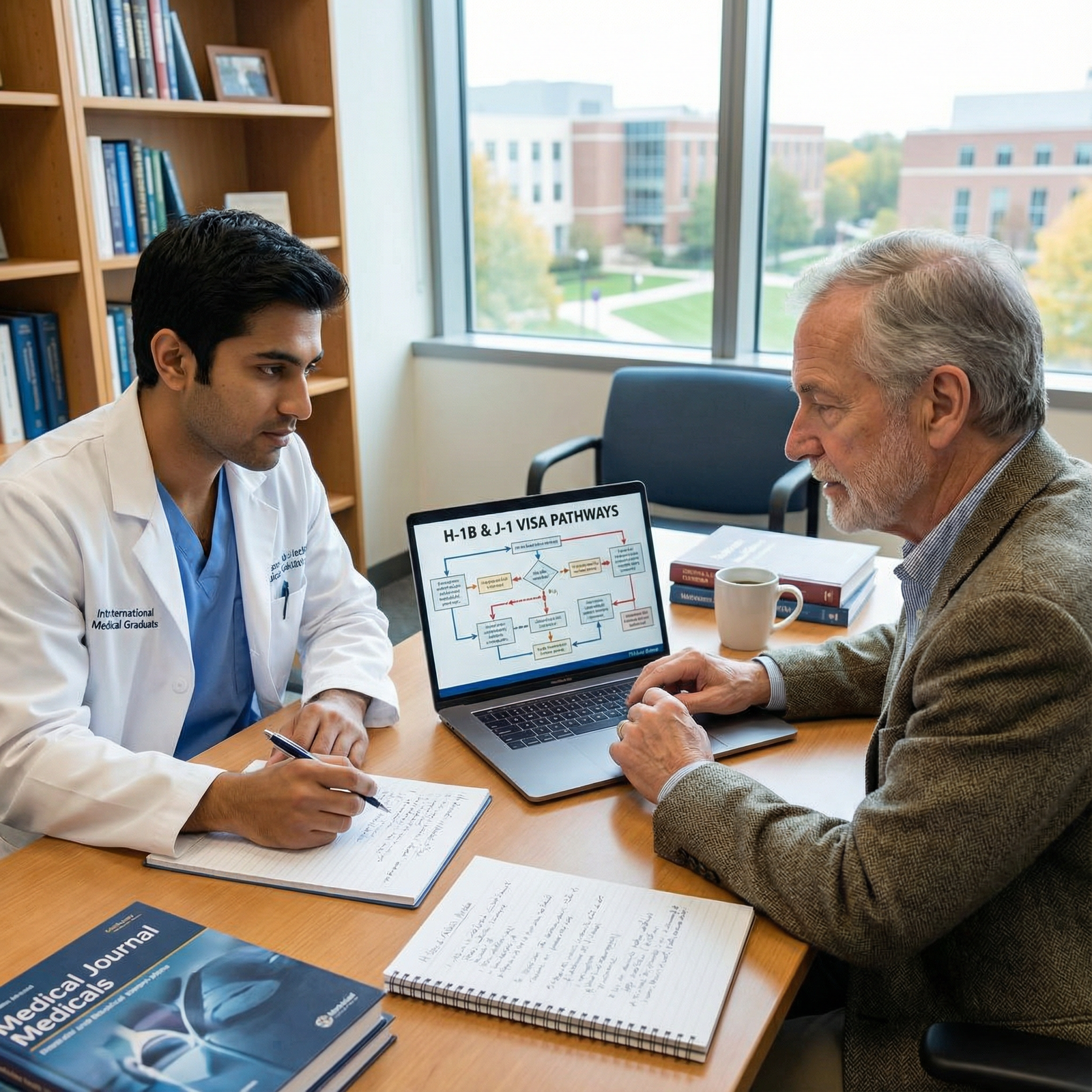
Vascular surgery is a small, highly specialized field with relatively few residency positions each year. For international medical graduates (IMGs), successfully entering a vascular surgery residency in the United States requires not only academic and clinical excellence, but also careful navigation of U.S. immigration and visa pathways. This article explains how visa issues intersect with vascular surgery training, what IMGs need to know about J-1 vs H-1B, and how to strategically plan your application and career.
Understanding the Training Pathways in Vascular Surgery
Before addressing visas, it helps to understand the main vascular surgery training paths in the U.S., because visa choices and sponsorship policies often differ depending on program type.
1. Integrated Vascular Surgery Residency (0+5)
The integrated vascular program (often called 0+5) accepts applicants directly from medical school into a five-year vascular surgery residency. You match into vascular surgery immediately and complete a full curriculum combining general surgery fundamentals with advanced vascular training.
Key points:
- Duration: 5 years of residency
- Entry: From medical school (or equivalent international degree)
- Outcome: Board eligibility in vascular surgery at completion
- Visa relevance:
- Long, continuous training period (5 years)
- Programs must commit to supporting a visa for the full duration
- Fewer positions nationwide → more competition and often stricter visa policies
2. Independent Vascular Surgery Fellowship (5+2 or 5+3)
Another path is to complete a general surgery residency first, then pursue a vascular fellowship (traditional 5+2 or sometimes 5+3 if including research).
Key points:
- Duration:
- 5 years general surgery residency
- 2–3 years vascular surgery fellowship
- Entry: From completed categorical general surgery training
- Outcome: Board eligibility in vascular surgery after fellowship
- Visa relevance:
- Two separate match processes (general surgery → vascular fellowship)
- You may be on one visa status for general surgery and another for vascular fellowship
- The J-1 waiver requirement may significantly shape what is possible after general surgery
3. Why This Matters for Visa Strategy
The structure of your training plan influences:
- The length of visa sponsorship you need from a single program (e.g., entire 0+5 training vs. 2-year fellowship)
- Your ability to change specialties or institutions while on a given visa
- The timing and impact of the J-1 two-year home residence requirement if you choose a J-1
- Availability of H-1B sponsorship, which may differ between large academic centers and smaller or community-affiliated vascular programs
Understanding these training paths helps you anticipate your total time in GME and where immigration restrictions might cause friction.
Core Visa Categories for Vascular Surgery Training
For graduate medical education (GME) in the U.S., the two primary visas IMGs encounter are the J-1 exchange visitor visa (through ECFMG) and the H-1B temporary worker visa.
Some applicants are also permanent residents or hold other visas, but for most IMGs, the focus is J-1 vs H-1B.
1. J-1 Visa for Physicians
The J-1 physician visa is administered through the Educational Commission for Foreign Medical Graduates (ECFMG). It is designed specifically for international physicians in GME.
Advantages:
- Widely used; the majority of IMG residents and fellows are on J-1
- Many vascular surgery programs are familiar and comfortable with J-1 sponsorship
- No need for USMLE Step 3 for visa issuance (only for ECFMG certification and state license issues later)
- Cap-exempt from the H-1B lottery (because it is not an H-1B at all)
- More uniform process across programs (centered through ECFMG)
Limitations:
- Comes with a two-year home country physical presence requirement (the “J-1 waiver”) that generally:
- Requires you to return to your home country for a cumulative two years after training, OR
- Obtain a waiver (often by working in an underserved area or federal program)
- You cannot change to certain other U.S. visas (including H-1B or permanent residence in many cases) without addressing the two-year requirement
- Generally limited to GME-level activities only (no moonlighting outside training institution without specific approval)
- Annual renewal and documentation through ECFMG and your program
Typical Use in Vascular Surgery:
- Common for IMGs in integrated vascular surgery residency (0+5)
- Frequently used for vascular surgery fellowship after general surgery residency
- Accepted by many academic and high-volume vascular centers
2. H-1B Visa for Residents and Fellows
The H-1B visa is a temporary worker visa allowing U.S. employers to hire foreign professionals in “specialty occupations.” For residency and fellowship, the hospital becomes the H-1B sponsor.
Advantages:
- No automatic two-year home return requirement at the end of training
- Can provide a smoother path toward:
- Employment as an attending in the U.S.
- Long-term permanent residency (green card) sponsorship
- Often more flexibility in changing employers after training (subject to transfer rules)
- Some states or institutions may allow limited moonlighting under H-1B (subject to local rules)
Limitations:
- Not all vascular surgery residency or fellowship programs offer H-1B sponsorship
- Requires USMLE Step 3 passed before the H-1B petition is filed
- More complex and often more expensive for hospitals, including legal fees
- Subject to prevailing wage and other DOL requirements
- H-1B usually counts against a six-year maximum, which may be an issue when you have:
- Long general surgery training
- Plus a vascular surgery fellowship
- Some state medical boards may have specific licensing requirements that interact with H-1B timing
Typical Use in Vascular Surgery:
- More frequently seen in:
- Larger, well-resourced academic centers
- Institutions that have an established H-1B pipeline for IMGs
- More commonly offered for vascular fellowships than for integrated vascular residencies, but practices vary
3. Other Immigration Statuses
Some applicants do not need GME visas at all:
- U.S. permanent residents (green card holders): Can train without J-1 or H-1B
- U.S. citizens: No visa needed
- Other visas (e.g., E-2, F-1 with OPT, O-1) may occasionally be involved but are less typical for GME and often more complex; most programs prefer J-1 or H-1B for standardization.

J-1 vs H-1B: Strategic Considerations for Vascular Surgery IMGs
Vascular surgery is a narrow subspecialty with fewer training and practice locations than more common specialties. This makes your visa decision more strategic, especially regarding where you can practice after graduation.
1. Training Goals vs Long-Term Career Goals
Ask yourself:
- Do I intend to return to my home country for long-term practice?
- Do I want to stay in the U.S. academic vascular surgery world long term?
- Am I open to working in a rural or underserved area to secure a waiver?
- How likely am I to pursue advanced academic/research roles that might support O-1 or EB2-NIW immigration later?
If you strongly prefer long-term U.S. practice, the H-1B may be more appealing because it avoids the default J-1 home residence requirement. However, H-1B availability is limited and program-dependent.
If you are flexible about returning home or working in underserved areas for a J-1 waiver, the J-1 route may be perfectly acceptable — and more widely available.
2. Availability of Visa Sponsorship by Vascular Programs
Vascular surgery programs vary widely in immigration policies. Some:
- Only sponsor J-1 visas for any resident or fellow
- Sponsor both J-1 and H-1B, but reserve H-1B for exceptional or special circumstances
- Prefer H-1B for fellows but not for 0+5 integrated residents
- Will not sponsor any visas at all (U.S. citizens or permanent residents only)
Actionable steps:
- Check each program’s website under “International Medical Graduates” or “Visa Information.”
- If unclear, email the program coordinator early in the season with a short, direct question:
- “Do you sponsor J-1 and/or H-1B visas for integrated vascular surgery residents?”
- “Do you ever consider H-1B sponsorship for vascular fellows?”
- Keep a spreadsheet to categorize:
- J-1 only
- J-1 or H-1B
- H-1B rarely/exceptionally
- No sponsorship
For a vascular surgery applicant, limited total positions mean that taking a rigid stance on visa type (e.g., H-1B only) can dramatically reduce your match chances.
3. Length of Training and the H-1B Six-Year Limit
H-1B has a typical maximum of six years (with some exceptions when green card processes are underway). For vascular surgery:
- General surgery residency: 5 years
- Vascular surgery fellowship: 2–3 years
- Total potential training: 7–8 years
If all of this is under H-1B, you may run into the six-year cap:
- Some applicants do general surgery on J-1 and vascular fellowship on H-1B
- Others complete all training on J-1 and later obtain a J-1 waiver position
- Some combine J-1, H-1B, and eventually a transition to O-1 or permanent residency through their academic or research achievements
Because integrated vascular residency (0+5) is 5 years alone, plus potential fellowships or research, careful planning is necessary if you consider H-1B for the entire arc of your GME time.
4. J-1 Waivers and the Nature of Vascular Surgery Practice
At the end of J-1–based training, you face the two-year home residency requirement unless you obtain a J-1 waiver. Common waiver pathways include:
- Conrad 30 state programs (designated shortage areas)
- Federal programs (VA, HHS, etc.)
- Persecution or hardship waivers (rare and case-specific)
For vascular surgeons, this intersects with:
- Limited total number of vascular surgery jobs nationwide compared with internal medicine or family medicine
- Concentration of vascular practices in urban tertiary centers rather than rural clinics
- Some states may not easily accommodate highly specialized surgeons in their Conrad 30 primary care–oriented spots, while others may
Consequently, finding a J-1 waiver job as a vascular surgeon can be more challenging than for primary care, although not impossible — especially if:
- You are flexible with geography and practice setting
- You are willing to join a health system that also provides general surgery or acute care surgery coverage in underserved regions
If your long-term intention is U.S. practice and you foresee difficulty in securing a J-1 waiver job, the H-1B path may provide more flexibility after training, provided you can secure it during residency/fellowship.
Residency Application Planning for IMGs: Visa-Focused Strategies
Image: Inline here.

1. Early Timeline Considerations
If you aim for an integrated vascular surgery residency, you must plan 2–3 years ahead:
Complete USMLE Step 1 (and Step 2 CK) early
Obtain U.S. clinical experience in surgery or vascular-related rotations
Clarify your visa priorities:
- If you want H-1B:
- Plan to pass Step 3 early enough before residency starts
- Identify programs with a history of H-1B sponsorship for 0+5 residents
- If you accept J-1:
- Understand future J-1 waiver or return-home implications
- If you want H-1B:
For those pursuing general surgery first, start your visa planning before general surgery applications. Your initial visa choice for general surgery will shape what is possible later for your vascular fellowship.
2. Communicating with Programs as an IMG
In your ERAS application and interviews:
- Be honest about your citizenship and visa needs
- If your status allows you to train without sponsorship (e.g., green card, asylum, other independent work authorization), highlight that clearly
- Avoid opening complex legal discussions in interviews, but show:
- Awareness of standard pathways (J-1 vs H-1B)
- Flexibility if possible (e.g., “I can train on either J-1 or H-1B; I am open to what aligns with the program’s policies.”)
If you strongly prefer H-1B but the program only offers J-1:
- Understand that pressing aggressively for H-1B may hurt your chances in a small, competitive field
- A pragmatic approach is often to accept J-1 at a top vascular program and plan strategically for a waiver or long-term path later
3. Application Examples and Scenarios
Scenario A: IMG, no U.S. visa, targeting 0+5 integrated vascular surgery
- You pass Step 1 and Step 2 CK with strong scores, do U.S. rotations
- Visa reality:
- Most integrated programs sponsor J-1
- A minority sponsor H-1B; many will require Step 3 before rank list certification
- Practical advice:
- Apply broadly to both J-1 and H-1B sponsoring programs
- If your top-choice program offers only J-1, consider accepting it; you can still build a U.S. academic career
Scenario B: IMG on J-1 for general surgery, now applying for vascular fellowship
- You are in year 3–4 of general surgery on a J-1
- Options:
- Continue on J-1 for fellowship: easier administratively, but home/waiver requirement persists
- Explore H-1B for fellowship: may complicate the two-year requirement, and many programs prefer to keep you on J-1
- Practical advice:
- Discuss with your current program’s GME and an immigration attorney before making changes
- In many cases, staying on J-1 through all training and focusing on your waiver job afterward is the most straightforward option
Scenario C: IMG on H-1B for general surgery, wants vascular fellowship
- You are 4 years into general surgery on H-1B
- You may be nearing your six-year maximum during or shortly after fellowship
- Practical advice:
- Track your total H-1B time carefully
- Consider starting a green card process (if institution supports) during late residency or early fellowship to extend H-1B beyond six years
- Maintain open communication with future employers about immigration timing
Practical Steps and Common Pitfalls
1. Work With Professionals
Visa and immigration rules are complex and change over time. For any non-routine situation, rely on:
- Your institution’s GME office and international services
- An experienced immigration attorney (especially before switching status, applying for waivers, or starting green card processes)
Do not rely solely on informal online forums for decisions with long-term consequences.
2. Documentation You Should Organize Early
Regardless of J-1 or H-1B, you will need:
- Valid passport (longer validity is better)
- Medical diploma and transcripts
- ECFMG certification (or status documents)
- USMLE score reports
- Curriculum vitae and recommendation letters
- For H-1B:
- USMLE Step 3 results
- State medical board requirements and timelines
Preparing these early reduces delays and shows programs you are visa-ready.
3. Licensing and Visa Timing
State medical boards may have different requirements for residents and fellows on visas, often intersecting with:
- Timing of ECFMG certification
- Primary source verification of your medical school
- Training permits vs full licenses (some fellowships require full licenses)
Because vascular surgery often involves high-acuity procedures, some states require more advanced licensing for fellows than for first-year residents. Coordinate licensing and visa timelines carefully.
4. Common Mistakes IMGs Make
- Assuming all programs treat visas the same way – policies differ widely.
- Waiting too long to pass Step 3 if targeting H-1B.
- Ignoring the J-1 two-year home rule until after fellowship, then realizing it restricts your options.
- Not asking programs about visa policies early – leading to late surprises.
- Relying heavily on one type of training path (e.g., only integrated vascular programs that sponsor H-1B) and therefore applying to too few programs.
Avoid these pitfalls by researching, planning ahead, and staying flexible where possible.
Frequently Asked Questions (FAQ)
1. Can I match into an integrated vascular surgery residency on an H-1B visa as an IMG?
Yes, it is possible but less common. Some integrated vascular surgery residency programs sponsor H-1B visas, especially larger academic centers with prior experience. However, many programs sponsor only J-1 visas for 0+5 residents. You should:
- Pass USMLE Step 3 early if you want to be considered for H-1B
- Directly confirm with each program whether they sponsor H-1B for integrated vascular residents
- Apply broadly to avoid over-restricting your options in a small specialty
2. If I do all my training on a J-1 visa, can I still build a long-term vascular surgery career in the U.S.?
Yes, many physicians on J-1 visas successfully remain in the U.S. by obtaining a J-1 waiver job fulfilling the two-year requirement and then transitioning to H-1B or permanent residency. For vascular surgery:
- Waiver opportunities may be more limited than in primary care but do exist, especially in underserved regions or integrated health systems with surgical shortages.
- Strong clinical skills, flexibility about location, and networking can help you identify waiver-eligible vascular or mixed surgical positions.
- Later in your career, you may pursue permanent residency through employer sponsorship, academic achievements (O-1 or EB2-NIW), or other pathways.
3. Should I delay applying to vascular surgery until I have H-1B-secure options, or accept a strong program on J-1 now?
This is highly individual. In many cases, accepting a strong vascular surgery program on J-1 is a wise decision, especially given the competitiveness and small size of the field. The benefits of premier training—robust case volume, mentorship, research, and reputation—often outweigh the uncertainty created by the J-1 waiver requirement. That said, if you have multiple offers and one includes H-1B sponsorship at a program that still fits your training goals, that can offer greater post-training immigration flexibility.
4. Can I switch from J-1 to H-1B during vascular surgery residency or fellowship?
Switching from J-1 to H-1B during training is legally complex because of the two-year home residence requirement tied to J-1. In general:
- If you are subject to the two-year rule, you must either fulfill it by returning home or obtain a waiver before you can change status to H-1B in many situations.
- Rare exceptions and specific legal strategies exist, but they are highly case-dependent.
- If you are considering such a switch, involve both your program’s legal team and an outside immigration attorney early. Do not rely on anecdotal stories without legal confirmation.
Navigating residency visa options as an IMG targeting vascular surgery requires balancing training excellence with immigration feasibility. Understanding how J-1 vs H-1B choices interact with the integrated vascular program pathway, traditional fellowship routes, and long-term job prospects will help you make informed, strategic decisions. By planning early, staying flexible where possible, and using professional legal guidance, you can build a clear, realistic path from international medical graduate to practicing vascular surgeon in the United States.