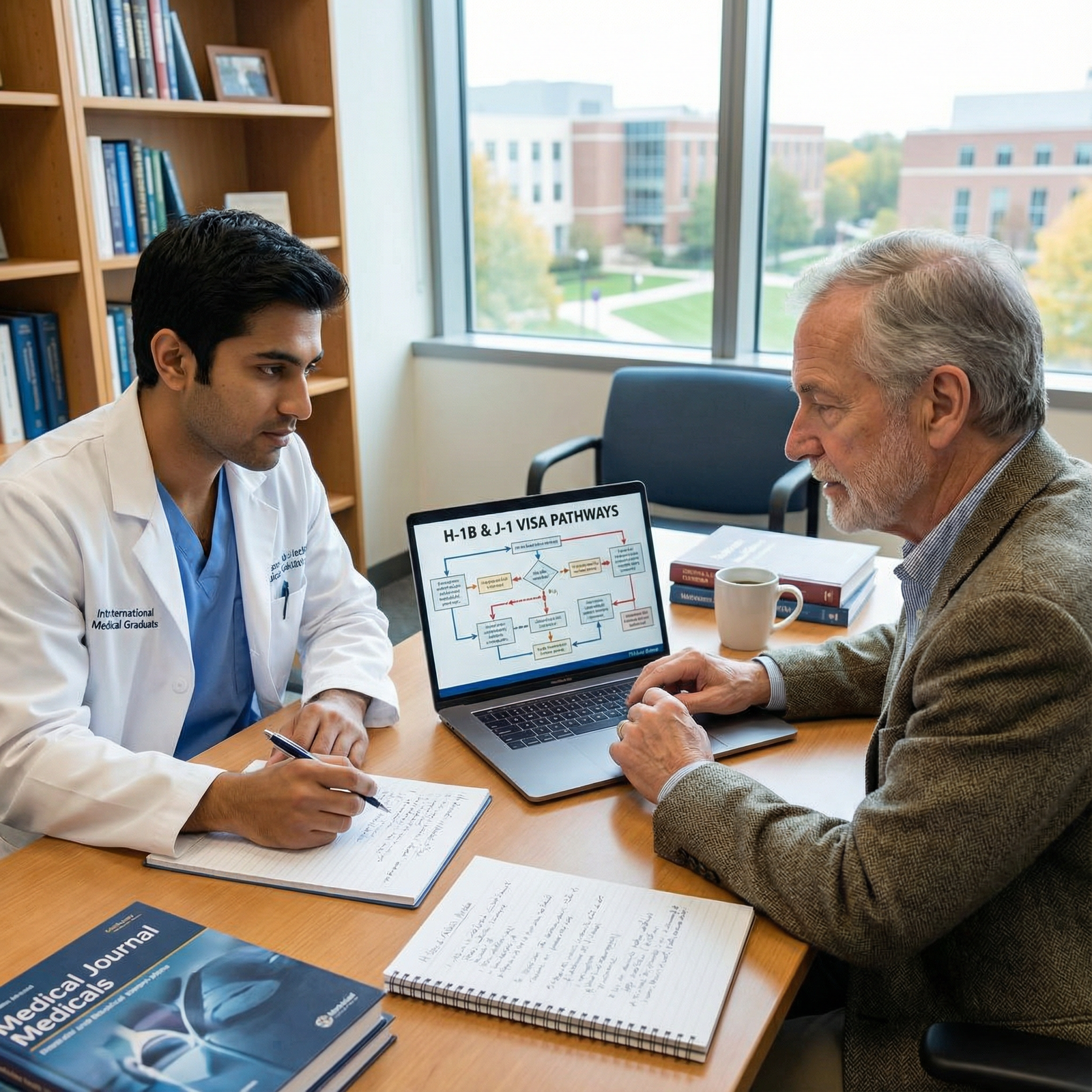
Understanding the Visa Landscape as a Caribbean IMG in Interventional Radiology
For a Caribbean medical school graduate aiming for an interventional radiology residency in the U.S., visa strategy is not a side issue—it is central to whether you can train and eventually practice. Programs want to know that you can (1) start on time, (2) remain in status without interruption, and (3) transition into fellowship and practice smoothly. You need to be able to answer visa questions confidently on applications and in interviews, particularly when pursuing a competitive specialty like IR.
This article focuses on:
- The main visa pathways used by IMGs for residency (J‑1 and H‑1B)
- How these apply specifically to interventional radiology residency (integrated and independent)
- Visa planning for Caribbean medical school residency applicants (e.g., SGU, AUC, Ross, Saba, etc.)
- Strategies to improve your IR match odds while managing immigration constraints
- Common pitfalls and FAQs about residency visa and IMG visa options
Throughout, “Caribbean IMG” refers mainly to graduates of offshore Caribbean medical schools (like SGU, Ross, AUC) who are not U.S. citizens or permanent residents.
Core Visa Options for Caribbean IMGs Entering U.S. Residency
When you think about residency visa, there are three broad categories:
- No visa needed (U.S. citizen / U.S. permanent resident)
- J‑1 visa (sponsored by ECFMG)
- H‑1B visa (employment-based, sponsored by the residency program)
1. If You Are a U.S. Citizen or Permanent Resident
If you hold a U.S. passport or green card:
- You do not need a residency visa.
- You can be considered the same as U.S. MD/DO graduates from a visa standpoint.
- Programs that “do not sponsor visas” are still open to you.
- You still have to pass USMLE/COMLEX and be ECFMG certified (if an IMG), but immigration is not a barrier.
For Caribbean grads at large schools like SGU, many are dual citizens. If you have (or can obtain) U.S. citizenship or a green card through family, employment, or marriage, that is almost always the most powerful “visa solution” you can have.
2. J‑1 Visa: The Default Visa for Most IMGs
The J‑1 physician visa (sponsored by ECFMG) is the most common residency visa for IMGs, including many in competitive fields—cardiology, GI, and increasingly, interventional radiology.
Key features:
- Sponsor: ECFMG (not the residency program)
- Purpose: Graduate medical education (residency/fellowship)
- Duration: Typically the length of your training (with a maximum of 7 years, though extensions are sometimes possible for advanced training)
- Work limitation: You can only train in the ACGME-accredited program listed in your DS-2019 and cannot moonlight or take extra jobs without explicit permission (and often not at all).
- Two-year home residency requirement: After finishing all your J‑1 training in the U.S., you are generally obligated to return to your home country for two years OR obtain a waiver before changing to H-1B or permanent residency (green card).
For most Caribbean IMGs who are not U.S. citizens, the J‑1 vs H‑1B decision is really about which one is realistically available:
- Many academic and community programs only sponsor J‑1.
- H‑1B sponsorship for residency is more limited and more complex.
From a match perspective, being open to J‑1 can dramatically expand the number of interventional radiology residency programs you can apply to.
3. H‑1B Visa: More Flexibility After Training, More Constraints Upfront
The H‑1B visa is an employment-based visa:
- Sponsor: Residency/fellowship program (employer)
- Purpose: Specialty occupation (physician in training can qualify)
- Duration: Up to six years total in H‑1B status (commonly issued in 3-year increments)
- Advantages:
- No two-year home country requirement.
- Easier to transition directly to certain jobs or apply for a green card.
- Some ability to change employers within the H‑1B framework.
However, for Caribbean IMGs applying to interventional radiology residency, H‑1B has important practical challenges:
- Many programs do not sponsor H‑1B due to legal and financial complexity.
- For residency, some state medical boards require full USMLE Step 3 before they will allow H‑1B sponsorship—and before your residency start date. That is a big hurdle, especially when you’re also focused on applications and interviews.
- Programs may be wary of using up your H‑1B years before fellowship or independent IR training is completed.
In IR specifically, your total training may include:
- 1–2 years of preliminary surgery or diagnostic radiology exposure during medical school or separate internship
- 5 years of integrated interventional radiology residency (or DR + IR independent residency)
- 1–2 years of additional fellowship (in some tracks or if switching)
This long training timeline can consume a significant portion of your six-year H‑1B limit, making programs cautious.
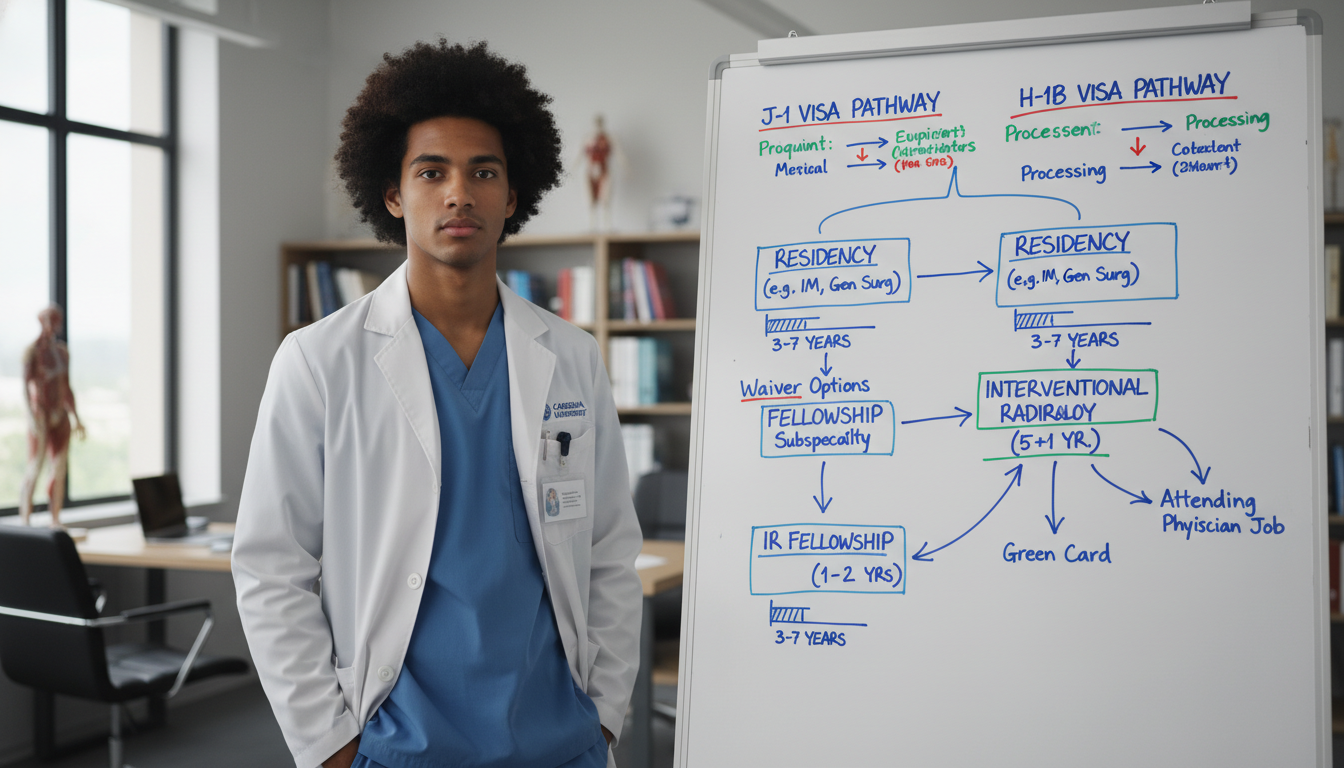
How Visa Choices Interact with Interventional Radiology Training Pathways
Interventional radiology has unique training pathways, which matter a lot for visa planning.
Integrated IR Residency vs Independent IR Residency
Integrated IR Residency (IR/DR)
- 6-year program (PGY-1 through PGY-6, depending on structure) combining diagnostic radiology (DR) and interventional radiology (IR).
- You match directly into IR/DR from med school via ERAS and the NRMP.
- This is the most common goal for Caribbean medical school residency applicants interested in IR.
DR Residency + Independent IR Residency
- 4 years of diagnostic radiology (after a preliminary year) + 1–2 years of independent IR residency.
- You may match into DR first, then apply for independent IR later (during DR residency).
Visa implications:
- Integrated IR: One continuous training program; you’re likely to remain on the same visa (usually J‑1) for the whole time, sponsored each year as long as you remain in good standing.
- DR → Independent IR: You might:
- Stay on J‑1 Resident category the entire time, shifting between DR and IR residency.
- Or, if you are on H‑1B, need a new H‑1B petition and possibly new prevailing wage determinations when changing programs or training levels.
Programs know IR is long and competitive, and some worry about:
- J‑1 7-year cap vs. total training time
- H‑1B 6-year cap vs. DR + IR training
- Whether you’ll be able to stay for independent IR after DR if you start on H‑1B
This is why you see many Caribbean IMG match profiles (e.g., SGU residency match lists) showing J‑1 as the primary pathway for IR or for DR that leads to IR.
Visa Considerations for the IR Match (Integrated IR)
When applying for integrated IR:
- Program filters: Many programs will categorically filter out candidates who require H‑1B sponsorship, but accept J‑1.
- Competitiveness: IR is highly competitive; being limited to only H‑1B-sponsoring programs can hurt your chances significantly.
- Strategy: If you are open to J‑1, you can apply broadly and then discuss visa details later.
If you are focused on IR match and are not a U.S. citizen/green card holder, you should strongly consider whether insisting on H‑1B is worth the significant reduction in available program options.
J‑1 vs H‑1B in Detail: Pros, Cons, and IR-Specific Tradeoffs
J‑1 Visa: Pros and Cons for IR-Bound Caribbean IMGs
Advantages:
Widest program availability
- Many academic radiology and IR programs only accept J‑1 for IMGs.
- You will likely see more interview invitations if you’re J‑1-eligible and flexible.
Streamlined process
- ECFMG handles most of the paperwork.
- Programs are very familiar with the J‑1 process.
Better alignment with long training
- The J‑1 category for physicians is known to allow up to 7 years (and sometimes extensions) for GME training, which can cover most IR pathways.
No need for Step 3 prior to residency
- For J‑1 sponsorship, Step 3 is not required before starting residency (though some states/programs may prefer it).
Disadvantages:
Two-year home residency requirement
- After training, you must either:
- Return to your home country for a total of 2 years, OR
- Obtain a J‑1 waiver (e.g., Conrad 30 waiver job, federal waiver program, etc.).
- This requirement can limit your immediate post-training job options.
- After training, you must either:
Limited moonlighting
- Extra income from moonlighting is often restricted or not allowed.
- This may be particularly relevant in IR, where procedural call coverage can be attractive for moonlighting.
Family limitations
- Spouses on J‑2 may have work authorization, but your long-term stability is constrained by your training status and waiver/post-waiver plans.
H‑1B Visa: Pros and Cons for IR-Bound Caribbean IMGs
Advantages:
No two-year home requirement
- You can pursue a job or green card directly after training without needing a J‑1 waiver.
- This can make negotiating your first job in interventional radiology easier.
More straightforward path to permanent residency
- Many employers are comfortable sponsoring green cards for H‑1B physicians who join as attendings.
Moonlighting is possible (with conditions)
- You can sometimes moonlight if:
- It is within the scope of your H‑1B petition, OR
- You obtain concurrent H‑1B for other employers (which is rare in residency but more common after training).
- You can sometimes moonlight if:
Disadvantages:
Fewer residency programs sponsor H‑1B
- In competitive fields like IR and DR, this drastically narrows your options.
- Some of the top academic IR programs may be J‑1 only.
Step 3 requirement
- Many H‑1B programs and state boards require passing USMLE Step 3 before residency start.
- That is tough to juggle alongside IR match preparations.
Six-year H‑1B limit vs long IR training
- A long training pathway (prelim + DR + IR) can approach or exceed 6 years.
- Programs may worry about running out of H‑1B time before you finish all training, making them hesitant to sponsor you.
Program legal/administrative burden
- H‑1B petitions entail legal costs, prevailing wage determinations, and more complex management.
- Some radiology departments prefer the simpler J‑1 route.

Practical Strategies for Caribbean IMGs Targeting IR: Applications, Interviews, and Beyond
Step 1: Clarify Your Immigration Status Early
Before you plan your IR match strategy, answer these questions honestly:
- Do you already have U.S. citizenship or a green card?
- If yes: You can ignore most visa barriers. Your main challenge is IR competitiveness.
- Do you have another long-term status in the U.S.?
- For example, F‑1 with OPT, pending asylum, TPS, etc. These can complicate the residency visa picture.
- What is your home country for J‑1 purposes?
- This matters for the home-country return requirement and potential waiver jobs later.
You should be able to explain this clearly in personal statements, interviews, and to program coordinators.
Step 2: Decide Your Stance on J‑1 vs H‑1B
For most Caribbean IMGs aiming directly for interventional radiology residency:
- Being open to J‑1 significantly increases your IR match chances.
- Insisting on H‑1B:
- Narrows your program pool.
- Requires Step 3 earlier.
- Adds complexity that some IR programs may wish to avoid.
A pragmatic stance might be:
- “I am open to J‑1 or H‑1B sponsorship, but I recognize that most programs only sponsor J‑1, so I am happy to pursue J‑1 if that is what your institution supports.”
Be prepared to state this clearly when asked about IMG visa options in interviews.
Step 3: Research Program Visa Policies Before Applying
Use a structured approach:
- ERAS and program websites
- Look for phrases like:
- “We sponsor J‑1 only.”
- “We sponsor J‑1 and may consider H‑1B for exceptional candidates.”
- “We do not sponsor visas.”
- Look for phrases like:
- FREIDA / AAMC resources
- Some databases allow you to filter by whether a program sponsors visas.
- Direct email to programs (if unclear)
- Ask briefly and professionally:
- “As an international medical graduate from a Caribbean medical school, I will require visa sponsorship for residency. Could you please confirm whether your interventional radiology (or diagnostic radiology) program sponsors J‑1 and/or H‑1B visas?”
- Ask briefly and professionally:
For Caribbean medical school residency applicants, your dean’s office often keeps internal notes on which programs previously sponsored J‑1 or H‑1B for prior grads; use that network.
Step 4: Communicate Visa Issues Professionally in Interviews
You may be asked:
- “Will you need visa sponsorship for residency?”
- “Are you seeking H‑1B only, or are you flexible with J‑1?”
- “Have you taken USMLE Step 3?”
Recommended responses for a Caribbean IMG targeting IR match:
If open to both J‑1 and H‑1B:
“Yes, I will require visa sponsorship. I am eligible for ECFMG-sponsored J‑1 and would be very comfortable training on a J‑1 visa. If your institution also sponsors H‑1B, I’d be happy to discuss that possibility, but I understand many programs prefer J‑1 for residency and I am flexible.”If strongly preferring H‑1B (after thoughtful consideration):
“Yes, I will require visa sponsorship, and I am particularly interested in H‑1B if that is an option at your institution because I hope to remain in the U.S. long-term. I understand H‑1B sponsorship involves additional steps, and I am prepared to complete USMLE Step 3 before starting residency.”
Be honest. Do not tell programs you are open to J‑1 if you know you will later refuse it.
Step 5: Plan for Long-Term Pathway: IR Fellowship or Independent IR, and Post-Training Job
When you choose between J‑1 and H‑1B, think beyond the residency match:
If you go J‑1 for IR:
- You must plan early for a J‑1 waiver job after training (e.g., underserved areas, Conrad 30, VA, or federal waiver).
- Many IR jobs in semi-rural or underserved areas may qualify; urban academic IR positions may not.
- Talk with mentors and current J‑1 fellows in IR about their waiver experience.
If you go H‑1B:
- Keep track of your total H‑1B time (including any prior H‑1B).
- During DR and independent IR, ensure you don’t exceed your 6-year limit.
- Discuss with your future employer how they can sponsor a green card during or soon after your H‑1B employment.
Being able to answer long-term questions like “What do you see as your visa pathway after IR training?” shows maturity and preparation.
Common Pitfalls and How to Avoid Them as a Caribbean IMG in IR
Pitfall 1: Applying Only to H‑1B-Sponsoring Programs in a Hyper-Competitive Specialty
In a field like interventional radiology, limiting yourself to a small subset of programs that sponsor H‑1B can severely damage your odds of an IR match.
Solution:
- Strongly consider accepting J‑1 for residency, especially if:
- Your Step scores are average or slightly above average.
- You have limited research or IR exposure.
- You are coming from a lesser-known Caribbean school without a strong IR reputation.
Pitfall 2: Ignoring the Timeline for Step 3 (If You Want H‑1B)
Many Caribbean IMGs underestimate how long it takes to:
- Study for and pass USMLE Step 3
- Receive scores (usually a few weeks)
- Complete all H‑1B documents before the residency start date
Solution:
- If you’re serious about H‑1B:
- Plan to take Step 3 by fall or early winter of your application year.
- Confirm that the state medical board and specific program require Step 3 for H‑1B.
Pitfall 3: Misunderstanding the J‑1 Home Residency Requirement
Some IMGs assume they “cannot stay in the U.S. at all” after J‑1 training. In reality:
- You can stay for waiver jobs in underserved areas.
- You can return home for shorter periods over time to fulfill the 2-year requirement in cumulative fashion (but this complicates immediate U.S. practice).
- You may ultimately be able to shift to H‑1B or permanent residency after the J‑1 obligation is satisfied or waived.
Solution:
- Talk with current or former J‑1 residents/fellows in radiology and IR about how they handled the waiver and job search.
- Educate yourself on state-specific Conrad 30 programs and whether they are IR-friendly.
Pitfall 4: Poor Communication with Programs About Visa Status
Lack of clarity or inaccurate statements about your visa situation can lead to lost offers or last-minute complications.
Solution:
- Always answer visa questions directly in ERAS supplemental forms.
- If your status changes (e.g., you obtain a green card), update programs promptly.
- Keep all documents organized:
- Passport
- ECFMG certification
- USMLE score reports
- Prior visa documents, if any
FAQs: Visa Navigation for Caribbean IMGs in Interventional Radiology
1. As a Caribbean IMG, will needing a visa hurt my chances in the IR match?
Needing a visa does add complexity, but it is not automatically disqualifying. Many programs regularly take J‑1 IMGs in radiology and even in IR. Where it can hurt you is if:
- You insist on H‑1B only, drastically limiting your program list.
- Your overall application is weaker (lower scores, limited research, no IR exposure), making programs less willing to navigate visa issues for you.
If you are a strong applicant and are open to J‑1, you can still be competitive in the IR match as a Caribbean IMG.
2. Is it better to match into DR first and then do independent IR from a visa perspective?
Not necessarily. Visa-wise:
Integrated IR:
- One continuous training program with a predictable visa path (usually J‑1).
- Attractive if you are clearly committed to IR early.
DR → Independent IR:
- More flexible; if you fail to get into IR, you can still practice DR.
- But requires new applications and potentially new visa petitions during residency.
From a pure visa standpoint, both tracks can work with J‑1 or H‑1B. The real decision should be based more on your competitiveness, risk tolerance, and how early you are sure about IR.
3. If I train on a J‑1 visa, can I still build a long-term IR career in the U.S.?
Yes, but you must navigate the J‑1 home residency requirement strategically:
- Many J‑1 IR graduates obtain Conrad 30 or federal waivers in hospitals that need IR services (often in semi-rural or underserved regions).
- After working in a waiver job (typically 3 years), you may transition to other positions and potentially pursue a green card.
- Academic IR jobs in large cities may be harder to obtain immediately after a J‑1 waiver, but some physicians work toward them gradually.
Planning early, networking with IR mentors, and understanding the waiver landscape will be key.
4. Does attending a well-known Caribbean school like SGU improve my visa options?
The school itself does not change U.S. immigration law, but it can help indirectly:
- Large schools such as SGU, Ross, and AUC have strong residency advising teams and established relationships with programs familiar with their grads.
- Their SGU residency match or similar match lists often include many J‑1 IMGs, including in radiology specialties.
- Some programs know that Caribbean IMGs from these schools are usually well-prepared for ECFMG and J‑1 requirements.
However, visa decisions (J‑1 vs H‑1B, residency visa sponsorship) are based on institutional policy and federal law, not the brand of your Caribbean medical school. You still need strong scores, clinical performance, IR exposure, and a clear, realistic visa strategy.
By understanding the nuances of residency visa, especially J‑1 vs H‑1B, and how they intersect with the unique structure and length of interventional radiology residency, you can position yourself as a prepared, low-risk candidate in the eyes of program directors. For a Caribbean IMG with a strong application and a flexible, well-reasoned visa plan, an IR career in the United States remains an achievable goal.