
Understanding the Big Picture: Visa Navigation as a Caribbean IMG in Pediatrics-Psychiatry
For a Caribbean medical graduate aiming for a Pediatrics-Psychiatry (often called “Peds-Psych”) or Triple Board pathway in the United States, visa navigation is not a side issue—it is a central strategic component of your residency plan.
You not only have to be competitive for a complex, relatively niche specialty, but you must also fit within a program’s ability and willingness to sponsor a visa. This is especially true if you trained at a Caribbean medical school and are relying on residency to secure legal status in the U.S.
In this article, we’ll walk through:
- How visa issues specifically impact Caribbean IMGs in combined Pediatrics-Psychiatry/Triple Board programs
- SGU residency match and other Caribbean medical school residency trends relevant to visas
- Core IMG visa options (J-1 vs H-1B and others)
- How to research and prioritize programs based on sponsorship
- Structuring your application strategy, from ERAS list building through Match and beyond
- Practical tips, examples, and timelines tailored to Pediatrics-Psychiatry aspirants
The goal is to help you make informed, realistic decisions so that visa constraints do not derail your career vision.
1. The Landscape: Caribbean Medical School Graduates and Residency Visas
Caribbean IMGs face a dual challenge: competitiveness for residency positions and limited visa sponsorship at many programs. When you add a specialized path like Pediatrics-Psychiatry or Triple Board (Pediatrics–Psychiatry–Child and Adolescent Psychiatry), the number of suitable programs shrinks further.
1.1 Caribbean Medical School Residency Realities
Well-known Caribbean schools, such as St. George’s University (SGU), Ross, AUC, and Saba, have developed strong match infrastructures. The SGU residency match data, for example, consistently shows many graduates entering primary care and categorical Pediatrics—but fewer in highly specialized or combined programs.
Key realities for Caribbean IMGs:
- Visa sponsorship is not guaranteed, even at IMG-friendly institutions
- Some Peds-Psych or Triple Board programs will not sponsor any visas
- Programs that do sponsor often prefer J-1 over H-1B due to cost and administrative burden
- USMLE scores, U.S. clinical experience, and strong letters are necessary but not sufficient if your visa needs do not align with program policies
For a Caribbean IMG, residency visa planning must begin early—ideally before or during clinical rotations.
1.2 Why Peds-Psych and Triple Board Make Visa Planning Trickier
Peds-Psych and Triple Board tracks are:
- Highly structured: They combine training across Pediatrics, Psychiatry, and often Child & Adolescent Psychiatry, with specific ACGME rules and limited positions.
- Offered at fewer institutions: Only a small subset of academic centers offers these pathways.
- More academic in orientation: Many are at university-based programs with strong research and child mental health focus.
What this means for visas:
- Fewer options: By choosing a niche combined specialty, you give yourself fewer program choices—and not all those programs can or will sponsor visas.
- Institutional priorities: Academic programs may have firm institutional policies favoring J-1 over H-1B.
- Long-term training implications: Triple Board involves 5 years of training, and Child & Adolescent Psychiatry fellowship often follows a pediatrics-psych pathway, raising long-term visa and waiver questions.
You must evaluate: Can I realistically secure a visa at a program that offers the training pathway I want, and what does that mean for my long-term immigration strategy?
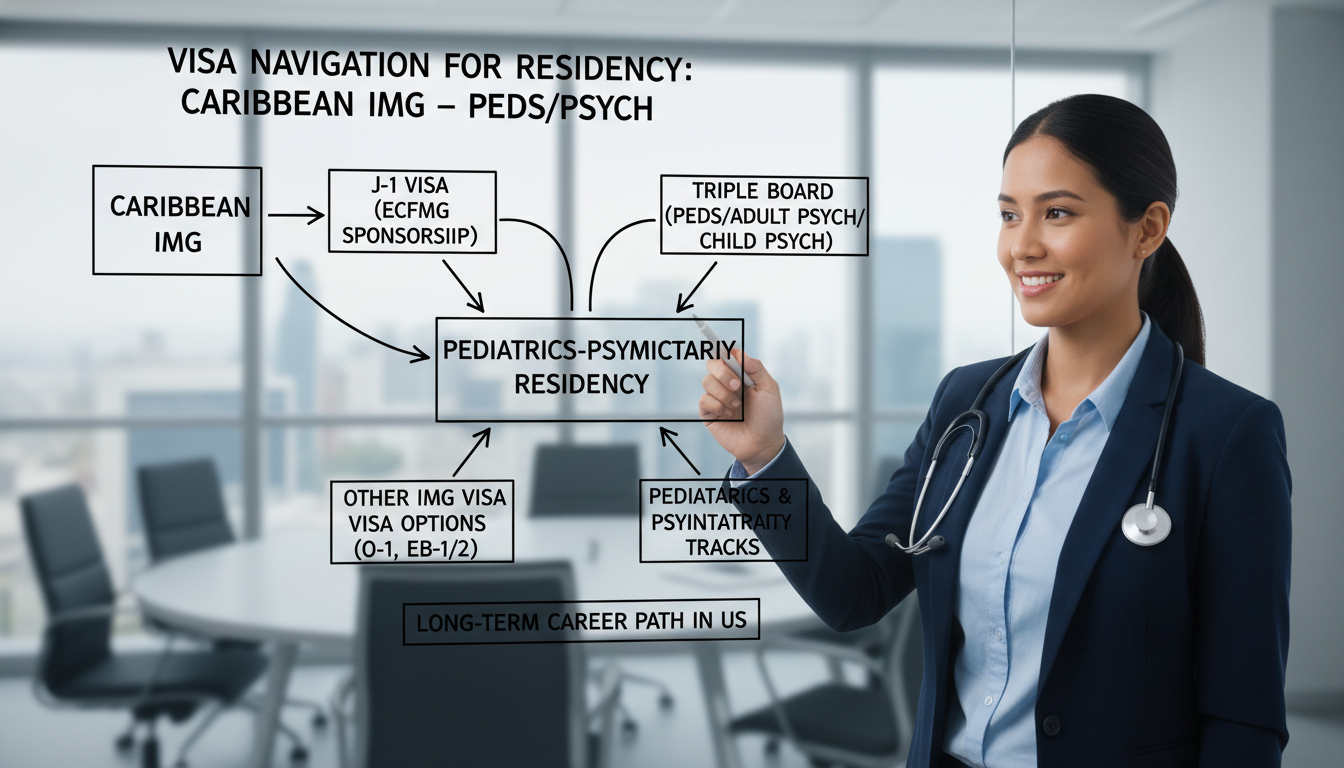
2. Core IMG Visa Options: J-1 vs H-1B and Beyond
Understanding the main residency visa categories is essential before you even start identifying programs.
2.1 The J-1 Visa (ECFMG-Sponsored)
For the vast majority of international medical graduates, the J-1 physician visa is the default training visa. It is sponsored by ECFMG, not by the residency program directly, although the program must support your application.
Key features:
- Purpose: For graduate medical education (residency and fellowship).
- Duration: Length of your training program (with caps—usually up to 7 years total, sometimes extended).
- Processing: Generally more streamlined and predictable for training programs.
- Obligation: Almost always includes a two-year home-country physical presence requirement after completion of training unless waived (e.g., J-1 waiver jobs in underserved areas).
Advantages for Caribbean IMGs:
- Widely accepted: Many university and community programs sponsor J-1s.
- Predictable: ECFMG has established procedures and timelines.
- Peds-Psych friendliness: Combined programs often have an institutional preference for J-1, especially academic centers.
Disadvantages:
- You generally must return to your home country for two years after training or secure a J-1 waiver (often tied to working in an underserved area).
- May be more complex if you later want to change to other statuses (e.g., O-1 or green card) without fulfilling the home-residency requirement.
For Triple Board or combined Peds-Psych programs, a J-1 can cover the full duration of training, but you must think ahead about:
- How many years you will need (e.g., 5 years for Triple Board)
- Whether you’ll pursue further fellowship (Child & Adolescent Psychiatry or others)
- Whether that fits within J-1 duration limits
2.2 The H-1B Visa (Temporary Worker in Specialty Occupation)
The H-1B is a work visa that can be used for residency and fellowship in some programs, but not all. Programs must file and pay for the petition, making them more selective.
Basic criteria:
- Requires all USMLE Step exams passed, including Step 3, before starting residency (variable by state, but this is common).
- Considered a dual-intent visa—allows the possibility of eventual permanent residency (green card) without the same home-country requirement as J-1.
- Typically valid for up to 6 years in total (including any other H-1B time you may have used).
Advantages:
- No automatic two-year home return requirement.
- Often more flexible in transitioning to employment or further training in the U.S.
- Attractive for long-term U.S. practice plans, especially if you aim to avoid the J-1 waiver process.
Disadvantages:
- Not all residency programs sponsor H-1B, and many explicitly do not for categorical Pediatrics or specialty tracks.
- More expensive and administratively burdensome for programs.
- Timing is tight: You must have USMLE Step 3 passed early enough for the petition to be filed and approved before July 1.
- Some states or institutions restrict H-1B use for residents.
For Peds-Psych or Triple Board:
- Some academic centers will not sponsor H-1B for combined or specialized programs, even if they do for categorical residency.
- Your list of viable programs will be smaller if you limit yourself to H-1B–sponsoring institutions.
2.3 Other Possible IMG Visa Options
While J-1 vs H-1B is central, a few other immigration pathways sometimes intersect residency:
- O-1 (Extraordinary Ability): Rare for residents, more often for established researchers or highly accomplished physicians. For a Caribbean IMG fresh out of medical school, this is usually not realistic.
- Green Card (Permanent Residency): If you already hold a green card, visa sponsorship is not an issue. But residency alone usually cannot directly confer a green card quickly enough to avoid needing an interim status.
- Other Dependent Visas (e.g., H-4, F-2): If you are a dependent of someone on another status, options differ. Some programs prefer that you convert to J-1 for training.
For planning purposes as a Caribbean IMG in Peds-Psych, focus your strategy on J-1 vs H-1B and treat other IMG visa options as unusual exceptions or long-term strategies.
3. Matching Visa Strategy to a Pediatrics-Psychiatry Career Plan
Before choosing among J-1 vs H-1B, you must clarify your career and geography goals. Your specialty choice (Peds-Psych vs Triple Board), desired location, and long-term U.S. plans all affect your optimal visa route.
3.1 Clarify Your Training Path: Peds-Psych vs Triple Board
Common pathways of interest:
Triple Board (Pediatrics–Psychiatry–Child and Adolescent Psychiatry)
- 5-year integrated program
- Board eligibility in all three: Pediatrics, General Psychiatry, Child & Adolescent Psychiatry
- Offered at a small number of academic centers
Pediatrics–Psychiatry Combined Programs (without full Triple Board)
- Fewer are formally accredited; some are flexible tracks within larger institutions
- You might do categorical Pediatrics or Psychiatry followed by a separate fellowship or track in Child & Adolescent Psychiatry.
Sequential training
- Categorical Pediatrics followed by Psychiatry or Child & Adolescent Psychiatry fellowship, or vice versa.
Because Triple Board positions are limited, if you restrict yourself to only those programs and to only one visa type (say, H-1B), your chances of matching drop dramatically. You should:
- Investigate each Triple Board and combined Peds-Psych program individually for their visa policy.
- Consider backing up with categorical Pediatrics or categorical Psychiatry at IMG-friendly programs that offer strong Child & Adolescent Psychiatry exposure.
3.2 J-1 vs H-1B: Which Makes More Sense for Peds-Psych?
For a typical Caribbean IMG targeting Pediatrics-Psychiatry, these patterns often emerge:
If you prioritize maximizing the number of programs that can consider you
→ J-1 is usually safer. Many Peds-Psych and Triple Board programs are at academic centers that default to J-1 sponsorship.If your long-term goal is definitely to stay in the U.S. and avoid J-1 waiver obligations
→ H-1B may be more appealing, but only if you:- Can pass Step 3 early
- Are willing to apply more selectively
- Accept that some of the ideal Peds-Psych or Triple Board programs may be off-limits
If you can accept practicing in an underserved or rural area for a few years after training
→ J-1 may not be a big barrier, since you can do a J-1 waiver job afterward (for example, as a child psychiatrist or pediatrician in a medically underserved area).
For many Caribbean IMGs in this niche, J-1 is the realistic and strategically sound option, with later planning focusing on J-1 waiver opportunities that still let them practice integrated child mental health.
3.3 Example: Two Caribbean IMGs with Different Plans
Applicant A: SGU Graduate, Interested in Triple Board, Flexible on Location
- Willing to work in underserved areas after training
- Comfortable with a J-1 waiver obligation
- Wants to maximize program options
- Strategy:
- Applies primarily to J-1 sponsoring Triple Board and Peds-Psych programs
- Backs up with categorical Pediatrics in IMG-friendly academic centers that accept J-1
- Focuses on strong application and letters from both Pediatrics and Psychiatry rotations
Result: Higher number of potential programs and relatively straightforward visa alignment with institutional preferences.
Applicant B: Caribbean Grad, Family Already in the U.S., Wants to Avoid J-1 Obligation
- Strong desire not to do a J-1 waiver job
- Prefers H-1B and aims for eventual green card through employment
- Strategy:
- Passes USMLE Step 3 early
- Creates a program list filtered to H-1B–sponsoring Pediatrics and Psychiatry programs
- Restricts Triple Board applications only to those few programs known to sponsor H-1B
- Prepares to accept a categorical Pediatrics or Psychiatry position (possibly sacrificing the combined Peds-Psych training structure)
Result: Fewer program options, but alignment with long-term immigration goals. Must accept higher match risk and narrower specialty structure.

4. Practical Steps: From Program Research to Interview Conversations
You can’t control a program’s visa policy, but you can control how early and accurately you understand it—then shape your strategy accordingly.
4.1 Researching Programs: Beyond “IMG-Friendly”
Generic “IMG-friendly” lists aren’t enough. You must explicitly investigate residency visa sponsorship for each program on your target list.
Steps:
Start with official program websites
- Look for sections labeled “International Medical Graduates,” “Visa Sponsorship,” or “Eligibility.”
- Note whether they mention:
- Sponsoring J-1 only
- Sponsoring J-1 and H-1B
- No visa sponsorship
Use FREIDA and program databases
- Some databases allow filtering or show whether programs sponsor J-1 and/or H-1B.
- Confirm any information directly with the program because online listings can be outdated.
Email program coordinators if unclear
Use a concise question, such as:“I am a Caribbean medical graduate who will require visa sponsorship to train. Could you please confirm whether your Pediatrics-Psychiatry / Triple Board residency program is able to sponsor J-1 and/or H-1B visas for incoming residents?”
Track your findings in a spreadsheet
Columns might include:- Program name and location
- Peds-Psych / Triple Board or categorical
- Visa types sponsored (J-1, H-1B, both, none)
- Historical acceptance of Caribbean IMGs (if known)
- Level of academic focus that aligns with your profile
This extra work is critical for combined specialties where the program number is inherently limited.
4.2 Tailoring Your ERAS Application Strategy
Once you know where your IMG visa options align with Peds-Psych or Triple Board offerings, you can structure your ERAS list.
A balanced list might include:
- 3–6 Triple Board / formal Peds-Psych programs that sponsor your visa type
- 20–30 categorical Pediatrics programs that sponsor your visa (mix academic and community)
- 10–15 categorical Psychiatry programs as an additional safety net
- If aiming for H-1B, ensure all programs on your list explicitly accept and sponsor H-1B for residents.
Within your application:
- Explicitly highlight your commitment to both Pediatrics and Psychiatry in your personal statement and experiences.
- If you’re open to J-1, you do not need to emphasize visa type; if you’re H-1B-focused, consider whether to clarify that in your program communications (but be cautious about sounding inflexible).
4.3 Discussing Visa Issues During Interviews
Program directors and coordinators expect international candidates to have visa questions. For a Caribbean IMG, clarity and professionalism are key.
What’s appropriate to ask?
- Confirmation of visa types sponsored:
- “Can you please clarify which visas your program is able to sponsor for residents?”
- For H-1B:
- “Do you sponsor H-1B for incoming PGY-1 residents, and is there any limit on the number you support each year?”
- For J-1 with long training:
- “For a Triple Board track, is there any concern about J-1 duration limits over the full 5 years of training?”
What to avoid:
- Aggressively negotiating your visa preferences during the interview.
- Sounding more focused on immigration than on patient care or training.
- Pressuring programs to change their policies—they rarely can.
Instead, frame visa questions as part of your due diligence and long-term planning, while emphasizing your enthusiasm for Pediatrics-Psychiatry training.
5. Timelines, Documentation, and Common Pitfalls
Even if you secure a residency position, visa missteps can jeopardize your start date. You should plan your timeline backward from July 1 of your intended residency year.
5.1 General Timeline (For J-1 and H-1B)
12–18 months before residency start
- Clarify long-term goals (U.S. vs home country, specialty, location).
- Research Peds-Pych/Triple Board and categorical programs’ visa policies.
- Begin strategic planning for J-1 vs H-1B.
ERAS season (September–February)
- Submit applications with your visa needs in mind.
- Attend interviews and clarify visa sponsorship.
- Rank programs with both training quality and visa feasibility considered.
Match Week (March)
- Once matched, contact your program and follow instructions regarding visa documentation and timelines.
Spring–Early Summer
- J-1:
- Ensure ECFMG certification is complete.
- Provide required documents for DS-2019 (passport, contracts, etc.).
- Schedule and attend your visa interview promptly.
- H-1B:
- Complete USMLE Step 3 early (ideally by Jan/Feb).
- Provide all documents needed for the petition (diplomas, ECFMG certificate).
- Track USCIS approval closely to avoid delay in start date.
- J-1:
5.2 Documentation Essentials
Whether J-1 or H-1B, organize:
- Valid passport (with sufficient time left before expiry)
- Medical school diploma and transcripts
- ECFMG certificate (for IMGs)
- Residency contract / offer letter
- USMLE score reports
- CV and any additional documents requested by your program or ECFMG
Caribbean IMGs sometimes underestimate the time required to gather all documents, especially if dealing with multiple campuses or administrative offices; start early.
5.3 Common Pitfalls for Caribbean IMGs
Applying widely without checking visa policies
→ Wasting applications on programs that cannot legally accept you.Relying solely on H-1B with no Plan B
→ Dramatically shrinking your viable options in a niche specialty.Delaying USMLE Step 3 (for those targeting H-1B)
→ Preventing timely submission of an H-1B petition, threatening your July 1 start.Ignoring the J-1 home-country rule
→ Being surprised after training by the requirement and scrambling for a waiver.Assuming Caribbean status equals U.S. immigration benefit
→ Training at a Caribbean school does not automatically help with U.S. visa status; you are still treated as a typical IMG for immigration purposes.
Awareness and early planning mitigate these issues.
6. Long-Term Planning: After Peds-Psych or Triple Board Training
Visa navigation does not end when you match. For a Peds-Psych–oriented Caribbean IMG, you must think about life after residency and any associated fellowships.
6.1 If You Train on a J-1
Post-training, your main options include:
J-1 Waiver Job
- Typically 3 years of service in a designated shortage area or underserved region.
- Options include:
- Child & Adolescent Psychiatry positions in community mental health centers
- Pediatric positions in rural or inner-city hospitals
- Some states prioritize psychiatry or child psychiatry in their waiver programs.
Return to Home Country for Two Years
- You can then seek permanent residency or other U.S. visas afterward if desired.
As a Peds-Psych or Triple Board graduate, you may be attractive to underserved areas where both pediatric and psychiatric needs are high. This reality can actually make the J-1 waiver path more workable.
6.2 If You Train on an H-1B
Your options post-training may include:
- Transition to another H-1B employer (e.g., a child psychiatry or pediatric practice), potentially without the J-1 constraints.
- Seek employment-based green card sponsorship from your employer (EB-2, NIW, etc.), especially if you work in a shortage area.
- Pursue fellowship (e.g., Child & Adolescent Psychiatry) on continued H-1B sponsorship, although not all fellowship programs are willing or able to file these petitions.
However, the total maximum of 6 years in H-1B status must be carefully monitored, especially if you hope to do:
- Long combined residencies (e.g., Triple Board for 5 years)
- Plus fellowship (usually 2 years)
This often pushes you to the edge of the H-1B time cap unless you have a green card process in motion that allows extensions.
6.3 Strategic Takeaway for Caribbean Peds-Psych IMGs
- J-1 is often the practical choice that maximizes residency opportunities in your niche specialty.
- With good planning, a J-1 waiver job can still align with your Peds-Psych interests in underserved populations.
- H-1B is more suitable if you:
- Strongly wish to avoid J-1 waiver obligations
- Can accept fewer eligible programs
- Are prepared to carefully manage the 6-year cap and Step 3 timing
Align your visa strategy with your skills, flexibility about location, and long-term life goals, not just with short-term training preferences.
FAQs: Visa Navigation for Caribbean IMG in Pediatrics-Psychiatry
1. As a Caribbean IMG targeting Pediatrics-Psychiatry, should I choose J-1 or H-1B?
It depends on your priorities. If you want to maximize the number of programs open to you—especially Triple Board and academic Peds-Psych programs—J-1 is usually the more realistic option, as many institutions default to J-1 sponsorship. If avoiding the J-1 home-country requirement is crucial and you can pass USMLE Step 3 early, an H-1B can work, but your program list will be narrower and may exclude some ideal Peds-Psych or Triple Board programs.
2. Do most Pediatrics-Psychiatry and Triple Board programs sponsor visas for Caribbean medical school residency applicants?
Many do sponsor visas for IMGs, but policies vary widely. Some sponsor only J-1; others sponsor both J-1 and H-1B; a few sponsor none. Because the number of Peds-Psych and Triple Board programs is small, you must individually verify each program’s visa sponsorship policy via their website or by contacting the coordinator. As a Caribbean IMG, you cannot assume visa support without explicit confirmation.
3. How does the SGU residency match experience relate to visa options for Peds-Psych or Triple Board?
SGU and other major Caribbean schools publish match lists showing that many graduates enter Pediatrics and Psychiatry, often on J-1 visas. However, Triple Board and formal Peds-Psych positions remain a small fraction of total matches. The SGU residency match trends highlight that Caribbean graduates can successfully secure U.S. training, but combined Peds-Psych pathways require stronger academic profiles and careful targeting of visa-friendly academic centers. Your school’s advising office can sometimes provide program-specific insights on visa sponsorship history.
4. What if I can’t find enough Peds-Psych or Triple Board programs that sponsor my preferred visa type?
You should create a flexible plan. Consider:
- Backing up with categorical Pediatrics or Psychiatry in visa-sponsoring, IMG-friendly programs that offer strong exposure to child mental health.
- Remaining open to J-1 if you initially preferred H-1B, especially if your desired combined programs do not sponsor H-1B.
- Planning to shape your career through fellowship (Child & Adolescent Psychiatry) and job selection, even if your residency is not formally combined.
For Caribbean IMGs, combining realistic visa opportunities with long-term specialty goals is usually more effective than insisting on one rigid pathway.