
Understanding the Visa Landscape as a Caribbean IMG Pursuing EM-IM
Caribbean medical school graduates targeting Emergency Medicine–Internal Medicine (EM IM combined) training face a double layer of complexity: a competitive, dual-board–eligible specialty and the extra hurdles of U.S. immigration. To succeed, you need to treat your visa strategy as seriously as your USMLE and residency application strategy.
For a Caribbean IMG in Emergency Medicine–Internal Medicine, “visa navigation” is not just paperwork—it influences:
- Which programs you can realistically match into
- What specialties or combined programs (EM IM combined) are feasible
- Your ability to moonlight, do fellowships, or work after residency
- Long‑term plans for staying in the U.S. vs returning home
Caribbean medical school residency outcomes—like the SGU residency match statistics—show that many IMGs successfully match with the right planning. Your task is to build a visa-aware application strategy that aligns with your career goals in emergency medicine internal medicine.
This article will walk you through:
- Key visa types (J-1 vs H-1B and others) relevant to residency
- How those options play out specifically for EM-IM combined programs
- Practical ways to research, ask programs about visas, and position yourself as a stronger IMG applicant
- Common pitfalls and frequently asked questions for Caribbean IMGs
Core Visa Types for Caribbean IMGs Entering U.S. Residency
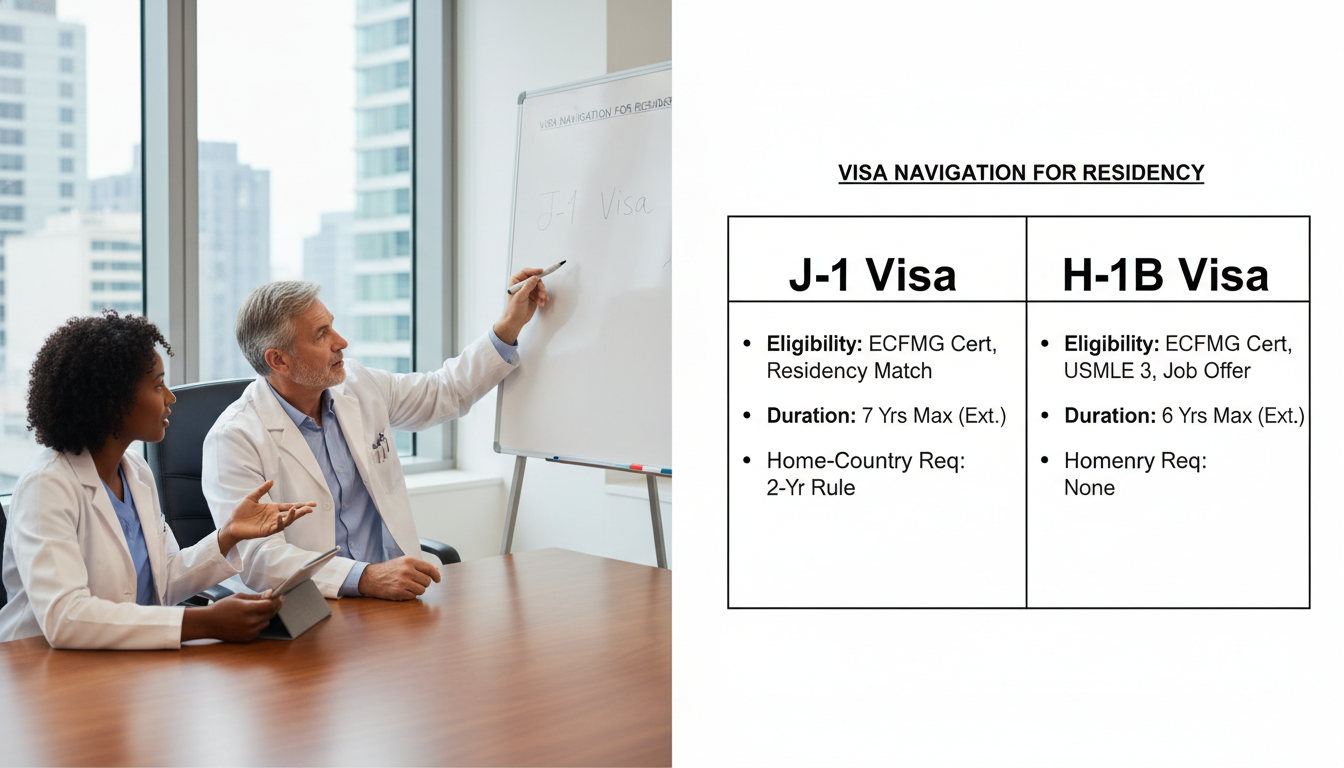
1. J-1 Clinical Exchange Visitor Visa
For most IMGs entering U.S. GME, the J-1 visa (sponsored by ECFMG) is the default pathway.
Key features:
- Sponsor: ECFMG (not the residency program directly)
- Purpose: Clinical training in an ACGME-accredited program
- Duration: Usually up to 7 years total (sufficient for most EM-IM combined programs which are 5 years)
- Work restriction: You can only work in the approved training program (no independent outside work)
- Home-country requirement:
- 2-year home residence requirement under U.S. law (INA 212(e))
- You must return to your home country (or last country of permanent residence) for 2 cumulative years after training, unless you obtain a waiver
Pros for a Caribbean IMG:
- Most widely available: The majority of community and academic programs sponsor J-1.
- Less burden on program: Program does not need to handle USCIS petitions; ECFMG does the primary sponsorship.
- Fully adequate for EM-IM: J-1 typically covers the full 5-year EM-IM combined training window.
Cons and long-term implications:
- 2-year home-country requirement can be restrictive:
- Without a J-1 waiver, you cannot easily change to H-1B or permanent resident status in the U.S.
- For many Caribbean IMGs, the home-country requirement may be to their passport country, not necessarily where their medical school is located.
- Waiver options after residency often require:
- Working in medically underserved or rural areas, frequently in primary care or hospitalist/internal medicine roles.
- For emergency medicine internal medicine graduates, this can still be compatible but may limit location and practice type.
- No dual intent: J-1 is not officially designed as a stepping stone to immigration, which complicates long-term residency plans in the U.S.
When J-1 makes sense for EM-IM:
- You’re most focused on training quality and matching first, willing to handle the 2-year requirement or pursue a waiver later.
- You’re open to working in underserved areas after graduation.
- You want to maximize program options, since a significant number of EM IM combined programs only sponsor J‑1.
2. H-1B Temporary Worker Visa for Residency
The H-1B visa is a dual-intent employment visa that some residency programs use to sponsor IMGs as “temporary workers in a specialty occupation.”
Key features:
- Sponsor: The residency program petitions USCIS directly.
- Duration: Typically up to 6 years total (often issued in 3-year increments).
- Exam requirement: You must have passed USMLE Step 3 before H-1B approval (many programs require it before rank list).
- Work: You can generally only work for the sponsoring employer, but H-1B has more flexibility for additional work (e.g., moonlighting) if properly structured.
Pros for a Caribbean IMG:
- No 2-year home-country requirement like the J-1.
- Dual intent allows:
- Pursuing permanent residency during or after training
- Smoother transition to fellowships, academic positions, or private practice without a J-1 waiver.
- Often seen as more favorable if you have a clear plan to stay in the U.S. long-term.
Cons and limitations:
- Not all programs offer H-1B:
- Many community programs and some academic centers do not sponsor H‑1B for residents due to cost and paperwork.
- EM IM combined programs are often more academically oriented, but visa policies vary widely.
- Time limit:
- EM-IM combined programs are 5 years; you have a 6-year H-1B cap.
- If you do a fellowship or extra research year, you may hit the H-1B max unless you move into a role that’s cap-exempt (e.g., certain academic positions).
- Step 3 requirement:
- You must pass Step 3 early, often before rank order submission. This is a major consideration in planning your Caribbean medical school residency timeline.
When H-1B makes sense for EM-IM:
- You’re strongly committed to long-term practice in the U.S. in emergency medicine internal medicine or subspecialties.
- You’re willing and able to:
- Take and pass Step 3 before Match Day (ideally before interviews).
- Target a narrower pool of programs that clearly offer H-1B sponsorship.
- You are wary of the J-1 2-year home requirement and waiver complexities.
3. J-1 vs H-1B: Which Is Better for Caribbean IMGs in EM-IM?
At the heart of residency visa planning is the choice between J-1 vs H-1B. There is no universal “best” option; there is a best option for your situation.
Key points of comparison:
| Feature | J-1 (ECFMG) | H-1B (Program-sponsored) |
|---|---|---|
| Sponsorship | ECFMG | Individual residency program |
| Home-country requirement | Yes, 2-year (unless waiver) | No |
| Dual intent | No | Yes |
| Availability | Widely available | Limited; fewer EM-IM programs offer it |
| Step 3 requirement | Not required for visa | Required for H-1B approval |
| Max duration vs EM-IM length | 7 years available vs 5-year training | 6 years vs 5-year training (tight for extra years) |
| Post-residency flexibility | Restricted until waiver/2-year service done | More flexible for jobs, fellowships, green card |
Practical decision framework:
If your top priority is:
- Maximizing your chances of matching EM-IM, especially at a broad range of programs:
→ Be open to J-1 and H-1B; do not limit yourself strictly to H-1B. - Long-term U.S. settlement without service obligations:
→ Strongly consider H-1B, but understand that this means fewer program options and earlier Step 3.
- Maximizing your chances of matching EM-IM, especially at a broad range of programs:
If you’re applying from a Caribbean medical school with limited financial or time resources:
- J-1 often presents a straightforward, realistic path to entering U.S. training first, then solving immigration later.
EM-IM Combined Programs: Visa Nuances and Strategy
Emergency Medicine–Internal Medicine combined programs are typically 5 years and often based at academic centers or large teaching hospitals. This influences visa options in several ways.
1. Training Length and Visa Duration
- J-1: Generally allows up to 7 years of clinical training:
- EM-IM (5 years) fits comfortably within this limit.
- Potential addition of a 1-year fellowship may still be possible within the 7-year total, but you’d need ECFMG approval.
- H-1B: Has a 6-year maximum (unless extended due to green card processing):
- 5-year EM IM combined consumes most of the available H-1B time.
- Limited room for:
- Additional fellowship training
- Time off for research or personal reasons
- Some residents transition to a cap-exempt H-1B at academic institutions or apply for permanent residency during training.
2. Program Sponsorship Policies for EM-IM
Different EM-IM programs have distinct policies:
- J-1 only: Many EM-IM programs state:
- “We sponsor J-1 visas only.”
- J-1 and H-1B: Some large academic centers sponsor both:
- Usually more selective for H-1B candidates (higher score expectations, must have Step 3).
- No visa sponsorship: A minority of programs may limit positions to U.S. citizens or permanent residents.
As a Caribbean IMG, you must:
- Systematically check each EM-IM program’s website for:
- “Visa” or “International Medical Graduate” sections
- Explicit statements like:
- “We sponsor J-1 visas for eligible international graduates.”
- “We do not sponsor H-1B visas.”
- “We sponsor J-1 and, in select cases, H-1B visas.”
- Email the program coordinator if the website is unclear:
- Brief introduction (name, Caribbean medical school, PGY year applying for)
- Direct question about IMG visa options for EM-IM applicants:
- “Do you sponsor J-1, H-1B, or both for EM-IM residents?”
3. Prioritizing Programs Based on Visa Flexibility
You can create a personal ranking framework that incorporates both training quality and visa feasibility:
- Tier A (High visa alignment):
- Programs that:
- Accept Caribbean IMGs regularly
- Sponsor your preferred visa type (J-1 or H-1B)
- Have a history of EM-IM graduates succeeding in fellowships and jobs
- Programs that:
- Tier B (Acceptable academically, visa compromise):
- Strong programs that sponsor only J-1 when you prefer H-1B, or vice versa
- Tier C (Low visa or IMG friendliness):
- Programs with unclear or restrictive policies
- Programs explicitly not sponsoring visas
For many Caribbean IMGs, combining Tier A + Tier B gives a realistic and broad list.
Building a Visa-Smart Application Strategy as a Caribbean IMG
1. Align Your Exams and Documentation with Visa Goals
To align with your chosen visa path:
For J-1:
- USMLE Step 1, Step 2 CK:
- Strong scores are crucial for a competitive EM-IM application.
- While Step 3 is not required for J-1, having it can still be a plus.
- ECFMG certification:
- Must be complete by the start of residency.
- Pay attention to deadlines based on your Caribbean medical school residency timeline.
For H-1B:
- Step 3 timing:
- Aim to take Step 3 before September of application year or at least before January when many rank list decisions are made.
- Some programs require Step 3 passed before issuing a contract; others even before interview.
- CV positioning:
- High USMLE scores, U.S. clinical experience, and research in EM or IM can make a program more willing to undertake H‑1B sponsorship.
2. Presenting Your Visa Situation in ERAS and During Interviews
In ERAS:
- Be honest and consistent about your citizenship and visa needs.
- You do not choose J-1 vs H‑1B in ERAS directly, but your status influences:
- Which programs automatically filter you in or out.
- How program coordinators review your profile.
During interviews:
- Be prepared to answer:
- “Are you eligible for a J-1 visa sponsored by ECFMG?”
- “Have you passed Step 3? Are you interested in H-1B sponsorship?”
- If you have a preference (e.g., strongly preferring H-1B due to long-term plans), state it professionally and flexibly:
- “I am eligible for both J-1 and H-1B. Given my long-term plan to practice in the U.S., H-1B would be ideal, but I understand that many excellent programs offer only J-1, and my priority is strong EM-IM training.”
Avoid sounding rigid or entitled about visa sponsorship. Programs value applicants who are:
- Realistic
- Well-informed
- Focused on training quality first
3. Leveraging Caribbean Medical School Networks
Caribbean schools like SGU, Ross, AUC, and others often maintain detailed match lists, including EM-IM and EM or IM placements. These can guide you on:
- Which EM-IM programs have a history of taking Caribbean IMGs
- Whether those programs typically sponsor J-1 only or also H‑1B
For example, looking at an SGU residency match list:
- Identify EM-IM or EM and IM combined outcomes by location.
- Cross-reference those institutions’ visa policies.
- Reach out to recent alumni:
- Ask how their IMG visa options were handled.
- Inquire whether the program is willing to consider H‑1B for high-performing residents.

Long-Term Planning: After EM-IM Residency on J-1 or H-1B
1. Pathways After EM-IM on a J-1 Visa
If you complete EM-IM on J-1, you must address the 2-year home-country requirement unless you are prepared to leave the U.S. for 2 years.
Common waiver routes:
Conrad 30 Waiver Programs (state-based):
- States sponsor up to 30 J-1 physicians per year in underserved areas.
- Historically heavy in primary care and internal medicine, but emergency medicine and hospitalist roles are increasingly included in some states.
- EM-IM graduates can:
- Work as hospitalists
- Provide ED coverage in underserved regions
- Typically requires a 3-year service commitment in a designated site.
Federal programs (e.g., VA, Indian Health Service, HHS):
- Certain federal employers can sponsor J-1 waivers.
- These roles may be competitive and location-limited.
Hardship or persecution waivers:
- Available in specific personal circumstances (e.g., extreme hardship to a U.S. citizen spouse or child).
- Requires legal guidance and strong evidence.
After securing a waiver job:
- You usually switch to H-1B in that job.
- Over time, you can pursue:
- Permanent residency (green card) via employer sponsorship or other categories.
- Career options in both emergency medicine and internal medicine.
2. Pathways After EM-IM on an H-1B Visa
If you complete EM-IM on H‑1B:
- You may still have H-1B time left (often 1 year or more).
- Your options:
Fellowship training:
- Fellowship programs may be willing to sponsor H-1B or ask you to switch to J-1 for the fellowship.
- Dual-trained EM-IM physicians might pursue critical care, toxicology, ultrasound, or other EM/IM-oriented fellowships.
Academic or hospital employment:
- Many academic centers are cap-exempt H-1B employers, allowing H-1B renewal beyond the cap and potentially beyond the 6-year limit if green card processes are started.
- Employers may sponsor you for a green card.
Permanent residency:
- With H-1B’s dual intent, you can:
- Begin green card processes during residency (if an employer is willing) or
- Transition directly after training.
- With H-1B’s dual intent, you can:
This pathway often offers more flexibility than the J-1 route but starts with more limited residency options.
Practical Tips and Common Pitfalls for Caribbean IMGs
Practical Tips
Start visa planning early (Year 3–4 of medical school):
- Decide whether you will attempt Step 3 before Match to keep H-1B realistic.
- Collect information on EM-IM programs’ visa policies as you build your application list.
Keep records organized:
- Passports, previous visas, DS-2019s (if any), transcripts, ECFMG documents.
- Consistent personal information across all forms and applications.
Communicate clearly with programs:
- Avoid last-minute surprises about visa needs after you match.
- If your status changes (e.g., you obtain permanent residency), inform programs promptly.
Consult an immigration attorney when needed:
- Especially if you have prior U.S. status, overstays, previous visa issues, or complex nationality/home residence questions.
Common Pitfalls
- Being too rigid about H-1B early on:
- Completely excluding J-1 can shrink your pool of EM-IM programs and reduce your match chances significantly.
- Underestimating Step 3 timing:
- Planning H-1B without a realistic Step 3 date is risky; delays can cost you H-1B–friendly spots.
- Misunderstanding the home-country requirement:
- Confusing the country of citizenship with country of last permanent residence for the J-1 requirement.
- Assuming all EM-IM programs treat visas the same:
- Policies differ widely; always verify with each program.
FAQs: Visa Navigation for Caribbean IMGs in EM-IM
1. As a Caribbean IMG, should I aim for J-1 or H-1B for an EM-IM combined program?
It depends on your priorities. If maximizing your chance of matching EM-IM is the priority, be open to J-1, since many programs only sponsor that. If you are strongly focused on long-term U.S. practice without a J-1 waiver, and you can pass Step 3 early, then targeting H-1B programs makes sense—but expect a smaller list of possible programs.
2. Can I switch from J-1 to H-1B after residency without going home for two years?
Not usually. If your residency was on a J-1 clinical visa, you are subject to the 2-year home-country requirement. You must either:
- Fulfill the 2-year requirement, or
- Obtain a J-1 waiver (e.g., via Conrad 30 or federal programs) and then typically move to an H-1B position aligned with that waiver.
3. Are EM-IM combined programs more likely to sponsor H-1B than categorical EM or IM programs?
Not inherently. EM-IM programs are often at academic centers, which may be more familiar with H‑1B, but each program’s policy is independent. Some EM-IM programs sponsor J-1 only, others both J-1 and H‑1B. You must check each program individually rather than assume based on specialty.
4. I’m an SGU (or other Caribbean) graduate. Does my school affect my visa options?
Your school itself doesn’t directly change visa laws, but it can influence:
- How familiar programs are with graduates of your institution (e.g., strong SGU residency match presence in certain hospitals).
- The power of your alumni network to help you find IMG-friendly programs and learn about their visa practices. The actual legal visa options (J-1 vs H-1B) depend on your citizenship, exam status, and each program’s policies—not the specific Caribbean school name.
By integrating visa strategy with your residency application planning, you can approach the EM IM combined path in a focused, realistic way. As a Caribbean IMG, understanding J-1 vs H-1B, program sponsorship patterns, and post-residency options will help you make informed decisions—so you can not only match into emergency medicine internal medicine, but also build the long-term U.S. career you’re aiming for.