
Understanding the Visa Landscape as a Caribbean IMG in Preliminary Medicine
For a Caribbean medical school graduate applying to U.S. residency—especially in a Preliminary Medicine (prelim IM) year—navigating visa options can be as challenging as securing interviews. Your Caribbean medical school residency outcomes depend not only on your scores and letters, but also on whether programs believe they can reliably sponsor you and keep you in training.
This is particularly important for:
- Students and graduates of Caribbean schools (e.g., SGU, AUC, Ross, Saba, etc.)
- IMGs targeting a Preliminary Medicine year before neurology, anesthesiology, radiology, PM&R, or other advanced specialties
- Applicants depending on IMG visa options to train and eventually practice in the U.S.
This guide will walk through:
- The big picture of residency visas for Caribbean IMGs
- Key differences between J-1 vs H-1B
- How visas intersect with Preliminary Medicine positions
- Strategies to improve your SGU residency match–type outcomes and similar Caribbean school matches
- Common pitfalls and planning tips through the entire match timeline
Big Picture: How Visa Status Affects Your Residency Options
Why Visa Planning Is Critical for Caribbean IMGs
As a Caribbean IMG, you are often evaluated through two lenses:
- Academic/clinical profile – scores, letters, U.S. clinical experience
- Logistical feasibility – can the program actually bring you into training?
For many community and even some academic programs, the second question is decisive. The program must:
- Know which visa they can sponsor
- Have funding and institutional approval for that visa type
- Feel confident you will clear all visa steps in time for the July 1 start date
If your visa plan is unclear or unrealistic, some programs may quietly rank you lower or not interview you, even if you are a strong applicant.
Common Applicant Profiles for Caribbean IMGs
You may fall into one of these situations:
- Current F‑1 student (U.S. undergrad or master’s) plus Caribbean MD
- No U.S. status (living in the Caribbean or another country)
- Dependent visa (F‑2, H‑4, etc.)
- Pending or approved green card / other immigration path
- Canadian citizen studying at a Caribbean medical school
Each starting point affects which residency visa paths are more realistic for you.
Core Visa Options for Residency: J‑1 vs H‑1B
The two primary IMG visa options for U.S. residency are the J‑1 and H‑1B. Understanding J‑1 vs H‑1B—their benefits, limitations, and implications after residency—is essential before you finalize your strategy.
The J‑1 Visa for Physician Training
The J‑1 Exchange Visitor (Physician) is the most common visa for IMGs in residency, including Caribbean graduates.
Key features:
- Sponsored by ECFMG, not directly by the hospital
- Used specifically for graduate medical education (GME) – residency and fellowship
- Valid for the duration of your training, with yearly renewals
Pros of the J‑1 visa:
- Widely accepted: Most university and many community programs are comfortable with J‑1 sponsorship
- Simpler onboarding: Institutional HR often has established workflows with ECFMG
- No USMLE Step 3 required for visa issuance (only for certain licensing steps, depending on the state)
Cons / limitations of the J‑1:
Two-year home country physical presence requirement
- After completing training, you must either:
- Return to your home country (or country of last permanent residence) for two years, or
- Obtain a J‑1 waiver (e.g., Conrad 30 or other waiver pathways) to stay in the U.S.
- This is a critical factor for long-term career planning.
- After completing training, you must either:
Less flexibility for moonlighting / outside work
- Employment is tied to the designated training program
- Side jobs or unapproved clinical work can violate your status
Extensions are training-dependent
- J‑1 is only for GME; once your training ends, you cannot remain in J‑1 without another approved training program
Practical example (Caribbean IMG):
A graduate from an SGU-like school matches into a Preliminary Medicine year on a J‑1, then matches into neurology (advanced program) on another J‑1. After finishing all training, they seek a Conrad 30 waiver by working in a medically underserved area before applying for permanent residency.
This is a very common pathway for Caribbean IMGs.
The H‑1B Visa for Residency
The H‑1B is a temporary worker visa for specialty occupations, including physicians. Some residency programs sponsor H‑1B visas for residents and fellows, but this is less common than J‑1.
Key features:
- Employer-specific: Your hospital (not ECFMG) files the H‑1B petition
- Often requires USMLE Step 3 at the time of application (varies by state/program)
- Typically up to 6 years total in H‑1B status (including pre-residency H‑1Bs if applicable)
Pros of the H‑1B visa:
- No two-year home residence requirement after training
- Easier to transition directly into H‑1B employment after residency (e.g., as an attending)
- May align better with long-term U.S. immigration plans for those aiming for a green card
Cons / limitations of the H‑1B:
Fewer programs sponsor H‑1Bs
- Many community programs and some academic ones do not sponsor H‑1B for residents
- This directly limits your potential interview pool
USMLE Step 3 requirement
- You usually need to pass Step 3 before the H‑1B petition is filed
- This can be tight if you graduate close to Match and haven’t scheduled Step 3 early
Cost and complexity
- Legal fees and filing costs are higher for programs
- Institutional policies and GME offices may prefer the simpler J‑1 route
Practical example (Prelim IM):
A Caribbean IMG hoping to match into Preliminary Medicine plus an advanced specialty might want H‑1B to avoid the J‑1 home return requirement. But they discover that:
- Many prelim IM programs only accept J‑1
- Their Step 3 date is after the common H‑1B filing window
- Their target advanced specialty program also doesn’t sponsor H‑1B
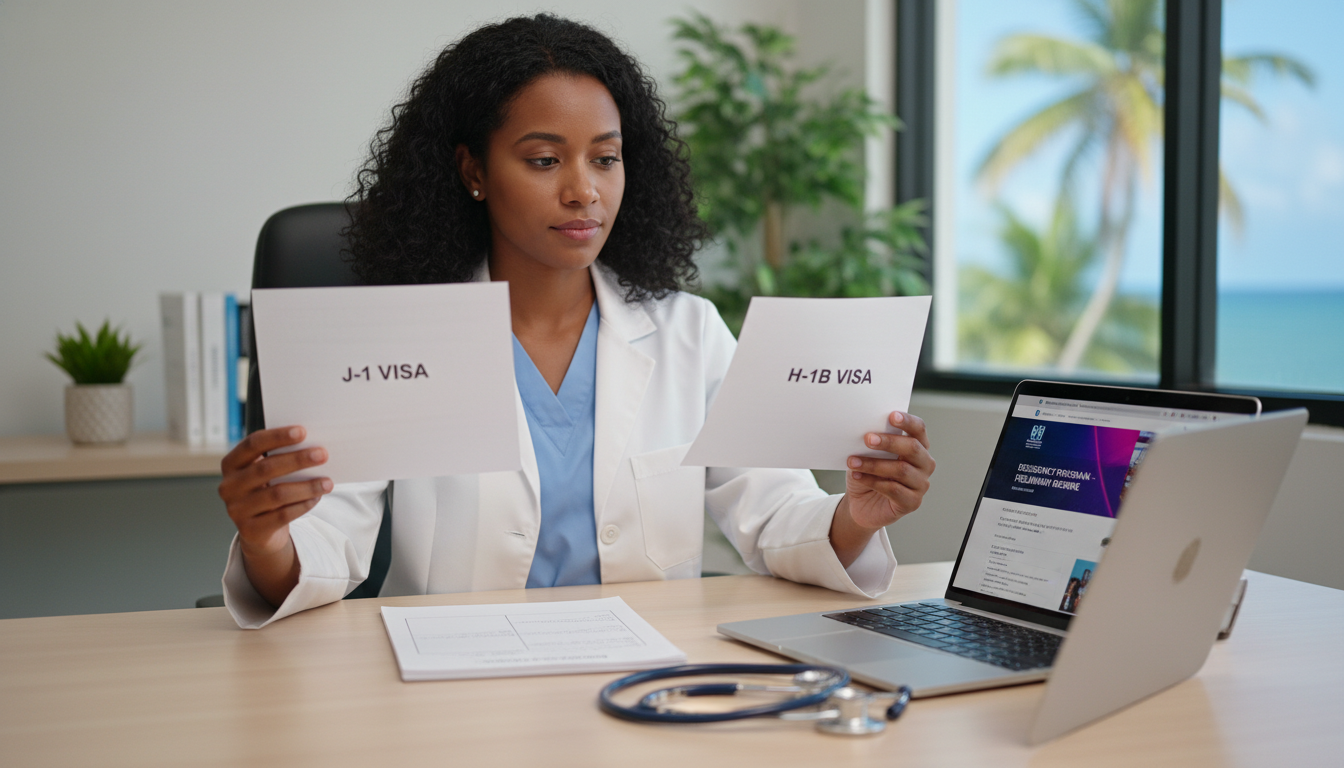
In such a case, insisting on H‑1B could severely limit interviews and possibly prevent a match, making J‑1 a more realistic (and safer) option.
How Visa Choices Interact with Preliminary Medicine Positions
What Makes Prelim Medicine Unique?
A Preliminary Medicine year is usually:
- A 1-year internal medicine training position
- Followed by an advanced residency (e.g., neurology, anesthesiology, radiology, PM&R, dermatology, etc.)
- Categorical internal medicine or other 3+ year programs are different; those are complete training tracks themselves.
For a Caribbean IMG, visa planning for prelim IM must consider:
- You are not done after one year—you still need an advanced spot
- Your visa must accommodate the transition from prelim IM to the advanced residency
- Some advanced specialties may have stricter visa policies than prelim IM programs
J‑1 Visa in the Context of a Prelim Year
On a J‑1, ECFMG sponsors you throughout your entire GME pathway, not just one year.
Key points for Prelim IM on J‑1:
- You will obtain a J‑1 visa for PGY‑1 with your prelim IM program as the primary training site
- When you match into your advanced program (e.g., Neurology PGY‑2), your sponsorship is continued, not restarted
- The total duration of your J‑1 allows for all required training, including fellowship if necessary (within ECFMG-imposed time caps)
Advantages of J‑1 for a prelim path:
- Smoother transitions between programs (ECFMG is the constant sponsor)
- More programs will consider you—both prelim and advanced specialties
- You avoid the Step 3 time pressure that can be significant in the busy Caribbean MD timeline
Caution:
Remember that each training year counts toward your total J‑1 clock. If you do:
- 1 year prelim IM (PGY‑1)
- 3 years neurology (PGY‑2–4)
- 1–2 years fellowship
You still need to stay within ECFMG’s maximum duration for J‑1 clinical training. This is usually sufficient for most standard paths, but long or multiple fellowships may be limited.
H‑1B Visa in the Context of a Prelim Year
H‑1B is more complicated for Preliminary Medicine because:
- It’s employer-specific and job-specific
- When you change from a prelim medicine program to an advanced program, your employer changes
You may need:
- A new H‑1B petition filed by the advanced program for PGY‑2
- Continuous legal status during the transition from prelim to advanced residency
This means both:
- Your prelim IM program must sponsor H‑1B
- Your advanced program must ALSO be willing and able to sponsor H‑1B
If either refuses, you risk:
- Needing to switch visas (e.g., from H‑1B to J‑1) mid-path, or
- Being unable to start your advanced program, jeopardizing your training plan
Practical risk:
Many prelim-only IM programs, especially smaller community hospitals, do not offer H‑1B. Likewise, advanced specialties like radiology or anesthesiology may have limited H‑1B availability and may prefer J‑1. This creates a double bottleneck for H‑1B-seeking Caribbean IMGs in a prelim path.
Strategic Planning: Matching as a Caribbean IMG in Prelim Medicine
Step 1: Clarify Your Long-Term Goals
Before choosing a visa preference, be brutally honest about:
- Do you plan to build your career in the U.S. long-term, or are you open to returning home or working elsewhere?
- Are you comfortable working in underserved or rural areas (for potential J‑1 waivers later)?
- How competitive is your profile for:
- The advanced specialty you want
- Regions where visa-friendly programs commonly exist
If your primary goal is maximizing your chance to match at all, J‑1 will usually give you a larger program pool than H‑1B.
If your foremost priority is avoiding the 2-year home requirement, and your profile is strong enough to be selective, then carefully targeted H‑1B attempts may be reasonable—but still risky in a Prelim Medicine setting.
Step 2: Research Program-Specific Visa Policies Early
Residency programs differ sharply in their residency visa stance. Before applying, systematically check:
- ERAS/FRIEDA entries for Visa Sponsorship listings
- Program websites (often under “Eligibility” or “FAQs”)
- Any notes about “We sponsor J‑1 only,” “We sponsor J‑1 and H‑1B,” or “We do not sponsor visas”
Create a simple spreadsheet with columns for:
- Program name
- Prelim vs categorical vs advanced
- J‑1 sponsor? (Y/N)
- H‑1B sponsor? (Y/N)
- Additional notes (e.g., “Requires Step 3 for H‑1B”)
As a Caribbean IMG, your targeted list for Caribbean medical school residency applications should:
- Include a core group of J‑1–friendly prelim IM programs
- For H‑1B, focus only on programs explicitly stating that they definitely support H‑1B for residents
Avoid guessing—if information isn’t clear, consider emailing the coordinator briefly:
“Do you sponsor J‑1 visa holders? Do you also sponsor H‑1B for preliminary internal medicine residents?”
Step 3: Coordinate Prelim and Advanced Applications
Prelim and advanced positions are usually applied for simultaneously in ERAS. For Caribbean IMGs:
- Many advanced programs have stricter visa policies than prelim programs
- Your advanced specialty visa posture should drive how you present yourself to prelim programs
For example:
- If most neurology programs you like are J‑1 only, it makes sense to lean into J‑1 as your stated preference when talking with prelim IM programs.
- If you find a rare advanced specialty that commonly sponsors H‑1B, ensure that both your prelim and advanced choices align with H‑1B practicality.
You don’t have to advertise your visa preference in every interview, but when asked, be consistent and realistic: programs dislike hearing “I only want H‑1B” when they know they can’t offer it.
Step 4: Timing and Requirements for Step 3 (if Considering H‑1B)
If you are trying to keep H‑1B on the table:
- Plan USMLE Step 3 early—ideally:
- Score reports available before H‑1B filing deadlines (often spring/early summer before residency start)
- As a Caribbean IMG, arrange:
- A U.S. address and eligibility state for Step 3 registration
- Sufficient U.S. clinical exposure so that studying for Step 3 is realistic amid rotations and exams
If you will not realistically have Step 3 done on time, being too focused on H‑1B will only hurt your chances. In that case, shift strategy to J‑1.

Visa Logistics During and After the Match
Before the Match: ERAS and Interviews
On ERAS, you will typically indicate that you require visa sponsorship. Programs may ask:
- “What visa are you seeking?”
- “Are you open to J‑1?”
- “Have you passed Step 3?” (if they sponsor H‑1B)
As a Caribbean IMG in Preliminary Medicine, a responsive, realistic answer might be:
- “I am open to J‑1 sponsorship and understand the two-year home requirement and waiver pathways.”
- If you have Step 3 passed and target H‑1B-friendly programs: “I have passed Step 3 and would be open to an H‑1B if your institution sponsors it, though I remain fully open to J‑1 as well.”
Being flexible often reduces friction and improves your rank-list position.
After the Match: DS‑2019 or H‑1B Petition
Once you match:
J‑1 path:
- Program works with ECFMG to issue a Form DS‑2019
- You submit supporting documents (passport, contract, proof of funding if needed, etc.)
- Then apply for a J‑1 visa stamp at a U.S. consulate (if outside the U.S.)
H‑1B path:
- Program files the H‑1B petition with USCIS (Form I‑129)
- Legal team may ask for:
- ECFMG certificate
- Step 3 score report
- State licensure/permit eligibility documents
- Once approved, you apply for a visa stamp abroad if not already in H‑1B status
As a Caribbean IMG, start collecting documents early (translations, police certificates if needed, degree/diploma copies, etc.) so that visa processing doesn’t delay your start date.
Transitioning from Prelim to Advanced Program (PGY‑2+)
J‑1 margin of safety:
With J‑1, this transition is relatively straightforward:
- ECFMG updates your primary training site
- You provide a new contract and program info
- Your J‑1 sponsorship continues seamlessly
H‑1B complexity:
With H‑1B, your advanced program must file a new or amended H‑1B petition:
- This must be carefully timed so you do not fall out of status
- Some advanced programs may be hesitant to assume this complexity
- Even if prelim IM accepted H‑1B, advanced neurology, radiology, or anesthesiology may not
For Caribbean IMGs, this risk is a major reason why J‑1 is often more practical in a prelim-then-advanced pathway.
After Residency: J‑1 Waivers, H‑1B Transfers, and Long-Term Planning
If you finish on a J‑1:
- You must either:
- Complete the two-year home country residence requirement, or
- Obtain a J‑1 waiver (e.g., Conrad 30, VA waiver, or other federal programs)
Many Caribbean IMGs pursue:
- Conrad 30 waiver jobs in states that welcome IMGs
- Often in primary care or hospitalist roles in underserved areas
- After the waiver job (usually 3 years), they transition toward a green card
If you finish on an H‑1B:
- You may transition directly into an attending H‑1B with another employer
- Accumulated H‑1B years (residency + post-residency) still cannot exceed the typical 6-year max (without certain green card-based extensions)
In both cases:
- Long-term planning is essential—you should discuss visa strategy not only with GME but possibly with an immigration attorney once you’re in training.
Special Considerations for Caribbean IMGs (e.g., SGU, AUC, Ross)
How “Caribbean Medical School Residency” Reputation Interacts with Visas
Large Caribbean schools with strong residency match networks, such as those similar to SGU residency match outcomes, may have:
- Dedicated advising on visa pathways
- Historical data about which programs routinely sponsor J‑1 or H‑1B
- Alumni in numerous prelim IM and advanced programs who can share experiences
Leverage your school’s:
- Office of Career Guidance / Clinical Education
- Alumni networks in internal medicine, neurology, anesthesia, radiology, etc.
- Data on IMG visa options used by past graduates in similar specialties
Ask specific questions:
- “For prelim IM into neurology, which programs are consistently J‑1 friendly?”
- “Have any Caribbean IMGs from our school completed prelim on H‑1B and advanced specialty also on H‑1B? Which programs?”
Canadian and Other Non-U.S. Caribbean IMGs
If you are a Canadian citizen studying at a Caribbean school:
- You still need J‑1 or H‑1B for U.S. residency (you are an IMG with foreign medical education)
- However, your “home country” for the J‑1 two-year rule may be Canada, not the Caribbean country where your campus is
- J‑1 waiver or eventual return to Canada may be more feasible logistically than for some other nationalities
If you are from a Caribbean nation, consider:
- Whether returning for two years after training is acceptable if a waiver is not obtained
- Whether your home country has bilateral agreements or specific policies related to J‑1 return requirements
Putting It All Together: Practical Action Plan
For a Caribbean IMG aiming at Preliminary Medicine and an advanced specialty in the U.S., a practical plan might look like this:
12–18 months before Match:
- Clarify your realistic specialty targets (e.g., prelim IM + neurology)
- Research visa policies of promising prelim and advanced programs
- Decide whether you want to keep H‑1B an option (and if Step 3 timing allows it)
6–12 months before Match:
- If going for H‑1B: schedule and pass USMLE Step 3 early
- Otherwise, accept that J‑1 will be your primary route
- Build a spreadsheet of:
- J‑1 friendly prelim programs
- J‑1 friendly advanced programs
- Any H‑1B supportive programs, clearly labeled
Application season:
- Apply broadly to J‑1 friendly prelim and advanced programs
- If Step 3 passed and programs clearly sponsor H‑1B, selectively mention your openness to H‑1B
- Otherwise, emphasize comfort with J‑1 and awareness of waiver options
Interview season:
- Be consistent:
- If a program is J‑1 only, do not insist on H‑1B in the interview.
- Show that you’ve thought through Prelim IM → Advanced specialty → Waiver or long-term plan.
- Be consistent:
Post-Match:
- Respond quickly to program/ECFMG requests for documents (J‑1) or legal team requests (H‑1B)
- Ensure your passport and civil documents are valid and accessible
- Inform your school’s dean’s office or clinical education office about any visa-related deadlines
During residency:
- Keep immigration documents organized and updated
- Ask your GME office early about timelines for:
- J‑1 renewal documentation
- H‑1B amendment/transfer if applicable
- Start learning about J‑1 waiver or post-residency employment landscapes well before your final year.
FAQ: Visa Navigation for Caribbean IMGs in Preliminary Medicine
1. Should I prioritize J‑1 or H‑1B as a Caribbean IMG applying to prelim internal medicine?
For most Caribbean IMGs, especially in a Preliminary Medicine path, J‑1 is the more practical option. It is more widely sponsored, avoids the Step 3 timing crunch, and transitions more smoothly between prelim and advanced programs. H‑1B is worth considering only if you have Step 3 done early, a strong application, and clearly identified prelim and advanced programs that both sponsor H‑1B.
2. Can I start residency on a J‑1 and then switch to H‑1B later for my advanced program?
Switching from J‑1 to H‑1B between prelim and advanced years is theoretically possible but practically difficult and case-specific. You would still have the J‑1 two-year home requirement unless you obtain a J‑1 waiver first. Most commonly, if you start on J‑1, you complete all GME on J‑1, then seek a waiver or fulfill the home requirement before shifting to H‑1B or permanent residence.
3. Will choosing J‑1 hurt my chances of getting a good fellowship or job later?
Not necessarily. Many subspecialists and attendings in the U.S. trained on J‑1 visas. The main impact of J‑1 is the two-year home return or waiver requirement, not the quality of training you can receive. If you are flexible to work in underserved or rural settings after training, J‑1 can lead to excellent long-term careers, including eventual green card sponsorship.
4. If my Caribbean school has strong match statistics (like SGU residency match outcomes), do I still need to worry about visas?
Yes. Strong match outcomes help, but visa sponsorship remains a separate gate. Even if many alumni matched historically, each program and year may differ in visa capacity, institutional policy, and willingness to sponsor H‑1B. You must still:
- Research each program’s current visa policy
- Be realistic about J‑1 vs H‑1B options
- Coordinate your visa strategy with your Preliminary Medicine and advanced specialty plans
Using your school’s advising resources and alumni network can improve both your Caribbean medical school residency prospects and your visa navigation, but it does not eliminate visa constraints.
By understanding J‑1 vs H‑1B, how they fit with Preliminary Medicine training, and how programs perceive IMG visa options, you can make informed decisions that boost your chances of matching and building a sustainable U.S. career as a Caribbean IMG.