
Understanding the Visa Landscape for Caribbean IMGs in State University Residencies
For a Caribbean medical school graduate targeting state university residency programs, visa strategy is not a side issue—it is a core part of your match plan. Your Step scores, clinical evaluations, and letters matter tremendously, but without a viable visa pathway, even a strong application can stall at the offer stage.
This guide is written specifically for Caribbean IMGs applying to state university residency programs in the U.S., with a focus on:
- How visa sponsorship works in residency
- J-1 vs H‑1B for residency (and what that means for your career)
- How your status as a Caribbean medical graduate (e.g., SGU residency match paths) affects options
- Program selection strategy at state universities
- Common pitfalls and how to avoid them
Throughout, keep in mind that immigration rules can change, and individual situations vary. Use this as a strategic roadmap, then verify details with official sources and, when needed, an immigration attorney.
Core Visa Pathways for Caribbean IMGs Entering Residency
Before you can plan, you need to clearly understand the main visas relevant to residency training.
The Big Picture: What IMGs Typically Use
Most Caribbean medical school graduates entering U.S. residency use one of these:
- J‑1 Exchange Visitor (Alien Physician) – Sponsored by ECFMG; the dominant route for IMGs
- H‑1B Temporary Worker (Physician in Graduate Medical Education) – Sponsored directly by the residency program/employer
- Alternative paths for a minority of applicants:
- Green card (permanent resident) – If you already have one, no training visa required
- EAD (Employment Authorization Document) – e.g., through asylum, DACA, pending green card, etc.
When people talk about “IMG visa options” for residency, they’re mostly talking about J‑1 vs H‑1B.
J‑1 Exchange Visitor Visa for Residency
The J‑1, administered for physicians through ECFMG, is the most common route for Caribbean IMGs.
Key features:
- Purpose: Graduate medical education and training
- Sponsor: ECFMG (not the hospital directly)
- Timing: Usually issued 1 year at a time, renewable annually during training
- Funding requirement: You must show adequate financial support (usually satisfied through your residency contract)
Critical point: The 2‑year home residency requirement
Most J‑1 physicians are subject to INA 212(e), meaning:
- After completing training, you must:
- Return to your home country or last country of permanent residence for at least 2 years, OR
- Obtain a J‑1 waiver (commonly through a service commitment in an underserved area)
Without fulfilling one of these, you generally cannot:
- Change status to H‑1B, L, immigrant (green card) status in the U.S.
- Get an immigrant visa or H‑1B visa at a consulate
For a Caribbean IMG, this requirement often means planning for a J‑1 waiver job after residency, usually in a medically underserved area via programs like:
- Conrad 30 (state-level waiver slots)
- Federal programs (e.g., VA facilities, some HHS waivers)
H‑1B Visa for Residency
The H‑1B is an employment-based visa, far less common in residency but very desirable for long-term U.S. practice.
Key features:
- Purpose: Specialty occupation (physician qualifies)
- Sponsor: The residency program or employing hospital directly
- Exam requirements: Typically requires USMLE Step 3 passed before starting (and often before H‑1B filing)
- Duration: Up to 6 years total (with possible extensions if in green-card process)
- Cap-exempt advantage: Many state university residency programs are cap-exempt because they are:
- Institutions of higher education, or
- Non-profits affiliated with such institutions
This means they can file H‑1B at any time of year, not subject to the lottery.
Why some IMGs prefer H‑1B:
- No 2‑year home residency requirement
- Easier to move to a standard attending job after residency
- Generally smoother transition to green-card sponsorship
Why some programs avoid H‑1B:
- More legal and administrative work for the employer
- Higher cost (legal fees, filing fees)
- Step 3 requirement may delay onboarding
- Complexities if training extends beyond 6 years (e.g., long subspecialty paths)
Which Visa Path is “Better” for a Caribbean IMG?
There is no universal “best” option. It depends on:
- Your long-term goals (stay in the U.S. vs flexibility abroad)
- Your willingness to work in underserved areas post-residency
- Your competitiveness as a candidate (scores, letters, specialty choice)
- Your timing (Step 3 completed early or not)
- What state university residency programs in your target states are realistically willing to sponsor
For most Caribbean IMGs, especially those focused on caribbean medical school residency at large state institutions, the reality is:
- J‑1 is more widely available
- H‑1B is more desirable long-term, but harder to get
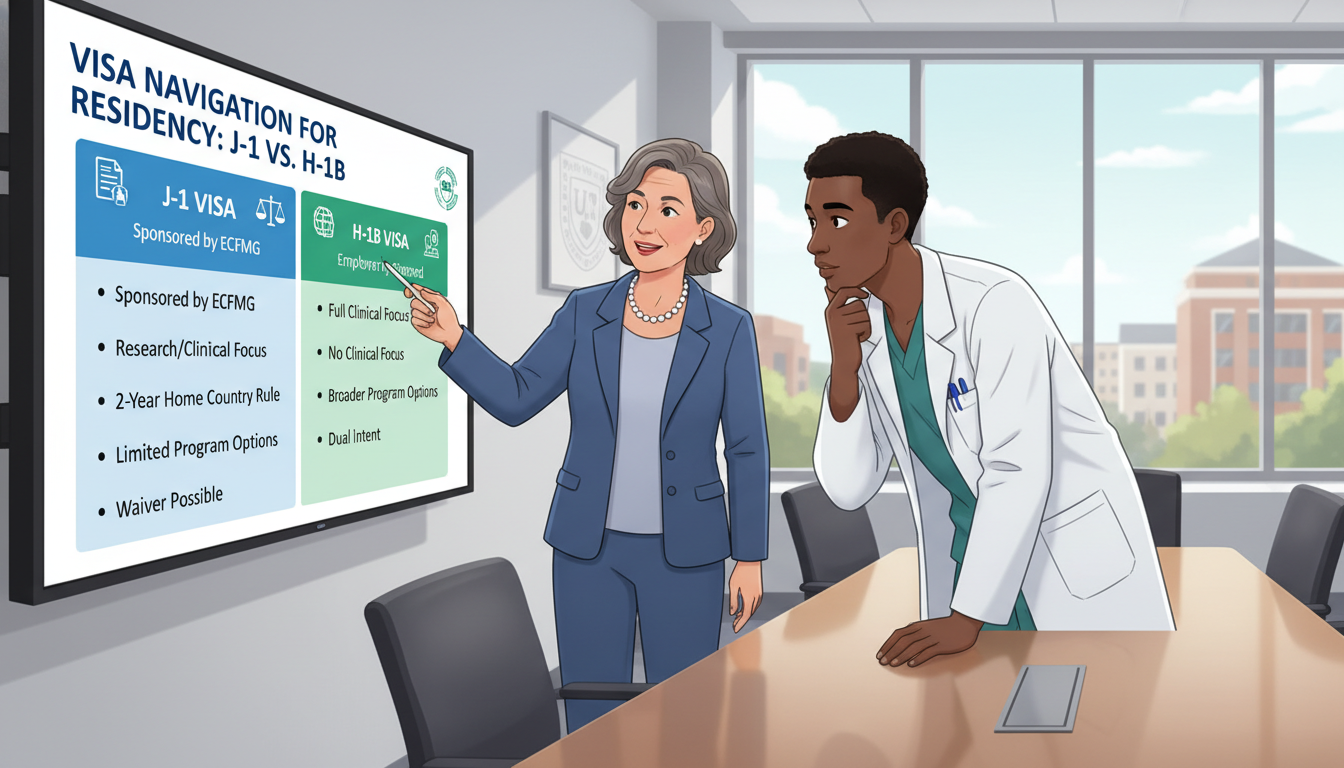
J‑1 vs H‑1B: Detailed Comparison Tailored to Caribbean IMGs
Residency programs will often ask about your “visa needs” during screening. Understanding J‑1 vs H‑1B at a practical level will help you present yourself strategically.
1. Eligibility and Timing
J‑1:
- No Step 3 required
- You need:
- ECFMG certification
- Contract or offer from an accredited residency program
- Some proof of funding (your residency salary usually qualifies)
- Typically easier to arrange in time for a July 1 start
H‑1B:
- Almost always requires Step 3 passed before filing
- Program must file an H‑1B petition with USCIS
- Extra layer of timing pressure:
- Match in March
- Need to have Step 3 and all paperwork ready quickly
- If Step 3 is not complete or timing is tight, programs may push you toward J‑1 or not consider you at all
Actionable advice for Caribbean IMGs:
- If you want to keep H‑1B as an option, plan to:
- Take Step 3 during your final year of med school or very early in PGY‑1 (if you already have another status)
- Explicitly ask programs about H‑1B sponsorship policies before you rank
2. Impact on Post-Residency Career
On J‑1:
You will likely need a J‑1 waiver job:
- Usually in a Health Professional Shortage Area (HPSA), Medically Underserved Area (MUA), or rural community
- Common for primary care, general internal medicine, pediatrics, psychiatry
- More competitive for highly specialized fields (e.g., dermatology, some subspecialties)
Typical J‑1 pathway:
- Residency (J‑1)
- J‑1 waiver job (often 3 years of service)
- H‑1B status during waiver job
- Green-card sponsorship through employer
On H‑1B:
- You are not locked into the J‑1 waiver route
- Many physicians:
- Do residency on H‑1B
- Move directly to an attending job (often still H‑1B)
- Start green-card process relatively early
For a Caribbean IMG planning long-term U.S. practice, H‑1B offers more immediate flexibility, but at the cost of fewer residency program options.
3. Program Perspective: State University vs Others
State university residency programs may differ from private hospitals or community programs:
- Many are H‑1B cap-exempt, making H‑1B more logistically feasible
- University counsel often has experience handling H‑1B physician petitions
- But policies vary dramatically by specialty and institution
Common patterns:
- Internal medicine, pediatrics, psychiatry, family medicine at state universities:
- More likely to consider H‑1B
- May have a mix of J‑1 and H‑1B residents
- Smaller, more competitive subspecialties:
- More likely to say “J‑1 only” for IMGs
- Some public medical school residency programs have institutional policies:
- “We only sponsor J‑1 for residency”
- “We sponsor H‑1B only in rare circumstances”
- “We sponsor H‑1B but only for candidates with Step 3 and outstanding credentials”
Practical step:
When researching programs, look specifically for:
- “We sponsor J‑1 only”
- “J‑1 and H‑1B considered”
- “We do not sponsor visas”
This is essential when building a list of state university residency programs that realistically fit your residency visa needs.
Strategic Program Selection for Caribbean IMGs Targeting State Universities
Your visa strategy should shape how you build and prioritize your residency application list—especially if you’re aiming for SGU residency match–style outcomes at large state hospitals.
Step 1: Clarify Your Status and Long-Term Goals
Ask yourself:
- What is my current status?
- Student in Caribbean medical school (no U.S. status)
- F‑1 student (e.g., U.S. undergrad or master’s before med school)
- Other nonimmigrant status
- Do I realistically have time to pass Step 3 before residency starts?
- How strongly do I want to avoid the J‑1 2‑year home rule?
- Am I open to underserved or rural work after training if needed?
If you:
- Have no U.S. status and no path to Step 3 before applying →
Plan primarily for J‑1. - Can complete Step 3 early, are competitive, and target cap-exempt state university programs willing to sponsor →
Aim for H‑1B-capable programs while keeping J‑1 in mind as backup.
Step 2: Research Program Visa Policies Early
When reviewing programs (FREIDA, program websites, or NRMP data):
- Filter for:
- “Sponsorship of J‑1” → baseline requirement if you need any visa
- “Sponsorship of H‑1B” → for more flexible, long-term options
Red flags for you as a Caribbean IMG:
- Programs stating: “We do not sponsor visas”
- Programs ambiguous about their policies, with no IMGs currently in training
Pro tip:
For public medical school residency programs, cross-check:
- Department FAQ pages (they often specify “J‑1 only” or “J‑1 and H‑1B”)
- Current residents’ profiles (do they include IMGs? from Caribbean medical schools?)
Step 3: Tailor Your List: J‑1‑Friendly, H‑1B‑Friendlier, and “No-Go”
Create three categories:
J‑1 Friendly State University Programs
- Explicitly accept IMGs
- Clearly sponsor J‑1
- Have Caribbean grads among past residents (e.g., SGU, Ross, AUC)
H‑1B-Friendly State University Programs
- University or teaching hospital explicitly sponsors H‑1B
- Cap-exempt environment
- Usually expect Step 3
- Competitive, but ideal if you prioritize avoiding the J‑1 2‑year rule
No-Go Programs
- No visa sponsorship
- Unclear policies and no recent IMGs
- Program communications that strongly discourage IMG applicants
Balance your list so that you:
- Maximize chances of matching (sufficient J‑1 friendly programs)
- Include a realistic number of H‑1B-friendly state university options if Step 3 and your profile allow

How Being a Caribbean Graduate (e.g., SGU, Ross, AUC) Impacts Visa Options
Caribbean medical school graduates occupy a unique niche in U.S. residency, especially regarding caribbean medical school residency and visa choices.
State University Perceptions of Caribbean IMGs
Many state university programs are familiar with:
- Saint George’s University (SGU)
- Ross University
- American University of the Caribbean (AUC)
- Saba and a small number of others
These schools have:
- Long match track records into state university residency programs
- Established processes for supplying ECFMG documents and supporting letters
- Alumni in many university-based departments
Because of this, program coordinators often know:
- How to process ECFMG J‑1 sponsorship paperwork for Caribbean IMGs
- That Caribbean graduates can be strong clinical workers, especially with solid U.S. clinical rotations
This can indirectly help with:
- Smooth J‑1 processing, as programs have experience
- Occasional openness to H‑1B for exceptional Caribbean IMGs with strong profiles
SGU Residency Match and Visa Dynamics
Looking at historical SGU residency match trends:
- Majority of SGU grads training in U.S. residencies are on J‑1 visas
- A subset, particularly those with:
- High scores
- Early Step 3
- Strong letters and U.S. research
do successfully secure H‑1B positions, especially at large public medical school residencies.
As a Caribbean IMG, you can:
- Leverage your school’s graduate statistics:
- Which state universities historically take your school’s grads?
- Which of those appear to sponsor H‑1B?
- Use alumni:
- Reach out to recent grads in your target specialty
- Ask about their visa types and whether the program is truly H‑1B-friendly or mainly J‑1
Clinical Rotations and Visa Credibility
Strong U.S. clinical experiences can indirectly strengthen your visa-related credibility:
- Programs are more willing to navigate complex IMG visa options if:
- You have robust U.S. letters from academic sites (especially from state university affiliates)
- Faculty are willing to advocate for you
- For H‑1B specifically, program leadership needs to be convinced you are worth the time and investment, compared with simply taking a J‑1 applicant
The better your clinical performance and networking at university-affiliated hospitals, the more leverage you have in visa discussions.
Practical Steps to Navigate J‑1 vs H‑1B During the Application and Match Process
You’ll need to manage timing, messaging, and documents carefully.
Before ERAS Submission
Decide your primary target visa type:
- If Step 3 is not done and time is short:
- Assume J‑1 will be your primary pathway.
- If Step 3 likely completed before ranking:
- Keep both J‑1 and H‑1B on the table.
- If Step 3 is not done and time is short:
Document readiness:
- Ensure your ECFMG certification is on track
- Keep your passport validity extended (ideally several years)
ERAS Application:
- Answer visa status questions accurately
- If you are open to both J‑1 and H‑1B, signal flexibility:
- Some programs appreciate: “Open to J‑1; H‑1B if available.”
During Interviews
You’ll frequently be asked: “What is your visa situation?”
For a Caribbean IMG, effective responses include:
If primarily J‑1 focused:
- “I will be ECFMG certified and will require a J‑1 visa sponsored through ECFMG. I’ve reviewed your website and see that you sponsor J‑1, which is why I’m particularly interested in your program.”
If open to both and targeting state universities with H‑1B capacity:
- “I am ECFMG certified and expect to have Step 3 completed by [month]. I would be eligible for either J‑1 or H‑1B sponsorship and am open to either, depending on your program’s policies.”
Avoid:
- Sounding uncertain or misinformed about the J‑1 2‑year home requirement or H‑1B limits
- Suggesting you will “figure out” the visa later; programs need confidence now
After Matching: Visa Paperwork Timelines
Once you match:
For J‑1:
- Program issues contract and GME documents
- You apply through ECFMG’s EVSP (Exchange Visitor Sponsorship Program)
- Coordination among:
- You
- Program coordinator
- ECFMG
- Start early: delays can jeopardize on-time start
For H‑1B:
- Program must:
- Work with immigration counsel
- File Labor Condition Application (LCA)
- Submit I‑129 H‑1B petition
- You must:
- Provide Step 3 score report
- Supply licensing documents required by the state’s medical board (often temporary training license)
- Cap-exempt state universities can file as soon as documents are ready, but USCIS processing times still matter
FAQs: Visa Navigation for Caribbean IMGs in State University Programs
1. Is it unrealistic for a Caribbean IMG to get an H‑1B for residency?
Not unrealistic, but selective and competitive:
- More feasible in:
- Internal medicine, family medicine, pediatrics, psychiatry at large state universities
- Higher chance if you:
- Have strong scores and robust U.S. clinical experience
- Complete Step 3 early
- Target programs with clear H‑1B sponsorship history
However, most Caribbean IMGs still match on J‑1, so you should be prepared (and comfortable) with that route.
2. Can I switch from J‑1 to H‑1B during residency?
Typically no, unless:
- You are not subject to the 2‑year home residency requirement (rare for physicians), or
- You complete a J‑1 waiver first.
In standard cases, once you begin residency on a J‑1 physician visa, you are bound by the 212(e) requirement. Internal switching during residency is usually not possible without addressing that requirement.
3. Do state university programs prefer J‑1 over H‑1B?
Many do, for practical reasons:
- J‑1 shifts administrative responsibility to ECFMG
- Less cost and paperwork than H‑1B
- More predictable process each year
That said, some public medical school residency programs are very comfortable sponsoring H‑1B, especially if:
- They are cap-exempt
- They value certain candidates highly
- They have institutional support for international hiring
You should treat H‑1B sponsorship as a program-specific privilege, not an assumption.
4. If I know I want to stay in the U.S. permanently, should I avoid J‑1?
Not necessarily. Many IMGs build successful U.S. careers despite starting on J‑1:
- They complete:
- Residency on J‑1
- A waiver job in an underserved area (often 3 years)
- Transition to H‑1B and then green card
You should consider:
- Your openness to working in underserved or rural areas for a few years
- Your competitiveness for H‑1B-friendly residencies
- The specialty you are entering (waiver jobs are more numerous in primary care fields)
For many Caribbean IMGs, J‑1 → waiver → H‑1B → green card is a very realistic and proven pathway.
By aligning your visa strategy with your program choices, exam timing, and realistic goals, you can turn a complex process into a manageable plan. As a Caribbean IMG targeting state university residency programs, your best advantage is early preparation: understand J‑1 vs H‑1B, research program policies thoroughly, and present yourself as visa-savvy and flexible when appropriate.