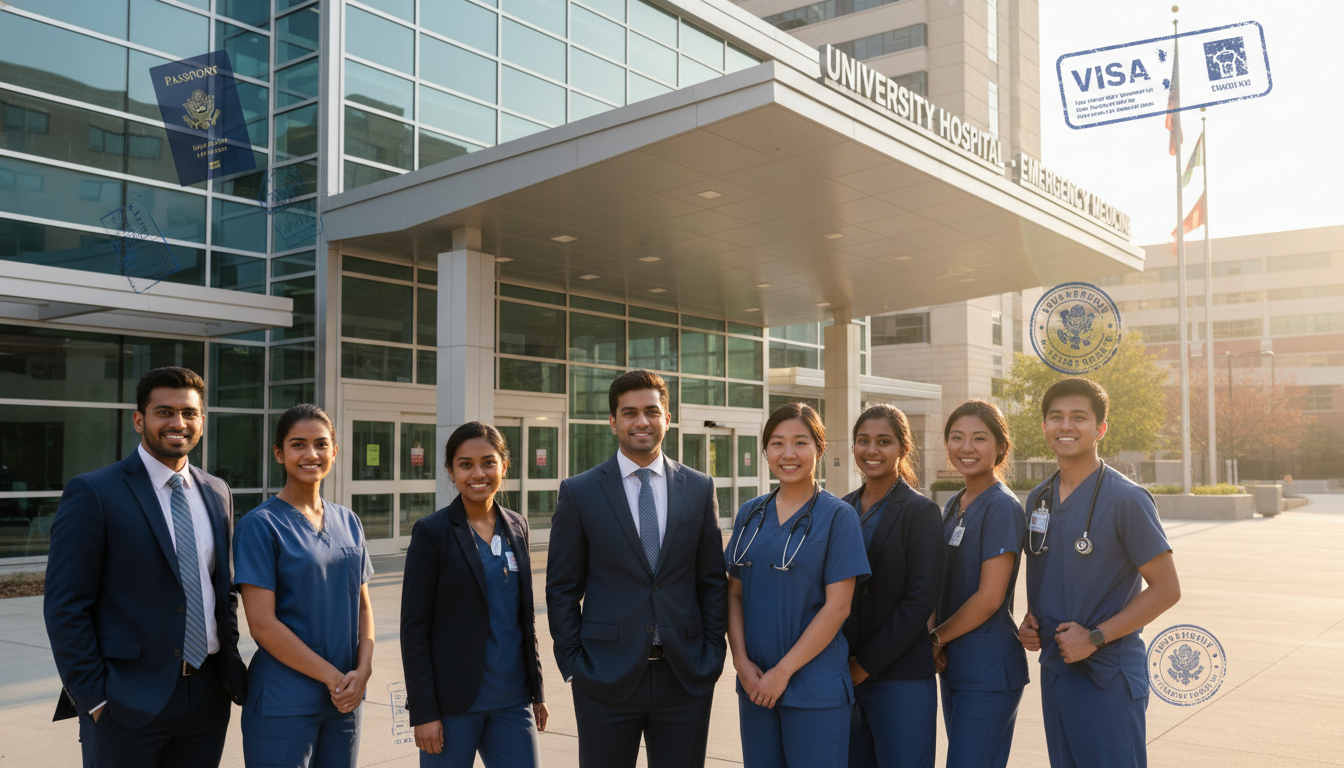
Understanding the Landscape: Why Visa Planning Matters in Emergency Medicine
Emergency medicine is one of the most IMG‑friendly specialties in the United States, but it also has unique challenges when it comes to visas. The emergency medicine residency environment is fast-paced, shift-based, and heavily reliant on direct patient contact—factors that intersect with visa requirements more than many applicants realize.
For an international medical graduate (IMG), your EM match success depends not only on your CV, USMLE scores, and letters of recommendation but also on how clearly and realistically you navigate your residency visa strategy. Programs want to know:
- Can you legally work as a resident for 3–4 years?
- Are you likely to obtain a license and credentialing without visa interruptions?
- Will your immigration pathway align with post‑residency plans (fellowship, academic medicine, community practice)?
This guide focuses on IMG visa options, with special attention to J‑1 vs H‑1B, and how these choices play out specifically in emergency medicine.
Core Visa Types for Emergency Medicine Residency
1. J‑1 Physician Visa (ECFMG‑Sponsored)
The J‑1 visa is the most common route for IMGs entering US GME training.
Key features
- Sponsor: ECFMG (Educational Commission for Foreign Medical Graduates)
- Purpose: Graduate medical education and training only
- Duration: Up to 7 years total (sufficient for EM residency and most fellowships)
- Employment: Only at the ACGME‑accredited training program listed on your DS‑2019
- Full-time clinical: Allowed, including overnight and high-acuity ED work, as long as it is part of your approved training
Two-year home residency requirement (212(e))
Most J‑1 physicians are subject to a rule requiring them to return to their home country for at least two years after finishing training before applying for:
- H‑1B or L‑1 visas
- US permanent residency (green card)
You can bypass this requirement only with an approved J‑1 waiver (e.g., Conrad 30, federal agency waivers), which is a major planning point for EM physicians.
Pros and cons for EM applicants
Advantages:
- Widely accepted: Many emergency medicine residency programs sponsor only J‑1 visas.
- Predictable: Processes are well standardized through ECFMG.
- License and moonlighting: Compatible with most state licensing pathways and standard clinical duties during residency.
Disadvantages:
- Home-country requirement: Limits flexibility if you cannot obtain a waiver later.
- Restricted employment: You cannot work outside the approved training program (e.g., no external moonlighting for extra income or experience).
- Transition complexity: Moving into fellowship or attending positions may require careful timing around waiver applications.
When J‑1 may be optimal in EM
- You are applying broadly and want to maximize the number of programs you’re eligible for.
- You come from a country with good prospects for J‑1 waiver jobs (e.g., underserved or rural areas often need EM physicians).
- You plan to work in underserved communities or are flexible about location after residency.
2. H‑1B Visa for Residency
The H‑1B is a dual‑intent work visa that allows training programs to sponsor you directly as a temporary worker.
Key features
- Sponsor: The residency program (or hospital/health system employer)
- Purpose: Specialty occupation work (resident physician)
- Duration: Up to 6 years total in H‑1B status (time in residency counts)
- Dual intent: You may legally pursue permanent residency while on H‑1B
- USMLE requirement: Most states and employers require USMLE Step 3 be passed before H‑1B petition filing
Pros and cons for EM applicants
Advantages:
- No two‑year home residency requirement.
- More flexible pathway to permanent residency and certain fellowship or academic positions.
- Potentially smoother transition from residency to attending jobs (especially in non‑underserved areas).
Disadvantages:
- Fewer EM programs sponsor H‑1B than J‑1.
- Requires earlier completion of USMLE Step 3—often before ranking programs or at least before match documents are finalized.
- More complex and expensive for programs (legal and filing fees), which some smaller programs may avoid.
- Cap considerations: Many residency programs are cap‑exempt (affiliated with universities or nonprofits), but later non‑academic jobs may be cap‑subject.
When H‑1B may be optimal in EM
- You have or can realistically obtain Step 3 before match rank deadlines.
- You want to avoid the J‑1 two‑year home rule and have long‑term plans to stay in the US.
- You are comfortable applying to a subset of EM programs that explicitly support H‑1B sponsorship.
3. Other, Less Common Visa Scenarios
While J‑1 vs H‑1B dominate the residency visa conversation, some IMGs arrive in the US already holding other statuses.
O‑1 (Extraordinary Ability)
Rare in residency, but possible for applicants with exceptional academic or research records (major publications, awards, national/international recognition).
- Pros: Very flexible, not subject to H‑1B cap; dual intent in practice.
- Cons: Hard to qualify for; requires strong documentary evidence and legal support; many GME offices are unfamiliar with O‑1 for residents.
F‑1 with OPT
Some IMGs complete US MD/DO degrees or research degrees under F‑1 status and may have Optional Practical Training (OPT) time.
- You cannot do residency purely on F‑1 OPT long‑term.
- Typically you must transition to J‑1 or H‑1B before starting or early in PGY‑1.
Key takeaway: For purposes of emergency medicine residency, nearly every IMG will end up choosing between J‑1 and H‑1B.

Emergency Medicine–Specific Considerations for Visa Strategy
Emergency medicine has specific program structures that influence IMG visa options and strategy.
1. Program Length and Visa Time Limits
Most EM programs are:
- 3 years (PGY‑1 to PGY‑3)
- Some are 4 years (PGY‑1 to PGY‑4)
J‑1:
- 3- and 4-year EM residencies fit within the 7-year J‑1 maximum.
- If you plan an EM fellowship (e.g., critical care, ultrasound, toxicology), you must budget your remaining J‑1 years.
H‑1B:
- EM residency of 3–4 years counts toward the 6‑year H‑1B maximum.
- If you later take a cap‑exempt H‑1B fellowship or academic position, your 6‑year limit may still be manageable, but must be tracked carefully.
2. Shift Work, Moonlighting, and Visa Rules
Emergency medicine is heavily shift-based; residents often seek moonlighting to supplement income or gain experience in lower‑acuity ED settings.
J‑1:
- Only activities that are officially part of your approved training (and listed on your DS‑2019) are allowed.
- External moonlighting (e.g., in a community ED outside the sponsoring institution) is usually not allowed.
- Internal moonlighting may be possible only if:
- It is approved by your program and GME office.
- It complies with ECFMG and institutional policies.
- It does not violate ACGME duty‑hour rules.
H‑1B:
- You can work only for the petitioning employer and in the role/location described in the H‑1B petition.
- Additional clinical work (moonlighting) may require:
- An amended H‑1B petition, or
- A concurrent H‑1B (a second, part‑time H‑1B with another employer), which is complex for residents.
- Many programs still restrict moonlighting independent of visa due to training and safety concerns.
Implication for EM residents: Don’t base your visa choice solely on moonlighting potential; the institutional GME policy is often a bigger constraint than immigration law.
3. Licensing, Credentialing, and State Regulations
Emergency medicine residents must obtain training licenses; later, full licensure for independent practice. Visa type can affect:
- Timing of Step 3 (often required for full license and for H‑1B)
- Acceptance of J‑1 status for state credentials
- Background checks and documentation requirements
Most state medical boards are accustomed to J‑1 and H‑1B residents, but:
- Some states have earlier Step 3 deadlines that match programs may incorporate into their own requirements.
- A few boards or employers may show preference for H‑1B due to long‑term retention concerns, especially in competitive urban EM markets.
4. Competitiveness and Program Attitudes in EM
Emergency medicine residency programs vary greatly in visa policies:
- University‑based academic EM programs: Often sponsor J‑1; some sponsor H‑1B. These may have extensive IMG experience.
- Community EM programs: Some sponsor J‑1; fewer sponsor H‑1B, but there are exceptions.
- High‑volume, safety‑net EDs: Often IMG‑friendly but may be bound by institutional visa policy.
During the EM match, programs will consider:
- Whether your visa needs match their institutional capabilities.
- Whether you already have Step 3 (for H‑1B candidates).
- How stable your immigration path appears over the 3–4 years of training.
Being explicit and realistic in your application about your visa status can help programs assess your fit without surprises later.
Planning Your EM Match Strategy Around Visa Options
1. Clarify Your Long‑Term Goals Early
Before deciding whether to prioritize J‑1 vs H‑1B, clarify your broader career goals:
- Do you strongly want to stay in the US long-term (academic EM, fellowships, leadership roles)?
- Are you open to:
- Returning to your home country after training?
- Working in rural or underserved areas to obtain a J‑1 waiver?
- Pursuing non‑traditional careers (global EM, NGO work, telemedicine)?
Example 1: Dr. A – J‑1‑Friendly Profile
- Wants to do a 3‑year EM residency, then possibly a fellowship.
- Open to working in underserved or rural US communities after training.
- Limited time/resources to pass Step 3 before match.
For Dr. A, a J‑1 visa is practical and likely increases the number of EM programs available.
Example 2: Dr. B – H‑1B‑Priority Profile
- Strongly desires long‑term US practice in a major metropolitan area.
- Has completed all Steps early and can realistically pass Step 3 before interviews.
- Will apply only to EM programs that sponsor H‑1B, even if this narrows the list.
For Dr. B, H‑1B aligns better with long‑term plans and may avoid the complexity of waivers later.
2. Research Programs’ Visa Policies Systematically
As an IMG targeting emergency medicine residency, you cannot treat visa sponsorship as an afterthought.
Steps to follow:
Start with official sources
- Program websites (look under “Eligibility,” “International Medical Graduates,” or “Visa” sections).
- FREIDA and other directories often list “Visa offered: J‑1 / H‑1B” but are sometimes outdated.
Cross-check with GME office policies
- Many institutions have a centralized GME policy on visa types they support for residents and fellows.
- If unclear, email the program coordinator or GME office with a concise, professional inquiry.
Create a spreadsheet with columns such as:
- Program name and location
- J‑1 sponsorship (Yes/No/Unclear)
- H‑1B sponsorship (Yes/No/Case-by-case)
- Step 3 required for interview/rank?
- Notes from direct email responses
Prioritize transparency in your ERAS application:
- Indicate your current immigration status.
- If you are aiming for H‑1B, mention your Step 3 plan (e.g., date scheduled or already passed).

3. Timing USMLE Step 3 for H‑1B Pathway
Because H‑1B typically requires USMLE Step 3, timing is key.
Ideal timeline for EM applicants targeting H‑1B:
- Step 1 and Step 2 CK: Completed early enough to allow Step 3 scheduling.
- Step 3:
- Passed before ERAS submission (ideal), or
- At least before rank list deadlines so that programs can confidently list you for H‑1B.
If you cannot complete Step 3 in time:
- Many programs will still consider you for J‑1.
- Some may be willing to sponsor H‑1B if they trust you can pass Step 3 early in PGY‑1; however, this is less common and riskier for both sides.
- Be honest with programs about your exam plans and constraints.
4. Communicating About Visas During EM Interviews
Interview season is your chance to clarify visa logistics without overshadowing your clinical and personal profile.
Best practices:
Wait for the appropriate moment:
- Many programs provide visa details during a formal presentation or Q&A.
- If still unclear, ask program coordinators or residents, not just the PD.
Frame questions constructively:
- “Could you share how your program typically supports IMGs in terms of J‑1 or H‑1B sponsorship?”
- “For residents on H‑1B, how do you usually handle Step 3 timing and H‑1B filing?”
Avoid sounding like visa is your only priority:
- Emphasize why you are genuinely interested in emergency medicine and that program’s training environment.
- Treat visa as one part of your overall fit, not the sole deciding factor.
Post‑Residency Pathways for EM Physicians on J‑1 vs H‑1B
1. If You Train on a J‑1 Visa
Upon completing your emergency medicine residency (and any fellowship), you usually have three broad options:
Option A: Return Home for Two Years
- Fulfill the 212(e) requirement in your home country.
- After two years, you may apply for H‑1B or permanent residence if you later wish to return to the US.
This path works best if:
- You have strong professional opportunities at home (academic EM, leadership roles).
- You are open to a global EM career without immediate US practice.
Option B: J‑1 Waiver Job (Conrad 30 or Federal Waivers)
Most J‑1 EM physicians who want to stay in the US pursue waivers by working in underserved locations.
Conrad 30 basics:
- Each state may recommend up to 30 J‑1 waiver positions per year.
- EM physicians are often in demand in rural or medically underserved EDs.
- You must:
- Obtain a full medical license.
- Sign a contract for full‑time work (typically 3 years) in a qualifying site.
- Have an employer willing to sponsor the waiver and subsequent H‑1B.
Other federal waiver options (e.g., VA, HHS programs) may also support EM roles, though often more for primary care.
Practical implications:
- Your first attending job may be geographically constrained.
- Compensation and workload can be high; many EM physicians accept this as a stepping stone.
Option C: Alternative Routes
In rare cases, J‑1 physicians may pursue:
- Exceptional hardship waivers (if their US family members would suffer unusual hardship abroad).
- Persecution waivers (if they would be persecuted upon return).
These are complex, heavily documented pathways requiring specialized legal support.
2. If You Train on an H‑1B Visa
After EM residency on H‑1B, your primary aim is to remain in legal status while you:
- Obtain board certification.
- Transition into attending roles.
- Pursue permanent residency if desired.
Common pathways:
H‑1B extension with new employer
- Many hospitals and EM groups sponsor H‑1B for attending physicians.
- If you trained at a cap‑exempt institution:
- Transitioning to a cap‑subject employer (e.g., private EM group at non‑university hospital) may require entering the H‑1B lottery, unless your new role is also cap‑exempt.
Permanent residency sponsorship
- Employers may sponsor you via EB‑2 or EB‑3 categories.
- EM physicians in underserved areas may qualify for National Interest Waiver (NIW) pathways.
- Your dual intent status on H‑1B makes these transitions more straightforward than from J‑1.
Fellowship training
- You can continue under H‑1B if the fellowship sponsor supports it.
- Alternatively, some switch to another cap‑exempt H‑1B role, staying within the 6‑year overall limit (unless extended via green card process).
Planning tip: Track your total time in H‑1B from residency onward and coordinate with both your program and future employers to avoid hitting the 6‑year ceiling before obtaining permanent residency.
Practical Action Plan for EM Applicants (Step‑by‑Step)
Self-assessment (12–24 months before applying)
- Clarify goals: long‑term US vs global EM vs home‑country practice.
- Assess exam status: Step 1, Step 2 CK, English proficiency (if needed), and realistic timeline for Step 3.
Choose primary visa target
- If Step 3 before match is unlikely → Plan for J‑1.
- If Step 3 before match is realistic and long‑term US stay is priority → Aim for H‑1B‑sponsoring EM programs.
Build a program list
- Identify all EM programs that:
- Accept IMGs, and
- Sponsor your target visa type (J‑1 and/or H‑1B).
- Categorize into reach, target, and safety programs, factoring in your academic profile.
- Identify all EM programs that:
Prepare ERAS materials with visa clarity
- Personal statement: Briefly and positively acknowledge IMG background; focus on EM passion.
- CV and application: Clearly state your citizenship and current status.
- For H‑1B aspirants: Highlight Step 3 status or scheduled date.
Engage proactively during interview season
- Ask specific but respectful questions about:
- Institutional visa policies.
- Historical experiences with IMGs.
- Support for future waiver jobs or transitions for J‑1 trainees.
- Take notes to inform your rank list.
- Ask specific but respectful questions about:
Rank list strategy
For J‑1 applicants:
- Rank based on training quality, fit, and supportiveness of program culture.
- Assume you will need to plan a waiver or home‑country return later and educate yourself on both.
For H‑1B applicants:
- Give higher priority to programs with clear, stable H‑1B policies and prior experience.
- Confirm Step 3 timing so the program can file your petition on time.
Post‑match execution
- Work closely with:
- Program coordinator and GME office.
- ECFMG (for J‑1) or immigration counsel (for H‑1B).
- Respond quickly to document requests (diplomas, translations, police certificates, financial evidence if needed).
- Work closely with:
Frequently Asked Questions (FAQ)
1. Is emergency medicine residency IMG‑friendly when it comes to visas?
Many EM programs are open to IMGs, but policies differ widely:
- J‑1: Commonly supported across academic and community EM programs.
- H‑1B: Supported by a smaller subset, usually larger academic centers or hospitals with established legal infrastructure.
Your competitiveness as an IMG in EM depends on your overall profile (scores, clinical experience, SLOEs) plus how well your visa needs align with program capabilities.
2. Should I delay my EM application by a year to pass Step 3 for H‑1B?
It depends on your priorities:
- If long‑term US practice and avoiding the J‑1 two‑year rule are critical to you, and your profile is otherwise strong, taking time for Step 3 to open H‑1B options can be reasonable.
- If you are eager to start residency and comfortable with J‑1 + waiver or return home afterward, applying sooner with a J‑1 focus may be better.
Weigh the opportunity cost of delaying residency against the immigration flexibility H‑1B could provide.
3. Can I switch from J‑1 to H‑1B during residency?
In most cases, no. Once you begin GME on an ECFMG‑sponsored J‑1 physician visa, you are generally expected to complete your training in that status. Switching mid‑residency is rarely permitted and, if possible at all, is complex and risky.
If avoiding the two‑year home rule is essential, you should pursue H‑1B before starting residency, not as a mid‑course correction.
4. How does my choice of visa affect EM fellowship options?
On J‑1:
- You can pursue fellowships as long as you remain within the 7‑year total limit for J‑1 physician training.
- Each additional year of fellowship reduces the time you have before needing a waiver or home return.
- Some fellowship programs may have limited experience with J‑1s; always check visa policies.
On H‑1B:
- Fellowships may be done under cap‑exempt H‑1B if the sponsoring institution qualifies.
- You must track your total 6‑year H‑1B time, including residency and fellowship, and plan for green card strategies if you anticipate staying long term.
By understanding how J‑1 vs H‑1B pathways intersect with the realities of emergency medicine residency, you can approach the EM match with a clear, strategic plan. Visa navigation is complex but manageable when addressed early, researched thoroughly, and integrated thoughtfully into your broader professional goals in emergency medicine.