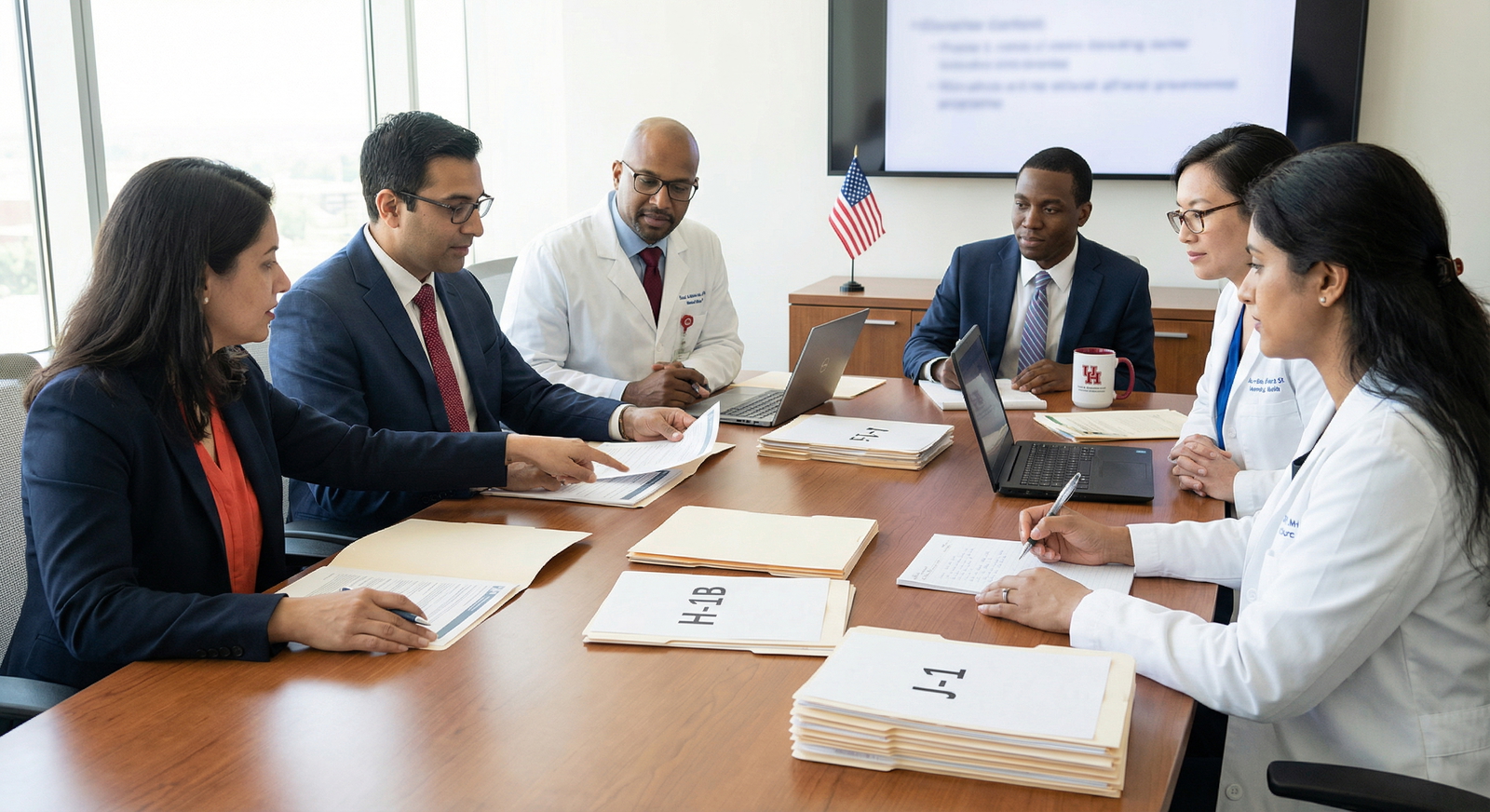
Understanding the Visa Landscape for Family Medicine Residency
For international medical graduates (IMGs), securing the right visa is often as challenging—and as critical—as earning interviews and ranking programs. In family medicine residency, where many programs welcome IMGs, understanding IMG visa options, especially J-1 vs H-1B, can shape not only your FM match strategy but also your long-term career.
This guide focuses on visa navigation specifically for family medicine residency applicants. It explains major visa types, how they interact with the FM match, what programs look for, and how to make practical decisions aligned with your career goals in primary care.
Core Visa Types for Family Medicine Residency
The three most relevant visa categories for IMGs entering a U.S. residency are:
- J-1 Exchange Visitor (ECFMG-sponsored)
- H-1B Temporary Worker (Sponsored by the residency program)
- Other/less common options (O-1, F-1 OPT, green card holders, etc.)
1. J-1 Visa: The Most Common Path for IMGs
What it is:
A non-immigrant exchange visitor visa sponsored by the Educational Commission for Foreign Medical Graduates (ECFMG) for physicians in graduate medical education (GME).
Why it’s common in family medicine:
- Many community and university-affiliated family medicine residency programs are familiar with J-1 sponsorship.
- Administrative process is standardized through ECFMG, not individual hospitals.
- Often easier/faster for programs than H-1B sponsorship.
Key features of the J-1 for residency
- Sponsor: ECFMG (not the hospital).
- Duration: Typically valid for the length of approved training (renewed annually).
- Clinical training: Specifically authorized for GME.
- Licensing exams: USMLE Steps 1 and 2 CK required for ECFMG Certification (and thus for the J-1).
Two-year home-country physical presence requirement (212(e))
This is the single most important consequence of a J-1:
- After completing your residency/fellowship, you must:
- Return to your home country (or country of last legal permanent residence) for at least two years,
OR - Obtain a J-1 waiver (e.g., Conrad 30, hardship, persecution, etc.)
- Return to your home country (or country of last legal permanent residence) for at least two years,
Without satisfying or waiving this requirement, you cannot:
- Change status in the U.S. to H-1B, L-1, or permanent resident (green card).
- Obtain these visas at a U.S. consulate abroad.
However, you can:
- Return home and work for two years.
- Re-enter the U.S. on certain non-immigrant visas that do not require waiver (e.g., B-1/B-2, F-1) if consulate approves—though these may not help your clinical career.
Pros of the J-1 visa
- Widely accepted by family medicine residency programs.
- ECFMG handles much of the process → standardized forms, timelines.
- Often available even when institutions cannot or will not sponsor H-1B visas.
- Does not require USMLE Step 3 for entry into residency.
- Recognized path to a Conrad 30 waiver job in primary care after training.
Cons of the J-1 visa
- Two-year home-country requirement unless waived.
- Limited flexibility if you plan to pursue early permanent residency or non-underserved practice directly after training.
- You must maintain ECFMG “good standing” and timely renewals.
2. H-1B Visa: The “Work Visa” Route
What it is:
A non-immigrant work visa for “specialty occupations” that require at least a bachelor’s degree, commonly used for physicians. In residency, it is sponsored directly by the hospital or institution.
Why some FM applicants pursue H-1B
- No mandatory two-year home-country requirement.
- Allows a more direct path toward long-term U.S. career and green card, particularly beneficial for those planning to remain in primary care in the U.S.
Key requirements for H-1B in residency
- USMLE Step 3 – Most institutions require Step 3 passed before they can file the H-1B petition.
- State medical license or eligibility – Requirements vary by state; some allow training licenses, others require specific exam completions or documentation.
- Program policy – Not all family medicine programs sponsor H-1B visas, even if they accept IMGs.
Cap-exempt status for residency
- Most residency programs are affiliated with non-profit or governmental hospitals and are cap-exempt:
- They can file H-1B petitions at any time of year.
- They are exempt from the annual H-1B lottery.
- This is a major advantage over many private employers that are subject to the cap.
Pros of the H-1B visa
- No two-year home-country physical presence requirement.
- Dual-intent friendly: easier to pursue permanent residency (green card) during or after training.
- Can be extended up to 6 years (and sometimes beyond if green card processing is underway).
- Often viewed favorably by IMGs hoping to stay in the U.S. long term.
Cons of the H-1B visa
- Requires USMLE Step 3 before residency (adding complexity and cost).
- More administrative and legal work for programs (attorney fees, filing fees).
- Many family medicine programs do not sponsor H-1B for residency, especially smaller community programs.
- Maximum duration of 6 years (including all previous H-1B time).
3. Other/Fewer-Use Visa Options
These are less typical starting points for residency, but relevant for certain applicants:
- F-1 (Student visa) with OPT
Some IMGs are already in the U.S. on F-1 (e.g., MPH or research master’s). They might consider:- Completing a degree
- Then using Optional Practical Training (OPT) before transitioning to J-1 or H-1B.
- Rarely used for direct clinical residency; more often a transient status before J-1/H-1B.
- O-1 (Extraordinary Ability)
For physicians with significant research output, national/international recognition. Very rare at residency entry level. - Green card / Permanent resident
If you already hold a green card, you do not need a residency visa. This dramatically simplifies the FM match process. - Other temporary visas (TN, E-2, etc.)
Country-specific and rarely used for residency training; usually not straightforward for GME.

J-1 vs H-1B in Family Medicine: Strategic Considerations
For the FM match, your choice—or flexibility—between J-1 and H-1B can influence:
- Which programs you apply to.
- How many interviews you receive.
- Where and how you can work after training.
Program Types and Their Typical Visa Preferences
While there are exceptions, trends across family medicine residencies often look like this:
University-based FM programs
- More likely to have institutional policies on visas.
- Some sponsor H-1B; many sponsor only J-1.
- Often clearly list visa policies on their websites.
Community-based, university-affiliated FM programs
- Many are very IMG-friendly and J-1 friendly.
- Mixed practices with H-1B; some do, many don’t.
Community-based, unopposed family medicine programs
- Often highly receptive to IMGs on J-1.
- H-1B options are more variable; check each program individually.
Rural or smaller programs
- Often have strong relationships with J-1 waiver employers for post-residency jobs.
- May or may not have resources to support H-1B sponsorship.
Matching on J-1: What It Means for Your Career
Choosing (or accepting) J-1 sponsorship is often the best or only practical route to a U.S. family medicine residency. The key is planning beyond residency.
The typical J-1 → FM career path:
- Residency: 3 years of family medicine on J-1.
- Optional fellowship: 1–2 years (e.g., sports medicine, geriatrics, palliative care, maternal-child health). This extends J-1 duration.
- J-1 waiver job:
- Most commonly through the Conrad 30 program:
- Each state can sponsor up to 30 IMGs per year to work in underserved areas.
- Family medicine is highly favored because of primary care shortages.
- You sign a contract to work full-time (usually 3 years) in a designated underserved area.
- Most commonly through the Conrad 30 program:
- Transition to H-1B or permanent residency:
- The waiver job employer typically sponsors you on H-1B.
- During/after that, you may start a green card process (EB-2, EB-3, or NIW).
Benefits for family medicine
- Strong demand for primary care in underserved regions.
- Many states prefer FM physicians when allocating Conrad 30 slots.
- Realistic pathway to long-term practice in the U.S., especially rural or inner-city primary care.
Risks/limitations
- You must be willing to work in underserved/geographically limited areas for several years after training.
- Waiver slots are competitive in some states.
- If you cannot secure a waiver job, you may need to return to your home country for two years.
Matching on H-1B: Strategic Advantages and Challenges
If you match into a family medicine residency on an H-1B:
Advantages
- Greater freedom in choosing post-residency practice (no mandatory waiver/job requirement).
- Can more easily:
- Move directly to H-1B employment in non-underserved areas.
- Start green card processing early.
- Attractive for those with long-term U.S. family commitments or those not wanting geographic constraints.
Challenges
- Fewer FM programs offer H-1B sponsorship.
- You must have USMLE Step 3 passed in time for H-1B filing.
- If you later switch to a non-cap-exempt employer (private clinic/hospital), you may face the regular H-1B cap or need timing strategies.
Practical Steps to Navigate Visa Choices During the FM Match
Step 1: Clarify Your Priorities
Before you decide on J-1 vs H-1B, ask:
- How strongly do I want a long-term career in the U.S.?
- Am I open to practicing in underserved or rural areas after residency?
- Can I realistically complete USMLE Step 3 before applications/interviews?
- How important is maximizing the number of programs I can apply to?
Patterns:
- If your priority is maximizing match chances in family medicine, being open to J-1 is usually wise.
- If your priority is long-term U.S. practice in flexible locations, and you can manage Step 3 early, aim for H-1B where possible—but still consider J-1 as a backup.
Step 2: Research Program Visa Policies Carefully
During your application planning:
Check program websites
Look for:- “We sponsor J-1 visas only.”
- “We sponsor J-1 and H-1B visas.”
- “We do not sponsor visas” (but may accept permanent residents/citizens).
Use filters on ERAS and FREIDA
Some databases and directories allow search filters by visa type.Email programs if unclear
A concise email template:Dear [Program Coordinator/Director],
I am an international medical graduate applying to family medicine residency this cycle. I would be grateful if you could clarify your policy on visa sponsorship for residents. Specifically, do you sponsor J-1 visas, H-1B visas, or both?
Thank you for your time and assistance.
Sincerely,
[Your Name, Credentials]
Document responses in a spreadsheet so you can prioritize your ERAS list accordingly.
Step 3: Decide on Your Visa Strategy for Applications
Scenario A: Open to both J-1 and H-1B
- Apply broadly to family medicine programs that:
- Accept IMGs.
- Offer J-1, H-1B, or both.
- During interviews, if appropriate, explain:
- Your flexibility.
- That your main goal is strong FM training; you are prepared for either route.
Scenario B: Strongly prefer H-1B
- Take Step 3 as early as possible.
- Apply aggressively to FM programs that explicitly sponsor H-1B.
- Still consider applying to some J-1-only programs as a safety net, especially if your profile is borderline.
Scenario C: Planning for J-1 from the start
- Focus on excellent application credentials (scores, clinical experience, letters) to secure interviews at J-1-friendly programs.
- Research J-1 waiver opportunities early during residency so you understand potential post-training paths.

After the FM Match: Visa Logistics and Next Steps
Once you match into a family medicine residency, visa navigation becomes more concrete.
If You Matched on a J-1 Visa
Immediate steps:
- ECFMG Certification:
Ensure all components are complete and verified. - DS-2019 issuance:
- The program sends ECFMG the necessary documentation.
- ECFMG issues Form DS-2019, which you will use for:
- Visa interview at U.S. consulate.
- U.S. entry (if outside the U.S.).
- Consular processing:
- Schedule a J-1 visa appointment.
- Prepare required documents (DS-2019, proof of finances, SEVIS fee receipt, etc.).
- Arrive on time
Ensure entry in time for orientation and start of residency.
During residency:
- Renew DS-2019 annually via ECFMG.
- Maintain continuous good standing in the program.
- Attend any ECFMG or institutional J-1 orientations.
If You Matched on an H-1B Visa
Immediate steps:
- Confirm Step 3 and license requirements with your program and state board.
- Provide necessary documents to the program:
- Diplomas, ECFMG certificate, passport, CV, etc.
- Program files the H-1B petition:
- Usually with institutional or external immigration counsel.
- If you are abroad, you will then attend a consular visa appointment.
- If you are in the U.S. on another status, you may apply for change of status.
During residency:
- Track your H-1B validity period.
- Coordinate any extensions needed during your 3-year FM residency.
- If you pursue a fellowship, confirm whether:
- The new institution is cap-exempt.
- They will file another H-1B petition.
Long-Term Planning: Family Medicine Careers and Visa Strategy
For J-1 IMGs: Planning a Waiver and Beyond
During your second and third year of family medicine residency:
- Research Conrad 30 programs by state
- Each state has different rules:
- Timelines
- Preferred specialties (FM is usually favorable)
- Employer and site criteria
- Each state has different rules:
- Decide where you’re willing to live and work
- Consider:
- Rural vs urban underserved
- Family needs
- State licensing processes and timelines
- Consider:
- Start job search early
- Some employers recruit 18–24 months before start date.
- Many FQHCs (Federally Qualified Health Centers) and rural hospitals are familiar with J-1 waivers.
After your 3-year waiver service:
- You may:
- Stay with the same employer on H-1B, or
- Move to a new employer (may need cap-subject H-1B if not cap-exempt), or
- Transition to a green card (if not already in process).
For H-1B FM Residents: Building a Stable U.S. Career
As an H-1B family medicine resident, you can:
- Negotiate roles in community clinics, urgent care, group practices, or hospital-employed positions.
- Start green card processes earlier, often via:
- EB-2/EB-3 PERM with employer sponsorship.
- NIW (National Interest Waiver) if serving underserved or high-need populations.
In both J-1 and H-1B paths, family medicine is a strong specialty for immigration:
- Persistent national shortage of primary care physicians.
- Preference in waiver and NIW categories for primary care and rural service.
Frequently Asked Questions (FAQ)
1. Is J-1 or H-1B better for family medicine residency?
Neither is universally “better”; it depends on your goals:
J-1 is:
- More widely accepted by FM programs.
- Often easier to obtain for residency.
- Tied to a 2-year home-country requirement unless you secure a waiver (commonly via Conrad 30 in underserved areas).
H-1B is:
- Less common but offers more long-term flexibility in staying in the U.S.
- Requires USMLE Step 3 before starting residency.
- Often preferred by applicants aiming for permanent U.S. practice without mandatory service requirements.
Most IMG applicants should stay open to J-1 while targeting H-1B where feasible.
2. Can I switch from J-1 to H-1B after residency?
Yes, but only if you:
- Obtain a J-1 waiver (commonly via Conrad 30, hardship, or persecution), and
- Have an employer willing to sponsor H-1B and support the waiver process.
You cannot simply convert a J-1 to H-1B without addressing the two-year home-country requirement.
3. Do all family medicine residency programs sponsor visas?
No. Family medicine is generally more IMG-friendly than many specialties, but:
- Some programs do not sponsor any visas and can only take U.S. citizens/green card holders.
- Many sponsor J-1 only.
- A subset sponsor both J-1 and H-1B.
You must check each program individually (website, ERAS listing, or direct email) to confirm their policy.
4. Is it realistic to get an H-1B for family medicine residency as an IMG?
Yes, but it’s more competitive and logistics-heavy than J-1:
- You need USMLE Step 3 before your residency start date (often before rank list certification).
- You must target programs that explicitly offer H-1B sponsorship.
- Having strong scores, U.S. clinical experience, and clear communication about your visa status will help.
Many IMGs successfully match into family medicine with H-1B each year, but being flexible and having J-1 as an acceptable alternative increases your chances in the FM match.
Navigating visas is as central to your U.S. family medicine trajectory as exam scores and clinical experience. By understanding IMG visa options, especially J-1 vs H-1B, and aligning them with your long-term goals, you can design a realistic, strategic path—from FM match to a stable, meaningful career in primary care.